
Font size
 Worksheets
Waves - sound and light
Total questions: 100
Worksheet time: 2hrs 51mins
If an ray of light is incident to a plane (flat) mirror at an angle of 67*, then what is the angle of reflection?
23*
27*
45*
67*
What term is used to describe the points on a wave that remain stationary and do not move up or down?
Antinode
Crest
Trough
Node
Which of the following is not part of the electromagnetic spectrum?
Infrared
Ultraviolet
Sound
X-ray
What type of wave is represented by ocean waves?
Sound waves
Light waves
Mechanical waves
Radio waves
What do water drops falling onto the surface of water produce?
A) A single large wave
B) Circular waves that move outward as expanding rings
C) A static pattern on the water surface
D) A whirlpool effect
What is moving outward when water drops fall onto the surface of water?
A) The water itself
B) The energy or momentum of the wave disturbance
C) Fish swimming away from the disturbance
D) Air bubbles
How does wave motion differ from particle motion?
A) Wave motion is always in a straight line, while particle motion is not
B) Wave motion can only occur in water, while particle motion can occur anywhere
C) Wave motion involves the transfer of energy without the transfer of matter
D) There is no difference between wave motion and particle motion
What is a wave?
A disturbance that carries energy through matter or space.
A movement of water in the ocean.
A sound that travels through air.
A pattern created by the wind on the surface of the ocean.
What is a wave pulse?
A continuous wave that does not stop
The frequency of a wave
A single disturbance that travels through a medium
The speed of a wave
What does a wave train consist of?
A single wave pulse
A device for measuring wave speed
A series of wave pulses transmitted through the medium
The medium itself
What is the term used to describe the back and forth motions of an object?
Acceleration
Vibration or oscillation
Rotation
Translation
What happens when a mass hanging on a vertical spring is pulled downward or pushed upward?
It remains in equilibrium position
It moves in a circular motion
It bounces up and down as the forces try to restore equilibrium
It stops moving completely
In which state of matter do mechanical waves travel fastest?
A) Solid
B) Liquid
C) Gas
D) Plasma
What type of waves are classified as needing no medium to travel?
Sound Waves
Water Waves
Electromagnetic Waves
Seismic Waves
At what speed do electromagnetic waves travel?
3.0 x 10^6 m/s
3.0 x 10^8 m/s
3.0 x 10^10 m/s
3.0 x 10^12 m/s
Which of the following is an example of electromagnetic radiation?
Sound from a guitar
Waves in the ocean
Radiation from the sun
Vibrations in the earth
Which of the following types of waves are considered transverse waves?
Sound waves
Seismic P-waves
Gamma rays
Longitudinal waves
In which direction do particles of a medium move in longitudinal or compression waves?
Perpendicular to the direction of the wave
In a circular motion
Parallel to the direction of the wave
Randomly
What is an example of a longitudinal or compression wave?
Light
Water wave
Sound
Radio wave
What type of wave do fans sitting and standing in a large stadium create during ball games as described in the text?
Longitudinal wave
Transverse wave
Surface wave
Torsional wave
What is the lowest point on a wave known as?
Crest
Trough
Frequency
Peak
What is the wavelength of a wave?
The height of the wave
The distance between two crests of a wave
The distance a wave travels in one second
The time it takes for one complete wave cycle
What is it called when two waves interact with each other?
Wave interactions
Standing Waves
Wave interference
Pass Interference

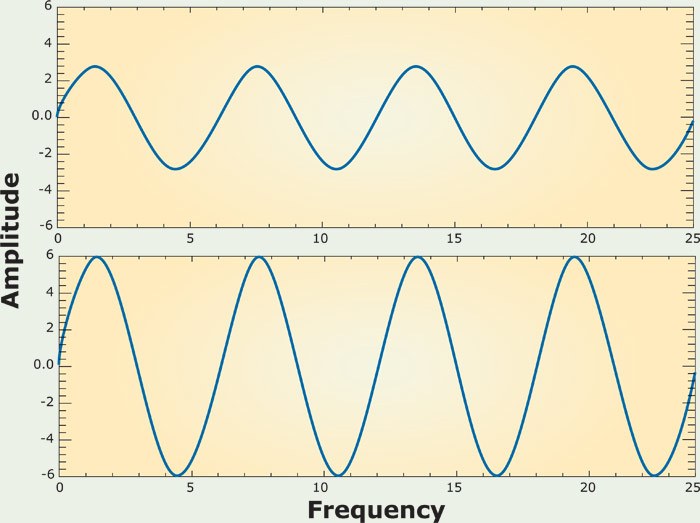
The two waves above are traveling at the same speed. Which statement best describes the difference between the waves?
Wave A has a higher frequency than wave B.
Wave A has a lower frequency than wave B.
Wave A has a higher amplitude than wave B.
Wave A has a lower amplitude than wave B.
A wave traveling at 230 m/sec has a wavelength of 5 meters. What is the frequency of this wave?
46 Hz
1,150 Hz
.002 Hz
46 m
A wave traveling at 230 m/sec has a wavelength of 5 meters. What is the frequency of this wave?
46 Hz
1,150 Hz
.002 Hz
46 m
What is a general definition of wave interference?
When a wave bounces off an object
When a wave bends around a corner
When more than on wave meet and interact in the same medium
When a wave creates static

The moving black dot is called:
a node
an anti-node
an anti-amplitude
the wangy bit

Standing waves are created by
Two identical waves reflecting off each other
Two identical waves being diffracted together
Two identical waves move through each other in opposite directions
Two identical waves are diffracted from two identical sources
Definition: The spreading out of waves as they pass through an opening or around objects.
Reflection
Refraction
Diffraction
Resonance
Definition: The spreading out of waves as they pass through an opening or around objects.
Reflection
Refraction
Diffraction
Resonance
What is a transverse wave? Give an example.
A wave where the particles move in the same direction as the wave, such as sound waves
A wave where the particles move in a circular motion, such as in a whirlpool
A wave where the particles move perpendicular to the direction of the wave, such as light waves
A wave where the particles do not move at all, such as in a vacuum
What is a compressional (longitudinal) wave? Give an example.
A wave where the particles move in a circular motion, such as in a whirlpool
A wave where the particles move perpendicular to the direction of the wave, such as light waves
A wave where the particles move in the same direction as the wave, such as sound waves
A wave where the particles do not move at all, such as in a vacuum
What does the following symbol represent (λ)?
Frequency
Amplitude
Wavelength
Speed of sound
How are frequency and wavelength related?
They are directly proportional; as frequency increases, wavelength increases
They are inversely proportional; as frequency increases, wavelength decreases
They are unrelated; frequency does not affect wavelength
They are the same thing; frequency is another term for wavelength
What causes sound?
Light waves in the air
Vibrations in the air from voices or objects
Movement of water particles
Electrical impulses in the air
What type of waves are sound waves?
Transverse waves
Compressional waves
Electromagnetic waves
Gravitational waves
Aside from air, through which other medium can sound waves travel?
Vacuum
Water
Light
Heat
At what speed does sound travel at 25°C and one atmosphere of pressure?
330 m/s
343 m/s
300 m/s
360 m/s
As the air temperature increases, what happens to the speed of sound?
It decreases
It remains constant
It increases
It fluctuates unpredictably
Which of the following is NOT a property of sound waves?
Amplitude
Velocity
Elasticity
Wavelength
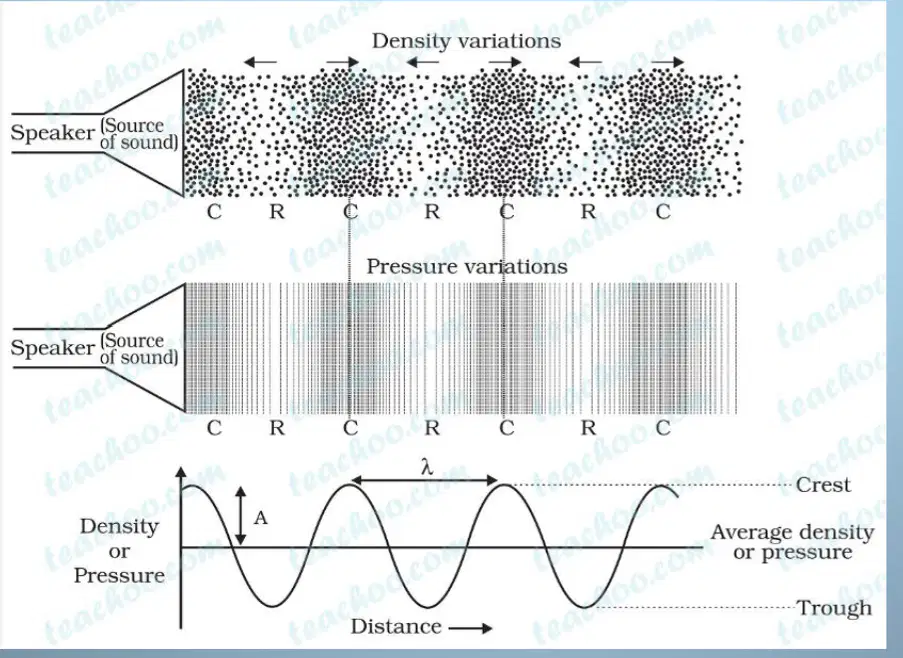
What does the diagram mainly illustrate about sound waves?
The electromagnetic spectrum of sound waves
The particle motion in sound waves
The amplitude and frequency of sound waves
The reflection, diffraction, and interference of sound waves
How can the distance across an echo lake be measured according to the text?
By measuring the depth of the lake
By calculating the time it takes for the echo to return
By using a boat to cross the lake
By the width of the lake at its widest point
What makes the sound from a brass instrument like a trumpet or trombone produced by?
The vibration of a reed
The vibration of strings
The vibrations of the performer's lips
The vibration of a column of air
What produces the sound in a wind instrument like a flute?
The vibration of strings
The vibration of a sounding board
The vibrations of the performer's lips
The vibration of a column of air
What is the role of the eardrum in hearing?
It converts waves to nerve impulses.
It amplifies the sound.
It decodes and interprets sound information.
It captures energy from sound waves.
What is pitch in terms of sound waves?
The amplitude of the sound wave
The intensity of the sound wave
The frequency of the sound wave
The energy of the sound wave
What does loudness indicate in terms of sound waves?
The frequency of the sound wave
The energy of the sound wave
The distance of the sound wave
The amplitude of the wave
What happens to the intensity of sound as it travels further from the source?
It increases
It remains constant
It decreases
It fluctuates
What does the Decibel Scale (dB) measure?
The pitch of the sound
The frequency of the sound
The sound intensity
The duration of the sound
What is pitch related to in terms of sound waves?
Amplitude of sound waves
Frequency of sound waves
Speed of sound waves
Loudness of sound waves
What is the length of the air column in a closed pipe that corresponds to the first displacement antinode for standing waves?
L = λ/2
L = λ/4
L = λ
L = 3λ/4
What type of waves are those with frequencies below 20 Hz called?
Ultrasonic waves
Audible waves
Subsonic waves
Infrasonic waves
What does the Doppler Effect refer to?
The change in the volume of a sound as a source moves closer or further away
The change in the pitch of a sound due to the movement of the source or the observer
The change in the speed of sound due to temperature variations
The change in the direction of sound due to obstacles in the environment
What happens to the pitch of a sound as the source of the sound moves closer to an observer?
The pitch decreases
The pitch remains constant
The pitch increases
The pitch fluctuates randomly

Which sound wave shows the sound with the highest pitch?
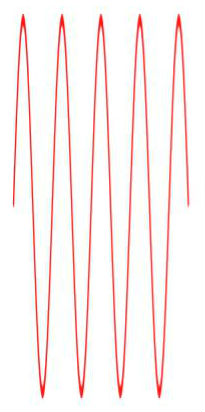
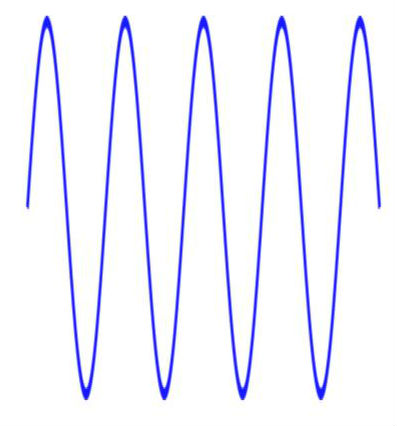
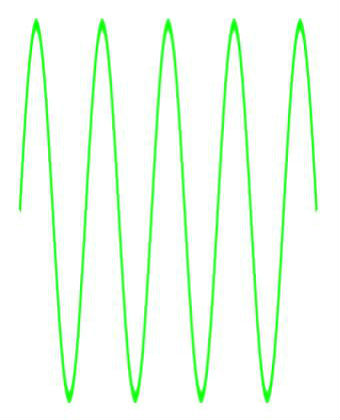
What is light described as in the provided material?
A type of sound wave
A form of matter
Electromagnetic radiation capable of stimulating the retina of the eye
A chemical reaction
What type of source creates a clear image of a shadow?
Extended source
Diffuse source
Point source
Ambient source
What is the term for the dark region where all the shadows overlap in the case of an extended source?
Umbra
Penumbra
Corona
Nimbus
What is a luminous body?
A body that reflects light waves.
A body that emits light waves.
A unit of light intensity.
A unit of illuminance.
What does the term 'illuminated body' refer to?
A body that emits light waves.
A unit for luminous flux.
A body that reflects light waves.
The rate at which light energy is emitted from a source.
What color would you expect to see if you remove some of the blue light from white light?
Red
Yellow
Green
Purple
Which of the following is an example of a translucent material?
Quartz
Bricks
Frosted glass
Clear water
Which of the following materials is considered opaque?
Lampshades
Bricks
Quartz
Frosted glass
What does the color of an object depend on?
The object's primary pigments
The wavelengths of light the object reflects
The object's secondary pigments
The amount of white light the object absorbs
What happens when white light strikes a red object?
The object reflects all colors except blue.
The object absorbs all colors except red.
The object reflects only the red color and absorbs the rest.
The object absorbs all colors including red.
What allows polarized sunglasses to reduce glare?
They intensify light from all directions
They change the color of the light
They allow only light from one direction to pass
They reflect light off their surface
What phenomenon causes colors in thin films?
Diffraction of light
Polarization of light
Interference of reflected light
Refraction through the film
What does the Law of Reflection state?
The angle of incidence is always less than the angle of reflection
The angle of incidence is equal to the angle of reflection
The angle of incidence is greater than the angle of reflection
The angle of incidence is unrelated to the angle of reflection
What is the term used to describe light rays reflected in many directions from a rough surface?
Regular reflection
Refraction
Diffuse reflection
Scattering


A wave has a velocity of 230 m/s and a wavelength of 4 meters. What is the wave's frequency? Manipulate the following equation to solve for frequency
v = f * ƛ
57.5 Hz
0.017 Hz
920 Hz
57.5 m

What property of this wave is represented by the letter "A"?
amplitude
trough
crest
wavelength

Which wave in the diagram has the lowest frequency?
1
2
3
4


A unit used to compare the loudness of different sounds.
Hertz
Decibel
seconds
meters
Refraction is
The bending of light as it passes through the one substance at an angle
A light beam shone in one end of an optical fibre and totally internally reflected at the other end
The bending of light as it passes from one substance to another at an angle
A type of convex object used in everyday life
Refraction happens because light travels _____________ in glass or water compared to air
Faster
The same
At the speed of sound
Slower

The angle of incidence is
56 degrees
124 degrees
90 degrees
34 degrees
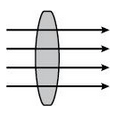
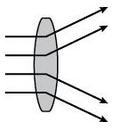
Which figure represents the path light takes through a converging lens?
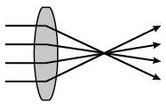
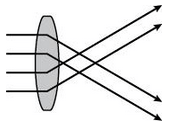

As the frequency of an electromagnetic wave increases, the amount of energy in that wave...
increases.
decreases.
stays the same.

What type of interference is being shown in the picture?
Constructive
Destructive
Standing waves are created by
Two identical waves reflecting off each other
Two identical waves being diffracted together
Two identical waves move through each other in opposite directions
Two identical waves are diffracted from two identical sources

Two wave pulses one with a positive amplitude the other with equal negative amplitude travel on a cord approaching each other. What is the result of the oscillations when the pulses reach the same point?
It is constructive interference with twice the amplitude
It is destructive interference with zero amplitude
It is constructive interference with slightly greater amplitude
It is constructive interference with the negative amplitude
The standing wave is produced
In the diagram which letters represent the nodes
A B C
A C E
B D
B D E
A C D

How many antinodes does this standing wave have?
5
6
7
8
Which of the following is the speed of a wave traveling with a wavelength λ, frequency f, and period T?
v=fλ
v=λf
v=λ⋅f
v=f⋅T
v=Tf

A pipe, opened at both ends (40 cm long) makes a tone travelling at 330 m/s. Calculate the frequency of the fundamental wave.
4.125 Hz
264 Hz
26400 Hz
412.5 Hz

The pipe length of B is 0.25 m. What is the wavelength of the sound produced?
0.25 m
0.5 m
0.75 m
1 m
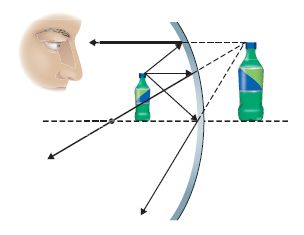

A
B
C
D
None of the others

A
B
C
D

