
 Worksheets
Ecology Quiz
Total questions: 108
Worksheet time: 1hrs 19mins

Which population would most likely have the smallest biomass?
rabbit
plant
hawk
frog

Which organisms would contain the greatest amount of available energy?
rabbits and deer
grasses and shrubs
lice
hawks
Members of the same species found in an ecosystem are called a
family.
population.
niche.
community.
Autotrophs might survive when heterotrophs cannot because autotrophs are able to
reproduce asexually
become dormant
exist without respiration
make their own food
Tapeworms are sometimes found in the small intestines of sheep. A tapeworm attaches to the intestinal wall using suckers and then absorbs nutrients from the sheep's intestine. Which of the following terms describes the relationship between the tapeworm and the sheep?
competition
herbivory
parasitism
predation
Which sequence shows increasing ecological levels of organization?
organism, population, community, ecosystem
ecosystem, population, organism, community
community, ecosystem, population, organism
population, organism, ecosystem, community
Which of the following is at the top of an energy pyramid?
Herbivore
Decomposer
Producer
Carnivore

Which statement describes what will happen if all the frogs die?
The fox population will increase
All snakes will die
The insect population will increase
The tree population will stay the same

In this energy pyramid, which organism would most likely be in level 2?
bird
fox
caterpillar
tree
The variety of all living organisms in the biosphere
Carrying capacity is the (a) number of organisms that can survive in an area based on the available (b) , such as food and water.

Something that regulates the size of a population is called...
a limiting measure
a limiting factor
carrying capacity
biodiversity
A group of very similar organisms that can mate and reproduce offspring of the same type
Community
Population
Species
Niche

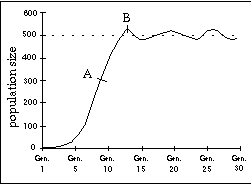
around 500
around 600
around 15
around 30

This graph shows ....
When one population increases, the other decreases.
When one population decreases, the other increases.
When one population increases, the other increases instantly.
When one population increases, it causes the other to increases shortly after.
What two factors decrease the population size?
Births
Deaths
Immigration
Emigration
In a food web, primary consumers are also known as:
A) Herbivores.
B) Carnivores.
C) Omnivores.
D) Decomposers.
What is the primary difference between the carbon cycle and the phosphorus cycle?
A) The carbon cycle does not involve atmospheric components.
B) The phosphorus cycle does not involve atmospheric components.
C) The carbon cycle is faster than the phosphorus cycle.
D) The phosphorus cycle is exclusively aquatic.
In the carbon cycle, plants use carbon dioxide during the process of:
A) Respiration.
B) Photosynthesis.
C) Decomposition.
D) Fossilization.
Which level of the ecological pyramid represents the largest amount of energy?
A) Primary consumers.
B) Secondary consumers.
C) Tertiary consumers.
D) Producers.
In the nitrogen cycle, what role do bacteria play?
A) Converting nitrogen gas into nitrates.
B) Releasing nitrogen gas back into the atmosphere.
C) Breaking down nitrates into nitrogen gas.
D) Both A and B.
Which of the following is a characteristic feature of a stable ecosystem?
A) It has a simple food web with few species.
B) It has a high degree of biodiversity.
C) It is dominated by tertiary consumers.
D) It has no producers.
Which statement is an example of how carbon moves through a food chain as part of the carbon cycle?
Producers release carbon dioxide, and consumers take it in.
Producers take in carbon dioxide, and consumers release it.
Producers take in carbon from the soil, and they release it when they decompose.
Producers release carbon into the soil, and consumers take it in from the soil.
What is the largest reservoir that contains about 78% of all atmospheric nitrogen?
Bacteria
Atmosphere
Soil
Plants
Carbon moves from living things to the atmosphere when they are
exhaled
stored
burned
broken down
Carbon moves from fossil fuels to the atmosphere when they are
exhaled
stored
burned
broken down

What is the order of succession shown in this figure?
A, B, C, D
B, A, D, C
C, D, A, B
D, A, B, C
How does urbanization impact local ecosystems?
It increases local biodiversity by introducing new species.
It has no significant impact on ecosystems.
It leads to habitat fragmentation and loss, affecting native species.
It enhances ecosystem services by increasing green spaces.
How do wetlands contribute to improving water quality in an ecosystem?
By acting as natural barriers to storm surges and flooding.
By providing habitats for a variety of aquatic plants and animals.
By filtering pollutants and sediment from water.
By increasing the rate of evaporation and reducing water availability.
What is the primary function of nitrogen-fixing bacteria in an ecosystem?
They decompose dead organisms and recycle nutrients.
They convert nitrogen gas from the atmosphere into forms that plants can use.
They produce oxygen through the process of photosynthesis.
They consume other organisms for energy.
What is the significance of keystone species in an ecosystem?
They are the most abundant species and provide the majority of the ecosystem's biomass.
They have no unique role but contribute to biodiversity.
They play a critical role in maintaining the structure of an ecological community, affecting many other organisms.
They are the primary producers and form the base of the food chain.
What role do decomposers play in the carbon cycle?
They fix atmospheric carbon dioxide into organic matter.
They release carbon dioxide back into the atmosphere by breaking down dead material.
They store carbon in their tissues for long periods, reducing atmospheric CO2.
They have no role in the carbon cycle.
How do invasive species affect biodiversity in an ecosystem?
They increase genetic diversity and ecosystem resilience.
They have no significant impact on native species or ecosystem functions.
They can outcompete native species, leading to a decrease in biodiversity.
They enhance ecosystem services and improve the quality of soil.
Name the pioneer species involved in primary succession and describe their role in soil formation.
Lichens and mosses, they break down rock and create new soil
Deciduous trees, they provide shade and reduce soil erosion
Mammals, they aerate the soil and contribute organic matter
Insects, they pollinate plants and increase biodiversity
What is the difference between Primary and Secondary Succession?
Primary succession is the only way to change within ecosystems.
Primary succession occurs in environments devoid of soil, such as bare rock or volcanic terrain
Secondary succession, takes place in areas where there are no existing ecosystems.
Only secondary successions illustrate nature's resilience and adaptability.
How does carbon in a grass plant get into a lion?
The lion absorbs the carbon given off by transpiration
Carbon from grass doesn't end up in a lion.
The lion breathes in carbon given out by the plant
The lion eats an antelope that ate the grass
What is the best definition of animal adaptation?
Changes to an animal's diet.
Characteristics that help animals survive.
Skills learned in order to hunt.


As time passes, and the trees become taller as the ecosystem attains the status of a climax community, what are the tree competing for at this stage?
water
CO2 (carbon dioxide)
sunlight
soil
Nitrogen fixing bacteria converts nitrogen gas into a usable form for plants. The bacteria multiply and thrive at the roots of the plants, and the plants are able to form proteins from the nitrogen provided by the bacteria.
What type of symbiotic relationship exists in the example above?
competition
mutualism
commensalism
parasitism
What is the term that describes a steady and stable community?
Disturbed community
Peak community
Climax community
Primary community
What is the main difference between primary and secondary ecological succession?
Primary builds plant community; secondary builds animal community
Primary begins WITH soil; Secondary begins WITHOUT soil
Primary is the first state and secondary is the second stage
Primary begins WITHOUT soil; Secondary begins WITH soil
A new island is formed after a volcano erupts.
What is the order that things would grow?
Lichen, Grass, Shrub, Tree
Tree, grass, moss
Shrub, grass, moss, tree
Lichen, Shrub, Moss, Tree

According to the graph, which of the following is true? (choose 2 answers)
(pH is the measurement of acidity)
As soil pH increases, the population of marigolds and annual flowers decreases
As soil pH increases, the pansies population increases
As soil pH increases, the pansies population decreases
As soil pH increases, the population of marigolds and annual flowers increases
An example of a population is:
Giraffe, Gazelle, Cheetah, Hornbill
A herd of zebras all in the same area
A Giraffe
Giraffe, Gazelle, Cheetah, Hornbill, Weather, Rainfall
Characteristics of Living Things Include all EXCEPT:
Can adapt and evolve
Are capable of growth
Are capable of eating leaves
Are capable of reproducing

What kind of competition is pictured here?
Interspecific
Intraspecific
Mutualism
Parasitism

What ecological concept is indicated by the dotted line in this diagram?
Carrying Capacity
Ecological Niche
Overshoot
Predation
Nitrogen fixation is the process in which certain bacteria convert nitrogen gas into
liquid nitrogen
nitrates
nitrites
ammonia
Match the following
Keystone Species
greater impact on ecosystem if removed
Invasive Species
Kudzu
Human Impact on Biodiversity
Land use and deforestation
Human Impact on Biodiversity
Invasive Species
Impact of Industrialization
Thermal Pollution


What does population density represent?
The number of individuals per unit area
The way individuals are spaced out about their range
The area inhabited by a population
What are density dependent limiting factors?
Factors that affect a population more seriously as the population density increases
Factors that are not dependent on population density
Factors that limit population growth indefinitely
What are density independent limiting factors?
Factors that are not dependent on population density
Factors that limit population growth indefinitely
Factors that affect the carrying capacity of a population
All of the elements that make up the macromolecules cycle through the environment, including phosphorous. Which macromolecule contains phosphorous?
nucleic acids
proteins
carbohydrates
lipids
Ecologists use these to show how energy decreases at each succeeding trophic level.
energy pyramid
pyramid of numbers
cladogram
phylogenetic tree

According to this food web, which organism is a primary consumer?
rabbit
snake
owl
green plant
When two organisms fight for the same resource
Competition
Parasitism
Commensalism
Predation
Mutualism
A unique ecological role of a species is called a ________
niche
limiting factor
biotic factor
abiotic factor


Which of the following is a density-independent limiting factor?
a struggle for food, space and mates
predator/prey relationships
flood damage from a hurricane
parasitism and disease

Native sponges and introduced muscles are both filter feeders in many of the Great Lakes. What is the ecological relationship?
Predator-Prey
Parasitism
Mutualism
Competition
Which of the following terms explains why multicellular organisms have many different cells with many different structures and functions?
metabolism
homeostasis
specialization
evolution
Which of the following is NOT a type of biogeochemical cycle?
Water cycle
Carbon cycle
Nitrogen cycle
Light cycle

This animal is best described as a(n)
herbivore
omnivore
carnivore
detritivore
Which process is primarily responsible for the movement of nitrogen from the atmosphere into the soil?
Condensation
Decomposition
Nitrogen fixation
Photosynthesis
Excessive amounts of rain caused a flood in the southwest United States that resulted in substantial amounts of deaths in the rabbit population? This situation is an example of a density _____________ limiting factor.
Independent
Dependent

If the producers have 50,000 kcal of energy, how much would be available to the SECONDARY consumers?
50
500
5000
50,000
What is an autotroph?
An organism that makes its own food
An organisms that has to obtain its food from an outside source

Which of the following best explains why there are usually no more than five trophic levels in a food chain
there are not enough organisms to fill more than five levels
the statement is not true: there can be unlimited trophic levels
there is too much competition among the organisms at the lower levels to support high levels
energy is lost at each trophic level
Barnacles create home sites by attaching themselves to whales. This neither harms nor benefits the whales. What type of symbiotic relationship is this?
Mutualsim
Commensalism
Parasitism

Which population is growing at a faster rate?
Mexico
United States
Which part of the water cycle takes water from plants to the atmosphere?
precipitation
evaporation
transpiration
condensation
Which biogeochemical cycle can only be found in rocks and minerals?
Carbon
Water
Oxygen
Phosphorus
Which biogeochemical cycle use bacteria to return nutrients to the soil?
Carbon
Water
Oxygen
Nitrogen
What is the number of individuals in an area?
Population Density
Population Distribution
clumped
carrying capacity

Which kind of growth is represented?
Exponential
Logistic
Neither
Both
How do invasive species impact ecosystems?
The increase density dependent limiting factors
They establish themselves as new keystone species in an area
The open up new niches in the ecosystem
They outcompete native species and overpopulate the area
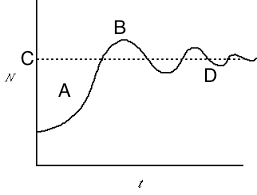
Carrying capacity is the (a) number of organisms that can survive in an area based on the available (b) , such as food and water.

