
 Worksheets
H Physics Ohm's Law 2024
Total questions: 75
Worksheet time: 5hrs 53mins
What is the resistance if the voltage is 10V and the current is 2A?
20 Ω
5 Ω
12 Ω
8 Ω
What are the units for resistance?
Ohms (Ω)
Voltage (V)
Amps (A)
Charge (C)
A 10 V battery makes 150 C of charge traverse a 100-Ω resistor in a simple circuit. How long was the battery connected to the circuit?
15 s
150 s
1500 s
15000 s


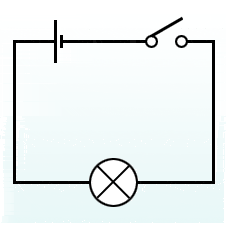
Electricity cannot flow.


The mathematical relationship among Voltage, Current, and Resistance is called _____________.
What is the voltage needed for 0.15 A to flow through an 80-Ω resistor?
24 V
12 V
533 V
0.15 V

Each battery is a 10-V battery. What is the voltage difference between points B and D?
10 V
20 V
30 V
40 V
If one bulb goes out in a series circuit, the remaining bulbs...
also go out
get brighter
get dimmer
explode, leaving shards of glass everywhere

If the switch was opened, what would happen?
the ammeter would measure a current flowing
current would no longer flow, so everything would be off
the bulbs would stay on because they're connected to the cell
the bulbs would burn out and catch fire
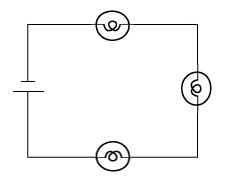
You build a circuit with two light bulbs, each on their own loop. When one light goes out, the other stays on. What type of circuit did you build?

Why are electrical wires usually covered with a layer of plastic?
To make it look pretty
To help electrons escape the wire
To make it safe by keeping the electrons flowing down the conductor.
To add more energy

If lamp 2 is unscrewed from its holder, what will happen to lamp1?
It will stay lit
It will go out
It will get dimmer
It will dissapear

Looking at the circuit, which statement below is TRUE?
The light bulb will light up because the circuit is complete.
The light bulb will light up because the circuit is broken.
The light bulb will not light up because the circuit is complete.
The light bulb will not light up because the circuit is open.

Which of the following is not a requirement of a basic circuit?
A switch
A source of energy
A closed path
A device that uses the energy

Which of the following is true about voltage?
Voltage resists the flow of electrons
The voltage is responsible for moving free electrons through the circuit
Voltage measures the rate at which charge flows through the circuit
The lower the voltage, the brighter the bulbs in a circuit

Electrons flow:
Randomly in all directions
Towards each other
From the positive terminal to the negative terminal
From the negative terminal to the positive terminal

Conventional current:
Flows in the same direction as electrons
Flows in the opposite direction as electrons
Sometimes flows with the electrons and sometimes against them
Has no relationship with electrons

Indicate which of the following statement is TRUE of series circuits.
Series circuits have multiple pathways for the electrons to flow
As bulbs are added in series, the brightness of each bulb decreases.
As bulbs as added in series, the brightness of each bulb increases.
If one bulb is removed or burns out, the circuit continues working.

Indicate which of the following statements is TRUE of parallel circuits.
Parallel circuits have one pathway for the electrons to flow.
As bulbs are added, the brightness of each bulb decreases.
As bulbs are added, the brightness of each bulb remains the same.
If one bulb is removed or burns out, the circuit stops working.

Which of the schematic diagrams shown below best matches the picture of the circuit shown above?


Identical light bulbs are connected to a 9 V battery in the different configurations shown below (Assume the switches are always closed). Which set-up will deplete the battery first?

Which of the schematic diagrams shown below best matches the picture of the circuit shown above?

Which of the schematic diagrams shown below best matches the picture of the circuit shown above?
If two objects repel, what can their charges be?
negative and negative or positive and positive
negative and neutral or positive and positive
neutral and neutral

If all of the switches were closed, how many paths can the current take?
4
6
8
10
If switch 1 and 2 were open, which device(s) would turn on?
none
A and B
C, D, E, F, G
all of them
If switches 2 and 5 were open, which device(s) would turn on?
none
B, C, D, E
C, D, E, F, G
all of them
A circuit has 4 D-Cell batteries (each 1.5 V) set up in series and a lightbulb with a resistance of 2 ohms. What is the current that flows through the circuit?
2 A
3 A
6 A
8 A
A circuit has 4 D-Cell batteries (each 1.5 V) set up in parallel and connected to a lightbulb with a resistance of 2 ohms. What is the current that flows through the lightbulb?
0.75 A
3 A
12 A
0.67 A

Calculate the current
6 A
54 A
0.6 A
5.4 A
Current is all of the following EXCEPT:
The flow of electrons through a conductive material
ΔtΔq
RV
Energy associated with the flow of electrons

Which of the following groups of materials are listed in
order of best conductor to worst conductor?
iron, copper, silver
iron, platinum, mercury
tungsten, aluminum, nichrome
platinum, gold, copper
What is the resistance of a 2 m long copper wire with a cross-sectional area of 2 x 10⁻⁷ m2?
ρ(Cu) = 1.68 x 10⁻⁸ Ω m
0.08 Ω
0.12 Ω
0.17 Ω
0.27 Ω

The following resistors are made of the same material. Rank them from GREATEST resistance to LEAST resistance.
Rx > Rw > Rz > Ry
Rz > Ry > Rx > Rw
Ry > Rz > Rw > Rx
Ry > Rw > Rz > Rx
The length of a copper wire is cut in half. By what factor does the resistance change?
1/4
1/2
2
4
Which factor does not affect the resistance of a wire?
Length
Mass
Cross-sectional area
Temperature
Resistivity
depends on the mass of the material.
relies on dimensions of the material.
is inversely proportional to resistance.
is a physical property of the material.
A wire has a resistance R.
What is the resistance when both the length and radius of the wire are doubled?
R/4
R/2
2R
4R
Which change will increase the resistance of a piece of copper wire?
decreasing the wire‛s length
decreasing the wire‛s resistivity
increasing the temperature of the wire
increasing the wire‛s diameter
The voltage supplied to a circuit is 17 V, and the current running through is 10 A. What is the power generated?
What will be the current drawn by an electric bulb of 1000 W when connected to a source of 220 V?


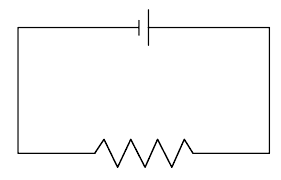
How are the batteries connected in this circuit?
In a series
In parallel
They are not connected
What is the electrical power consumption when the voltage is 230V and the current is 8.7A?
2,500 watts
3,000 watts
1,500 watts
2,001 watts

A heater has an internal resistance of 16 ohms and uses 900 watts of power. What is the voltage?
7.5 V
56 V
120 V
14400 V

A heating element has a resistance is 24 ohms and a 10 A current running through it. What is the Power?
240 W
240 J
2400 W
4.2 W
What is the resistance of a device with a current of 4 A and a power of 800 W?
200 Ω
12800 Ω
400 Ω
50 Ω
Calculate the electric power of an electrical appliance in which 10 A of current is flowing through a resistor of 2 ohms.
80 W
200 W
2.5 A
22.5 KJ
The length of a certain wire is doubled while its radius is kept constant. What is the new resistance of this wire?
It is 2 times as large.
It is 3 times as large.
It is 4 times as large.
It is 1/2 as large.
Consider two copper wires of equal cross-sectional area. One wire is three times longer than the other. How do the resistivities of these two wires compare?
Both wires have the same resistivity.
The longer wire has 3 times the resistivity of the shorter wire.
The longer wire has 9 times times the resistivity of the shorter wire.
The longer wire has 27 times times the resistivity of the shorter wire.
A charge of 48 C flows for 6s. What is the current?
8 A
288 A
8 V
288 V
How many electrons flow through a wire that has a 2 Ampere current flowing for 10 seconds?
20 electrons
5 electrons
6.25x10¹⁸ electrons
1.25x10²⁰ electrons
Which statement defines power?
The amount of energy consumed in 1 hour
The rate of consumption of energy
When work is done by moving a force through a distance
When work is done by moving mass through a distance
You plug two lamps into a 120 V outlet at your home. One lamp has a 40 W bulb, the other lamp has a 60 W bulb. Which bulb has the greatest resistance?
40 W Bulb
60 W Bulb
Both bulbs have the same resistance
Cannot be determined.
If the current through a 5 ohm resistor is doubled, the power expended in the resistor ____________.
increases by a factor of 5.
doubles.
decreases by 1/2.
quadruples.
The resistivity (ρ) of an element or material is dependent on the __________ of that material.
mass
density
temperature
color
A 20 Ohm resistor is rated to handle a maximum of 12 W of power. What happens if you push more than 12 W of power through the resistor?
Nothing.
The resistor will become cold to the touch.
The resistor will heat up.

