
NEW
Font size
 Worksheets
Ecology Review
Total questions: 66
Worksheet time: 41mins

What is a population?
One individual member of a species
a group of individuals of the same species that live in the same area
a community of different species and their environment
Which is an example of an ecosystem?
An area of cold climate and communities of different species
one elk
a group of elks living together in the same area
elks, snow rabbits, and owls living in the same area
Which definition best fits the term BIOTIC?
The study of the interactions between animals and their environment
Factors in the environment that are considered not alive
Factors in the environment that are considered living or the remains of living things
One species benefits, the other is unaffected
symbiosis
parasitism
mutualism
commensalism
Tapeworms reside in human intestine and take nutrients from the human
symbiosis
parasitism
mutualism
commensalism

Predator
Autotroph
Producer
Decomposer
The ecological role an organism performs in their specific environment is considered the organism's...
Habitat
Population
Biome
Niche
They point to the organism that is being eaten.
It shows how sunlight flows within an ecosystem.
They show what direction the energy is flowing between organisms.
They represent how water is transferred within a habitat.

The populations of which organisms will most likely increase as a result of a disease that suddenly reduced the population of Texas horned lizards?
Grasses and ants
Ants and grasshoppers
Grasshoppers and Texas Cottonmouths
Texas cottonmouths and red shouldered hawks

Producers /Autotrophs
Consumers /Heterotrophs
Decomposers
Scavengers


Why might an organism have more than one arrow coming FROM them in a food web?
More than one organism may eat them.
They may eat more than one other organism.
This organism gets its energy from multiple sources.
Grass > Grasshopper > Bird > Snake

What happens to the amount of available energy in the pyramid as it moves up through the different levels?
it increases
it decreases
it remains the same

Ecology is the study of .
life
Interactions among organisms and their environments
interactions among organisms
how traits are passed from parents to offspring
Which of the following is abiotic?
A tree in a forest.
Wood from the tree on the forest floor.
A termite on the tree.
The soil the tree is growing in.
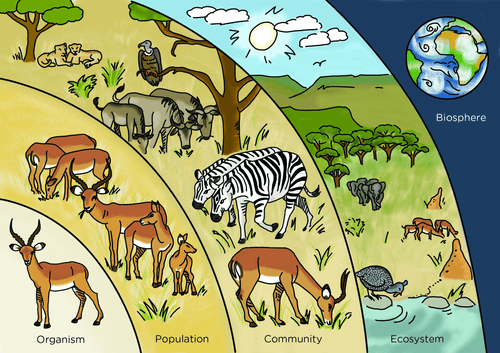
What is made up of all the populations in an area?
Habitat
Niche
Community
Ecosystem
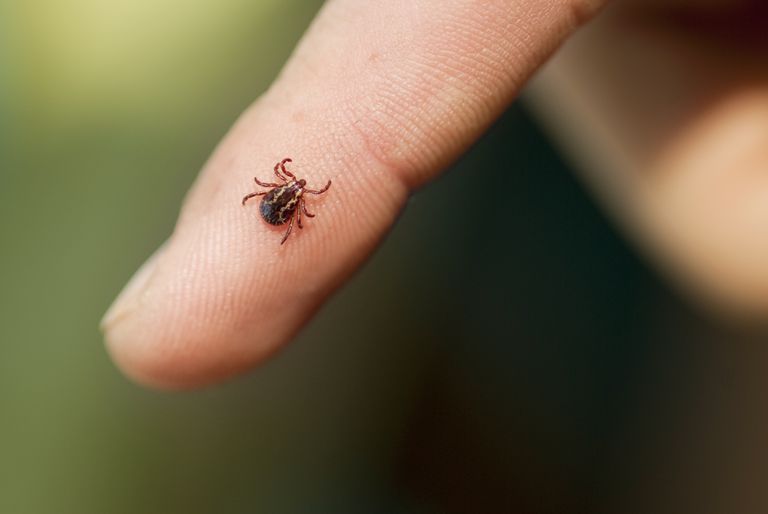
An ongoing relationship in which one organism benefits and the other is harmed.
A. Predator & Prey
B. Mutualism
C. Commensalism
D. Parasitism
There are birds that eat the food from between the teeth of alligators, leaving the alligators with clean teeth and the birds with a meal. What type of ongoing relationship is this?
A. Predator & Prey
B. Mutualism
C. Commensalism
D. Parasitism
An organism’s habitat is where it lives.
True
False
Tell if the item is an abiotic factor or biotic.....
Water
Abiotic
Biotic
Tell if the item is an abiotic factor or biotic.....
TREE
Abiotic
Biotic
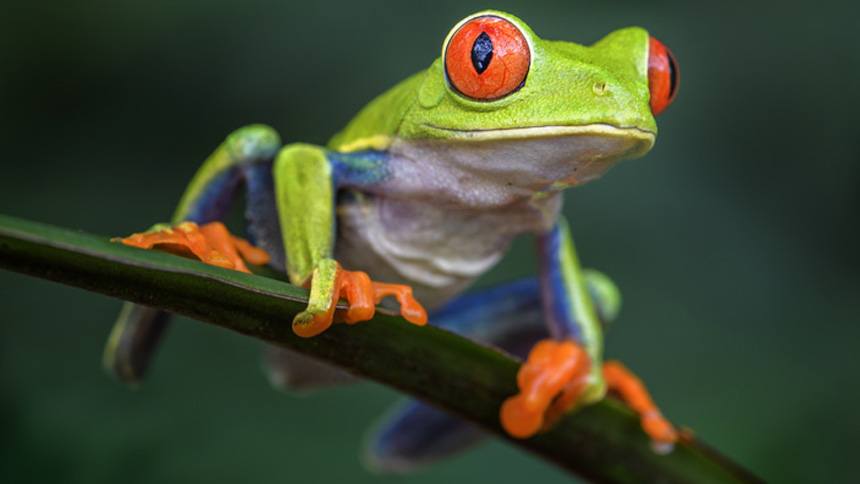
Tell if the item is an abiotic factor or biotic factor.....
Tree Frog
Abiotic
Biotic

Tell if the item is an abiotic factor or biotic.....
Sandy Soil
Abiotic
Biotic
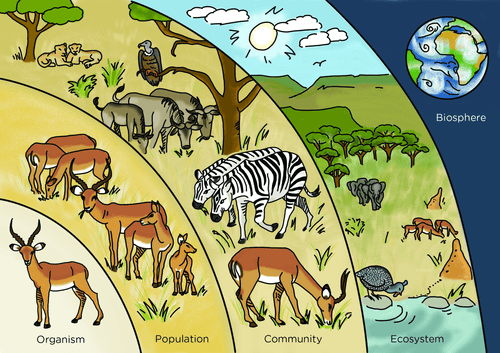
The living world is organized in levels. Biotic and abiotic factors also can be arranged into levels of biological organization. Put the words below in order from the least complex to the most complex
Community, Organism, Biome, Population, Biosphere, Ecosystem
Organism, Population, Community, Ecosystem, Biome, Biosphere
Organism, Biome, Population, Community Biosphere, Ecosystem


What is the biggest reason humans are negatively impacting the environment?
overhunting
pollution
increasing human population
invasive species
________ refers to the variety of life.
succession
industrialization
biodiversity
carrying capacity
low biodiversity means the ecosystem is
more stable
less stable
Which of the following is not an action to reduce or repair damage to the environment?
use fossil fuels
recycle
protect habitats and species
pass laws to control pollution, land, hunting and fishing

The arrows most likely represent. . . ..
Energy released from metabolism into the environment as heat
Oxygen released from metabolism produced by cellular respiration
The absorption of energy from the environment that has been created
The transport of glucose away from the organism through photosynthesis
Living things are made up of units called
DNA
Cells
Homeostasis
Seeds
The number of different plants and animal found within an area. The more varied an ecosystem is, the more stable the ecosystem.
Biodiversity
Homeostasis
Biotic
Biosphere
Organisms, known as producers, that synthesize their own food (glucose) by using the process of photosynthesis.
Autotroph
Heterotroph
Carnivore
Chloroplast
All of the living populations that are found and interact within an ecosystem.
Population
Species
Community
Ecosystem
An organism that feeds exclusively on plant material, example – a deer.
Carnivore
Herbivore
Omnivore
Producer
The most biodiverse and stable stage of ecological succession.
Pioneer Species
Climax Community
Shrubs and Grasses
Predator
Those resources that are unable to be replaced and, once used up,are gone. Fossil fuels are examples of this type of resource.
Renewable Resources
Non Renewable Resources
Sun Energy
Biotic
Organisms that feed exclusively on other animals,example - a fox.
Herbivore
Omnivore
Carnivore
Heterotroph
What would happen within a few months after the formation of a volcanic island?
pioneer species would grow
no pioneer species would grow
trees and large plants would grow
rich, organic soil would be present

Barnacles do not affect whales as they grow, but receive the benefit of a food source. This is
parasitism
mutualism
commensalism
neutralism

These organisms are often not shown in a food chain, but are important for recycling nutrients
producers
decomposers
primary consumers
carnivores
Which event would not cause secondary succession?
forest fire
flooding of a valley
volcanic lava flow
tornado

90% of the energy that gets lost as you move up a food pyramid or chain gets lost as
pollution to the environment
heat to the environment
energy for decomposers
gets recycled
What is the order that plants grow to repopulate the area in primary succession, such as a glacier receding or a volcano covering land with lava?
Lichens → Shrubs → Grasses → Trees
Lichens → tree → shrubs→Grasses
Grasses → Lichens → Shrubs → Trees
Lichens → Grasses → Shrubs → Trees

Which biome would have the highest biodiversity?
grasslands
desert
tundra
rainforest

Which of the following is not required for photosynthesis?
carbon dioxide
oxygen
water
radiant energy from sunlight

Photosynthesis creates...
only glucose
only oxygen
glucose and oxygen
glucose and carbon dioxide

In the food web above, a large decrease in the number of rats will cause ____.
an increase in the number of ants, tarantulas, and snakes
an increase in the number of snakes, coyotes, and hawks
a decrease in the number of snakes, coyotes, and hawks
a decrease in the number of cacti and sagebrush plants

Which animal receives the most energy originally produced by the plants in the food web?
rabbit
owl
frog
snake

