
 Worksheets
Optics Quiz
Total questions: 60
Worksheet time: 30mins
Which is NOT part of the visible spectrum?
infrared
orange
violet
yellow
Which has the longest wavelength?
infrared
red
ultraviolet
violet
Which is evidence that light travels in straight lines?
Candles give off light.
Car headlights point forward.
Glass is transparent.
Shadows form.
Which statement best defines "medium"?
the height of a wave
the matter that waves travel through
the number of oscillations that occur in a given time
the order of colors in the visible spectrum
Which statement best describes the term "ray"?
an explanation based on observation of how light behaves
a straight line that represents the path of a beam of light
light that is bent as it passes through a translucent object
light that passes through any substance.
What will be the characteristics of the image formed in a plane mirror?
larger and inverted
larger and upright
smaller and inverted
Same size and upright
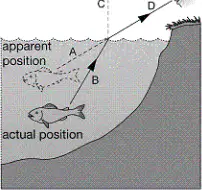
Which letter corresponds to the refracted ray?
A
B
C
D
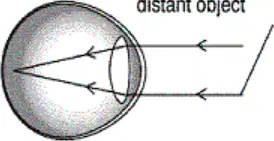
The diagram demonstrates Jerome's eye condition. What is this condition called?
color blindness
far-sightedness
near-sightedness
snow blindness
Which device does NOT use lenses?
magnifying glass
microscope
satellite dish
Telescope
Which of the following is not a property of light?
Travels to the same degree through all materials
Rectilinear propagation
Refraction
Dispersion
If a wave has high frequency, it has:
Short wavelengths
Long wavelengths
No energy
Low energy
Light is shone into a prism and the light is broken down into the colors of the rainbow. What is this an example of?
Refraction
Reflection
Rectilinear propagation
Dispersion
The bent stick effect is an example of which property of light?
Refraction
Reflection
Rectilinear propagation
Dispersion
What is the type of radiation that results from nuclear reactions called?
Alpha radiation
Beta radiation
Gamma radiation
Delta radiation
Which type of electromagnetic wave is mentioned as having the shortest wavelength in the list provided?
Radio waves
Infrared rays
Gamma rays
Ultraviolet rays
Which statement is correct about the behavior of light?
Light can travel in a vacuum
Light cannot travel in a vacuum
Light travels more slowly than sound
Light travels faster in water than air
What is the scientific study of light called?
Biology
Optics
EMR
Light studies
What happens to light when it bounces off an object?
Refraction
Dispersion
Reflection
Rectilinear propagation
When light rays pass from air into glass, how do they behave?
They bend away from the normal as they move into a material with greater density.
They bend away from the normal as they move into a material with lower density.
They bend toward the normal as they move into a material with greater density.
They bend toward the normal as they move into a material with lower density.
How are light rays described when they are focused to a point after passing through a lens?
Conjoining
Converging
Diverging
Merging
Which statement is false regarding drawing a ray diagram for a concave mirror?
A ray drawn through the optical center will pass straight through
A ray drawn parallel to the principal axis will reflect back through the focal point
A ray drawn through the focal point will reflect back parallel to the principal axis
A ray drawn that hits the vertex will reflect back at the same angle
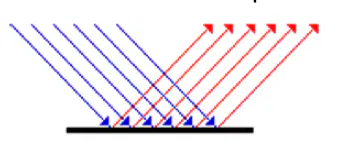
What type of reflection is depicted in the illustration below?
Crooked
Diffuse
Regular
Specular
Which statement is false about the characteristics of an image in a plane mirror?
The image is smaller
The image is the same size
The image is upright
The image is virtual
What is the frequency of a fly flapping its wings back and forth 40 times in 5 seconds?
8 Hz
35 Hz
45 Hz
200 Hz
What does the inside of a metal bowl act as?
Convex mirror
Convex lens
Concave mirror
Concave lens
What is the correct order of the colors in a rainbow?
Red-Orange-Yellow-Green-Blue-Indigo-Violet
Orange-Yellow-Red-Indigo-Green-Violet-Blue
Red-Orange-Yellow-Blue-Green-Indigo-Violet
Indigo-Violet-Green-Blue-Yellow-Orange-Red
Which color has the longest wavelength?
Red
Green
Blue
Violet
Which of the following colors have the shortest wavelength?
Orange
Blue
Violet
Red
Which scientist was the first to propose that light beams were made of tiny particles?
Pythagoras
Michelson
Newton
Diablo
Who was the first person to accurately measure the speed of light?
Pythagoras
Michelson
Newton
Diablo
What is the approximate speed of light?
1,000,000,000 km/hr
1,000,000 km/hr
300,000 km/hr
300,000 m/s
What determines the height of a wave crest or the depth of a wave trough?
Frequency
Wavelength
Amplitude
Hertz
Which type of mirror consists of a flat reflective surface?
Plane
Convex
Concave
Diffuse
Which type of mirror is curved inward like the inside of a bowl?
Plane
Convex
Concave
Diffuse
Which type of mirror is curved outward like the outside of a bowl?
Plane
Convex
Concave
Diffuse
Which of the following is an example of a plane mirror?
Inside a metal spoon
Spotlights
Overhead projectors
Bathroom mirror
Which term indicates a material that all light passes through?
Opaque
Transparent
Translucent
Transcendent
Which term indicates a material that no light can pass through?
Opaque
Transparent
Translucent
Transcendent
Which term indicates a material that some light passes through?
Opaque
Transparent
Translucent
Transcendent
Incident light ray is the...
Incoming light ray
The ray that bounces off the mirror.
The barrier
The refracted ray on the other side of the mirror.
Reflected ray is the...
Incoming light ray
The ray that bounces off the mirror.
The barrier
The refracted ray on the other side of the mirror.
What is the term for the ray that bounces off the mirror?
Incoming light ray
Reflected ray
Barrier
Refracted ray
What does the angle of incidence refer to?
Angle between the normal and the mirror
Angle between the normal and the reflected ray
Angle between the refracted ray and the normal
Angle between the normal and the incident ray
What is the angle of reflection?
Angle between the normal and the mirror
Angle between the normal and the reflected ray
Angle between the refracted ray and the normal
Angle between the normal and the incident ray
What does SPOT stand for in the "spot method" of describing images?
Size, Position, Orientation, Type
Size, Planar, Orientation, Type
Sigma, Position, Orientation, Type
Sigma, Planar, Omega, Type
Which statement is always true of planar image characteristics?
Size: same, Position: same, Orientation: upright, Type: Virtual
Size: smaller, Position: further, Orientation: upside-down, Type: real
Size: larger, Position: further, Orientation: upside-down, Type: real
Size: smaller, Position: closer, Orientation: upside-down, Type: real
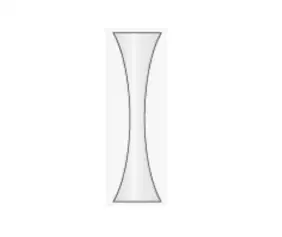
What type of lens is depicted in the first diagram?
Convex-Converging
Convex-Diverging
Concave-Converging
Concave-Diverging
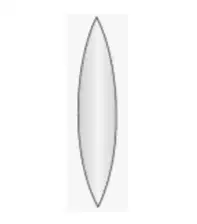
What type of lens is depicted in the second diagram?
Convex-Converging
Convex-Diverging
Concave-Converging
Concave-Diverging
What is the term for the bending of light when passing through one transparent substance to another of different density?
Reflection
Refraction
Diffusion
Specular
Which of the following substances will light travel the fastest?
Glass
Plastic
Water
Air
As light travels from a less dense medium to a more dense medium, the refracted ray _____?
bends towards the normal
bends away from the normal
does not bend
is reflected
As light travels from a more dense medium to a less dense medium, the ray bends _____?
bends towards the normal
bends away from the normal
does not bend
is reflected
Nearsightedness is which of the following?
One can see objects close but not far
One can see objects far but not close
Everything is blurry close or far
None of the above
Farsightedness is which of the following?
One can see objects close but not far
One can see objects far but not close
Everything is blurry close or far
None of the above
Which lens is used to correct nearsightedness?
Concave
Convex
Plane
None of the above
Which lens is used to correct farsightedness?
Concave
Convex
Plane
None of the above
The electromagnetic radiation with the longest wavelength and lowest energy and frequency is known as ______.
Radio Waves
Microwaves
Infrared waves
Light
The electromagnetic radiation that can be continually detected by our eyes is ______.
Radio Waves
Microwaves
Infrared waves
Light
Which type of electromagnetic radiation is used to see bones inside our bodies?
Microwaves
Radio Waves
X rays
UVA/UVB
Which of the following is used in industry to destroy bacteria?
Microwaves
Radio Waves
X rays
UVA/UVB

