
 Worksheets
Final Exam
Total questions: 120
Worksheet time: 4hrs 50mins
Which pair of compounds represents one Arrhenius acid and one Arrhenius base?
CH3OH and NaOH
CH3OH and HCl
HNO3 and NaOH
HNO3 and HCl
What is the [H+] in a solution with a pH of 11?
1 x 10⁻¹ M
1 x 10⁻² M
1 x 10¹¹ M
1 x 10-11 M
What is the [OH-] if the [H+] is 1.0 x 10⁻³ M?
1.0 x 10⁻³ M
6.02 x 10⁻²³ M
1.0 x 10⁻¹⁴ M
1.0 x 10⁻¹¹ M
An Arrhenius acid
donates H+ to another substance
accepts H+ from another substance
produces H+
produces OH-

Is pure water acidic, basic, or neutral?
Acidic
Basic
Neutral
An acid has a pH
higher than 7
lower than 7
7
greater than 14
the H in pH stands for
hood
happy
hydrogen
help
Select the properties that all acids share:
Taste sour
covalent compounds
red litmus paper turns blue
blue litmus paper turns red
taste bitter
True or false: An acid is a molecule that accepts H+ ions
True
False
True or False: Amphiprotic compounds are substances that turn one color in the presence of acids and another color in the presence of bases
True
False
True or False: When ionic compounds dissolve they split into their constituent ions
True
False
What is the chemical equation for Molarity (M)?
M = # of mol
_____
#of liters
M = #of liter
_____
#of mol
m = # of mol solute
____
#of kg solvent
m= #of kg solvent
____
#of mol solute

Which of the following gases is NOT diatomic?
HCl
Hydrogen
Carbon monoxide
Neon
Which molecule would move the fastest in the gas state at 25.0°C and 1 atm?
CO2 (molar mass 44)
NH3 (molar mass 17)
H20 (molar mass 18)
C4H10 (molar mass 58)
Which gas is an odorless gas frequently used in fire extinguishers?
CO2 (molar mass 44)
NH3 (molar mass 17)
H20 (molar mass 18)
C4H10 (molar mass 58)
What is the ratio of the average speed of gaseous Ne atoms to gaseous SO3 molecules, if equal volumes of both gases are measured at the same temperature and pressure?
8 to 1
4 to 1
2 to 1
1 to 1
A real gas closely approaches the behavior of an ideal gas under conditions of
low pressure and high temperature
low pressure and low temperature
high pressure and low temperature
high pressure and high temperature
A mixture of 0.40 mole of He gas and 0.50 mole of N2 gas exerts a total pressure of 0.90 atm at 25ºC. What is the partial pressure of the He gas?
0.36 atm
0.40 atm
0.45 atm
0.81 atm
An inverse relationship is to Boyle's Law as a direct relationship is to
Ideal Gas Law
Graham's Law of Gas Diffusion
Hess's Law
Charles' Law
When water is heated to boiling in an open soda can and the can is then inverted into a bucket containing cold water,
the can expands due to rapid expansion of the water vapor inside
the can implodes due to the rapid change in room air pressure
the can implodes due to rapid condensation of the inside water vapor
the can implodes due to the rapid change in room air pressure and rapid condensation of the inside water vapor
A rigid metal contains nitrogen gas. Which of the following statements applies to the N2 gas in the tank if 10% of the gas is allowed to escape? (Assume the temperature remains constant.)
The volume of the gas decreases.
The pressure of the gas decreases.
The average kinetic energy of the N2 gas decreases.
The mass of the gas remains the same.
Hydrogen gas is produced and then collected over water at 24°C in a long gas-collecting tube, which is inverted in a battery jar. The water levels in the battery jar and the tube are made equal, and the volume of the gas is 37.20 mL. The gas, mixed with evaporated water, exerts a total pressure of 751.0 mm.
If the vapor pressure at this temperature is 23.1 mm, what is the pressure of the "dry" hydrogen at 24°C?
774.1 mm Hg
751.0 mm Hg
727.9 mm Hg
23.1 mm Hg
Hydrogen gas is produced and then collected over water at 24°C in a long gas-collecting tube, which is inverted in a battery jar. The water levels in the battery jar and the tube are made equal, and the volume of the gas is 37.20 mL. The gas, mixed with evaporated water, exerts a total pressure of 751.0 mm.
The purpose of leveling the gas measuring tube in the above experiment is to
determine the volume of the gas at room temperature
ensure that the gas pressure inside the tube is equal to room pressure
prevent further water molecules from evaporating in the tube
prevent the gas molecules from escaping from the tube
When a balloon filled with helium gas is released, it rises and floats away. Which statement below is the best explanation for this observed behavior?
The helium density inside the balloon is less than that of the surrounding air.
The temperature of the surrounding air is less than the temperature of the helium.
Air pressure is greater than the pressure exerted by the helium.
The rate of diffusion of cooler air is less than that of warmer air.
IF we are using Boyles' law and our Pressure goes UP, what must our volume do?
Go UP
Go DOWN
Stay the same
Wrong law.
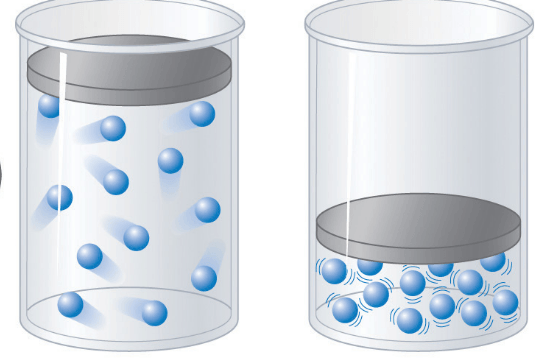
I have added 15 L of air to a balloon at sea level (1.0 atm). If I take the balloon with me to Denver, where the air pressure is 0.85 atm, what will the new volume of the balloon be?
24 L
18 L
32 L
15 L

A line graph of the PV constant for an ideal gas would have a
a positive slope
a straight line, slope = 0
a negative slope
Which best explains why increasing the pressure on a gas decreases the volume of the gas sample?
Increasing the pressure causes the gas particles to hit the container walls more often.
Increasing the pressure on a gas sample moves the gas particles closer together.
Increasing the pressure on a gas sample causes the kinetic energy to increase.
How do you convert Kelvin to Celsius?
Add 273
Subtract 273
You can't convert those
They are the same thing
All of the following are temperature units except ______
atm
Kelvin
Celsius
Farenheit
Pressure units used for Chemistry are
atm
psi
mmHg
kPa
Which answer shows the correct Combined Gas Law


.001 L
1ml
10 ml
100 ml
.01 ml
.001 mL
1 L
10 L
.100 L
.01 L
True or false: In an endothermic reaction, heat is released
True
False
Which of these processes are always exothermic?
Burning
Melting
insulation
evaporation
During an endothermic reaction in a beaker if we are part of the surroundings and touched the beaker, it would feel...
warm
cold
Endo or Exo reaction?
6 CO2+ 6 H2O + Energy → C6H12O6 + 6 O2
Endothermic reaction
exothermic reaction
The substance being dissolved is called the ________
solvent
solid
solute
solvate
A non-electrolyte is composed of __________in solution
ions
molecules
ions and molecules
none of the above
When no more solute dissolves the solution is ________
saturated
unsaturated
supersaturated
Gases are more soluble at ______temps and _____pressures
high, low
low, high
high, high
low, low
Define ΔH
Change in Temperature; the energy we calculate; Degree Celsius
Change in Specific Heat; Heat by one Degree Celsius
Change in Time; time travel
Change in Enthalpy; the energy/heat we calculate
Specific Heat is
the temperature final minus temperature initial
the amount of heat/energy required to raise 1 gram of a substance by 1°C (or K) aka "C"
the temperature initial minus temperature final
the item in a system with given weight in grams
True or False: A substance with a low specific heat requires less energy to heat up and a substance with high specific heat require more energy to heat up and heats up slower
True
False
What does entropy measure?
The total energy of a system
The disorder or randomness in a system
The work done by a system
The heat transfer of a system
What is the definition of enthalpy?
The heat content of a system at constant pressure
The energy available to do work
the measure of disorder or randomness in a system
The capacity of a system to do work due to its temperature
What is Gibbs Free Energy?
The heat content of a system
The total energy of a system
The energy available to do work at constant temperature and pressure
The energy required to break bonds
What does a positive value of ΔG indicate about a process?
The process releases heat
The process is non-spontaneous
The process is spontaneous
The process absorbs heat
Which pair of compounds represents one Arrhenius acid and one Arrhenius base?
CH3OH and NaOH
CH3OH and HCl
HNO3 and NaOH
HNO3 and HCl
An Arrhenius acid
donates H+ to another substance
accepts H+ from another substance
produces H+
produces OH-
Is pure water acidic, basic, or neutral?
Acidic
Basic
Neutral
An acid has a pH
higher than 7
lower than 7
7
greater than 14
the H in pH stands for
hood
happy
hydrogen
help
Select the properties that all acids share:
Taste sour
covalent compounds
red litmus paper turns blue
blue litmus paper turns red
taste bitter
True or false: An acid is a molecule that accepts H+ ions
True
False
True or False: Amphiprotic compounds are substances that turn one color in the presence of acids and another color in the presence of bases
True
False
True or False: When ionic compounds dissolve they split into their constituent ions
True
False
What is the chemical equation for Molarity (M)?
M = # of mol
_____
#of liters
M = #of liter
_____
#of mol
m = # of mol solute
____
#of kg solvent
m= #of kg solvent
____
#of mol solute
Which of the following gases is NOT diatomic?
HCl
Hydrogen
Carbon monoxide
Neon
Which molecule would move the fastest in the gas state at 25.0°C and 1 atm?
CO2 (molar mass 44)
NH3 (molar mass 17)
H20 (molar mass 18)
C4H10 (molar mass 58)
Which gas is an odorless gas frequently used in fire extinguishers?
CO2 (molar mass 44)
NH3 (molar mass 17)
H20 (molar mass 18)
C4H10 (molar mass 58)
A real gas closely approaches the behavior of an ideal gas under conditions of
low pressure and high temperature
low pressure and low temperature
high pressure and low temperature
high pressure and high temperature
A mixture of 0.40 mole of He gas and 0.50 mole of N2 gas exerts a total pressure of 0.90 atm at 25ºC. What is the partial pressure of the He gas?
0.36 atm
0.40 atm
0.45 atm
0.81 atm
An inverse relationship is to Boyle's Law as a direct relationship is to
Ideal Gas Law
Graham's Law of Gas Diffusion
Hess's Law
Charles' Law
When water is heated to boiling in an open soda can and the can is then inverted into a bucket containing cold water,
the can expands due to rapid expansion of the water vapor inside
the can implodes due to the rapid change in room air pressure
the can implodes due to rapid condensation of the inside water vapor
the can implodes due to the rapid change in room air pressure and rapid condensation of the inside water vapor
A rigid metal contains nitrogen gas. Which of the following statements applies to the N2 gas in the tank if 10% of the gas is allowed to escape? (Assume the temperature remains constant.)
The volume of the gas decreases.
The pressure of the gas decreases.
The average kinetic energy of the N2 gas decreases.
The mass of the gas remains the same.
Hydrogen gas is produced and then collected over water at 24°C in a long gas-collecting tube, which is inverted in a battery jar. The water levels in the battery jar and the tube are made equal, and the volume of the gas is 37.20 mL. The gas, mixed with evaporated water, exerts a total pressure of 751.0 mm.
The purpose of leveling the gas measuring tube in the above experiment is to
determine the volume of the gas at room temperature
ensure that the gas pressure inside the tube is equal to room pressure
prevent further water molecules from evaporating in the tube
prevent the gas molecules from escaping from the tube
IF we are using Boyles' law and our Pressure goes UP, what must our volume do?
Go UP
Go DOWN
Stay the same
Wrong law.
Which best explains why increasing the pressure on a gas decreases the volume of the gas sample?
Increasing the pressure causes the gas particles to hit the container walls more often.
Increasing the pressure on a gas sample moves the gas particles closer together.
Increasing the pressure on a gas sample causes the kinetic energy to increase.
Which answer shows the correct Combined Gas Law
.001 L
1ml
10 ml
100 ml
.01 ml
Endo or Exo reaction?
6 CO2+ 6 H2O + Energy → C6H12O6 + 6 O2
Endothermic reaction
exothermic reaction

