
 Worksheets
Cloud Concepts Review
Total questions: 82
Worksheet time: 1hrs 22mins
What does the cloud primarily deliver to users online?
Physical hardware
Software installation services
Services such as compute, network, storage, databases, web, mobile, DevOps, artificial intelligence, big data, and IoT
In-person technical support
Which of the following is NOT a benefit of using cloud computing as mentioned in the text?
Limited storage ability
Scalable services
No need to worry about hardware purchase
Reduced operating costs
According to the text, what can be scaled in a cloud environment?
The number of physical servers only
The processing speed only
CPUs and memory specifications
The cost of internet services

What is illustrated by the figure?
The cost analysis of cloud services
The physical setup of cloud servers
How devices connect to cloud services via the internet
Security protocols for cloud computing
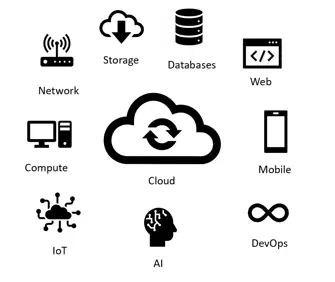
According to the diagram, which of the following is not a component of cloud computing?
Storage
Databases
Web
What is a public cloud primarily used for in a business environment?
To provide a physical space for IT equipment
To host certain components such as servers and storage on virtual servers owned by a third party
To increase the need for IT equipment maintenance
To limit data access to within a single organization
Which of the following is a security concern when using public clouds?
Data is encrypted and cannot be accessed by unauthorized users
Public cloud servers share data across multiple organizations
Data is stored on physical devices within the company premises
All data is automatically private and secure
What is an advantage of using public cloud services over purchasing physical IT equipment?
Higher costs for IT equipment and cloud service upkeep
Less processing power is available
It is often cheaper than buying physical IT equipment or software packages
Data is stored on physical devices which are more secure
When moving applications to the public cloud, what must organizations with legacy IT systems consider?
Reducing the number of applications used
Using only private cloud solutions
The integration and compatibility with existing systems
Completely replacing all old systems immediately
How is data managed between different companies sharing the same public cloud service?
All companies have access to each other's data
Each company's data is totally separate and not accessible to each other
Data is merged for efficiency
Only the cloud provider can access the data of all companies

What type of cloud environment is shown here?
A) A private cloud network
B) A hybrid cloud model
C) A public cloud network
D) An on-premises data center
What is a private cloud primarily dedicated to?
A single user company
Multiple companies sharing data
Public access
Government use only
Which of the following is a benefit of using a private cloud over public clouds?
Less control over servers
Higher risk of fraudulent traffic
More control and protection over servers
Less predictable performance
Why are private clouds considered more secure than public clouds?
They are used by multiple organizations
They handle fewer transactions
They are only used for internal transactions
They are cheaper

What does the diagram in the document illustrate?
The network structure of a public cloud
The sharing of clouds between companies
The concept of a private cloud with separate clouds for different companies
The cost comparison between private and public clouds
What long-term financial benefit does a private cloud offer?
Higher initial costs
Monthly subscription fees
More cost-effective use of existing gear and network
Increased costs due to specialized infrastructure
What is a hybrid cloud in cloud computing?
A model combining multiple public clouds
A single private cloud model
A combination of at least one private cloud and at least one public cloud
A temporary cloud service used for data migration
Which of the following is NOT a listed advantage of hybrid cloud usage?
Reducing the cost of IT operations
Migrating workloads quickly using existing tools
Combining microservices and container-based apps on the same platform
Handling more queries by freeing IT employees from repetitive tasks
How does a hybrid cloud help businesses in terms of operational needs?
It restricts the operational model to one environment
It allows businesses to choose where and when workloads and data are delivered
It prevents businesses from using cloud-native services
It limits the use of traditional tools and processes
What operational efficiency does the unifying of the operating model across environments in a hybrid cloud achieve?
Decreases operational and security risks
Increases the need for data center consolidation
Reduces the flexibility of cloud services
Limits the migration of workloads without refactoring
What is a hybrid cloud in cloud computing?
A) A cloud service hosted entirely by a single company for its own use.
B) A combination of public and private cloud services tailored to meet specific organizational needs.
C) A public cloud service used by multiple companies without any private components.
D) A less expensive cloud service that scales up without any capital expenditure.
Which of the following is an advantage of using public cloud services?
A) It requires significant capital expenditure to scale up.
B) It is less expensive after initial infrastructure investment.
C) It scales quickly without requiring capital expenditure.
D) It allows for storing sensitive data securely within the company.
Why might a company choose a hybrid cloud solution?
A) To avoid using cloud services altogether.
B) To use only private cloud services for all types of data.
C) To benefit from both public and private cloud services based on specific data requirements.
D) To reduce the need for any cloud services by relying on traditional on-premises solutions.
What is a potential drawback of a private cloud compared to public cloud?
A) It scales easily and requires no additional equipment.
B) It may involve the purchase of additional equipment when usage falls.
C) It is always more expensive than public cloud services.
D) It does not allow for any data to be stored securely.
Google Apps
SaaS
PaaS
IaaS
None of these

Whose console is this?
MS Azure
Google Cloud
Amazon WS
IBM Blue Cloud
Amazon Web Services, Microsoft Azure, Google Compute Engine are
IaaS
PaaS
SaaS
All of the above
A third-party provider hosts applications and makes them available to customers over the Internet.
SaaS
IaaS
Paas
Traditional model
Provides a platform allowing customers to develop, run, and manage applications without the complexity of building and maintaining the infrastructure.
PaaS
IaaS
SaaS
AaaS
You are running a virtual machine in a public cloud using IaaS. Which model correctly reflects how that resource is managed?
user management model
cloud user management model
no responsibility management model
shared responsibility model
Users are able to provision cloud computing resources without requiring human interaction.
On-demand self-service
On demand action
Self service console
Automated service
What terms from the list below would be viewed as benefits of using cloud services?
Elasticity
Un-predictable costs
Local reach only
Agility
Economies of scale
Which cloud model provides the greatest degree of ownership and control?
Public
Private
Hybrid
What does the term "Flexibility" in cloud computing refer to?
The ability to deploy and configure cloud resources quickly.
The ability to scale services to meet specific requirements and use cloud services from any location.
The ability to quickly bring new apps to market without infrastructure expenses.
The ability to provide disaster recovery services.
Which term describes the capability to scale computing capacity by adding more CPUs or RAM to the same virtual machine?
Scaling out
Scaling up
Elasticity
Agility
What is the difference between scalability and elasticity in cloud computing?
Scalability involves increasing the number of servers based on user count, while elasticity adjusts server numbers automatically based on active user count.
Scalability deals with deploying new apps quickly, while elasticity focuses on geographical distribution.
Scalability is about adding more virtual machines, while elasticity involves adding more physical servers.
Scalability is about disaster recovery, while elasticity deals with strategic importance.
What is the primary benefit of geo-distribution in cloud computing?
It allows for quicker deployment of cloud resources.
It ensures that consumers always have the greatest performance in their region.
It provides organizations with a competitive advantage.
It reduces capital expenditure on physical assets.
This is the up-front expense that a company spends on physical assets such as physical servers, network switches and infrastructure, storage devices, backup devices, etc.
CapEx
OpEx
FedEx
What does Operational Expenditure (OpEx) refer to in cloud services?
Initial costs that are paid once and decrease over time
Recurring costs that are paid as services are used
Costs associated with non-cloud services like rent and utilities
One-time fees for setting up cloud services
Which of the following best describes the consumption-based model in cloud computing?
Paying for services only when the business is operational
Paying a fixed monthly fee regardless of service usage
Paying for each user within the company
Paying for services upfront before usage
How does the cost of Capital Expenditure (CapEx) change over time?
Increases as more services are used
Remains constant regardless of usage
Decreases as the initial value depreciates
Fluctuates based on market demand
Which of the following best describes the concept of 'elasticity' in cloud computing?
The ability to stretch physical servers to their limits
The capacity to scale computing resources up or down easily, according to demand
The flexibility of choosing different operating systems
The capability to wear elastic gloves while handling server hardware
Rapid elasticity
Resources are provisioned and released on-demand
Resources are stretched to capacity
Resources are paid for by use
Resources are scalable
The ability to continue to function at a high level of performance as workflow volume increases.
Scalability
Self service
Elasticity
Measured service
Which of the following is a feature of cloud computing?
Decreased scalability
On-premises infrastructure
Resource pooling
Manual maintenance
When you need to add more virtual machines to meet an increasing demand, which form of scalability does this refer to?
Scaling Out
Vertical Scaling
Scaling Up
Virtual Scaling
This guarantees there is no single point of failure of a cloud resource.
Scalability
Reliability
Availability
Predictability
What is the primary advantage of implementing auto-scaling in cloud computing environments?
It reduces the overall operational costs by automatically adjusting resources.
It increases security by adding more servers automatically.
It simplifies the user interface for cloud services.
It requires more manual intervention to manage resources.
How does resource pooling in cloud computing enhance service delivery?
By allowing physical access to the server hardware.
By segregating resources based on client requirements.
By providing a shared pool of configurable computing resources to multiple consumers.
By limiting the scalability and elasticity of resources.
What does the Shared Responsibility Model in cloud computing imply?
The cloud provider is solely responsible for managing the datacenter.
Responsibilities are divided between the cloud provider and the customer based on the service type.
Customers are solely responsible for managing their data and applications.
The physical hardware is managed by third parties, not the cloud provider or customer.
Which of the following is NOT listed as a responsibility under the Shared Responsibility Model?
Identity and Directory Infrastructure
Marketing and Sales Strategies
Applications
Operating System
Which of these exemplifies Infrastructure as a Service (IaaS) ?
It is like renting a house where you can choose the furniture but not the house structure.
It is similar to leasing a car, where you can choose the vehicle and drive it but do not own it.
It is like owning a software where you can modify it as per your needs.
It is compared to purchasing a mobile device that you can upgrade anytime.
What is a key difference between on-premises IT model and cloud services?
In on-premises IT, the company owns and manages all responsibilities, unlike in cloud services.
Cloud services require physical presence at datacenters, whereas on-premises IT does not.
On-premises IT is less secure compared to cloud services.
On-premises IT offers less control over data compared to cloud services.
What does Platform as a Service (PaaS) most closely resemble in everyday life?
Driving a personal car
Hailing a cab
Riding a bicycle
Flying on an airplane
Which of the following is NOT a responsibility of companies in an On-Premises IT model?
Managing the physical hardware of servers, network, and storage
Running multiple operating systems on one physical server
Developing the applications used by the company
Outsourcing the management of their IT infrastructure
What is primarily stored in the 'Storage' component of the On-Premises IT infrastructure?
The company's financial records
The company's data
The company's marketing strategies
The company's employee details
In the On-Premises IT model, what does 'Compute' refer to?
The routers and switches used
The CPU and RAM of the physical servers
The operating systems installed
The security protocols used
What does the term "on-premises" refer to in cloud computing?
A method where cloud services are hosted externally by a third-party provider.
A setup where the company owns and operates the IT infrastructure within their own facilities.
A cloud service model where the provider leases hardware to the company.
A service that allows companies to use shared IT infrastructure.
Which of the following best describes Infrastructure-as-a-Service (IaaS)?
A service model where the cloud provider hosts applications for the company.
A cloud computing model where the provider maintains the hardware and the client is responsible for operating systems and applications.
A model where all IT services are managed by a third-party, including applications and runtime environments.
A service where the company owns all the hardware and software but stores data in the cloud.
What is the role of a "cloud tenant" in cloud computing?
The individual responsible for maintaining the physical servers in a data center.
The entity that provides cloud services.
The customer or company that uses the virtual machines and other services provided by the cloud.
The owner of the data center where cloud services are hosted.
According to the on-premises model, who is responsible for maintaining and operating the IT infrastructure?
The cloud provider.
The cloud tenant.
The company that owns the hardware components.
A third-party IT service firm.
What is the primary benefit of Infrastructure-as-a-Service (IaaS) for companies that do not have physical IT infrastructure?
They can use physical servers.
They must manage their IT operations.
They can rent virtual machines that run their operating systems.
They need to invest in heavy IT infrastructure.
Which of the following is NOT a use case for IaaS?
Lift-and-Shift Migration
Software Development and Testing
Hosting Complex Websites
Direct hardware access for performance tuning
What is a key advantage of using IaaS for disaster recovery and backup solutions?
Increases the need for physical data centers
Reduces the cost of maintaining high availability and business continuity
Requires frequent hardware upgrades
Decreases application performance

According to the diagram, which component is directly managed within IaaS? (Green items are run and owned by the cloud tenant, Items not highlighted are owned by the cloud provider)
Applications
Data and Access
Networking
None of the above
What is the primary focus of the cloud tenant in a Platform-as-a-Service (PaaS) model?
Managing the IT infrastructure
Operating virtual machines
Developing and deploying applications to the cloud
Overseeing the cloud provider's operations

In the context of Platform-as-a-Service (PaaS), which of the following is maintained and operated by the cloud provider? (Green=cloud tenant, White=cloud provider)
Business intelligence tools
The applications developed by the tenant
The virtual machines and IT infrastructure
The hiring of more personnel
Which of the following is NOT a use case of Platform-as-a-Service (PaaS) mentioned in the document?
Development Framework
Analytics or Business Intelligence
Data Security Management
None of the above
What advantage does Platform-as-a-Service (PaaS) provide to development teams?
Reduces the need for advanced technical skills
Decreases the need for investment in technology
Allows for the installation of applications anywhere
Provides more capabilities without hiring more personnel
What does SaaS stand for in cloud computing?
Storage-as-a-Service
Software-as-a-Service
System-as-a-Service
Solution-as-a-Service
Which of the following is a key feature of Software-as-a-Service (SaaS)?
Users must install software on their local machines.
Users can access applications directly from their web browser without installing software.
Users have to manage their own data storage and networking.
Users are responsible for maintaining operating systems and runtime environments.
How does the cost structure of SaaS typically benefit companies?
Companies pay for SaaS services whether they use them or not.
Companies must purchase additional storage separately.
Companies save money as costs adjust based on usage levels.
Companies pay a fixed cost for unlimited access to all resources.

According to the diagram, which of the following components is not highlighted as being managed by the cloud provider in the SaaS model? (Green=cloud tenant, White=cloud provider)
Applications
Data and Access
Virtual Machine
Storage
What is the primary benefit of serverless computing as described in the text?
It requires more infrastructure management by the developer.
It allows developers to focus more on business logic and productivity.
It is less scalable and event-driven compared to traditional computing.
It increases the visibility of servers to developers.

According to the diagram, which component is common across On-premises, IaaS, PaaS, and SaaS models?
Data and Access
Applications
Runtime
All of the above
How does serverless computing differ from traditional server-based models?
Serverless computing hides the servers from developers.
Serverless computing requires constant server management.
Serverless computing is less scalable.
Serverless computing is not event-driven.
What does serverless computing automatically manage, according to the text?
Only the application code
Building, scaling, and managing the infrastructure
Triggering specific functions or events
Business logic and core business value
Which of the following is a key consideration for cloud security?
Physical security of cloud servers
Only using private clouds
Ignoring software updates and patches
Avoiding the use of encryption
All hardware and software is in house managed by the organisation.
Traditional on premises
SaaS
PaaS
IaaS
You have two types of applications which you need to run: legacy applications that require specialized mainframe hardware and newer applications that can run on commodity hardware. Which cloud deployment model would be best for you?
Public Cloud
Private Cloud
Hybrid Cloud
On-Premise
What is a common method used in cloud computing to secure data transmission?
Plain text transmission
Encryption
Public posting of data
Using unsecured protocols
What advantage does cloud computing offer to businesses in terms of application development?
Longer development cycles
Reduced collaboration
Increased scalability
Higher operational costs

