
 Worksheets
PLTW DE
Total questions: 127
Worksheet time: 2hrs 35mins
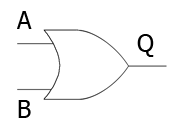

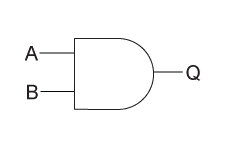
Which logic gate is this?
AND
OR
XOR
NOT
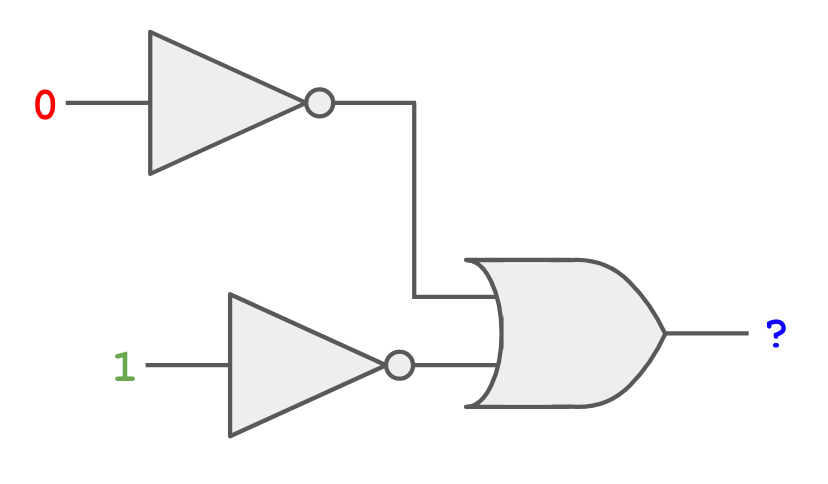
What will the circuit's output be?
1
0


Which Logic gate does this Truth Table represent?
AND Gate
OR Gate
NOT Gate
NAND Gate

Which logic gate is shown?
NOR Gate
XOR Gate
XNor Gate
AND Gate
NAND gate

Which logic gate is shown?
AND gate
OR gate
NOT gate
NOR gate

What gate is represented by the truth table shown?
NOR gate
NOT gate
AND gate
XOR gate
Convert the binary number 01011 into decimal
10
11
13
12
The NOR Gate is OR Gate followed by ...............
OR Gate
NOT Gate
AND Gate
None of the above
What is the meaning of 0 in a Digital signal?
Max possible value
No current/voltage
A light On
A light Off
Which are UNIVERSAL GATES?
AND gate and OR gate
NAND gate and NOR gate
XOR gate and XNOR gate
NOT gate
Which of the following statements is TRUE for an OR Gate:
A '1' at any of the inputs causes the output to be '1'
A '1' at any of the inputs causes the output to be '0'
A '0' at any of the inputs causes the output to be '0'
A '0' at any of the inputs causes the output to be '1'
Which is the correct order of sequence for representing inputs in K-map
(00,01,10,11)
(00,01,11,10)
(00,10,11,01)
(00,11,01,10)

For staircase wiring (one lamp controlled by two switches), which logic function can be used to realize the application?
AND Gate
OR Gate
XOR Gate
NOR Gate

The output of this combinational circuit is:
A+B+C
A(B+C)
B(C+A)
C(A+B)

In the figure shown, the output ܻ is required to be ܻ Y=AB+ C'D'. The gates G1 and G2 must be, respectively:
NOR, OR
NAND, OR
AND, NAND
NAND, NOR
The Boolean expression (X+Y) (X+Y')+(XY')'+(X')'simplifies to:
X
XY
X+Y
Y

The Boolean expression for the truth table shown (D is the output) is :
B(A+C) (A` +C`)
B(A+C`)(A`+C)
A subtractor subtracts the subtrahend from the minuend
True
False
A priority encoder is a sequential circuit
True
False
How many select lines does a 16:1 MUX require?
4
3
8
2
Can a decoder be used as a DMUX
Yes
No
In active low logic, logic 0 is considered as logic 1
True
False
Which flip flop is used for designing counters?
T Flip Flop
D Flip Flop
T Latch
D Latch
Which MATH function does an XOR gate perform
Addition
Multiplication
Which Logic gate does this Truth Table represent?
AND Gate
OR Gate
NOT Gate
NAND Gate
Which logic gate is shown?
NOR Gate
XOR Gate
XNor Gate
AND Gate
NAND gate

Which logic gate is shown?
NOR gate
NAND gate
OR gate
NOT gate
Which logic gate is shown?
AND gate
OR gate
NOT gate
NOR gate
What gate is represented by the truth table shown?
NOR gate
NOT gate
AND gate
XOR gate

Which logic gate is shown?
AND gate
XOR gate
OR gate
NOT gate

Which logic gate is represented by the truth table shown?
AND gate
Xor gate
XNOR gate
NAND gate

Which logic gate does the truth table shown represent?
OR gate
NAND gate
XNOR gate
XOR gate
1101 + 1001 = ?
11001
11001
101010
10110
Your partner has been working on your group’s circuit and has le the wo you begin working on the circuit, what should you do to ensure that the c and prevent yourself from getting a shock?
Disconnect the power source.
Measure the circuit with an ohmmeter for resistance.
Check the circuit with a continuity tester.
Use a voltmeter to measure voltage at the power source.
You used a tool and it inadvertently became damaged. What should be the next action for you to take?
Continue using the tool as long as it still somewhat works.
Label the tool that is broken and inform the instructor.
Throw the tool away.
Put the tool away and find another tool to use.
If you have not been given instruction on a tool or piece of equipment in the laboratory, you should:
Not use the tool until you have had proper instruction.
Use it anyway if you think you can figure it out.
Ask a classmate how to use it.
Have another classmate (who has also not had instruction) do it for you.
Which of the following is appropriate for working in an electronics workspace?
Wearing multiple rings on your fingers.
Wearing an oversized, baggy hoodie sweatshirt.
Clothing that is not loose and no jewelry.
Dragging your feet on the carpet and shocking your friends.
Chemicals can be used to etch circuit board. Which of the following should be done before using the chemicals in an electronic classroom?
Read all instructions that come with the chemical.
Read the Safety Data Sheet to prepare for emergencies.
Wear goggles and a lab coat to protect from potential spills.
All of the above.
What is the maximum current level that a human body can withstand before sustaining injury?
100 uA
1.0 mA
15 mA
50 mA
A large voltage is applied to a circuit and a fire is started on a circuit board in the lab. When you inform your instructor, which of the following should the instructor use to extinguish an electrical fire?
Water
Class A fire extinguisher
Class B fire extinguisher
Class C fire extinguisher
Before working with a chemical or solder, a student obtained a Safety DataSheet. Which of the following will the student find on this document?
What the chemical is made of.
The first aid procedure that you should follow.
How to handle the material.
All of the above.
Which of the following is the appropriate scenario for wearing safety glasses in anelectronics classroom?
Safety glasses or goggles should be worn to prevent eye injuries from chemicals that splash.
Safety glasses or goggles should be worn when using tools that may cause objects to be thrown.
Safety glasses or goggles should be used when soldering components.
All of the above.
Why should the students not rush? Why should students take their time when working in an electronics classroom?
Taking your time allows you to double check your connections and reduce the need for troubleshooting later.
Taking your time allows you to create your circuits more neatly. This allows you to pick up where you left off last time more easily.
Taking your time allows you to double check all part numbers and values. A common error.
All of the above.
What are the types of injury that are most common in an electronics classroom?
Electrical shock.
Minor burn from active electrical components or a soldering iron.
Puncture from a wire.
All of the above.
The electrical cord for a soldering iron has a grounding prong. However theextension cord you are trying to plug into only has only a place for 2 prongs(no grounding prong). What should you do in order to plug in the tool?
Wire grounding prong to the neutral prong on the soldering iron.
Use an appropriate adapter/extension cord.
Cut off the grounding pin.
All of the above.
When you enter the electronics classroom, you notice there is water on the floornear an electrical outlet. The roof appears to be leaking. Which of the following should be done first?
Immediately mop the floor.
Make sure no one enters and turn the power off to the classroom at the circuit breaker.
Disregard the problem as long as it is not near projects workspace.
Mop the floor with an insulated mop.
You notice that the cord of your soldering iron is frayed and possibly broken. What should be done next?
If the cord works, continue to use the soldering iron.
Label the broken section and notify the instructor.
Put the soldering iron back and pick one without a frayed cord.
Throw the soldering iron away.
A student obtained an injury in the electrical classroom. The accident should bebrought to the attention of the instructor so that:
The teacher can document the injury.
The teacher can administer first aid.
The teacher can make sure other students are not injured.
All of the above.
It is important to keep your workspace clean and organized in an electronicsclassroom. Which of the following is a not a valid reason for this practice?
This allows other classmates to easily locate materials when sharing the same workspace.
Minimizes potential for injuries.
These practices help maintain the equipment in the electronics classroom.
It gives students something to do.
Chemicals, materials, and processes in an electrical lab can be dangerous. Which of the following is not a potential hazard in typical electronics classrooms?
Burns from hot/active components or from the soldering iron.
Electrocution
Fumes from soldering.
Falling objects.
Certain devices in an electronics classroom such as capacitors can store a lethalamount of charge. When handling a capacitor you will want to ensure that thedevice is uncharged. How do you make certain a capacitor is discharged beforehandling?
Use the ammeter to read current.
Touch the leads with your finger.
Ask your instructor.
Use the ohmmeter to read resistance.
You are getting ready to power another student's electrical circuit in this class, but you are not sure of the voltage necessary to use. Students in this class should always use:
5V because all of the components we use are always TTL.
3.3V because all of the components we use are always CMOS.
9V because that is the battery lying next to the circuit.
Check with the other students who created it or the instructor. The design may require different voltage based on what it does and how it is designed.
Which of the following statements is good practice in an electronics classroom?
Always follow procedure.
Investigate before you act. Read and review all datasheets and service manuals.
When in doubt, ask your instructor.
All of the above.
A base-10 number system that uses the digits 0-9
decimal number
binary code
byte
OR gate
A base-2 number system that uses two digits, 0 and 1.
decimal number
binary code
XOR gate
ASCII
American Standard Code for Information Exchange. A 7-bit code for representing alphanumeric and control characters.
ASCII
binary code
digital number
byte
data represented as either yes/no or true/false
digital
decimal number
ASCII
binary code
an electronic system that performs a logical operation on an input signal
binary number
digital numbers
truth table
logic gate
a logic gate that changes its input logic level to the opposite state
inverter (NOT gate)
AND gate
OR gate
XOR gate
a logic circuit whose output is 1 when all inputs are 1
NOR gate
AND gate
NAND gate
XOR gate
a logic circuit whose output is 1 when at least one input is 1
XOR gate
NOR gate
OR gate
NOT gate
a logic circuit whose output is 0 when all inputs are 1
AND gate
OR gate
NOR gate
NAND gate
a logic circuit whose output is 0 when at least one output is 1
NOR gate
OR gate
XOR gate
NAND gate
a logic circuit whose output is 1 when one input is 1, but not both
OR gate
AND gate
XOR gate
NAND gate
a binary number 8 bits long
binary code
byte (bit)
digital
decimal number
a table listing all possible inputs to a circuit and the corresponding outputs
decimal numbers
digital
binary code
truth table
a device with multiple inputs and one output
gate
logic gate
binary code
digital
What is the decimal equivalent of the binary number 1010?
10
12
8
5
Which logic gate has an output of 1 only when all its inputs are 1?
NOT gate
OR gate
NAND gate
AND gate
Simplify the Boolean expression: (A + B) * (A + C)
A + A * C + B * A + B * C
A * A + A * C + B * A + B * C
(A + B) * (A + C)
A * C + B * A + B * C
What is the output of a half adder when the inputs are A = 1 and B = 0?
What is the purpose of a flip-flop in sequential circuits?
The purpose of a flip-flop in sequential circuits is to perform mathematical calculations.
The purpose of a flip-flop in sequential circuits is to amplify signals.
The purpose of a flip-flop in sequential circuits is to store and remember a single bit of information.
The purpose of a flip-flop in sequential circuits is to generate random numbers.
Convert the decimal number 25 to binary.
11001
10010
11111
10101
Which logic gate has an output of 0 only when all its inputs are 1?
NAND
AND
OR
XOR
Simplify the Boolean expression: (A + B) * (A + C) + (B * C)
A^2 + AB + AC + BC + B + C
(A + B + C)^2
A^2 + AB + AC + BC + B + C^2
A^2 + AB + AC + BC + B * C
What is the output of a full adder when the inputs are A = 1, B = 1, and Cin = 1?
1
0
3
2
What is the difference between combinational and sequential circuits?
Combinational circuits only depend on the current input, while sequential circuits depend on both the current and previous inputs.
Combinational circuits are used for digital signals, while sequential circuits are used for analog signals.
Combinational circuits and sequential circuits are the same thing.
Combinational circuits depend on the current and previous inputs, while sequential circuits only depend on the current input.
which of the following circuits can be used as parallel to serial converter?
Multiplexer
Demultiplexer
Digital counter
Decoder
which device has one input and many outputs
flip flop
multiplexer
demultiplexer
counter
A flip flop can store
1 bit
2 bits
4 bits
8 bits


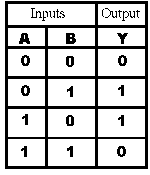
What is a Flip-Flop?
a 2 state device which offers basic memory for sequential logic operations, heavily used in banks called "registers"
a logic device used to invert a value
a storage device that works with non binary numbers
A "universal" basic memory device used in banks called registers
J-K Flip-Flop
D-Type Flip-Flop
S-R Flip-Flop
A collection of flip-flops used to move data(bits) within a register is a _______.
Shift Register
Bit Register
Flip Register

What type of Flip-Flop is pictured here?
J-K
D
S-R
Toggle
( A + B ) ( C + D )
is the same as
AC + BD
(A . B ) + ( C . D )
A + B + C + D
AC + AD + BC + BD
In a clocked SR latch the outputs of the latch change when:
Clock is 0
Clock is 1
Does not depend on clock
None of the above
A D latch can have both Q and Q BAR the same
True
False
A JK-FF has no Invalid State
True
False
Sequential logic is _______?
where the output is a function of only the present input.
a fundamental building block of digital electronics.
difficult to predict the output.
How many probes would I need to represent a 2-Bit counter?
2
6
1
4
This dependency is aided with a clock signal to _______ and ______ to retain previous outputs.
open gate and light switch
toggle and define
flip and flop
control sequencing and memory
The output values of sequential logic depend ______________.
when the switch is on.
The output values depend not only on the current input values, but also on previous output values.
on the amount of inputs.
the value of the resistor.
How many probes would I need to represent a 4-Bit counter?
2
6
1
4
If you added a fifth bit, what would you guess is the highest number
you could count to? (engineering notebook)
Counters are one of the most common applications of flip-flops. Now create a simple binary counter using two D flip-flops.
Dual D Flip-Flop
J/K Flip-Flop
The circuit that you will build is a two-bit binary counter. It will count from zero to three. What are these number values in binary?
Zero is represented as 00 and two represented as 02 and three is represented as 11.
Zero is represented as 00 and two represented as 01 and three is represented as 11.
Zero is represented as 00 and two represented as 01 and three is represented as 101.
Exit Ticket: The 2-Bit and 4-Bit counters you explored in this activity are referred to as “divide-by-two” counters. Explain the relationship between each consecutive flip-flop and the order in which they are laid out in the design from right to left that creates a binary count. (engineering notebook)


Capacitors
Resistors
Inductors
Batteries

Battery
Capacitor
Resistor
Inductor
What color should the top wire be?
White
Black
Red
Green
According to the progression of digital design tools slide;
Which is these is the earliest design tool?
Programmable Logic Devices
Microcomputers Microcontrollers
Integrated Chips
Transistors
Gates
How do I get the circuit to do what I want it to do?
Combinational Logic
Sequential Logic
How do I get the circuit to do what I want it to do, when I want it to happen?
Combinational Logic
Sequential Logic

