
 Worksheets
AP Chemistry Full Year Review
Total questions: 120
Worksheet time: 4hrs 17mins

If the specific heat of water is 4.18 J/g∙°C, how much heat is required to increase the temperature of 1.2 kg of water from 23 °C to 39 °C? (show your work)
-80,256 J
80.256 J
80,256 J
-80.256 J
Steel is an example of a/an _______________ alloy because carbon atoms move between the iron atoms’ crystal structure.
eutetic
interstitial
substitutional
vacancy

Pb + 2Ag+ → Pb+2 + 2Ag
The chemical species being reduced is
Ag
Pb
Pb+2
Ag+

why would O2 effuse faster than CO2 in the same room
because it has more energy
because it has a smaller molar mass
because oxygen has a higher temperature
they will effuse the same because the temperature is fixed
What is the average mass of this element?


Complete the sentence.
A substance that is more acidic has a _____ pH, and ____H+ than a substance that is basic.
lower, more
higher, less
the same
none of the above
(1) SO2(g) + 1/2O2(g) ↔ SO3(g)
(2) 2SO3(g) ↔ 2SO2(g) + O2(g)
HCl + KOH --> H2O + KCl
If a student uses 25.0 mL of a 0.5M solution of KOH, what is the molarity of the acid if 15.0mL of acid neutralized?
In which of the following aqueous solutions does the weak acid exhibit the highest percentage of ionization?
(Remember : 1. the stronger the acid, the greater is the percent ionization; 2. diluting the solution increases the percent ionization)
.01 M HC2H3O2 . (Ka 1.8 x 10 -5)
.01 M HNO2 . ( Ka =4.5 x 10 -4)
.01 M HClO . (Ka= 3.0 x 10 -8)
.01 M HF (Ka= 6.8 x 10 -4)

Based on the information given above, which of the following is the strongest acid?

Does a precipitate form when 0.050 L of 2.0x10⁻²M Pb(NO3)2 is mixed with 0.010 L of 1.0x10⁻²M Na2SO4? (PbSO4 has a Ksp = 3 x 10-28)
Yes Qsp = 2.84x10⁻⁵
No Qsp = 2.84x10⁻³⁵
Yes Qsp = 3.14x10⁻⁵
No Qsp = 3.14x10⁻³⁵
which element, if any, is oxidized?
2Ca(s) + O2(g) --> 2CaO(s), calcium is __________
What is the limiting reactant if 12 moles of P4 react with 15 moles of O2?
The reaction of 75.0g P4 with excess chlorine gas produces 110g PCl3 in lab. Find the theoretical yield and calculate percent yield for the reaction.

Yellow dye is separated from a mixture using a polar stationary phase (filter paper) and non-polar mobile phase (solvent). The yellow dye is:
polar
nonpolar
What formula do we use for dilution calculations?
M1V1=M2V2
D=m/V
V1=M2
Total Volume/Partial Volume
Losing electrons is ________________, gaining electrons is ________________
oxidation, reduction
reduction, oxidation
The ______ the acid, the ______ its conjugate base.
stronger, weaker
stronger, stronger
What coefficients balance this equation? ___Na + ___ZnI2 → ____NaI + ___Zn
1,2,1,2
2,1,2,1
2,2,2,1
1,1,2,1
The conjugate base of H2SO4 is ___.
H2SO3
HSO4-1
H3SO4+1
SO4-2
NH3 + H2O ↔ NH4+ + OH-
What is H2O in this reaction?
acid
base
conjugate acid
conjugate base
What type of bonding is found within a water molecule?
ionic bonding
polar covalent bonding
nonpolar covalent bonding
hydrogen bonding
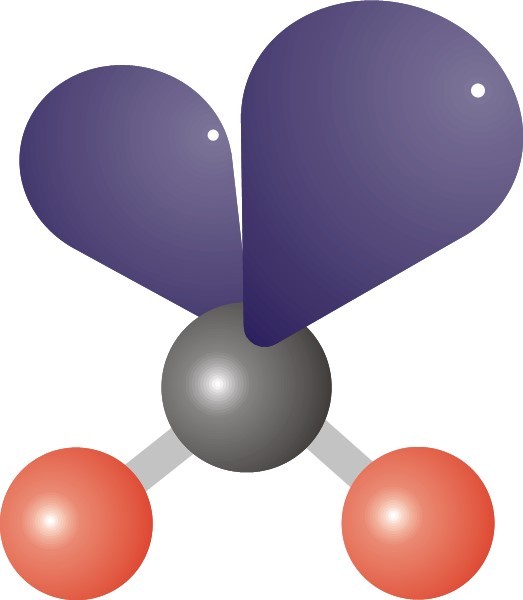
The Lewis structure of which compound is best represented with resonance structures?
MgCl2
CO2
SO3 2-
OCl2

The molecule shown above represents alanine, one of the simplest amino acids. This amino acid is considered nonessential to the human diet as it can be synthesized in the body from other compounds.
Which statement is correct concerning alanine?
Each carbon atom is sp3 hybridized.
The hybridization of the nitrogen atom is sp2.
All bond angles are approximately 109.50.
The molecule contains 12 sigma and 6 pi bonds.
Which bond is the most polar?
F-O
H-O
Na -O
Sn-O
Which of the following compounds would have the highest lattice energy?
LiF
MgCl2
CaBr2
C2H6

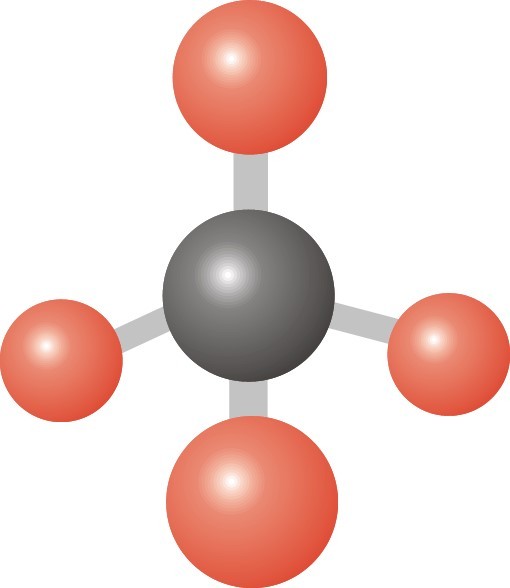
What is the molecular geometry in the structure A?
Tetrahedral
Trigonal Planar
Trigonal Pyramidal
Octahedral

Which structure is more likely to correspond with the actual Lewis diagram for the sulfate ion?
Structure A; single bonds are more stable than double bonds
Structure A; it has the most unshared pairs of electrons
Structure B; there are more possible resonance structures
Structure B; fewer atoms have formal charges
Which of the following typically has the lowest melting point?
Metals
Covalent network solids
Ionic compounds
Covalent molecules
Which of the following probably has the highest solubility in hexane, C6H14?
Metals
Polar covalent molecules
Ionic compounds
Nonpolar covalent molecules
Of the following molecules, which is the most polar?
CO
CO2
O2
HF
F2
Which of the following has the lowest melting point?
Zn
SiO2
CaCl2
C2H6
Which of the following is an assumption of the kinetic-molecular theory of gases?
Collisions between gas particles are inelastic.
Gases consist of closely spaced particles.
Gas particles move around in an orderly manner.
The temperature of a gas depends on the average kinetic energy of the gas particles.
1. Under which conditions does a real gas behave very much like an ideal gas?
high temperature and low pressure
high temperature and high pressure
low temperature and high pressure
low temperature and low pressure

What order is this graph?
Zero
First
Second
Third

What order is this graph?
Zero
First
Second
Third
If you quadruple the concentration and the rate quadruples, what order is this reaction?
zero
first
second
Which step of a reaction mechanism determines the rate?
the slow step
the fast step
the first step
the second step

What order is the half life of Carbon14?
Zero
First
Second
What is the unit for the rate constant (k) for 2nd order reactions?
s-1
M/s
M-1s-1
How does a catalyst speed up a reaction?
Adding more reactant
Providing a pathway that has a lower activation energy
Increasing the activation energy
Increasing binding energy
___________ are produced in one step and used up in a later step and __________________ are present and unchanged in the reactants and the products
intermediates, catalysts
catalysts, intermediates
If a “reaction profile” has a taller ‘hill’ (or activation energy) then the reaction is ____________________?
Faster
Slower
What are the 2 characteristics that an effective collision must have? SELECT TWO
Enough energy to overcome Ea
Molecules in the correct orientations
High enough temperature
Apporpriate intermediates present
What is the rate law for the reaction with this slow elementary step? A --> B + C
rate = k[A]2
rate = k[B]2
rate = k[A][B]
rate = k[A]
What is the rate law for the reaction with this slow elementary step? A + 2B --> D + C
rate = k[A]2
rate = k[A][B]2
rate = k[A][B]
rate = k[A]

Which curve represents the most particles in this Maxwell-Boltzmann curve (# of particles vs. speed)?
Black (peak on the left)
Red (peak in the middle)
Blue (peak on the right)
They all have the same number of particles

How are the exponents n and m determined?
step 2: O3 + O → 2 O2
The oxygen atom (O) is considered to be a(n)...

Mechanisms in which one elementary step is followed by another are very common.
step 1: A + B → Q
step 2: B + Q → C
net reaction: A + 2B → C
Which of the following is false?

The graph shown depicts the relationship between concentration and time. What is the slope of this line?
-k
-1/k
k
ln[A]o
In an exothermic reaction, the sign of ΔH is ____ and the reaction feels ______
(-), hot
(+), hot
(-), cold
(+), cold
Freezing is an _________________________ process
Endothermic
Exothermic
Breaking bonds is _________________. Forming bonds is ______________________
endothermic, exothermic
exothermic, endothermic
ΔHrxn = ΔH_________________ − ΔH_________________
products, reactants
reactants, products
According to Hess' Law, if you double the coefficients of a reaction, ΔH will ________________________
Stay the same
Double
Quadruple
Halve
According to Hess' Law, if you reverse a reaction, ΔH will ________________________
Change signs
Double
Be inversed
Halve
Exothermic
absorb energy
release energy
Endothermic
absorb energy
release energy
In a system, the energy lost by the reacting species must be ________________ the energy gained by the surrouding
greater than
less than
equal to
Using bond energies to solve for enthalpy,
ΔH = Bond broken - bonds formed
undefined = Bond formed- bonds broken
undefined = products - reactants
undefined = reactants- products
At equilibrium, rates of the forward and reverse reaction are...
The same
Not the same
At equilibrium, concentrations of reactants and products are
equal
constant

At what time does the system first reach equilibrium?
24s
40s
60s
80s
The equilibrium constant expression, Kc, given aA + bB ⇄ cC + dD, is...
Kc = [A]a[B]b[C]c[D]d
Kc = [C]c[D]d[A]a[B]b
Which substance(s) would not be included in a equilibrium constant expression?
NaCl(s)
NaCl(aq)
NaCl(l)
NaCl(g)
If a K value is greater than 1,
more products are present at equilibrium
more reactants are present at equilibrium
If K < Q, the reaction will proceed in the...
reverse direction to reach equilibrium
forward direction to reach equilibrium
To calculate the K of an overall reaction from individual reaction K values, the individual K values are
added
subtracted
multiplied
divided
When the coefficient of a reaction is multiplied by a factor x,
the K value is multipled by x
the K value is divided by x
the K value is raised to the power x
Given the following equilibrium equation,
A (g) + 2B (g) ⇄ AB2 (g) ΔH > 0, which of the following changes will increase the amount of AB2 in the vessel?
Decreasing the temperature
Increasing the concentration of A
Removing a small amount of B
Decreasing the pressure
Given the following equilibrium equation,
A (g) + 2B (g) ⇄ AB2 (g) ΔH < 0, which of the following changes will decrease the amount of AB2 in the vessel?
Increasing the temperature
Increasing the concentration of A
Increasing the pressure
Adding a catalyst
The following system at equilibrium is exothermic. If the temperature is increased...
A (g) + 2B (g) ⇄ AB2 (g)
[A] will increase the most
[B] will increase the most
[AB2] will increase the most
If a common ion is present, the solubility of a salt
is increased
is decreased
will remain the same
If pOH=4.5, pH=?. and is the solution acidic, basic, or neutral
9.5
Basic
11.2
Basic
6.25
Acidic
7
Neutral
If [H] = 1 x10^-7, pH= ?. Is the solution acidic, basic, or neutral
7
Neutral
2.3
Acidic
11.34
Basic
7.5
Basic
What two values are equal to the equivalence point of a titration
Moles of Acid and Moles of Base
Volume of Acid and Volume of Base
Moles and Volume of Acids Only
Moles and Volume of Base Only
A process which causes a decrease in entropy is
condensation of steam to form liquid water
vaporization of liquid water to form steam
dissociation of solid sodium chloride into aqueous sodium cations and chloride anions
sublimation of snow to water vapor
reaction is ALWAYS thermodynamically favorable
- H, - S
+ H, + S
+ H, - S
- H, + S
a reaction that is exothermic and has a decrease in entropy is
spontaneous at high temps
spontaneous at low temps
always spontaneous
never spontaneous
For which of these processes is the value of ΔS expected to be negative?
I. NaCl is dissolved in water.
II. Steam condenses to liquid water.
III. MgCO3 is decomposed into MgO and CO2 .
I only
I and III only
II only
II and III only

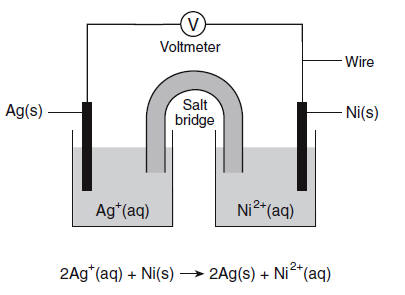
What is an anode?
It is the electrode where oxidation takes place.
It is the electrode where reduction takes place.
It is an aqueous solution containing an electrode.
It is the salt bridge that connects half-cells.
What does Ecell need to be for a galvanic cell (thermodynamically favored)?
+
-
If a reaction occurs, then delta G is
negative
positive
can't tell
0

