
Font size
 Worksheets
8th Grade LEAP 2025 Science Review
Total questions: 50
Worksheet time: 1hrs 18mins

How do folded mountains form?
They form when plate boundaries diverge.
They form on the continent side of convergent boundaries.
They form when plates collide or push against each other.
They can form several different ways.
Which two processes could result in the formation of high mountains with well-rounded peaks?
volcanic eruptions and global warming
earthquakes and tidal activity
movement of tectonic plates and erosion
production of greenhouse gases and weathering
Which of the following is the best clue that a chemical reaction has taken place?
Change in color
Change in state
Change in particle size
Change in volume

The students most likely have which type of rock? (a)

Which process describes only a physical change? (a)

If the pendulum was at X, what type of energy is at its maximum?
Kinetic
Mechanical
Potential
Thermal

All of these finches have different shaped beaks, they are an adaptation to gain access of
Water
Food
Shelter
Heat transfer by light is called...
Radiation
Conduction
Convection
Reflection
Which of these is a better conductor?


Heating will continue until what is reached?
Energizers
Equilibrium
Equality
Energy

Why are advantageous traits more likely to be passed onto offspring?
Because organisms with those traits are more likely to survive and reproduce.
Because they come from recessive alleles.
Because they come from dominant alleles.
Because the trait is an acquired (learned) phenotype.

The bird on the right is better adapted to get the worm. It will probably survive and reproduce. This is known as_____.
Atomic distribution
Natural Selection
Population
Natural selection is affected by ___ or traits that are different in members of the same species.
camouflage
ancestor
variations
evolution
What are fossils?
molds and casts of organisms that live today
footprints or burrows of small animals that live today
drawings of ancient animals and other organisms
the preserved remains or traces of organisms that lived in the past
A slight change in a rabbit's ability to hear its predators better and help it survive is
an adaptation.
an acquired trait.
a vestigial structure.
an isolation.
Why did the populations of peppered moths in England change from light to dark after the Industrial Revolution?
Light moths were easy to see against sooty trees and were eaten.
The birds that ate the dark moths were killed by soot.
Dark moths were produced by industrial processes.
Light moths were killed by soot.
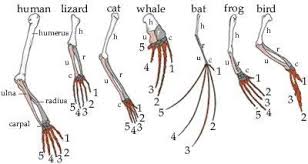


What are some common similarities that all embryos share? select ALL that apply
tails at some point of development
similar shape
eye spots that develop into eyes
all develop into mammals


Which of the following is a genetic factor that affects an organism's growth?
Temperature
Nutrition
Genes inherited from parents
Amount of sunlight
What is a phenotype?
The genetic makeup of an organism
The physical appearance of an organism resulting from its genetic makeup and environment
A type of gene
A type of protein
How can pollution affect the growth of organisms in an ecosystem?
By increasing their growth rate
By having no effect
By decreasing their growth rate or causing mutations
By improving their genetic makeup
Which of the following is a way that animals adapt to their environment through genetic changes?
Learning new behaviors
Changing coloration to blend in with their surroundings
Moving to a new location
Eating different types of food
How do mutations affect an organism's growth?
They always result in positive growth
They have no effect on growth
They can either hinder or enhance growth, depending on the mutation
They prevent growth entirely
Which of the following best describes how environmental factors and genetic makeup interact to determine the height of a human?
Environmental factors have no impact on height, which is determined solely by genetics.
Height is determined solely by environmental factors like diet and exercise.
Genetics set the potential for height, while environmental factors such as nutrition can influence whether this potential is reached.
Height is randomly determined and not influenced by genetics or environmental factors.


The biggest unit of time on the Geologic Time Scale is ___
(not one we have focused on)
an era
a period
an eon
an epoch

Of the following organisms, which was around (or has been around) for the shortest amount of time?
Dinosaurs
Mammals
Humans
Reptile

The geologic time scale is divided by major changes or events such as______.
mass extinctions
the extinction of one species
the development of one new species
a small temperature change
Aa, DD, Bb, yy are all examples of ---
genotypes.
phenotypes.
In a heterozygous genotype, the _____ allele takes over in the phenotype.
recessive
dominant
both

In the second generation of this pedigree, how many people are carriers of the trait? *Remember: a carrier does not have the disorder/disease, but can pass it on to his/her children.
1
2
3
5

