
 Worksheets
Review Quizizz - 1st 9-Weeks Science
Total questions: 50
Worksheet time: 2hrs 25mins


Density is...
the amount of mass in an object
the amount of space an object takes up
Mass per unit of volume (the amount of mass in a given space)
the weight of an object

50 mL of water was added to the graduated cylinder. After we drop in the object, the new water level goes up to 60 mL. What is the volume of the blocks? (Hint: new volume- old volume)
8 mL
10 mL
60 mL
5 mL
What is the mass of a 400.0 mL container filled with mercury, given the density of mercury is 13.6 g/mL?
5440.0 grams
400.0 grams
3400.0 grams
1360.0 grams
What is the density of a substance if 250.0 mL of it weighs 200.0 grams?
0.80 g/mL
1.25 g/mL
0.50 g/mL
2.00 g/mL
Calculate the volume of a piece of platinum that weighs 500.0 g, given the density of platinum is 21.45 g/cm³.
23.31 cm³
21.45 cm³
25.00 cm³
20.00 cm³
What is the volume of a sample of ethanol that weighs 394.5 grams? The density of ethanol is 0.789 g/mL.
500.0 mL
250.0 mL
394.5 mL
300.0 mL
If 50.0 mL of acetone weighs 39.5 g, calculate the density of acetone.
0.79 g/mL
0.50 g/mL
1.00 g/mL
0.95 g/mL
What is the mass of a gold bar that has a volume of 100.0 cm³, given that the density of gold is 19.32 g/cm³?
1932.0 g
2000.0 g
1500.0 g
1800.0 g
A solid aluminum sphere is dropped into a graduated cylinder filled with 30.00 mL of water. The water level rises to 33.25 mL after the sphere is fully submerged. Given the mass of the aluminum sphere is 81.0 g, calculate its density.
24.92 g/mL
3.00 g/mL
8.10 g/mL
5.40 g/mL
Put each state in order from particles closest together to particles farthest apart.
Solid
Liquid
Gas
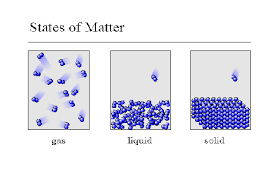
Which process could cause a material to change state from gas to liquid?
Adding heat
Adding energy
Removing particles
Removing energy
If I add heat to a solid, how will the motion of the particles be affected?
They will move slower
They will stop moving
They will move faster
They will move to a different container

Condensation
B
E
D
F
Evaporation or Vaporization
B
E
D
F

Freezing
F
C
A
D
Match the arrangement to the state of matter

Solid

Gas

Liquid

Match the State of Matter to the proper particle movement/ arrangement
solid
Vibrating in place
Compacted
liquid
A little spaced out and moving freely passed each other
gas
Spread apart and moving quickly

On which points on the graph is water increasing in temperature?
F and G
G and K
F, G, H, and K
F and H
Physical or chemical change? Dissolving sugar in water
physical
chemical

Physical or chemical change? Alka seltzer reacting with Bromothymol blue to make bubbles and a greenish blue color.
physical
chemical

Physical or chemical change? A firework exploding to create colors, heat, light, smoke, and ash.
physical
chemical

Jack leaves solid butter near a warm surface. When Jack returns, the butter has turned into a liquid. Jack's friend Elijah insists this is a chemical change. Is Elijah right?
no, because no new matter was formed
yes, because the matter changed states
no, because the butter didn’t have enough time to go through a chemical change
yes, because melted butter is a new type of matter
Josh decided to mix some vinegar with baking soda. He knew that a reaction occurred because he made careful observations. He noted that the mixture started to foam up and bubble, and it was white in color. How did Josh know that a chemical reaction occurred?
He was sure a reaction occurred because of
the color of the mixture
the smell of the vinegar
the volume of the mixture
the formation of a gas
Chemical change is
A change of matter from one form to another without turning into a new substance.
A change that occurs when one or more substances produce new substances with different properties.
The changes that happen to substances during a chemical change.
The temperature at which a solid becomes a liquid. The melting point of water is 0 °C.
Physical change is
A change of matter from one form to another without turning into a new substance.
A change that occurs when one or more substances produce new substances with different properties.
The changes that happen to substances during a chemical change.
The temperature at which a solid becomes a liquid. The melting point of water is 0 °C.
Which of the following is a sign of a chemical reaction?
Change in state of matter
Change in temperature
Dissolving of a substance
Change in volume
What is the term for the amount of space an object occupies?
Mass
Density
Volume
Weight
Which of the following processes is an example of a physical change?
Burning wood
Rusting iron
Boiling water
Cooking an egg

