
 Worksheets
Chemical Reactions and Equations T1 (O)
Total questions: 102
Worksheet time: 51mins
Chemical reactions is a process in which one or more substances react together to form new substances.
True
False
Breaking of the chemical bonds and formation of new chemical bonds is responsible for the occurrence of a chemical reaction.
True
False
The substances which take part in a chemical reaction are called as
Reactants
Products
Both Reactants and Products
None of the above
The substances which are formed in a chemical reaction are called
Reactants
Products
Which of the following is not a chemical reaction?
Digestion of food
Respiration
Dissolution of salt in water
None
A chemical equation is the shorthand notation of the chemical reaction in terms of symbol, formulae and the ratio of number of various reactants and products involved.
True
False
In balanced chemical equation number of atoms of each element on reactant side is not equal to that on product side.
True
False
Which of the following determines the occurrence of a chemical reaction?
Change in state
Change in colour
Change in temperature
All of the above
A balanced equation is a equation in which atoms of various elements on both sides
of a chemical equation are equal in accordance with the law of conservation of mass.
True
False
Which of the following is not a physical change?
Boiling of water to give water vapour
Melting of ice to give water
Dissolution of salt in water
Combustion of liquified petroleum gas (LPG)
Which one of the following processes involve chemical reactions?
Storing of oxygen gas under pressure in a gas cylinder
Liquification of air
Keeping petrol in a china dish in the open
Heating copper wire in presence of air at
high temperature
In which of the following chemical equations, the abbreviations represent the correct states of the reactants and products involved at reaction temperature ?
2H2(l) + O2(l) --> 2H2O(g)
2H2(g) + O2(l) --> 2H2O (l)
2H2(g) + O2(g) --> 2H2O(l)
2H2(g) + O2(g) --> 2H2O (g)
Which of the following reactions is an endothermic reaction?
Burning of coal
Decomposition of vegetable matter into compost
Process of respiration
Decomposition of calcium carbonate to form quick lime and carbon dioxide.
The following reaction is an example of a 4NH3(g) + 5O2(g) --> 4NO(g) + 6H2O(g)
(i) Displacement reaction (ii) Combination reaction (iii) Redox reaction (iv) Neutralisation reaction
(i) and (iv)
(ii) and (iii)
(i) and (iii)
(iii) and (iv)
Three beakers labelled as A,B and C each containing 25 mL of water were taken. A small amount of NaOH, anhydrous , and NaCl were added to the beakers A, B and C respectively. It was observed that there was an increase in the temperature of the solutions contained in beakers A and B, whereas in case of beaker C, the temperature of the solution falls. Which one of the following statement(s) is (are) correct?
(i) In beakers A and B, exothermic process has occurred. (ii) In beakers A and B, endothermic process has occurred. (iii) In beaker C, exothermic process has occurred. (iv) In beaker C, endothermic process has occurred.
(i) only
(ii) only
(i) and (iv)
(ii) and (iii)
A dilute ferrous sulphate solution was gradually added to the beaker containing acidified permanganate
solution. The light purple colour of the solution fades and finally disappears. Which of the following is the
correct explanation for the observation?
KMnO4 is an oxidising agent, it oxidises FeSO4
FeSO4 acts as an oxidising agent and oxidises KMnO4
The colour disappears due to dilution, no reaction is involved
KMnO4 is an unstable compound and decomposes in presence of FeSO4 to a colourless compound
In the following chemical reaction "zinc oxide reacts with carbon to produce zinc metal and carbon
monoxide." ZnO + C --> Zn + CO Which substance is getting oxidized ?
C
ZnO
CO
Zn
In the following chemical reaction "zinc oxide reacts with carbon to produce zinc metal and carbon
monoxide." ZnO + C --> Zn + CO Which substance is getting reduced ?
C
ZnO
CO
Zn
In the following chemical reaction "zinc oxide reacts with carbon to produce zinc metal and carbon
monoxide." ZnO + C --> Zn + CO What is the the type of reaction ?
Decomposition reaction
Combination Reaction
Redox reaction
None of the above
P,Q and R are 3 elements which undergo chemical reactions according to the following equations:
(i) P2O3 + 2Q --> Q2O3 + 2P (ii) 3RSO4 + 2Q --> Q2(SO4)3 + 3R (iii) 3RO + 2O --> P2O3 + 3R Which element is most reactive?
Q
P
R
P,Q and R are 3 elements which undergo chemical reactions according to the following equations:
(i) P2O3 + 2Q --> Q2O3 + 2P (ii) 3RSO4 + 2Q --> Q2(SO4)3 + 3R (iii) 3RO + 2O --> P2O3 + 3R Which element is least reactive?
Q
P
R
P,Q and R are 3 elements which undergo chemical reactions according to the following equations:
(i) P2O3 + 2Q --> Q2O3 + 2P (ii) 3RSO4 + 2Q --> Q2(SO4)3 + 3R (iii) 3RO + 2O --> P2O3 + 3R
The type of reactions is:
Displacement Reaction
Combustion Reaction
Neutralization Reaction
Substitution Reaction
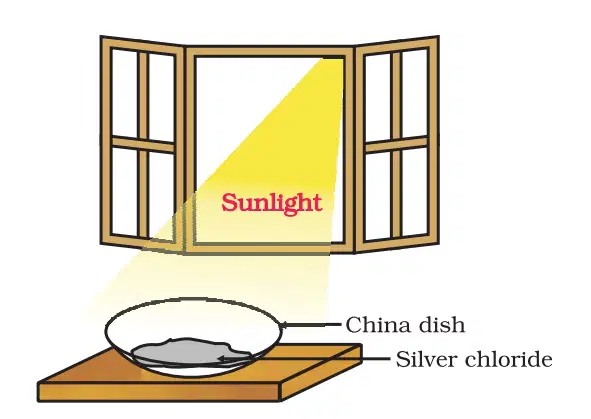
In the above image, the type of chemical reaction that will take place is
Photochemical Decomposition
Displacement Reaction
Reduction Reaction
Combination Reaction
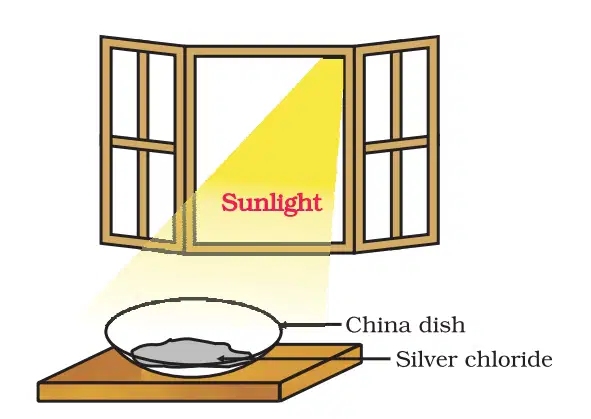
In the above image, what happens to the silver chloride?
White silver chloride changes to grey
White silver chloride changes to black
No change
White silver chloride changes to brown
State true or false: Silver chloride is used in black and white photography.
True
False
Assertion (A) : Carbon dioxide turns lime water milky
Reason (R) : Carbon dioxide sullies the water
Both assertion (A) and reason (R) are true
and reason (R) is the correct explanation of
assertion
Both assertion (A) and reason (R) are true
but reason (R) is not the correct
explanation of assertion (A)
Assertion (A) is true but reason (R) is false
Assertion (A) is false but reason (R) is true.
Assertion (A): A chemical reaction becomes faster at high temperatures.
Reason (R): At higher temperatures, molecular motion becomes more rapid.
Both assertion (A) and reason (R) are true
and reason (R) is the correct explanation of
assertion
Both assertion (A) and reason (R) are true
but reason (R) is not the correct
explanation of assertion (A)
Assertion (A) is true but reason (R) is false
Assertion (A) is false but reason (R) is true.
Which one is a chemical change- rusting of iron or melting of iron?
Rusting of iron
Melting of iron
Both of them
None of them
State true or false: A balanced equation is a equation in which atoms of various elements on both sides
of a chemical equation are equal in accordance with the law of conservation of mass.
True
False
Which of the following things happen when quick lime is added to water?
Slaked lime is formed
Large amount of heat is released
Both Slaked lime is formed and Large amount of heat is released
Grey precipitate is formed
N2 + 3H2 --> 2NH3, name the type of reaction
Photochemical Decomposition
Displacement Reaction
Reduction Reaction
Combination Reaction
State true or false: Silver articles get tarnished by reacting with atmospheric air to form silver sulphide.
True
False
Why do chips manufacturers usually flush bags of chips with gas such as nitrogen ?
To prevent the oil and fats of the chips
from being oxidized or becoming rancid
To prevent the oil and fats of the chips
from being reduced.
To increase the weight
None of the above
Write observations when lead nitrate is heated in a test tube.
It turns yellow due to formation of lead
oxide.
Reddish brown fumes evolve
Both It turns yellow due to formation of lead oxide and Reddish brown fumes evolve
None
Name the type of reaction when lead nitrate is heated in a test tube.
Thermal decomposition reaction
Displacement Reaction
3.2 g of ferrous sulphate crystals are heated in a dry boiling tube. List the observations.
Change in state
Change in colour
Evolution of gas.
All of the above
3.2 g of ferrous sulphate crystals are heated in a dry boiling tube. Name the type of chemical reaction taking place.
Decomposition Reaction
Displacement Reaction
Solution of a substance X is used for testing carbon dioxide. How is X obtained?
Obtained by reaction of calcium oxide and water
obtained by reaction of calcium oxide and
carbon
1.2 g of silver chloride is taken in a china dish and the china dish is placed in sunlight for sometime. What
will be your observation in this case ?
White silver chloride changes to grey
White silver chloride changes to black
White silver chloride remains white
White silver chloride changes to brown
Which type of chemical reaction is taking place when Zinc reacts with silver nitrate to produce zinc nitrate and silver?
Displacement Reaction
Combination Reaction
Neutralisation Reaction
Decomposition Reaction
Which type of chemical reaction is taking place when Potassium iodide reacts with lead nitrate to produce potassium nitrate and lead iodide?
Displacement Reaction
Double Displacement Reaction
Neutralisation Reaction
Decomposition Reaction
1.2 g of silver chloride is taken in a china dish and the china dish is placed in sunlight for sometime. Identity the type of chemical reaction.
Displacement Reaction
Combination Reaction
Neutralisation Reaction
Decomposition Reaction
On heating blue coloured powder of copper (II) nitrate in a boiling tube, black copper oxide, and a
brown gas X is formed. What type of chemical reaction is taking place?
Displacement Reaction
Double Displacement Reaction
Decomposition Reaction
Neutralisation Reaction
On heating blue coloured powder of copper (II) nitrate in a boiling tube, black copper oxide, and a
brown gas X is formed. Identify the gas X.
NO
N2O
N2O2
NO2
On heating blue coloured powder of copper (II) nitrate in a boiling tube, black copper oxide, and a
brown gas X is formed. What is the pH range of aqueous solution of the gas X ?
Less than 7
Equal to 7
More than 7
The reaction of sodium with dilute hydrochloric acid is very explosive due to which of the following reasons ?
Sodium is highly reactive
Hydrogen gas is released which catches
fire
Reaction is highly exothermic
All of the above
Some bubbles of a gas are seen when lead is reacted with dilute hydrochloric acid due to which of the following reason ?
Rate of reaction is slow
Lead lies above hydrogen in reactivity
series
Hydrogen gas is released
All of the above
Silver does not show any change during the reaction of silver metal with dilute hydrochloric acid due to
which of the following reasons?
Silver is placed below Hydrogen in
reactivity series
Silver does not react with dilute
Hydrochloric acid.
Silver is among least reactive metal.
All of the above
The temperature of the reaction mixture rises when aluminium is added to dilute hydrochloric acid due to
which of the following reasons?
Reaction is exothermic
Reaction is endothermic
None of the above
State true or false: In decomposition reaction a single compound is broken down into two or more simpler substances.
True
False
In the reaction MnO2 + 4HCl --> MnCl2 + 2H2O + Cl2. Which compound is getting oxidised?
HCl
MnO2
In the reaction MnO2 + 4HCl --> MnCl2 + 2H2O + Cl2. Which compound is getting reduced?
HCl
MnO2
In which of the following chemical reaction there is gain of oxygen atoms and loss of hydrogen atoms?
Reduction
Oxidation
None of the above
State true or false: In the reduction there is a loss of oxygen atoms and gain of hydrogen atoms.
True
False
Which of the following is the correct balanced equation for the chemical reaction Na + H2O --> NaOH + H2 ?
2Na + 2H2O --> 2NaOH + H2
2Na + 2H2O --> NaOH + H2
2Na + 2H2O --> 2NaOH + 2H2
2Na + H2O --> NaOH + H2
Is the chemical reaction, Na + H2O --> NaOH + H2 is exothermic reaction ?
Yes
No
The chemical reaction FeSO4 --> Fe2O3 + SO2 + SO3 is
Endothermic reaction
Exothermic Reaction
Name the term used to indicate the development of unpleasant smell and taste in fats and oils
containing food due to oxidation.
Corrosion
Rancidity
Acidity
Erosion
Anti-oxidants are the substances which prevents
Oxidation
Reduction
None of the above
Why are anti-oxidants added to fat and oil containing food?
To prevent food from oxidation
To prevent rancidity
All of the above
Which of the following metals do not corrode easily?
Gold
Platinum
Both Gold and Platinum
Silver
State true or false: Corrosion of aluminium is useful.
True
False
State true or false: Corrosion of iron is a serious problem.
True
False
A small amount of calcium oxide is taken in a beaker and water is slowly added to it. Will there be any
change in temperature of the content ? Explain.
Yes, temperature rises as the beaker gets
hot. This is because large amount of heat is
released or the reaction is exothermic.
No, temperature lowers as the beaker gets
cold. This is because large amount of heat
is not released or the reaction is
endothermic.
A small amount of calcium oxide is taken in a beaker and water is slowly added to it. Which type of
reaction is taking place?
Combination reaction
Decomposition reaction
Redox reaction
None of the above
State true or false: Chemical reactions is a process in which one or more substances react together to
form new substances.
True
False
Which of the following determines the occurrence of a chemical reaction?
Change in state
Change in colour
Change in temperature
All of the above
State true or false: Conversion of metals into their undesirable compounds (sulphides, carbonates,
oxides, etc) by interaction with atmospheric gases and moisture is called as corrosion.
True
False
What is corrosion of iron called?
Rusting
Rancidity
None of the above
Why corrosion of iron is a serious problem ?
It causes destruction to car bodies, bridges etc
It decreases lifetime of objects.
It causes economic loss
All of the above
Which of the following can prevent corrosion of iron?
Coating the metal surface with paint
Applying the film of grease and oil on the
metal surface
Covering metal surface of metal with
another metal which is more
electropositive
All of these
State true or false: Conversion of metals into their undesirable compounds (sulphides, carbonates,
oxides, etc) by interaction with atmospheric gases and moisture is called as corrosion.
True
False
What is corrosion of iron called?
Rusting
Rancidity
None of the above
What is the colour of coating formed on silver articles, when exposed to air?
Black
Green
Brown
Grey
What is the colour of coating formed on copper articles, when exposed to air?
Black
Green
Brown
Grey
Identify the type of reaction in digestion of food in our body.
Displacement Reaction
Oxidation Reaction
Double Displacement Reaction
Decomposition Reaction
Identify the type of reaction in rusting of iron
Displacement Reaction
Oxidation Reaction
Double Displacement Reaction
Decomposition Reaction
Identify the type of reaction in heating of manganese dioxide with aluminium powder.
Displacement Reaction
Oxidation Reaction
Double Displacement Reaction
Decomposition Reaction
Identify the type of reaction in blue colour of copper sulphate solution disappears when iron filings are added to it.
Displacement Reaction
Oxidation Reaction
Double displacement reaction
Decomposition Reaction
Identify the type of reaction when dilute hydrochloric acid is added to sodium hydroxide solution to form
sodium chloride and water.
Displacement Reaction
Oxidation Reaction
Double Displacement Reaction
Decomposition Reaction
Which of the following is the type of a chemical reaction?
Combination reaction
Decomposition reaction
Displacement reaction
All of the above
State true or false: In combination reaction two products are formed from two or more reactants.
True
False
State true or false: In decomposition reaction a single compound is broken down into two or more simpler substances.
True
False
State true or false: In displacement reaction one atom or a group of atoms of a compound is replaced by
another atom or group of atoms.
True
False
State true or false: In electric decomposition reaction a single compound is broken down into two or
more simpler substances upon passage of electric current.
True
False
In which of the following chemical reaction heat energy is absorbed?
Endothermic reaction
Exothermic Reaction
State true or false: In exothermic reactions heat energy is released along with the formation of products.
True
False
State true or false: In photo decomposition reaction a single compound is broken down into two or more
simpler substances in presence of bulb light
True
False
State true or false: In thermal decomposition reaction a single compound is broken down into two or
more simpler substances upon heating.
True
False
Which of the following cannot help in decomposition reaction?
Electricity
Water
Sunlight
Heat
How many types of decomposition reaction are there ?
1
2
3
4
On the basis of heat transfer there are how many types of chemical reactions?
1
2
3
4
In which of the following chemical reaction heat energy is absorbed?
Endothermic Reaction
Exothermic Reaction
Which of the following type of reaction produces an insoluble salt?
Redox reaction
Precipitation reaction
In which of the following chemical reaction there is gain of oxygen atoms and loss of hydrogen atoms?
Reduction
Oxidation
State true or false: In the reduction there is a loss of oxygen atoms and gain of hydrogen atoms.
True
False
Which of the following is the method to prevent rancidity?
Vacuum packaging
Adding antioxidants
Replacing air by nitrogen
All of the above
Oxidation of oils or fats in food resulting in bad taste and smell is known as ?
Corrosion
Rancidity
Acidity
Erosion
State true or false: Conversion of metals into their undesirable compounds (sulphides, carbonates,
oxides, etc) by interaction with atmospheric gases and moisture is called as corrosion.
True
False
Assertion (A) : Sodium metal is stored under kerosene.
Reason (R): Metallic sodium melts when exposed to air.
Both assertion (A) and reason (R) are true
and reason (R) is the correct explanation of
assertion
Both assertion (A) and reason (R) are true
but reason (R) is not the correct
explanation of assertion (A)
Assertion (A) is true but reason (R) is false.
Assertion (A) is false but reason (R) is true
Assertion (A) : To dilute sulphuric acid, acid is added to water and not water to acid.
Reason (R): Specific heat of water is quite large.
Both assertion (A) and reason (R) are true
and reason (R) is the correct explanation of
assertion
Both assertion (A) and reason (R) are true
but reason (R) is not the correct
explanation of assertion (A)
Assertion (A) is true but reason (R) is false
Assertion (A) is false but reason (R) is true
State true or false: When a decomposition reaction is carried out with the help of electric current, the
process is called electrolysis.
True
False

