
 Worksheets
Unit 6 Review
Total questions: 122
Worksheet time: 2hrs 2mins
The process of biological change in a population over time is called...
Evolution
Natural Selection
Creationism
Intelligent Design
Which type of evolution affects many populations?
Microevolution
Macroevolution
Gene Flow
Genetic Drift
What is taxonomy?
Classifying organisms based on their age
Classifying organisms based on their anatomy
Classifying organisms based on their size
Classifying organisms based on their diet
Natural Selection states that...
Genetic mutation is random
Organisms will change to adapt to their environment
The best adapted organisms will live longer and reproduce more than others
Organisms are naturally selected by God to reproduce
Survival of the Fittest states that...
Only the strongest organisms will survive
Only the fastest organisms will survive
Only the largest organisms will survive
Only the best adapted organisms will survive
Overproduction of offspring creates...
Competition
Gene Flow
Migration
Genetic Drift
Which of the following is NOT a source of genetic variation?
Random Mutation
Crossing-Over during Meiosis
Migration
Genetic Drift
The combined alleles of all individuals in a population are called its...
DNA
Gene Pool
Genome
Genetic Code
According to the principle of Descent with Modification, what happens to harmful traits, in a population, over time?
They become less common
They become more common
They increase allele frequency
They decrease genetic drift
Mutations...
Are always a bad thing
Cannot change a large population
Only occur in microevolution
Increase genetic variation within a population
Genetic Drift causes...
Increased genetic variation
Loss of genetic variation
Population growth
Population decline
Gene Flow...
Increases genetic variation
Decreases genetic variation
Increases population size
Decreases population size
Which of the following will NOT cause genetic equilibrium?
Population is small
Random mating
No migration
No mutation
Who's theory of evolution is most accepted today?
Charles Darwin
James Hutton
Thomas Malthus
Charles Lyell
An inherited trait that allows an organism to better survive in its environment.
variation
adaptation
population
mutation
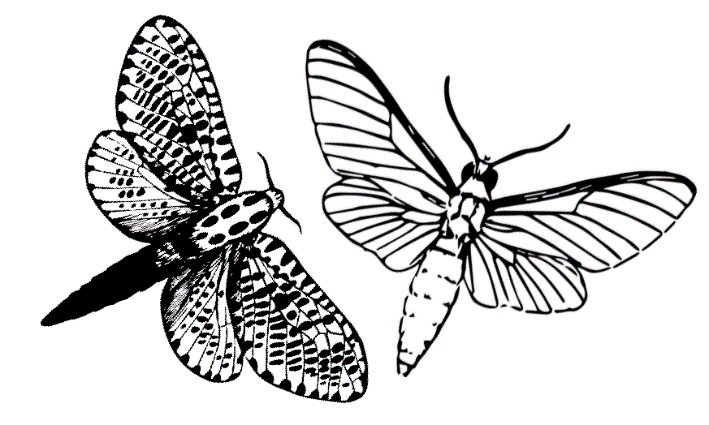
According to natural selection, light colored tree trunks would favor
light colored moths
dark colored moths
red colored moths
red and light colored moths
Some emus run fast (between 30-35 mph) and others run slower (between 20-25 mph). Dingos are the main predators of emus and at their absolute fastest can reach speeds of 30 mph. What modifications will the descendants (offspring) have over time?
They will run faster
They will run slower
They will have less babies
They will have more babies
In a population there are red bugs and green bugs. The birds prefer the taste of the red bugs. The green bugs end up surviving longer and reproducing more. Over time the red bugs go extinct. What adaptation did some bugs have that increased their chances of survival?
They were less visible
They were more visible
They tasted better
They tasted worse
Bob believes that giraffes have long necks because they stretched their necks to try and reach food high in trees. Since the parent stretched its neck, it passed the long neck to its offspring.
Ryan believes that giraffes have long necks because the ones with long necks were able to reach the food and those with short necks starved and died. The long neck giraffes were able to reproduce and soon all the giraffes had long necks.
Who's idea is closest to Darwin's theory of Natural Selection. Explain why.
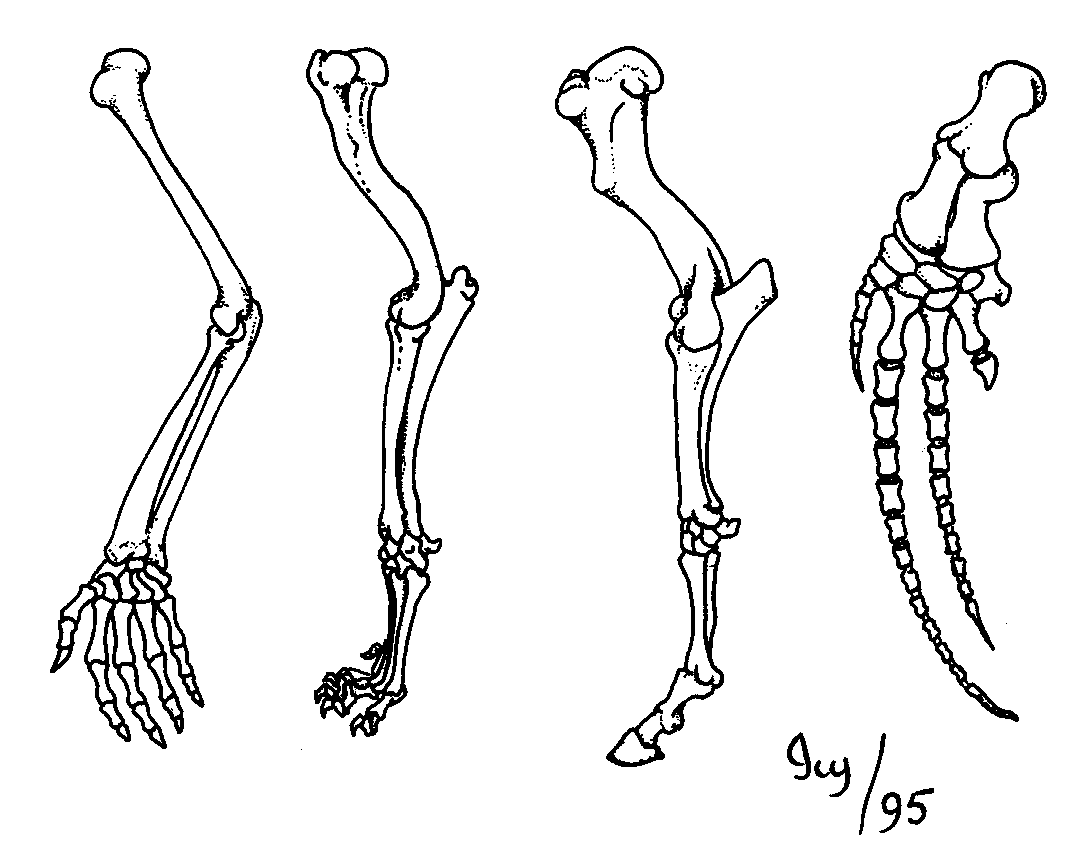


Which of the following can be determined by observing the embryos shown in the diagram

Vestigial structures
structures that perform a similar function but are not similar in origin
remnants of once-important structures that have slowly lost all or most of their function
features found in different organisms that share structural similarities but may have very different functions
preserved remains of an organism


The picture shows a/an ___________
homologous structure
vestigial structure
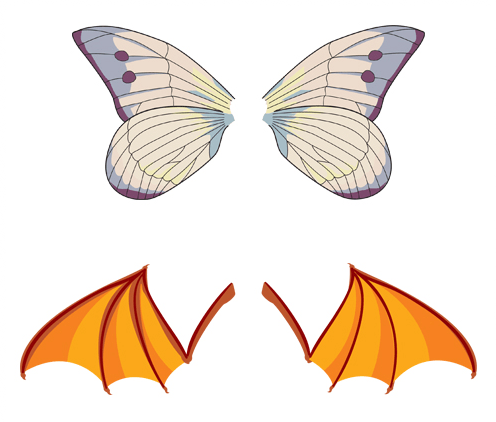
What is this an example of?
Homologous structure
Analogous structure
Vestigial organs
Functional adaption
Which of the following can be determined by observing the embryos shown in the diagram

What best describes the hind leg bones seen in the whale?
The bones are analogous structures to the fins of living fish.
The bones are vestigial structures that had a function in an ancestor.
The bones are homologous structures to the wings of butterflies.
The bones are fossil structures from an extinct ancestor.


Some organisms that share a common ancestor have features that have different functions, but similar structures. These are known as
vestigial structures
analogous structures
anatomical structures
embryology
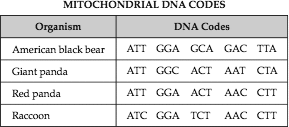
What conclusions can be made based on this table shown?
the American black bear and the giant panda are most closely related
the giant panda and the red panda are most closely related
the red panda and the racoon are the most closely related
the giant panda and the racoon are most closely related


Which scientist visited the Galapagos Islands and came up with the theory of natural selection?
Theodor Schwann
Gregor Mendel
Charles Darwin
Rudolf Virchow

Mutations are important because they bring about
death of the organism in which they develop
genetic variation needed for a population to evolve
benefits for the individual, not for the population
Hardey-Weinberg equilibrium within a population
The adaptations of wasps, flying fish, flying birds, and bats that allow them to fly are examples of:
punctuated evolution
convergent evolution
divergent evolution
gradual evolution

A bumble bee has just enough mass to pull down and open up the snapdragon flower to get to the nectar inside. Other insects cannot do this. This adaptation is an example of:
convergent evolution
co-evolution
divergent evolution
speciation
The rapid speciation of one ancestral species into many descendant species is called
Adaptive radiation
Punctuated equilibrium
Coevolution
Divergent evolution
Which best describes punctuated equilibrium?
Speciation occurs due to natural selection
Speciation occurs due to isolation
Speciation occurs slowly in geologic time, followed by long periods with very fast evolutionary change.
Speciation occurs suddenly and rapidly in geologic time, followed by long periods with little evolutionary change.
The large-scale events of speciation that happen over hundreds or thousands of generations are called...
macroevolution
simplification
adaptation
microevolution


Evolution occurring gradually and slowly over long periods of time
Homeostasis
Stasis
Punctuated Equilibrium
Gradualism
When two species evolve because of how they influence eath other, which usually results in a symbiotic relationship, this is called:
extinction
coevolution
symbiosis
mutualism
Select the best definition for Macroevolution.
Select all types of evolutionary patterns.
Extinction
Convergent and Divergent Evolution
Gradualism
Coevolution
Select the best description of the term Extinction.
Why do species go extinct?
Select the best definition for Divergent Evolution.
Darwin's finches are an example of:
Coevolution
Extinction
Divergent Evolution
Convergent Evolution
Select the best definition for Convergent Evolution.
Select the best definition for Coevolution.
Which of the following is an example of Coevolution?
Select the best definition of gradualism as it relates to evolution.
Select the best definition for Punctuated Equilibrium.
Ostriches are native to the Savannahs of Africa, while penguins live in the polar regions. Although penguins and ostriches are closed related, they look very different. This is an example of:
Divergent Evolution
Convergent Evolution
Coevolution
Punctuated Equillibrum
Ostriches (birds) and giraffes (mammals) are both native to the Savannahs of Africa. They share the same characteristic of a very long neck. This is an example of:
Divergent Evolution
Convergent Evolution
Coevolution
Punctuated Equillibrum
Horse evolution shows long stable periods of little evolution interrupted by brief periods of rapid change. This is an example of:
Divergent Evolution
Convergent Evolution
Coevolution
Punctuated Equilibrium
In the ocean surrounding Antarctica, there are fish that survive the cold water by using a molecule made of glycoproteins that circulates the blood and keeps it from freezing. Certain kinds of worms that live in the Arctic ocean also make antifreeze proteins that help them live in icy water.
convergent evolution
divergent evolution
coevolution
Ants are the correct size and weight needed to open the flowers for the peony plant. The peony plant provides food for the ant and the ant fertilizes the peony’s flowers
divergent evolution
convergent evolution
coevolution
The kit fox lives in the desert and has large ears with greater surface area that keep the fox from getting overheated. The red fox lives in the forest and has a red coat that keeps it camouflaged.
divergent evolution
convergent evolution
coevolution
Ostriches (birds) and giraffes (mammals) are both native to the savannahs of Africa. They eat food that is high off the ground and share the same characteristic of an elongated neck.
divergent evolution
convergent evolution
coevolution
The Galapagos finches evolved through natural selection from a common mainland ancestor into a wide variety of different looking species.
divergent evolution
convergent evolution
coevolution
A form of evolution where two species having a close ecological relationship evolve together such that one species adapts to changes in the other, thereby affecting each other's evolution.
divergent evolution
convergent evolution
coevolution
The extinct pterosaurs (reptile) of the Jurassic period and the modern albatross (bird) both evolved wings as well as a distinct long beak, but are not derived from a common ancestor.
divergent evolution
convergent evolution
coevolution
Evolution occurring gradually and slowly over long periods of time
Homeostasis
Stasis
Punctuated Equilibrium
Gradualism

Evolution occurring quickly due to catastrophic events
Homeostasis
Gradualism
Statsis
Punctuated Equilibrim

According to evolutionary theory, all living things have a common
Purpose
Function
Ancestor
Phone Number
Gradualism occurs when geologic and climatic conditions are _______________.
stable
unstable
long
short
Which form of evolution can occur quickly?
gradualism
punctuated equilibrium
allopatric speciation
sympatric speciation
Phylogeny is...
The study of classification of different species
The study of the evolutionary history of a species
The study of prehistoric life
The study of the distribution of different species
Phylogenetic trees show...
Evolutionary relationships between different species
How one species has evolved through time
Which species has evolved the most
Which species have evolved from other species

Based on the data given in the table, which two are most closely related?
Human & Gorilla
Gorilla & Orangutan
Human & Chimpanzee
Chimpanzee & Orangutan

Based on the figure, which organism is most closely related to the polar bear?
black bear
european brown bear
western north american brown bear
asian brown bear
Forming of a new species by evolution from pre-existing species.
Speciation
Extinction
Gradualism
Punctuated equilibrium
Elimination of a species.
Extinction
Gradualism
Coevolution
Adaptive radiation
A flash flood carried a raft of Amazon ants away from their original population. There is enough distance between the two groups, that they will never meet in nature again. What type of isolation is this?
Behavioral isolation
Temporal isolation
Geographic isolation
What is phylongeny?
the study of all phyla in the classification system
the evolutionary history of a species or taxonomic group
the study of plants
the study of animals

According to the diagram, what is the common ancestor of ALL organisms on the phylogenetic tree?
B
C
D
E

Using the diagram, is organism 4 MORE closely related to organism 3 or 5?
3
5

Which group on the cladogram arose FIRST?
Theropods
Allosaurus
Robin
Velociraptor

Do theropods have light bones?
yes
no

Does Allosaurus have light bones?
yes
no

What is the common ancestor of Letters C and E?
1
2
3
4

Who is most closely related to Taxidea taxus?
Lutra lutra
Panthera pardus
Canis latrans
Canis lupus


Which organism is the most distantly related to all the others?
Raccoon
Dog
Giant Panda
Sun Bear

Which of these animals does not have/produce an amniotic egg?
Turtle
Leopard
Lamprey
All three of these animals produce the amniotic egg

Which group of animals on this tree are most closely related to birds?
Saurischian dinosaurs
Ornithischian dinosaurs
Crocodiles
None of these are related to birds

If a plant has vascular tissue but no seeds, which of the four plant groups here would it fall into?
Ferns
Cone-bearing plants
Mosses
Flowering plants

Phylogeny is usually represented by a tree diagram called a _________ - _____
Genetic Line
Phylogenetic Tree
Photographic Queue
Future Babies

In a phylogenetic tree, the branching points represent common ancestors.
True
False
________________ is the evolutionary history of a group of related organisms.
Phylogeny
Cladistics
Ecology
Physiolgy

How many animals on this cladogram have lungs?
2
3
5
7
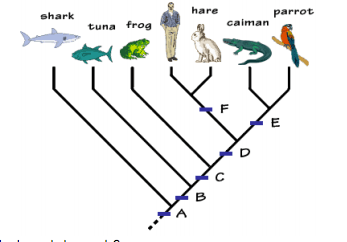
On the cladogram, which organism is the closest relative of the parrot?
Frog
Hare
Caiman
Parrot
This domain contains organisms that have a true nucleus in each of their cells. This domain breaks down into four kingdoms.
Protista
Archaea
Bacteria
Eukarya


