
 Worksheets
Work-Energy-Electricity Unit Review
Total questions: 62
Worksheet time: 2hrs 0mins
What is needed to calculate work?
time and distance
speed and distance
force and direction
acceleration and velocity

Is this an example of work?
Yes
No
What is the unit of measurement for work?
meters
newtons
m/s
Joules

Is this an example of work?
Yes
No!
500 J of work is done by a person who uses a force of 50N to move a box, how far does it go?
10 m
0.1 m
25,000 m
10 J
Newtons are the unit for _____________.
Work
Distance
Acceleration
Force
A push or a pull
Work
Force
Acceleration
Speed
For work to be done on an object, the direction and force have to be going the same direction.
True
False
Picking up a box is an example of____________
Work
Not Work
You exert 200 J of work by pulling on an object with 20 N of force. What distance is the object moved?
.01 m
10 m
10 J
4,000 m
Energy is
stored work
is destroyed when used
can not be changed into another form of energy
measured in newtons
_____________ is the rate of doing work.
Conservation of energy
Joules
Energy
Power
Power is measured in ___________.
meters
joules
newtons
watts
The law of Conservation of Energy says________
energy is constantly created
energy can not be created or destroyed instead it changes from one form to another
energy can not change forms
A 10 kg cat runs across the room with a speed of 5 m/s. How much kinetic energy does the cat have?
50 Joules
2 Joules
250 Joules
125 Joules
Which of the following has more kinetic energy?
A 1000 kg car moving at 10 m/s
A 4000 kg semi truck moving at 5 m/s
They have the same kinetic energy
A 2 kg book is sitting on a shelf 5 meters from the ground. How much gravitational potential energy does the book have? (To make things easier for now, use g = 10 m/s2)
2 Joules
10 Joules
50 Joules
100 Joules
Which has more gravitational potential energy?
A 0.25 kg apple sitting on a countertop 1 meters off the ground
A 1000 kg car sitting the driveway on the ground.
They have the same gravitational potential energy

A student is holding the end of a pendulum. The student releases the pendulum. What energy transfers are taking place?
potential energy is transferred to kinetic energy
chemical energy to thermal energy
mechanical energy to chemical energy
kinetic energy is tranferred to potential energy

The faster an object moves, the ________ kinetic energy it has.
more
less
Which of the following is stored energy that exists based on the position of an object?
chemical energy
thermal energy
kinetic energy
gravitational potential energy
Which energy transformation below occurs in a blow dryer?
electrical ----> thermal
electrical -----> chemical
chemical -----> thermal
thermal ------> electrical
Which is an example of potential energy?
A child is hopping down the sidewalk.
A horse is galloping in a field.
A person is sitting on a horse.
A car is driving on the street.



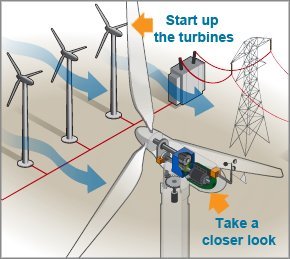
What is the energy conversion when a wind turbine turns to provide energy to a power grid?
electrical to potential
potential to kinetic
kinetic to electrical
nuclear to heat

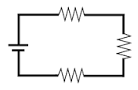
What are the three properties of an electric circuit?
Current, Voltage, Power
Current, Voltage, Resistance
Power, Voltage, Resistance
Current, Power, Resistance
What is the unit for voltage
Watts
Ohms
Volts
Amperes
What is the symbol for resistance
𝝮
A
V
W
What is the symbol for voltage
𝝮
A
V
W
What is the symbol for current
𝝮
A
V
W
What are facts about electricity
Flow of electrons
Provides heat
Provides sound
All of the above
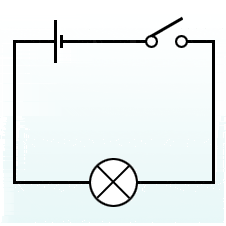


What is the equivalent or total resistance (Re) across this circuit?
3 kΩ
10 kΩ
13 kΩ
18 kΩ
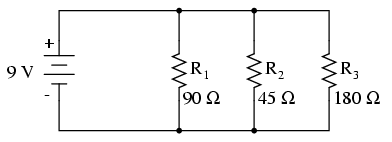
How do you calculate total resistance in a parallel circuit?
R1 + R2 + R3
R1 - R2 - R3
1/R1 +1/R2 + 1/R3 = 1/RT
R1 = R2 = R3

What is the equivalent resistance in this circuit?
3 Ω
5 Ω
8 Ω
9 Ω
How to you calculate the total resistance in a series circuit?
R1 + R2+ R3
R1 - R2 - R3
1/R1 + 1/R2 + 1/R3
R1 = R2 = R3

What is the equivalent resistance in the circuit?
2 Ω
3 Ω
6 Ω
9 Ω

What is the current though R 1?
1 A
2 A
4 A
6 A

