
 Worksheets
B24 13-24
Total questions: 115
Worksheet time: 2hrs 18mins

Students planned and conducted an investigation to identify factors that affect the growth of populations of bacteria. The students set up two test tubes with nutrients and placed the test tube at 37C. They placed two types of bacteria into test tube 2: bacteria A and bacteria C. The graphs summarize their data.
Which explanation is BEST supported by the data?
Bacteria A and Bacteria B compete for the same resources.
Bacteria A and Bacteria C have the same carrying capacity in this environment.
Bacteria B and Bacteria C require the same resources to survive.
Bacteria A and Bacteria C have a predator-prey relationship.
Snowy egrets are birds that breed in coastal and inland waterways. In the past, hunting the birds for their feathers greatly reduced the snowy egret population. Laws now protect egrets from hunting, and the population has recovered. Today, many wetlands are being drained and filled with rocks and soil so that humans can build on the land. What is the MOST LIKELY impact of the draining of these wetlands on the snowy egret population?
The snowy egret will be unaffected because it will adapt to living in dry envrionments.
The snowy egret's habitat will be reduced, and its population will decrease.
The snowy egret's habitat will not be affected, so its population size will remain stable.
The snowy egret will move to forests and its population will increase.

The diagram show relationships among a group of plants.
Based on this information, which pair of organisms would you expect to be most similar?
Liverworts and hortworts
Liverworts and mosses
Lycophytes and ferns
Lycophytes and mosses
Shifts in the timing of hibernation, as well as shortening of the length of hibernation periods, have been recorded in a variety of species in response to changes in climate. As global temperatures increase, many animals have been emerging from hibernation earlier than usual. Which explanation BEST predicts how this environmental change will affect hibernating animals?
The animals may emerge before they can find the food they need to survive.
The animals that emerge earlier will have more time to gather resources, so survival will increase.
The animals will probably find ways other than hibernation to conserve energy.
The animals will migrate rather than hibernate, to better meet their needs for resources.
In a population of bluebirds, females often choose to mate with males that have the most brightly colored feathers. Assuming that feather color is a genetic trait, which is the MOST LIKELY consequence of this behavior?
The number of male birds in the population will increase.
The number of birds that have brightly colored feathers will increase.
The number of male birds that leave the population will increase.
The number of birds that have new mutations for brightly colored feathers will increase.
Students planned and conducted an investigation to identify factors that affect the growth of populations of bacteria. The students set up two test tubes with nutrients and placed the test tube at 37C. They placed two types of bacteria into test tube 2: bacteria A and bacteria C. The graphs summarize their data.
Which explanation is BEST supported by the data?
Bacteria A and Bacteria B compete for the same resources.
Bacteria A and Bacteria C have the same carrying capacity in this environment.
Bacteria B and Bacteria C require the same resources to survive.
Bacteria A and Bacteria C have a predator-prey relationship.
Which of Mendel's laws could BEST be used to explain why a parent with the genotype AaBb can produce a gamete with the genotype aB?
law of dominance
law of independent assortment
law of segregation
law of variability
Snowy egrets are birds that breed in coastal and inland waterways. In the past, hunting the birds for their feathers greatly reduced the snowy egret population. Laws now protect egrets from hunting, and the population has recovered. Today, many wetlands are being drained and filled with rocks and soil so that humans can build on the land. What is the MOST LIKELY impact of the draining of these wetlands on the snowy egret population?
The snowy egret will be unaffected because it will adapt to living in dry envrionments.
The snowy egret's habitat will be reduced, and its population will decrease.
The snowy egret's habitat will not be affected, so its population size will remain stable.
The snowy egret will move to forests and its population will increase.

The Punnett square shows a cross in pea plants. G represents the allele for green pods, and g represents the allele for yellow pods.
Based on the Punnett square, which statement best explains the inheritance of pod color in pea plants?
The alleles for pod color are codominant.
The alleles for pod color show incomplete dominance.
The allele for green pods is dominant over the allele for yellow pods.
Many alleles control the pod color of pea plants.
The diagram show relationships among a group of plants.
Based on this information, which pair of organisms would you expect to be most similar?
Liverworts and hortworts
Liverworts and mosses
Lycophytes and ferns
Lycophytes and mosses
Shifts in the timing of hibernation, as well as shortening of the length of hibernation periods, have been recorded in a variety of species in response to changes in climate. As global temperatures increase, many animals have been emerging from hibernation earlier than usual. Which explanation BEST predicts how this environmental change will affect hibernating animals?
The animals may emerge before they can find the food they need to survive.
The animals that emerge earlier will have more time to gather resources, so survival will increase.
The animals will probably find ways other than hibernation to conserve energy.
The animals will migrate rather than hibernate, to better meet their needs for resources.
A student examined a food label and noticed that one serving of the food contained 4 grams of lipids and 4 grams of carbohydrates. Which argument could be supported by this evidence?
This food provides and equal amount of energy from lipids and carbohydrates.
This food provides an equal amount of proteins, lipids and carbohydrates.
This food provides more energy from lipids than from carbohydrates.
Each macromolecule of carbohydrates in this food bonds to a lipid macromolecule.
In a population of bluebirds, females often choose to mate with males that have the most brightly colored feathers. Assuming that feather color is a genetic trait, which is the MOST LIKELY consequence of this behavior?
The number of male birds in the population will increase.
The number of birds that have brightly colored feathers will increase.
The number of male birds that leave the population will increase.
The number of birds that have new mutations for brightly colored feathers will increase.
Which statement BEST describes the relationship between phosphates and energy in the ATP-ADP cycle?
Energy is released for cell processes when a phosphate is removed from ATP, while energy from glucose is used to attach a phosphate to ADP.
Energy is released for cell processes when a phosphate is removed from ADP, while energy from glucose is used to attach to phosphate to ATP.
Phosphates break the bonds between a nitrogenous base and ATP, while phosphates form bonds between a nitrogenous base and ADP.
Phosphates form bonds between a nitrogenous base and ATP.
Two populations of a plant species are separated after a period of volcanic activity. The environmental conditions for the separated populations are different. Which piece of evidence would BEST support a claim that speciation has occurred?
a comparison of average leaf length in each population.
genetic analysis that shows the populations cannot interbreed
data that show one population is better adapted to its environment
a graph that compares the number of individuals in each population.
Tropical rain forests have more biodiversity than any other ecosystem. Tropical rain forests also absorb large amounts of carbon dioxide from the atmosphere. Which would be the BEST way to protect these ecosystems?
Design barriers to prevent animals from leaving rain forest ecosystems.
Develop alternatives to fertilizers for use in agriculture near rain forests.
Design filters to keep greenhouse gases out of the atmosphere around rain forests.
Develop synthetic alternatives to rain forest products such as teak wood and rosewood.

The diagram models the development of antibiotic resistance in bacteria.
Which TWO statements BEST explain the role of natural selection in this process?
natural selection resulted in an unfavorable variation in a population.
Random variation provided some bacteria in the population with a favorable adaptation that spread through the population.
The bacteria developed variations that made them resistant to antibiotics because their survival depended on it.
Some bacteria are just naturally immune to all kinds of antibiotics.
A trait that gave some individuals in the population an advantage increased over time.
A student developed an explanation of how organelles interact to make the proteins needed to maintain homeostasis in a cell. In her explanation, she included descriptions of the organelles directly related to the process. Which organelle is MOST LIKELY to be included in her explanation?
lysosome
ribosome
mitochondria
chloroplast

This diagram shows the corresponding limbs of a whale and a bat. These homologous structures provide evidence about how whales and bats evolved.
Which statement about another pair of organisms is MOST similar to the evidence about whale and bat evolution?
Butterfly wings and bat wings both enable an animal to fly.
Carrots and sweet potatoes are both underground structures that store food for a plant.
Cats and horses are both animals that humans have domesticated.
The needles of pine trees and the spines of cacti are both structures that come from a common ancestor.

The diagram shows the DNA fingerprints of four bird species.
Based on this information, which two species are MOST closely related?
species 1 and 2
species 1 and 4
species 2 and 3
species 3 and 4
In a report explaining how the structures of DNA and RNA lead to the expression of information in a cell, a student included the following statement:
Each strand of the original DNA molecule becomes one strand in each of the new DNA molecules. Each of the other strands in the new DNA molecule is constructed from nucleotides.
In which section of the student's report does this statement belong?
the section describing how replication occurs
the section describing the process of transcription
the section describing the synthesizing of proteins
the section describing how translation occurs in cells

Biologists observed a small island ecosystem. They used their observations to construct the following food web.
Part A
Which food chain arranges components to this food web according to energy flow?
flowering plants --> herbivorous insects --> ferns --> toroises
mosses --> herbivorous insects --> toads --> owls
ferns --> tortoises --> toads --> hawks
owls --> toads --> herbivorous insects --> ferns

Biologists observed a small island ecosystem. They used their observations to construct the following food web.
Part B:
About how much energy from the mosses, ferns and other plants is available to the animals at the trophic level occupied by tortoises and herbivorous insects?
one half
one quarter
one tenth
one hundredth
Which statement describes a difference between a virus and a bacterium?
A bacterium divides to reproduce but a virus cannot replicate with out a host cell.
A virus contains cytoplasm, but a bacterium does not.
A virus contains proteins, but a bacterium does not.
A virus is much larger than a bacterium.

The diagram summarizes the carbon-oxygen cycle in an ecosystem.
Based on the information shown, which process is the source of the oxygen the rabbit takes into its body?
combustion
decomposition
photosynthesis
respiration

The diagram shows the four nucleotides that make up DNA, which is one type of nucleic acid.
What evidence supports the argument that nucleic acids can store genetic information?
Nucleotides are arranged in a sequence that can thought of as a code.
Genetic information can be stored in the bonds between the sugars and phosphate groups.
Each nucleotide alone stores information about a single cellular process.
The bonds between nitrogen bases and sugars are broken and re-formed as information is transmitted.
A student argued that in a particular environment, organisms that undergo sexual reproduction have a long-term advantage over organisms that undergo asexual reproduction. Which environment is the student most likely discussing?
An environment with a sparse population in which individuals have difficulty finding mates.
An environment that is undergoing change that will be continuing for many years.
A new environment where organisms that can colonize quickly have an advantage.
A stable environment with conditions that change very little over many years.

Two aquatic ecosystems at two different points in the same river were affected by a sudden change in water temperature. The graph shows how the number of species in each ecosystem changed in response to the change in water temperature, and during the months after the change.
Which statement BEST compares the responses of these ecosystems to the environmental change?
Ecosystem A recovered better due to higher biodiversity.
Ecosystem B had greater stability because it was less diverse.
Ecosystems A and B both returned to their original structure and function.
Ecosystem B was less affected by the change.
Which two characteristics support the argument that an organism should be classified as a bacterium?
Its cells lack nuclei
It has membrane-bound organelles.
it has peptidoglycan in its cell walls.
it has tissues and organs.
it is multicellular
Trisomy 22 is a genetic disorder in humans that results when chromosome 22 does not separate during meiosis in one parent. Some cases of trisomy 22 result from chromosome 22 not separating during meiosis I. In such cases, how many copies of chromosome 22 are found in each of the four gametes produced after meiosis II?
All four gametes have one copy of chromosome 22.
All four gametes have two copies of chromosome 22.
Two gametes each have one copy of chromosome 22 and two gametes each have two copies of chromosome 22.
Two gametes each have two copies of chromosome 22 and two gametes have no copies of chromosome 22.

The table summarizes the partial classification of four organisms.
Which argument is BEST supported by the information in the table?
Tigers and mountain lions have the greatest similarity in structure and function.
All four organisms are similar in that they have cells with cell walls.
These organisms all belong to the same species and domain.
Zebras share no similarities with the other organisms in the table.
Students are investigating cellular transport. In their investigation, an animal cell is placed in an isotonic solution. What is the MOST LIKELY description of what students will observe during their investigation?
Osmosis will continue, with water moving only into the cell.
Osmosis will continue, with water moving only out of the cell.
Osmosis will continue, with the same amount of water entering and leaving the cell.
Osmosis will stop, with the cell membrane becoming impermeable to water.

Apple flies and hawthorn flies are two varieties of the same species. Apple flies mate and lay eggs on apples, while hawthorn flies mate and lay eggs on hawthorn fruits. Scientists have found that the genes of the apple fly and the hawthorn fly are very similar. However, specific nerve cells enable each kind of fly to detect the odor of the fruit where they breed. The table shows the percent of each kind of fly that is attracted to the odors of apples and of hawthorn fruit.
Which statement BEST supports the prediction that these two varieties of fly will eventually become separate species?
In both varieties, about a fifth of the flies are attracted to both kinds of fruit and thus can mate with either variety.
In each variety, a small percentage of flies is attracted to the fruit that the other variety likes, and thus can mate with the other variety.
In both varieties, about a fifth of the flies are attracted to neither kind of fruit and thus have reduced opportunities to mate.
In each variety, the majority of flies are attracted to a specific fruit and therefore mate with flies that are also attracted to that fruit.

The top diagram shows the sister chromatids of homologous chromosomes from a woman who is heterozygous for two traits, hair color and eye color. The bottom diagram shows the chromosome that this woman passed to an offspring.
Based on the two diagrams, which statement is accurate?
The offspring is homozygous for hair color and eye color.
The offspring received a chromosome that is identical to one of the mother's chromosomes.
The offspring received a chromosome that differs from either of the mother's chromosomes.
The offspring received only one chromosome due to nondisjunction during meiosis.

The top diagram shows the sister chromatids of homologous chromosomes from a woman who is heterozygous for two traits, hair color and eye color. The bottom diagram shows the chromosome that this woman passed to an offspring.
Which argument do these two diagrams support?
Errors occurring during replication can result in genetic variation.
Crossing over during meiosis can result in genetic variation.
Substitution mutations can be caused by environmental factors.
Insertion mutations decrease the total number of chromosomes.
Tropical rain forests have more biodiversity than any other ecosystem. Tropical rain forests also absorb large amounts of carbon dioxide from the atmosphere. Which would be the BEST way to protect these ecosystems?
Design barriers to prevent animals from leaving rain forest ecosystems.
Develop alternatives to fertilizers for use in agriculture near rain forests.
Design filters to keep greenhouse gases out of the atmosphere around rain forests.
Develop synthetic alternatives to rain forest products such as teak wood and rosewood.
The diagram models the development of antibiotic resistance in bacteria.
Which TWO statements BEST explain the role of natural selection in this process?
natural selection resulted in an unfavorable variation in a population.
Random variation provided some bacteria in the population with a favorable adaptation that spread through the population.
The bacteria developed variations that made them resistant to antibiotics because their survival depended on it.
Some bacteria are just naturally immune to all kinds of antibiotics.
A trait that gave some individuals in the population an advantage increased over time.
This diagram shows the corresponding limbs of a whale and a bat. These homologous structures provide evidence about how whales and bats evolved.
Which statement about another pair of organisms is MOST similar to the evidence about whale and bat evolution?
Butterfly wings and bat wings both enable an animal to fly.
Carrots and sweet potatoes are both underground structures that store food for a plant.
Cats and horses are both animals that humans have domesticated.
The needles of pine trees and the spines of cacti are both structures that come from a common ancestor.
The diagram shows the DNA fingerprints of four bird species.
Based on this information, which two species are MOST closely related?
species 1 and 2
species 1 and 4
species 2 and 3
species 3 and 4
Biologists observed a small island ecosystem. They used their observations to construct the following food web.
Part A
Which food chain arranges components to this food web according to energy flow?
flowering plants --> herbivorous insects --> ferns --> toroises
mosses --> herbivorous insects --> toads --> owls
ferns --> tortoises --> toads --> hawks
owls --> toads --> herbivorous insects --> ferns

What is the greenhouse effect?
It is a phenomenon where the sun’s rays are absorbed by clouds.
It is a phenomenon that occurs when heat escapes into space.
It is when heat is trapped by gases, then sent back to earth’s surface.
It describes the atmosphere’s composition.

In an ecosystem, there are populations of moose, rabbits, grass, and pine trees. Suddenly, a fire blazes through the area, which kills all of the populations. As the months go on, new species of grass begin to take root. This attracts animals, and eventually the ecosystem is restored.
What type of ecological succession happened?
Primary succession
Secondary succession
Tertiary succession
None of the above
What would happen within a few months after the formation of a volcanic island?
pioneer species would grow
no pioneer species would grow
trees and large plants would grow
rich, organic soil would be present
Which is an example of where primary succession could occur?
a glacier melts and exposes new rocks
natural fire burns a prairie
a corn field is abandoned and left to overgrow
flood covers a piece of land


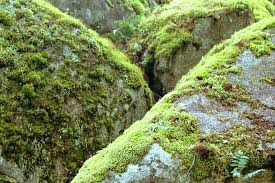
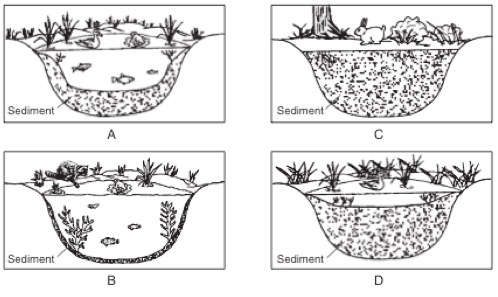
What is the correct order in this pond succession? (YOUNGEST to OLDEST)
A, B, C, D
D, C, B, A
B, A, D, C
C, D, A, B
Synthetic fertilizers contain both Nitrogen and Phosphorus. When these nutrients enter a water supply through runoff, what is most likely to happen?
the water becomes toxic
mutations in aquatic species
overgrowth of algae and decreased biodiversity
increased productivity and biodiversity
The phenomenon by which toxins concentrate in the organisms at higher trophic levels within an ecosystem is known as...
Biotoxicity
Biomagnification
Eutrophication
Predation
Consider the following food chain:
Algae > Mayfly > Minnow > Trout
In a polluted ecosystem, which organism would likely have the HIGHEST level of toxic chemicals in its body?
Algae
Mayfly
Minnow
Trout
The number of pythons found throughout Everglades National Park has increased in recent years. These huge snakes are not native to Florida and are believed to have been released into the wild by pet owners. Wildlife biologists have initiated attempts to capture and remove these pythons. Which statement best explains the biologists’ reason for removing these pythons from the Everglades?
The pythons could upset the territorial boundaries of native organisms.
The pythons could adapt to overcome diseases common to native snakes.
The pythons could prey on native organisms and cause native populations to decline.
The pythons could begin to interbreed with native snakes and produce a more successful species.
A new species of snake was introduced to a tropical region. Scientists then noticed a steady decline in the presence of field mice and an increase in the number of snakes. Which of these is the most likely explanation about why the population size of each animal changed?
The snakes introduced to the region dominated the habitat, forcing the mice to find another place to live.
The mice became prey to the introduced snakes, allowing the snake population to increase but decreasing the mice population.
The snakes introduced to the region competed with the mice for food, allowing the snake population to increase but decreasing the mice population.
The people in the surrounding area set traps that killed the mice, allowing the snakes to live without any predators and therefore to increase in number.
Why are fossil fuels considered non-renewable resources if they are still forming beneath the surface today?
They are being formed as a type of methane which we cannot use.
They are being formed too far beneath the surface.
We are depleting the fossil fuels much faster than they can form.

The diagram shows the embryos of a reptile and a mammal.
Which claim is BEST supported by evidence in the picture?
Mammals evolved directly from reptiles.
Mammals share many analogous structures with reptiles.
Reptiles and mammals descended from a shared ancestor.
Reptiles and mammals develop differently from one another.
When 2 species can no longer to interbreed, this leads to the creation of new species. This is called....
variation
convergent evolution
speciation
isolation

Scientists gathered data about two populations of animals that are found in the same ecosystem.
Which explanation is BEST supported by the data?
The two populations have similar sets of limiting factors.
Species A is a keystone species in this ecosystem.
The resource availability in this ecosystem is consistent year round.
Species B has a higher carrying capacity in this ecosystem than Species A.

The diagram shows relationships among some groups of animals. The dark-shaded triangles indicate extinct organisms.
Based on the information in the diagram, which pairs of organisms share the LEAST characteristics?
frogs and humans
humans and whales
trout and bird
sharks and whales

The diagram models available energy in a meadow ecosystem.
In a square kilometer of the meadow ecosystem, mice obtain 125,000 kcal of grasses per year. About how much energy is available to hawks per square kilometer?
125 kcal
1250 kcal
12,500 kcal
125,000 kcal

The diagram summarizes the nitrogen cycle.
Based on the information shown, what happens to the nitrogen in a rabbit's body when it dies?
The nitrogen is broken down and destroyed.
The nitrogen is trapped and removed from the cycle.
The nitrogen is converted into a usable form through nitrogen fixation.
The nitrogen is broken down and returned to the cycle through denitrification.
If evolution happens in “quick” jumps or burst, we’d expect to see big changes happen quickly in the fossil record, with little transition between ancestor and descendant. This is_______
gradualism
punctuated equilibrium
adaptive radiation
variation

What process is shown in the image?
convergent evolution
divergent evoution
coevolution
adaptive radiation
What process is shown in the image?
convergent evolution
divergent evoution
coevolution
adaptive radiation

What type of evolution is show in the image?
adaptive radiation
convergent evolution
divergent evolution
coevolution
When collecting DNA at the crime scene, the amount of DNA collected are often in small quantities.
Therefore, forensic investigator needs to make more copies of these DNA before testing. What is this practice?
Cloning
Gel Electrophoresis
Polymerase Chain Reaction (PCR)
DNA Fingerprinting
B25 13
Why did scientists edit the genes of bacteria to produce insulin?
Because the bacteria were diabetic
Because bacteria have simple DNA that is easier to manipulate, making it easy to produce insulin in a lab
Because bacteria's complex DNA was perfect for insulin production
Because insulin has no use outside of a lab setting
Darwin observed many finch species on the Galapagos Islands. To explain these observations, he
proposed that each species evolved from the same common ancestor, which was a finch species
that migrated to the islands from the mainland. Due to that isolation, many niches/habitats became available for these finches. What is being described?
Convergent Evolution
Coevolution
Adaptive Radiation
This is.....
A population of rabbits grows rapidly from one year to the next. Then one year, a disease strikes approximately one fourth of the adult rabbits. The disease remains with the population in the years that follow.
As explained by Darwin’s theory, which of these conditions allows the rabbit population to evolve by natural selection?
The disease affects adult and juvenile rabbits equally.
The disease reduces the ability of the rabbits to reproduce.
Some rabbits are resistant to the disease, and they pass the resistance to their offspring.
No rabbits are resistant to the disease, and all die when the disease strikes them.
The desert is a dry, extreme biome. Which adaptation would allow a plant to survive?
Long, deep roots to gather water.
Flowers that open all the time to conserve water.
Broad leaves to capture more sunlight for photosynthesis.
Loss of leaves in the fall to converse energy.
A student has researched an organism and made a list of its characteristics.
eukayrotic
multicellular
autotrophic
cell walls made of cellulose
Which kingdom does this organism belong to?
bacteria
archaea
fungi
plants
At one time scientists placed the hippopotamus in the same classification group as pigs based on similarities in pig and hippo teeth. Later, scientists discovered a fossil of a hippo limbs and a modern whale flippers. They noticed the similarites in bone structures between these two organsisms. Discovering these fossils allow scientists to re-classify the hippopotamus.
Which type of evidence would support the outcome described?
similarities in the DNA sequences of pigs and hippos
homologous structures in hippo limbs and whale flippers
evidence that analogous structures exist between whale flippers and hippo limbs.
evidence that hippos and modern whale develop differently as embryos
In a stable meadow ecosystem, the size of a plant population has increased sharply due to a seasonal increase in rainfall. What is the BEST prediction of how the plant population will continue to change.
Supplies of another resource will limit the growth of the population, causing it to stabilize or leveling off.
The size of the plant population will continue to increase indefinitely.
The plant population will remain at its current size indefinitely.
After the increase, the plants will use up the resources they need and they population will die out.
The environment around Manchester, England, changed during the Industrial Revolution. How did this change affect peppered moths living in the area?
Natural selection favored moths with dark wings because predators could not see them on the soot-colored trees.
Natural selection caused moths with white wings to mutate to have black wings in order to avoid predators
Natural selection favored moths with white wings because predators could not see them on the soot-colored trees.
Natural selection caused moths with white wings to become extinct.

When investigating shell color of a species of snail found only in a remote area seldom visited by humans, scientists discovered the distribution of individuals that is shown in the graph in Figure 11.1. Based on the information shown in the graph, what form of selection is the snail population undergoing?
stabilizing selection
disruptive selection
artificial selection
directional selection
Which combination of characteristics in a population would provide the greatest potential for evolutionary chage?
small populations, few mutations
small populations, many mutations
large populations, few mutations
large populations, many mutations,

Which are causes of speciation? Choose all that apply
Isolation caused by mountains, rivers and man-made structures
preference for different foods
different mating behaviors

The hypothesis that evolution of a species occurs in periods of rapid change separated by periods of little or no change is called
divergence
gradualism
punctuated equilibrium
isolation

Which option would correctly match the diagram to the term?
A= convergent evolution
B = divergent evolution
C = co-evolution
A= divergent evolution
B = convergent evolution
C = co-evolution
A= co-evolution
B = divergent evolution
C = convergent evolution
A= convergent evolution
B =co-evolution
C = divergent evolution

Which characteristics would a taxonomist use to classify organisms as Archaebacteria or as Eubacteria?


small prokaryotic cells were ingested by larger eukaryotic cells
small eukaryotic cells were ingested by larger prokaryotic cells
small prokaryotic cells became large eukaryotic cells
small eukaryotic cells became large prokaryotic cells.
____________ & _________________ are organelles that definitely arose from endosymbiosis.
Nucleus and cell membrane
Chloroplast and mitochondria
Mitochondria and nucleus
Cell wall and chloroplast
Which of the following is evidence to support the endosymbiotic theory?
Mitochondria and chloroplasts have their own DNA, which is similar to prokaryotic DNA.
Fossil evidence shows that the first forms of life were prokaryotic cells.
All eukaryotic cells have a double-layered membran composed of phosplipids and proteins.
Prokaryotes have the same number and types of enzymes as eukaryotes.
Energy flows in one direction and nutrients recycle.
True
False
Green plants and algae make their own food through photosynthesis. What is photosynthesis?
a cell process that uses energy from sunlight to convert water and oxygen into food
a cell process that uses energy from sunlight to convert water and glucose into food
a cell process that uses energy from sunlight to convert water and chlorophyll into food
a cell process that uses energy from sunlight to convert water and carbon dioxide into food
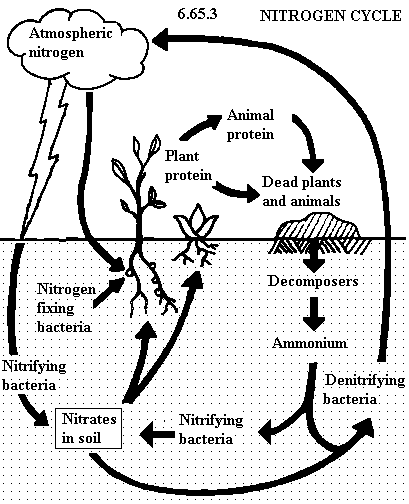
_______________________ converts nitrogen into a form that plants can absorb.
Denitrifying bacteria
Nitrogen fixing bacteria
Decomposers
How do animals obtain nitrogen stored in plants?
Denitrifying bacteria
Nitrogen fixing bacteria
Directly from the atmosphere
They eat the plants
How do humans affect the carbon cycle?
by burning fossil fuels that increases CO2 levels in the atmosphere
mining of fossil fuels that deform the landforms and increases CO2 level
planting the same crop (monoculture) that dried up the soil that increases CO2 level in the atmosphere
by clearing forests (deforestation) that increases CO2 levels in the atmosphere


A group of elephants gets stuck in mud at the edge of the river from a recent mud slide. A lion waits for an elephant to get tired before it attacks. What is the limiting factor to the elephant population?
Density dependent: Predator-Prey Relationships
Density independent: Natural Disaster
Density dependent: Herbivory Effect
Density independent: Competition

The wolf goes extinct, and the deer population has no predator to worry about. They graze the land. Because there is no more food. Some of the deer begin to bite at each other, while others die of starvation. What is the limiting factor to the deer population?
Density dependent: Competition and overcrowding
Density dependent: weather
Density dependent: Predator-Prey Relationships
Density dependent: Herbivory Effect

