
NEW
Font size
 Worksheets
6 Energy Summary
Total questions: 50
Worksheet time: 44mins
If a person weighing 645 N climbs up a ladder to a height of 4.55 m, then what is the increase in gravitational potential energy?
2,935 J
645 J
45 J
28,790 J
If a monkey of mass 8 kg climbs up a tree and the tree is 10 meters high, then the potential energy of the monkey at the top of the tree will be 784 J.
TRUE
FALSE
A stretched rubber band has potential energy.
TRUE
FALSE
If Sara has a mass of 60 kg and lives on the fifth floor of her apartment 18 m above the ground, then what is her gravitational potential energy?
177 J
589 J
10595 J
1000 J
The ability to move an electric charge from one point to another is
electrical kinetic energy
potential energy
electric potential energy
kinetic energy
What is the unit of measurement for potential energy?
Watts
Joules
Newtons
Meters
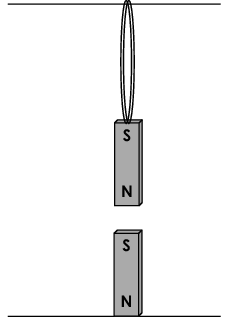
The upper magnet is hung from the top of a box with a rubber band.
The bottom magnet is held in place at the bottom of a box.
What THREE potential energies are affecting this attraction in the picture?
Gravitational, Electrical, Chemical
Gravitational, Elastic, Chemical
Magnetic, Elastic, Chemical
Gravitational, Magnetic, Elastic
True / False: The heavier an object is, the more potential energy the object has.
True
False
Which object has elastic potential energy?
a hanging leaf
a burning coal
a rolling ball
a stretched bow
Explain what happens to the potential energy of a rock as it falls off the side of a cliff.
The kinetic energy decreases as the potential energy increases.
The kinetic energy decreases as the potential energy increases.
The potential energy decreases as the kinetic energy increases.
The potential energy decreases as the kinetic energy decreases.
If a 1800 kg car starts at rest and speeds up to 5.0 m/s, then the work done is 22,500 J. Is this statement true or false?
TRUE
FALSE
Not enough information
Irrelevant to kinetic energy
If a 2000 kg roller coaster is rolling down a track with an instantaneous speed of 10 m/s, what is its kinetic energy?
100000 J
20000 J
50000 J
150000 J
What is the amount of work required for a 60 kg runner to accelerate from rest to a velocity of 2 m/s?
240 J
0 J
120 J
60 J
If a firefighter dropped a person onto the safety net, and right before the person hit the net they had a velocity of 12 m/s and 1800 J of kinetic energy, then what was the mass of the person?
25 kg
2.5 kg
250 kg
2500 kg
If a 2.0 kg ball rolls down a hill and its kinetic energy is 25 J at the bottom of the hill, then what must the ball's velocity be at the bottom of the hill?
5 m/s
12.5 m/s
25 m/s
50 m/s
The faster an object moves, the _______________ kinetic energy it must carry.
more
less
constant
varying
Which of the following is an example of kinetic energy?
A compressed spring
A car moving down a road
A book on a shelf
Water stored behind a dam
Kinetic Energy is the energy of _________
thermal
movement
potential
atoms
The metric unit for kinetic energy.
Joule
Newton
Kilogram
Watt
What is the equation for calculating kinetic energy?
21mv2
FΔx
vm
mgh
What is the equation for calculating gravitational potential energy?
21mv2
FΔx
vm
mgh
What is energy?
The force to move an object
The motion of an object
The ability to do work
Magic rays of sunshine that come down when you're feeling blue

A ball is tossed from rest, at point W. Where would this ball have the greatest amount of kinetic energy?
point W
point X
point y
point z
The Law of Conservation of Energy states that the total energy of a system is always conserved. Is this statement:
TRUE
FALSE
A 0.5 kg ball is at the top of a ramp which is 8 meters high. How much kinetic energy does the ball have at the bottom of the ramp?
40 J
4 J
10 J
400 J
If an object is dropped from a certain height, does the total energy of that object keep decreasing until it becomes zero once it strikes the ground?
TRUE
FALSE
If the velocity of an airplane is doubled, then its kinetic energy will increase by a factor of ____.
8
It will remain the same
4
2

What energy transformations are occurring in this picture?
gravitational potential --> sound --> thermal
chemical potential --> mechanical --> elastic potential --> gravitational
electrical --> sound --> thermal --> radiant
chemical potential --> radiant --> thermal
The sum of kinetic and potential energy in an object that is used to do work.
Elastic Energy
Sound Energy
Magnetic Energy
Mechanical Energy

Photosynthesis goes through two energy transformations. What are the transformations?
radiant
chemical
chemical
radiant
electrical
nuclear
radiant
sound

What energy transformation occurs in the chameleon as it quickly launches its tongue to catch an insect?
Radiant --> Chemical
Thermal --> Chemical
Chemical --> Mechanical
Mechanical --> Chemical

The dotted line on the chart shows the energy of the Skater, where could she be on the track?
A
B
C
D
E
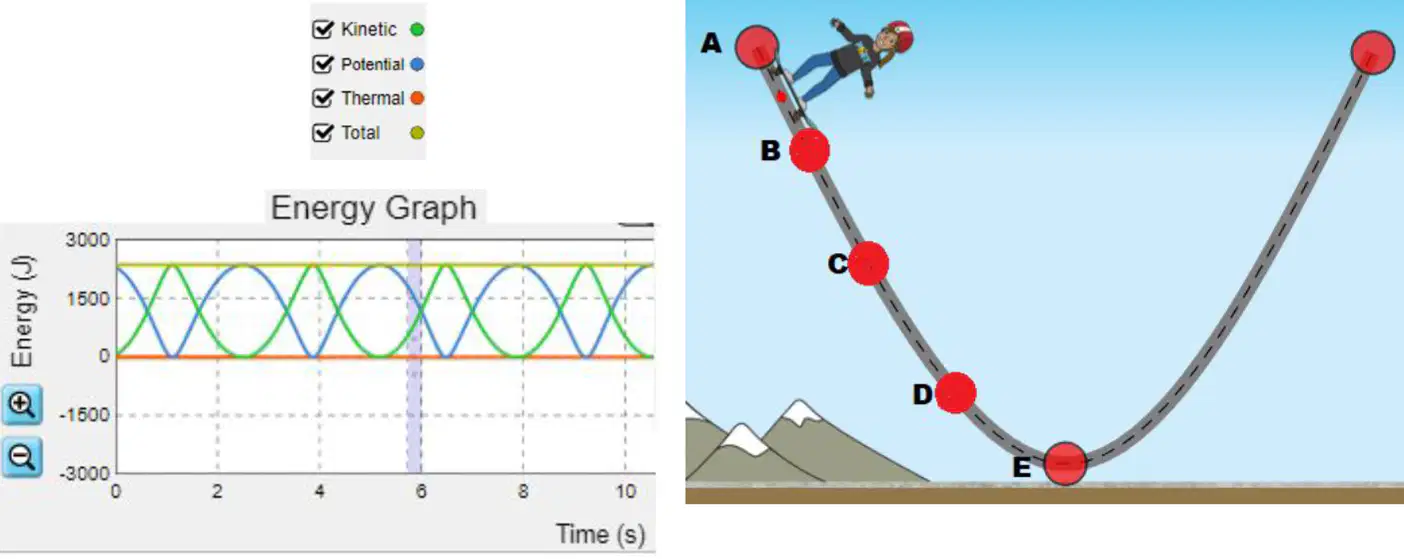
At which point on the track is the skater's potential energy likely at its maximum according to the energy graph?
Point A
Point B
Point C
Point D
Point E
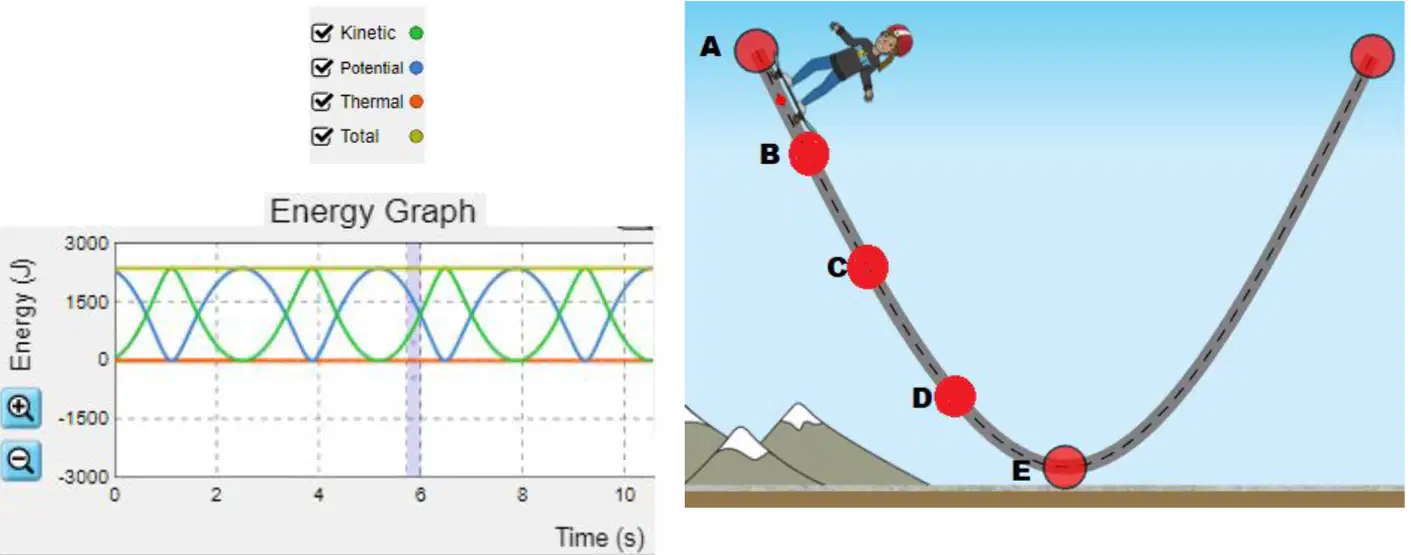
What does the total energy line (Yellow) in the graph indicate about the skater's energy throughout the track?
It increases over time
It decreases over time
It remains constant
It fluctuates wildly

The bar graph shows the energy of the Skater, where could she be on the track?
Point A
Point B
Point C
Point D
Point E

Based on the pie graph showing the energy distribution of the skater, at which point on the track is the skater likely to have the highest kinetic energy (KE)?
Point A
Point B
Point C
Point D
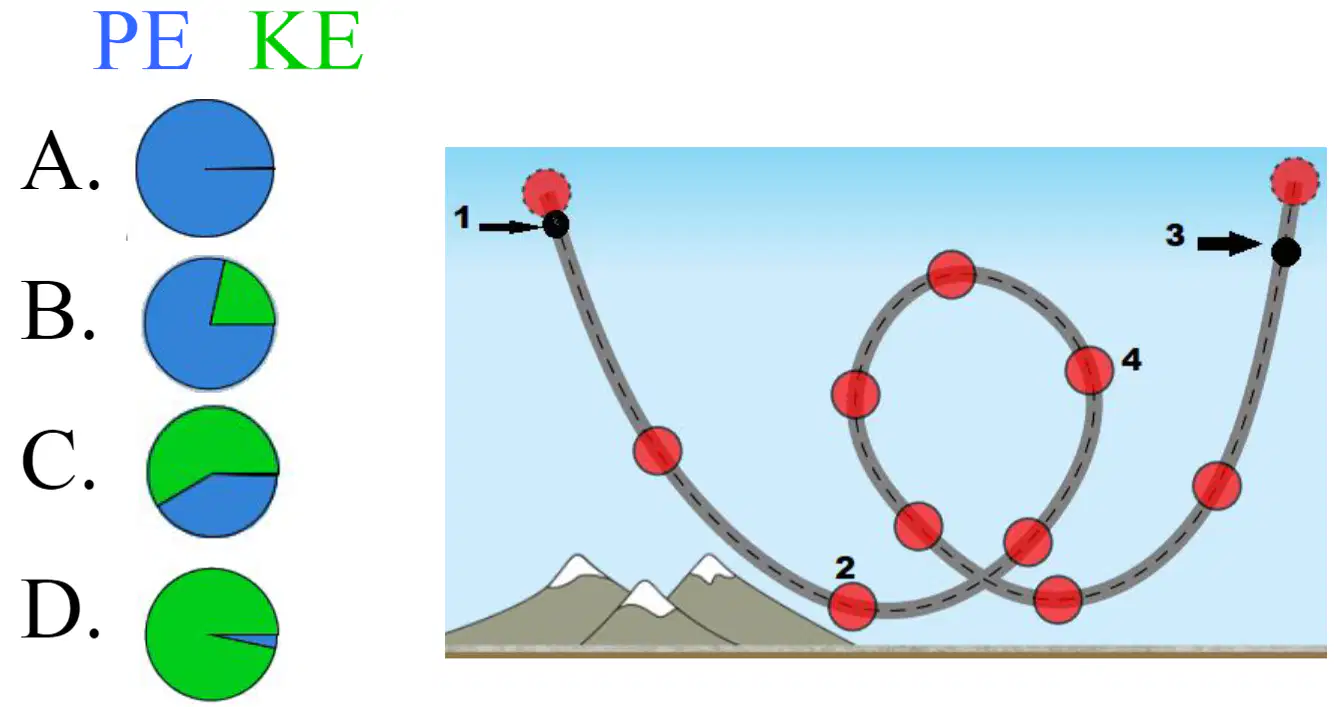
If the skater is at point 4, which chart could represent the skater's energy?
A. Entirely blue pie chart
B. Mostly blue with a small green segment
C. A little more green than blue
D. Mostly green with a small blue segment.
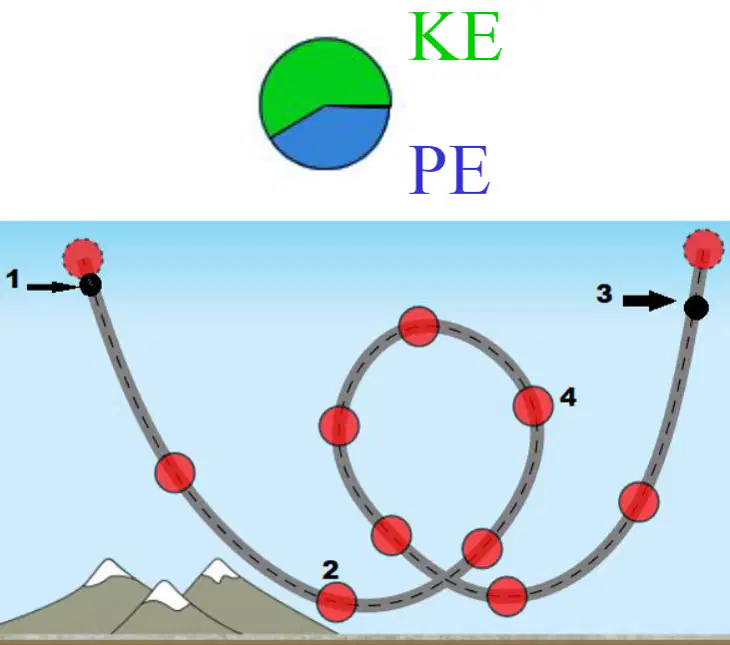
If a heavier skater is at point 4, how would the pie chart change?
No changes
The entire pie would be larger
The PE part would be larger
The KE part would be larger

As the ball skater moves from point 4, in which direction is the skater rolling according to the diagram?
A. Up
B. Down
C. Not Enough Information
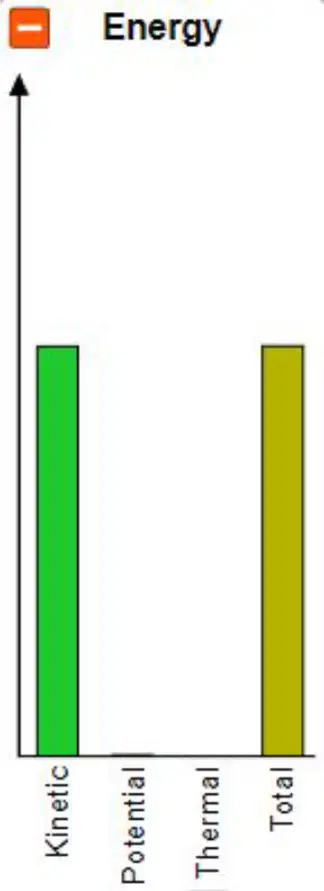
The Energy chart of a skater is shown. How would you describe his speed based on the energy distribution in the chart?
He is at his maximum speed
He is stopped
He is going his average speed
He is going slow
He is going fast
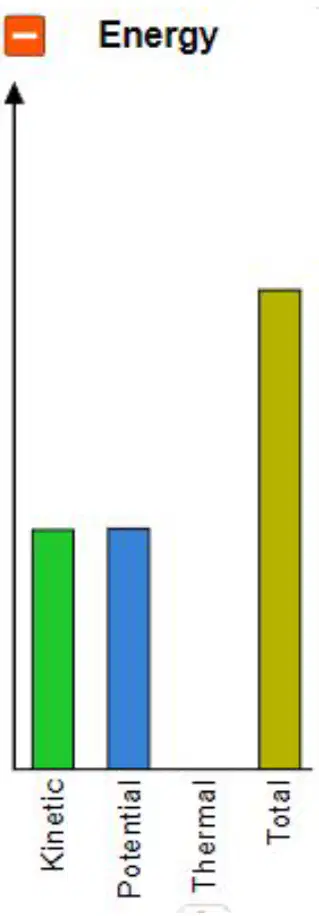
Based on the energy chart of the skater, how would you describe his speed?
He is at his maximum speed
He is stopped
He is going his average speed
He is going slow
He is going fast
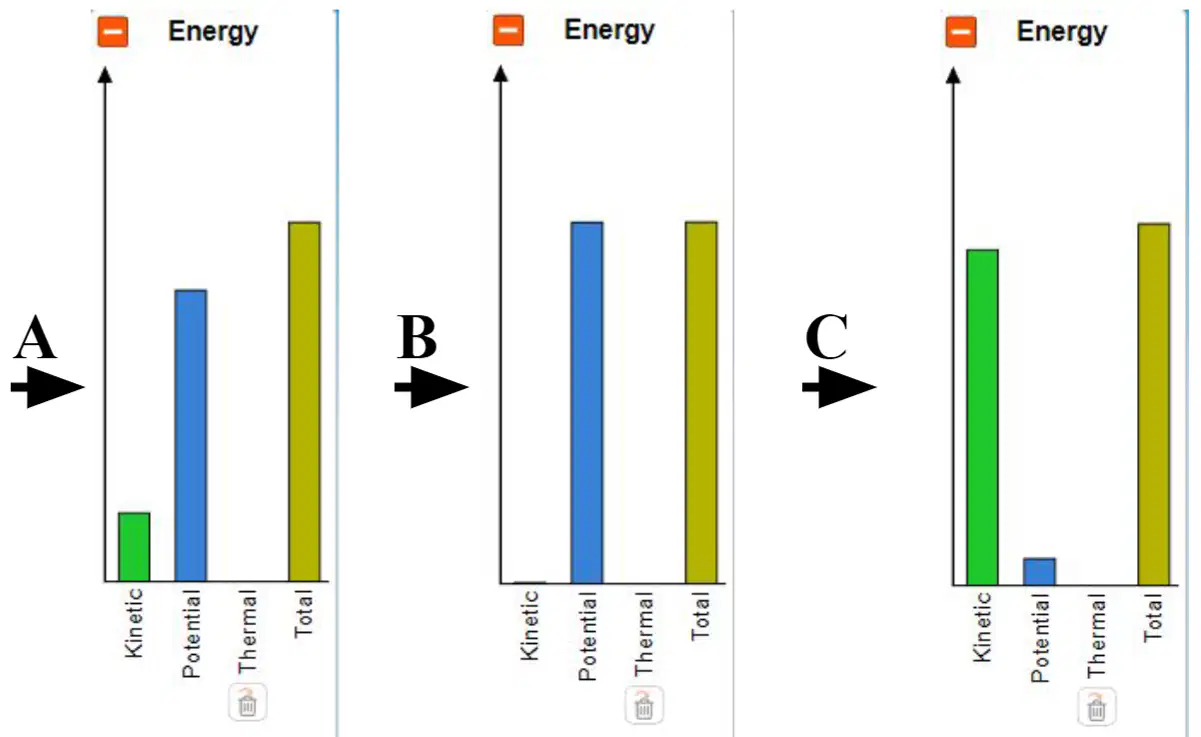
Based on the energy distribution in the diagrams, which letter corresponds to the object that is moving the fastest?
A
B
C
None of the above

Which letter represents the object with the highest potential energy?
A
B
C
None of the above

Which letter represents the object that has stopped?
A
B
C
None of the above

