
 Worksheets
AP Physics 1 Final Review
Total questions: 65
Worksheet time: 56mins


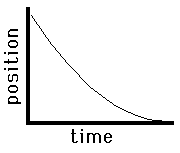
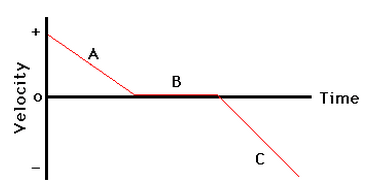

Which diagram represents an object at rest?
A
B
C
D


Given the FBD, which of the following must be true?
The frictional force must be accelerating the system to the left.
The box must be accelerating to the right.
The box must be moving to the right.
The FBD is incorrectly drawn. This situation isn't possible

Which of the following statements is true about the image above?
The accelerations of the blocks will vary according to their mass
The net force acting on each block is the same
The blocks will experience the same acceleration
The 3m box will eat the 2m and the m boxes

Sam is hover boarding down they hall at a constant velocity. Assuming there is friction, which of the following must be true?
The force applied by the board must be greater than the frictional force
The frictional force must equal the force applied by the board
The force applied must equal zero
There is not enough information

Is this object in equilibrium?
Yes and it's moving right
Yes and its at rest
No, it's accelerating right
No, it's at rest

Assuming all objects were moving at a constant velocity, which diagram would produce the largest frictional force?
A
B
C
Which of the following pairs of surfaces would have the highest coefficient of friction?
Air hockey puck and air hockey table
Sneakers and cement sidewalk
Bicycle tire and icy road
Rumble strip and car tire
What are the 4 types of FRQs on the AP Physics Exam?
Experimental Design
Qualitative/Quantitative Translation
Paragraph Argument Short Answer
Short Answer


An object sliding across a surface will experience ______ friction.
static
potential
kinetic
no
When dealing with circular motion, the time that it takes to make one revolution of the circle is called the:
rotation.
orbit.
period.
segment.
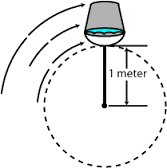
The term centripetal means
circular motion
center accepting
center seeking
center fleeing
Gravitational potential energy is defined as
What is the definition of Mechanical Energy?
a change in speed or direction
the ability to do work
a force that works against motion as surfaces rub together
the energy an object has because of its motion
True or False
Negative work means that energy is being removed from the object.
True
False
The sum of the kinetic and potential energy in a system is known as the system's total _____________________ energy.
mechanical
chemical
thermal
combined
Work involves a force acting upon a __________ object, either with its motion or against its motion.
moving
stationary
heavy
light
True or False
The total energy in an isolated system can be increased.
True or False
Gravity does negative work on you when you walk up some stairs.
True
False

A spring is compressed by a force F against a wall as shown. Which of the following describes the sign of work done by the spring as it is being compressed?
The spring does positive work since it is gaining potential energy.
The spring does zero work since all the work is done by force F.
The spring does negative work since it applies a force against the direction of its compressing motion.
The spring works part-time at Chik Fil-A.
In which of the following situations is kinetic energy decreasing?
A lit tinsel llama is dropped from a building.
A satellite is moving in a circular orbit around the moon.
A baseball is headed upward after being thrown up in the air.
An elevator is moving upward at a constant velocity.
A purple ball and a gold ball each weigh 9.5 lbs. If the purple ball is moving at a velocity of 20 m/s, and the gold ball is moving at a velocity of 100 m/s, which ball has more momentum?
purple
gold
their momentums are equal
You have a 5 kg purple ball and a 1 kg gold ball. If the purple ball is moving at a velocity of 20 m/s, and the gold ball is moving at a velocity of 100 m/s, which ball has more momentum?
purple
gold
their momentums are equal

When is the pendulum at maximum velocity
At its lowest point
At its highest point
It moves at a constant velocity
It is at rest
Which of these formulas denotes momentum?
F = -kx
p = mv
F = ma
a = v/r


When does the mass move at maximum velocity in a mass-spring system?
At equilibrium
At the farthest point from the equilibrium
At its hightest point
At its lowest point
What are the two requirements for a simple harmonic oscillator?
The object vibrates about the equilibrium point and the restoring force is proportional to the displacement
The object moves left to right and the restoring force is proportional to the displacement
The object vibrates about the equilibrium and the restoring force is greater than the displacement
The object moves left to right and the restoring force is greater than the displacement
When is the pendulum at 0 velocity
At its lowest point
At its highest point
It moves at a constant velocity
It is at rest
When does the mass move at 0 velocity in a mass-spring system?
At equilibrium
At the farthest point from the equilibrium
At its hightest point
At its lowest point
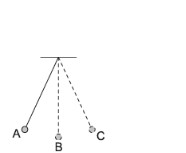
A pendulum oscillates as shown. At which of the following positions is the potential energy equal to the total energy?
A
B
C
Not enough information
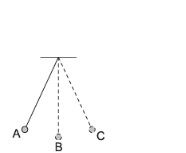
A pendulum oscillates as shown. At which of the following positions is the kinetic energy equal to the total energy?
A
B
C
Not enough information given.

The broomstick shown is in static equilibrium. The torque due to the mass to the right of the person's finger is ____________ compared to the torque due to the mass to the left of the person's finger.
more
less
equal
None of the above

The broomstick shown is in static equilibrium. The mass to the right of the person's finger is ____________ compared to the mass to the left of the person's finger.
more
less
equal
None of the above
"A point at which entire weight of object concentrated toward the earth".
Identify the concept explained in the statement above.
Free body diagram
Concurrent forces
Center of gravity
Rigid body
What does α (alpha) represent?
angular displacement
angular velocity
angular acceleration
Which of the following describes how fast you are spinning or rotating about an axis?
linear speed
angular displacement
angular speed
linear acceleration
According to convention, counter-clockwise is always considered the ______________ direction when rotating.
positive
negative
zero
If net force causes a change in velocity, then a net torque causes a ...
change in angular velocity.
change in angular position.
change in position.
change in linear momentum.
How many radians are there in one complete rotation?
π
2
1
2π
If you analyze points farther radially outwards from the center of a rotating object, the linear/tangential velocity and linear/tangential acceleration are
increasing.
decreasing.
remaining the same.
If an object has a positive ω and a positive τ , then what is the object doing?
rotating clockwise and speeding up
rotating counterclockwise and speeding up
rotating clockwise and slowing down
rotating counterclockwise and slowing down
If an object has a negative ω and a positive τ , then what is the object doing?
rotating clockwise and speeding up
rotating counterclockwise and speeding up
rotating clockwise and slowing down
rotating counterclockwise and speed up

