wayground logo

Free Printable Worksheets

Font size

S
M
L
XL
Worksheets

LC Chem Mega Quiz

Total questions: 80

Worksheet time: 40mins

Name
Class
Date
1.
Which of these was not proposed by John Dalton in 1805?
a)
All matter is made of atoms
b)
Atoms are made of protons, neutrons and electrons
c)
During chemical reactions, atoms rearrange themselves
d)
The atoms of a particular element are all identical
2.
The periodic table is organized by the number of ______ in each element's nucleus
a)
neutrons
b)
protons
c)
electrons
d)
atoms
3.

Who arranged the first periodic table.

a)

Moseley

b)

Einstein

c)

Mendeleev

d)

Bohr

4.

What property did Mendeleev use to organize his first periodic table?

a)

atomic number

b)

atomic mass

c)

alphabetical order

d)

chemical properties

5.

Scientist who first grouped the elements in groups of threes (triads).

a)

Johann Dobereiner

b)

John Newlands

c)

Dmitri Mendeleev

d)

Henry Moseley

6.
What property did Newlands use to arrange his elements?                               
a)
atomic mass
b)
 number of protons 
c)
atomic size     
d)
melting point      
7.
Newlands compared his arrangement to a piano and called it what?  
a)
Newlands Piano
b)
Piano Keys of Newlands
c)
Newlands Octaves
d)
Beethoven's Octaves
8.
Why were there blank spaces left in Mendeleev's periodic table?                                              
a)
He didn't know what to put there.
b)
 Undiscovered elements not yet known.
c)
Multiple elements could have fit
d)
He forgot to add the elements in.
9.
Moseley discovered that the ________ was the most fundamental property needed for organization.                                                 
a)
atomic mass
b)
mass number
c)
atomic number
d)
number of protons
10.

Groups on the periodic table are arranged...

a)

Vertically

b)

Horizontally

c)

Diagonally from bottom right corner

d)

Diagonally from top right corner

11.

How many periods are there in the periodic table?

a)

7

b)

9

c)

10

d)

18

12.

What Greek philosopher first spoke about the idea of an atom?

a)

Democritus

b)

Dalton

c)

Thomson

d)

Rutherford

13.
Which is the correct sequence of the scientists who made major changes in the model of the atom?
1-JJ Thomson
2-Erwin Schrodinger
3-John Dalton
4-Niels Bohr
5-Ernest Rutherford
a)
2, 1, 4, 3, 5
b)
3, 1, 5, 4, 2
c)
5, 3, 2, 1, 4
d)
4, 3, 2, 1, 5
14.

What scientist is best known for his "Plum Pudding" model of the atom?

a)

J.J. Thomson

b)

Ernest Rutherford

c)

John Dalton

d)

Democritus

15.
Which scientist discovered the electron?
a)
Bohr
b)
Rutherford
c)
Dalton
d)
Thomson
16.
Which scientist discovered the nucleus?
a)
Bohr
b)
Rutherford
c)
Chadwick
d)
Thomson
17.
Which scientist described electrons as waves that move in orbitals? 
a)
Thomson
b)
Rutherford
c)
Schrodinger
d)
Chadwick
18.

This model of the atom described atoms as tiny spheres that could not be broken down into smaller pieces.

a)

Dalton's model of the atom

b)

The Plum Pudding Model of the atom

c)

The Nuclear Model

d)

The Bohr Model

19.
According to the Bohr model, how many electrons can the first orbital hold?
a)
8
b)
2
c)
4
d)
6
20.

Who is credited with developing the atomic theory?  (Sometimes called the father of atomic theory)

a)

John Dalton

b)

J. J. Thomson

c)

Ernest Rutherford

d)

Niels Bohr

21.

Atoms are neutral because...

a)

They have 3 particles

b)

Neutrons and protons = 0

c)

They have equal numbers of protons and electrons

d)

They have a pH of 7

22.
What is the electron configuration for this atom?
a)
1s22s22p6
b)
1s22s22p5
c)
1s22s22p3
d)
2s22p3
23.
What atom matches this electron configuration?
1s22s22p63s2
a)
Neon
b)
Magnesium
c)
Aluminum
d)
Potassium
24.
What is the charge of an atom that has lost one electron?
a)
-1
b)
-2
c)
+1
d)
+2
25.
What is the electronic configuration of iron?
a)
1s22s22p63s23p64s23d6
b)
1s22s22p63s23p63d8
c)
1s22p63s23p64s23d6
d)
1s22s22p63s23p64s13d6
26.
Formula for Sodium Oxide?
a)
NaO
b)
Na2O
c)
ONa
d)
Na1O1
27.
Formula for Aluminum Chloride?
a)
ClAl
b)
AlCl3
c)
Cl3Al
d)
AlCl
28.
Ionic compounds are written with
a)
cation (+ ion) first then anion (- ion)
b)
anion (- ion) first then cation (+ ion)
c)
either way is fine
d)
polyatomic ions first
29.
What is the correct formula for carbonic acid?
a)
H₂C
b)
H₂CO₃
c)
HCO₃
d)
HClO
30.

Potassium sulfate is written as

a)

K4SO4

b)

P2(SO4)3

c)

K2SO4

d)

P4SO3

31.
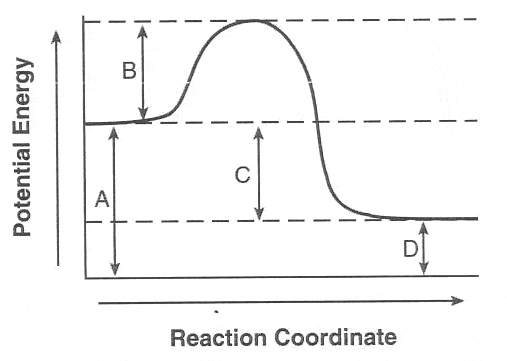
What letter represents the energy of the products?
a)
A
b)
B
c)
C
d)
D
32.

What letter represents ΔH?

a)

A

b)

B

c)

C

d)

D

33.
Endothermic reactions _______ heat and have _______ ΔH
a)
give out, negative
b)
take in, negative
c)
give out, positive
d)
take in, positive
34.
Collision theory states that
a)
particles collide at random and react
b)
collisions between particles often result in a reaction
c)
collision between molecules are sometimes needed before a reaction occurs
d)
reacting particles must collide with enough energy in order to react
35.
Explosions can happen when there is a large amount of powdered substance because of a large
a)
temperature
b)
surface area
c)
concentration
d)
pressure
36.

Which has greater repulsion?

a)

l.p : l.p

b)

l.p: b.p

c)

b.p: l.p

d)

b.p : b.p

37.

Predict the shape of a molecule with 2 l.p's and 2 b.p's on the central atom.

a)

tetrahedral

b)

linear

c)

pyramidal

d)

v-shaped or bent

38.

What is sigma and pi bonding respectively?

a)

head on overlap and sideways overlap of two orbitals.

b)

both are sideways overlap of two orbitals.

c)

sideways overlap and head on overlap of two orbitals.

d)

type of bonding for p orbitals only.

39.
What is the bond angle of a water molecule?
a)
104.5
b)
107
c)
109.5
d)
120
40.
Which of the following is an example of a covalent compound?
a)
NaCl
b)
CH4
c)
BeO
d)
KF
41.
What is the oxidation number of Fe in FeO?
a)
+1
b)
-1
c)
+2
d)
-2
42.
What is oxidation number of Ca in CaCl2 ?
a)
-1
b)
-2
c)
+1
d)
+2
43.

What is the oxidation number of O in O2?

a)

0

b)

-2

c)

+1

d)

+2

44.
     In the reaction Zn + H2O → ZnO2 + H2
 which element, if any, is oxidized?
a)
Zinc
b)
Hydrogen
c)
Oxygen
d)
None
45.

Oxidation involves

a)

gaining electrons; gaining oxygen

b)

losing electrons; gaining oxygen

c)

gaining electrons; losing oxygen

d)

losing electrons; losing oxygen

46.
Name this structure.
a)
propanal
b)
propanol
c)
propanoic acid
d)
propanone
47.

Classify the compound based on the functional group present.

a)

Ketone

b)

Carboxylic acid

c)

Ester

d)

Ether

48.
Classify the compound based on the functional group present.
a)
aldehyde
b)
ketone
c)
carboxylic acid
d)
ester
49.

Is the name of doubled bonded, unsaturated hydrocarbons.

a)

Alkanes

b)

Alkenes

c)

Alkynes

d)

Tannins

50.
Classify the compound based on the functional group present.
a)
aldehyde
b)
ketone
c)
carboxylic acid
d)
ester
51.
Acids are what range on the pH scale?
a)
0-14
b)
0-6.99
c)
7
d)
7.1-14
52.
When found in food, bases are _______.
a)
Sour
b)
Bitter
c)
Salty
d)
Soggy
53.
What might happen if you mixed a strong acid with an equally strong base?
a)
You would see an explosive chemical reaction.
b)
The acid would destroy the base.
c)
The base would destroy the acid.
d)
You'd wind up with a pH-neutral substance.
54.
A Bronsted-Lowry acid is 
a)
a proton donor
b)
a proton acceptor
c)
gives H+ ions in solution
d)
gives OH- ions in solution
55.
A salt is formed when ..... Choose the definition of a salt.
a)
when an acid reacts with a base. 
b)
when a metal reacts with a base.                                            
c)
when H+ from an acid is replaced by a metal or ammonium ion.
d)
when an acid reacts with base or carbonate                                            
56.

What is hard water?

a)

Ice

b)

Impure water

c)

Water with Ca and Mg ions

d)

Water that will not form a lather easily with soap.

57.
The ions that cause hard water are;
a)
Calcium and Manganese ions
b)
Calcium and Magnesium ions
c)
Carbon and Magnesium ions
d)
Carbon and Manganese ions
58.
Boiling can be used to make which type (s) of water soft.
a)
Temporary and  permanent hard water
b)
Soft water
c)
Permanently hard water
d)
Temporary hard water
59.

Which of the following is measured in analysis of water quality?

a)

turbidity

b)

salinity

c)

temperature

d)

BOD (biochemical oxygen demand)

60.

Runoff of sewage and agricultural wastes into coastal waters introduce

a)

algae growth

b)

rainwater

c)

surface runoff

d)

oil spill

61.
2CO  +  O2  −-> 2CO2
How many liters of carbon dioxide are produced from 10L of carbon monoxide?
a)
10
b)
20
c)
1
d)
5
62.
 SiO2 + 3C → SiC + 2CO
I need to add 8 moles of Carbon to the reaction. How many grams of Carbon should I weigh?
a)
96 g
b)
0.67 g
c)
2.67 g
d)
48 g
63.
If a chemist calculates the maximum amount of product that could be obtained in a chemical reaction, he or she is calculating the
a)
theoretical yield
b)
mole ratio
c)
actual yield
d)
percentage yield
64.
N2 +  3H2 → 2NH3 
How many moles of hydrogen are needed to react with 2 moles of nitrogen?
a)
6
b)
2
c)
3
d)
1
65.
Name the following ZnO
a)
Zinc oxide
b)
Zinc II oxide
c)
zirconium oxalate
d)
zinc oxalate
66.

Which of the following would NOT affect the rate of a reaction?

a)

Temperature

b)

Pressure

c)

Catalyst

d)

Concentration

e)

Electronegativity

67.

2SO2(g) + O2(g) ⇌ 2SO3(g) + Heat


Removing O2(g) will

a)

shift equilibrium right

b)

shift equilibrium left

c)

increase pressure

d)

have no change

68.

2SO2(g) + O2(g) ⇌ 2SO3(g) + Heat

Using a catalyst

a)

shift equilibrium right

b)

shift equilibrium left

c)

increase the rate of reaction

d)

have no change

69.

1N2 + 3H2 →2NH3

When the pressure on the system is increased, the equilibrium position shifts to the right. Why?

a)

To increase the amount of products

b)

To reduce the pressure, as the right side has fewer molecules of gas

c)

Keq will increase when it is shifted to the right

d)

To increase the pressure, as the right side has more molecules of gas

70.

The Kc expression for the reaction 2NH3 ⇌ N2 + 3H2

a)

b)

c)

d)

71.

Crude oil is made up of:

a)

Ethane

b)

Butane

c)

A mixture of different hydrocarbons

d)

Extremely large hydrocarbons which are broken up once extracted

72.

A fraction of crude oil is made up of:

a)

Hydrocarbons of similar chain lengths

b)

Numbers

c)

Large hydrocarbons

d)

Alkenes only

73.

Shorter hydrocarbons have:

a)

Higher boiling points

b)

Lower boiling points

74.

Kerosene (paraffin) is used for:

a)

Fuel for cars

b)

Domestic heating and cooking

c)

Fuel in aircraft

d)

Fuel for large ships and in power stations
75.

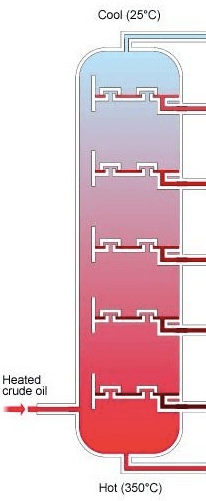
What process happens at each level in the fractionating column?

a)

Evaporation

b)

Condensation

c)

Combustion

76.

The atomic radius across period

a)

decrease from left to right

b)

Increase from left to right

c)

decrease from right to left

d)

stay the same

77.

As you move across a row on the periodic table, what generally happens to the atomic radius?

a)

it decreases

b)

it increases

c)

it stays the same

78.
As you move down the periodic table atoms get bigger.  This is because ____________.
a)
The atoms have more mass.
b)
The atoms have more protons.
c)
The atoms have more energy levels
d)
The atoms have more neutrons
79.

Fluorine and Chlorine are ____________at room temperature.

a)

gases

b)

liquids

c)

solids

d)

edible

80.

As you move down the group, halogens' reactivity...

a)

increases

b)

decreases

c)

doesn't change

d)

shows no trend.