
 Worksheets
Semester Review Spring 2024
Total questions: 150
Worksheet time: 6hrs 14mins
In order for an object to be in equilibrium:
All forces must be equal and opposite
One force over powers the others and causes an object to accelerate
All forces face the same direction
All forces on the object converge
What is the difference between weight and mass?
If a car goes from 30 m/s to 50 m/s in 2 seconds, what is its acceleration?
40 m/s2
20 m/s2
2 m/s2
0 m/s2
What is the acceleration of a car moving at a constant velocity of 30 m/s?
0 m/s2
30 m/s2
90 m/s2
120 m/s2
Which of the following is Newton's 3rd law?
For every action, there is an equal and opposite reaction.
The acceleration of an object is produced by a net force and is inversely proportional to the mass of the object.
An object will remain at rest or in motion unless an outside force acts upon it.
A force is a push or pulll
Which of the following is Newton's 2nd law?
For every action, there is an equal and opposite reaction.
The acceleration of an object is produced by a net force and is inversely proportional to the mass of the object.
An object will remain at rest or in motion unless an outside force acts upon it.
A force is a push or pulll
Which of the following is Newton's 1st law?
For every action, there is an equal and opposite reaction.
The acceleration of an object is produced by a net force and is inversely proportional to the mass of the object.
An object will remain at rest or in motion unless an outside force acts upon it.
A force is a push or pulll
What are the units for Force?
W
N
m/s
m/s2
Normal force is
Always opposite the weight
Always parallel and down the incline
Always perpendicular to the surface
It depends on the direction of motion
The force of friction which acts between two surfaces when there is no relative motion between them is called:
Static Friction
Kinetic Friction
Sliding Friction
Rolling Friction


A cannonball is launched horizontally at 50 m/s from an 80 m tall cliff. How far will it go (horizontally) before hitting the ground?
100 m
200 m
400 m
800 m
100 N 230 N
<------ --------->
If you see something that is the color black, you are really seeing what?
All of the visible light that strikes the object being reflected
Most of the visible light that strikes the object is being reflected
All of the visible light that strikes the object is being absorbed
Most of the visible light that strikes the object is being absorbed
Complete the sentence:
______________ is the number of crests of a wave that passes a single point in each second.
Amplitude
Frequency
Wavelength
Period
A wave is a disturbance that transports which of the following?
particles
water
light
energy
A longitudinal wave travels _____ to the direction of the wave's motion.
at various angles
parallel
at a right angle
perpendicular
If the net force acting on an object is doubled, what happens to the acceleration of the
object?
It is unchanged
It is doubled
It is quadrupled
It is halved

A student release a ball from a height of 1.5 m above the floor. Which of the following statements best describes the energy of the ball as it falls?
Its potential energy is changed to kinetic energy
The total amount of its mechanical energy increases
Its kineitc energy is changed to potential energy
The total amount of its mechanical energy decreases

Choose the description that best describes this motion graph.
Graph represents the motion of an object with increasing speed
The object is moving at a constant velocity/speed.
The object moved at a constant speed, then stopped. After stopping, it returned to the beginning and then moved back in the original direction at a very fast constant speed.
Object not moving
Tyler is taking a bus to see his grandmother. He has been riding on a bus for 2 hours and
has traveled 120 miles. Which equation can be used to show the distance, d, he will travel
in hours, h, assuming the bus will travel at a constant speed?
d=2h
d=60h
d=150h
d=155h
A ball thrown straight up takes 8 total seconds to complete its journey all the way up and down. 1 second into its journey and 7 seconds into its journey the magnitude of its velocity will be ______________ and its direction _______________.
opposite, the same
the same, opposite
the same, the same
opposite, opposite
If a ball thrown straight up into the air takes 4 seconds to reach the top (peak), how long will it take to travel from the peak back to the original position?
0s
1s
3s
4s
The fact that an apple and a watermelon, dropped simultaneously from the same height, would hit the ground at the same time indicates that
you don't like apples or watermelons.
greater masses have greater acceleration.
lesser masses have greater acceleration.
acceleration is independent of mass.
The initial horizontal velocity of a projectile is ____ its final horizontal velocity.
less than
equal to
greater than
What is true about the vertical velocity of a projectile launched horizontally?
It is initially at its maximum value.
It increases due to gravity as it falls.
It remains constant throughout its trajectory.
It decreases as it falls due to gravity.
If two projectiles are launched at two different heights, 2m and 10m, which one will reach the ground first?
2m
10m
they both will hit the ground at the same time
Which hits the ground first if they start at the same height: a dropped ball or a ball launched with a
horizontal velocity?
the launched ball
the dropped ball
they both hit at the same time
What is the velocity of an object launched straight up at its highest point?
zero
equal to its vx
½ its maximum value
equal to gravity
The path followed by a projectile is also known as its
trajectory
range
height
vertical displacement
Once a projectile is launched, what is the only force that affects its motion?
mass
friction
inertia
gravity
Which of the following would NOT be considered a projectile?
A cannonball fired towards a distant castle.
A cannonball rolling down a slope.
A cannonball fired straight outward from a castle wall.
A cannonball after it rolls off the edge of a cliff.


Velocity is?
a helium nucleus
rate of change of distance moved with the direction
the energy store in a body due to its height
the amount of matter that an object is made of
Acceleration is defined as
the change in velocity over time
the change in position over time
the change in time over velocity
the change in time over distance
mass
position where zero amplitude
the amount of matter in an object
the force exerted by the Earth
force/area
Weight
Current in a circuit
Force exerts on a body due to gravity
the amount of matter in a body
energy of a mass due to its motion
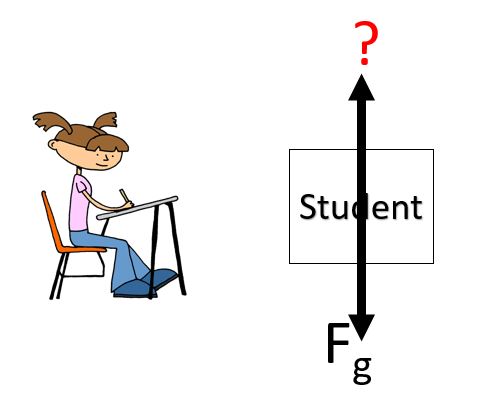
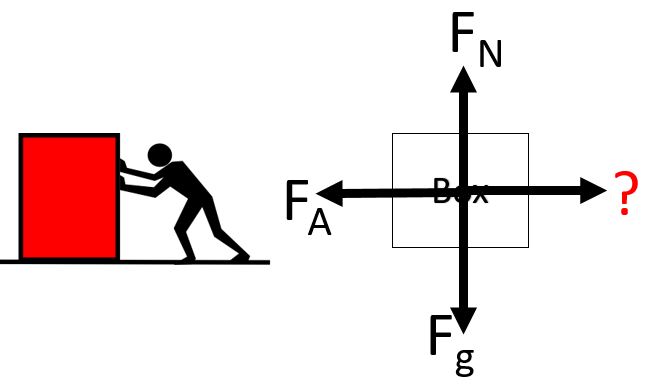
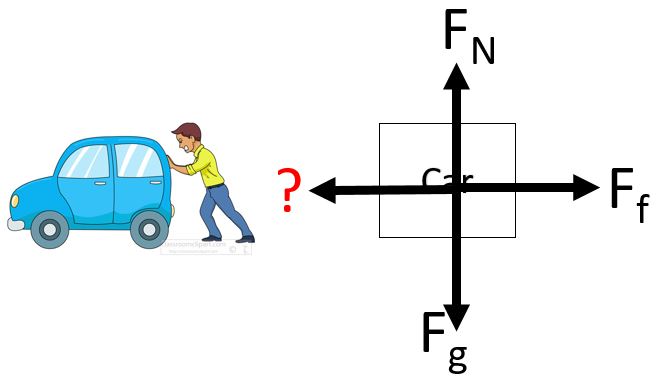
Whenever an object is moving, there is always this force opposing the motion:
inertia
momentum
friction
applied force
The force that keeps objects on top of surfaces instead of letting them sink into the surface is known as:
normal
abnormal
static
inertia
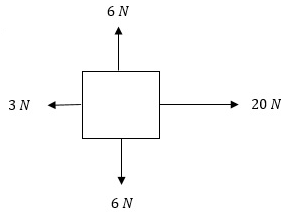
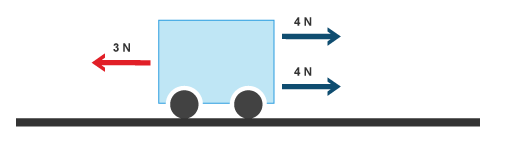
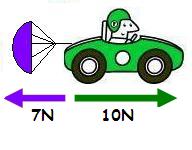
What is the NET FORCE of this diagram?
17 N, right
17 N, left
23 N, right
12 N, up
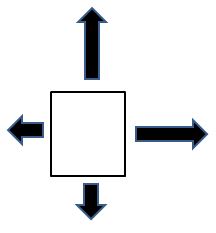
This object would be moving (pick all that are correct):
up
down
left
right
The down-arrow in this diagram is most-likely:
gravity
normal
a push or pull
friction
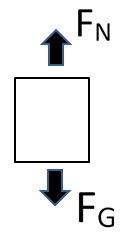
Which of the following is true about this free-body diagram?
the forces are are balanced
the object is free-falling
the object is moving upward
the forces are unbalanced

What forces are on a leopard laying on a log?
Fg & Fapp
Fb & Fg
Fg & FN
Ff & FN
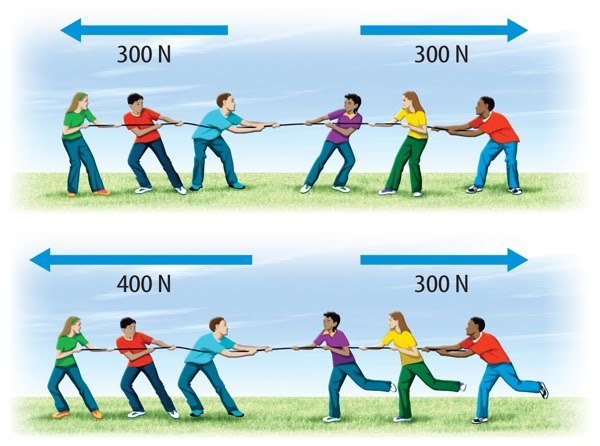
An object that has momentum can be described as _________
changing its velocity
moving fast
resisting changes in its state of motion
having its mass in motion
encountering a net force
Which one of these objects has the greater amount of momentum?
A turtle that slowly crosses a road
A parked car
A stop sign
Which one of the following units represents the standard metric units of momentum
Newtons * meter / second
Kilograms * meter / second2
meter / second
Kilograms * meter / second
Which one of the following units represents the standard metric units of impulse
Kilograms * meter / second2
Newton * meter
meter / second2
Newton * second
During a collision. an object experiences an impulse. How can this impulse be calculated?
Multiplying force by time
Multiplying mass by velocity
Dividing velocity by time
Multiplying mass by acceleration
During a collision. an object experiences an impulse. The impulse causes and is equal to the _____ of the object
energy change
kinetic energy change
force
momentum
momentum change
When a cannon fires a cannon ball, it recoils backwards. This occurs because of...
Energy in the system is conserved
Energy in the system is increased
Momentum in the system is conserved
Energy in the system is not conserved
A freight car of mass 20,000kg moves along a track at 15 m/s. What is the momentum of the car?
30,000 kg*m/s
3,000 kg*m/s
300,000 kg*m/s
3,000,000 kg*m/s
A 2kg object moving at 5 m/s encounters a 30 N resistive force over a duration of 0.10 seconds. The impulse experienced by this object is _____
0.30 N*s
2 N*s
2.5 N*s
3 N*s
7 N*s
A 5kg ball has a momentum of 30 kg*m/s. What is the speed of the ball
150 m/s
35 m/s
6 m/s
5 m/s
Padded dashboards in cars are safer in accidents than non padded ones because the passenger hitting the dash has...
a) Increased time of impact
b) decreased impulse
c) decreased impact force
d) a and b
e) a and c
Before objects A and B collide, A has a momentum of 26 kg*m/s and B has a momentum of -14 kg*m/s. After the collision, A has a momentum of 8 kg*m/s. B has a momentum of..
2 kg*m/s
4 kg*m/s
6 kg*m/s
12 kg*m/s
32 kg*m/s
A 10 kg object moves at 2 m/s to the right and collides with a 4 kg object moving at 5 m/s to the left. The total momentum is_____
20 kg*m/s
40 kg*m/s
10 kg*m/s
30 kg*m/s
0 kg*m/s
In an elastic collision...
objects bounce off each other
objects stick together
objects stick together for a while then separate
one object flips over the other
In a completely inelastic collision...
objects bounce off each other
objects stick together
objects stick together for a while then separate
one object flips over the other

What is the law that states that the total momentum of a closed system remains constant before and after a collision?
Law of motion
Newton's first law
Law of inertia
Law of conservation of momentum


Sound waves
are a part of the electromagnetic spectrum.
do not require a medium for transmission.
are longitudinal waves.
are transverse waves.

As a sound source approaches and then moves past a stationary observer, the observer will hear
a steady rise in pitch.
a sudden drop in pitch.
a rise in pitch, then a drop in pitch.
a drop in pitch, then a rise in pitch.

If you hear the pitch of a siren become lower, you know that
neither you nor the siren is moving.
you are moving toward the siren or the siren is moving toward you.
you are moving away from the siren or the siren is moving toward you.
the source has just passed you or it is accelerating away from you.
Sound waves are produced by
radio stations.
vibrating objects.
soft objects.
objects under pressure.
Sound waves cannot travel in
steel
air
a vacuum
water
Match the description to the wave type!
high speed
very tall
lots of water moved at once
slow speed
not very tall
very little water moved at once
As tsunami waves get closer to shore, they get (a)
What do you do if a tsunami is coming?
Grab your surfboard and get ready, dude!
Get to higher ground.
Go to the beach to watch it!
Nothing. Accept your fate.
Put the tiles into the correct category!
wind
boats
earthquakes
underwater volcanoes
landslides
a person cannonballing from a cruise ship deck
When a Tsunami is far from shore it can be hard to detect.
True
False
A Tsunami wave can move at over _______ miles per hour.
10
50
500
1000
What natural event can cause a Tsunami?
Earthquakes
Volcanic Eruptions
Landslides
Glacier breaking off into the ocean
All of the above
What is a Tsunami?
A large storm with high speed winds
A tropical cyclone that occurs in the Pacific Ocean
A large and powerful ocean wave
A type of tornado
Any earthquake that causes significant damage


In this clip, the sound of the jet illustrates the doppler effect AS OBSERVED BY
The man on the ground
The pilot in the jet
Both the man on the ground and the pilot in the jet
The Doppler effect applies to light waves as well as sound waves. Astronomers use this to measure the motion of stars and galaxies. In 1929, Edwin Hubble discovered that light from distant galaxies was shifted away from the blue end of the spectrum and towards the red end of the spectrum. Red light has a longer wavelength (and a lower frequency) than blue light. What could Hubble conclude about these galaxies?
The distant galaxies are growing smaller.
The distant galaxies are moving towards the Earth.
The distant galaxies are moving away from earth
What is a transverse wave?
A wave with particles moving parallel to the wave's energy transfer.
A wave that travels in a straight line.
A wave not requiring a medium to travel.
A wave with particles moving perpendicular to the wave's energy transfer.
How does a longitudinal wave differ from a transverse wave?
Particles in longitudinal waves vibrate parallel to the direction of the wave, while particles in transverse waves vibrate perpendicular to the direction of the wave.
Longitudinal waves have a higher frequency than transverse waves.
Longitudinal waves can only travel through solids, while transverse waves can only travel through liquids and gases.
Particles in longitudinal waves vibrate perpendicular to the direction of the wave, while particles in transverse waves vibrate parallel to the direction of the wave.

What kind of wave is in the image?
Longitudinal (Compression)
Transverse

What kind of wave is in the image?
Longitudinal (Compression)
Transverse

What does point A represent?
Amplitude
Wavelength
Crest
Trough

What does point C represent?
Amplitude
Trough
Crest
Wavelength
Waves transfer (a)
6. Which of the following can act as media for a wave? (a)
What types of waves can travel through empty space AND mediums? (a)

Identify the simple machine in the picture.
Lever
Inclined plane
Wheel and axle
Screw

Identify the simple machine in the picture.
Wheel and axle
Inclined plane
Lever
Wedge

Identify the simple machine in the picture.
Inclined plane
Wedge
Pulley
Screw

Identify the simple machine in the picture.
Wheel and axle
Inclined plane
Screw
Pulley

Identify the simple machine in the picture.
Screw
Wheel and axle
Wedge
Pulley

Identify the simple machine in the picture.
Inclined plane
Wedge
Lever
Screw

A hammer would be an example of which type of simple machine?
Inclined plane
Pulley
Wheel and axle
Lever

A slide would be an example of which type of simple machine?
Lever
Inclined plane
Wheel and axle
Wedge

A teeter-totter would be an example of which type of simple machine?
Inclined plane
Wedge
Pulley
Lever

A door knob would be an example of which type of simple machine?
Pulley
Wheel and axle
Screw
Inclined plane

A door stop would be an example of which type of simple machine?
Wedge
Inclined plane
Wheel and axle
Lever

A crane would be an example of which type of simple machine?
Wedge
Wheel and axle
Pulley
Lever

A wheelchair ramp would be an example of which type of simple machine?
Inclined plane
Wedge
Pulley
Wheel and axle

A drill bit would be an example of which type of simple machine?
Lever
Wedge
Incline plane
Screw

A simple machine makes work easier by doing which of the following?
Increasing the distance through which force is applied.
Changing the direction of applied force.
Multiplying the force of the energy applied.
All of the above.

Compound machines consist of two or more simple machines combined together to make work easier and increase the mechanical advantage. What two simple machines are used in a wheelbarrow?
Wheel/ axle and a lever
Lever and a wedge
Wheel/ axle and a screw
Inclined plane and a lever
Compound machines consist of two or more simple machines combined together to make work easier and increase the mechanical advantage. What two simple machines are used in a pair of scissors?
Lever and a wheel/ axle
Screw and a wedge
Wedge and a lever
Pulley and a lever

Compound machines consist of two or more simple machines combined together to make work easier and increase the mechanical advantage. What two simple machines are used in a corkscrew?
Pulley and a wedge
Wedge and a screw
Lever and an inclined plane
Screw and a lever

Compound machines consist of two or more simple machines combined together to make work easier and increase the mechanical advantage. What three simple machines are used in a can opener?
Wedge , wheel/ axle, and inclined plane.
Wedge, lever, and wheel/ axle.
Inclined plane, screw, and wheel/ axle.
Pulley, wheel/axle, and wedge.

Compound machines consist of two or more simple machines combined together to make work easier and increase the mechanical advantage. What three simple machines are used in a bicycle?
Wheel/ axle, pulley, and a lever.
Inclined plane, pulley, and wheel/ axle.
Wedge, lever, and screw.
Screw, lever, and Inclined plane.
Potential energy depends on the ________ and ________ of the object.
Height (position)
Mass
Speed
Friction

Which point has the most potential energy?
G
F
B
A
Kinetic energy depends on the ________ and ________ of the object.
Height (position)
Mass
Speed
Friction

A cheetah can run briefly with a speed of 31 m/s. Suppose a cheetah with a mass of 47 kg runs at this speed. What is the cheetah’s kinetic energy?
1457 J
728.5 J
45,167 J
22,583.5 J

Where does the pendulum have the greatest kinetic energy?
A
B
C
D
E
Which of the is the equation for calculating work?
W = Fd
W = ma
W = mv
W = mc2
The sum of the kinetic and potential energy in a system is known as the system's _____________________ energy.
mechanical
chemical
thermal
combined
How much power is used when 9000 J of work are done in 0.5 seconds?
4,500 W
18000 W
9453 W
917.4 W
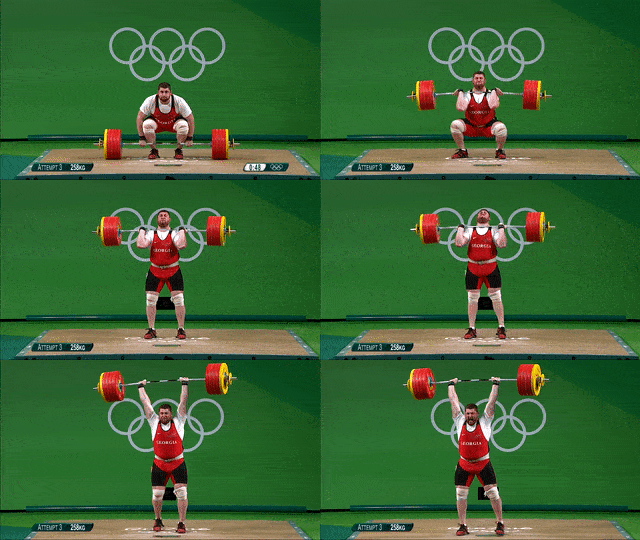
This weight lifter raised 105 kg to a height of approximately 2.31 m in 9 seconds. How much power did he developed?
264 Watts
1029 Watts
2,377 Watts
4,009 Watts

Two people are lifting the same weight as shown in the animation. If they both do 10 reps, who will supply the most power?
Bro A
Bro B
They both will do the same work
Can't tell without knowing the weight they are lifting
After a roller coaster cart reaches ground level and starts heading back up, what happens to its potential energy?
1,224 J
0.264 J
3.77 J
12.24 J
Match the following Types of Friction to their descriptions
Static Friction
Pushing a stationary car
Slide Friction
Sledding down a hill
Fluid Friction
A plane flying through the air
Rolling Friction
A skateboarder going down a ramp
Match the following descriptions to the type of friction
Opposes motion in a liquid or gas
Fluid friction
Opposes motion on objects that are on wheels
Rolling friction
Opposes motion on objects that are gliding over a surface
Sliding friction
Opposes motion on objects that aren't moving
Static friction
N
Newton

Newton's 1st Law

Newton's 2nd Law

Newton's 3rd Law

Impulse
Match Newton's Laws of Motion to their descriptions.
An object stays in motion at a constant velocity unless acted on by an unbalanced force.
1st Law
F=m⋅a
2nd Law
Every force on an object exerts an equal and opposite force back.
3rd Law
What is the definition of "weight"?
measure of the gravitation pull on an object
the time it takes to get on a ride
the amount of matter in an object
the size of an object
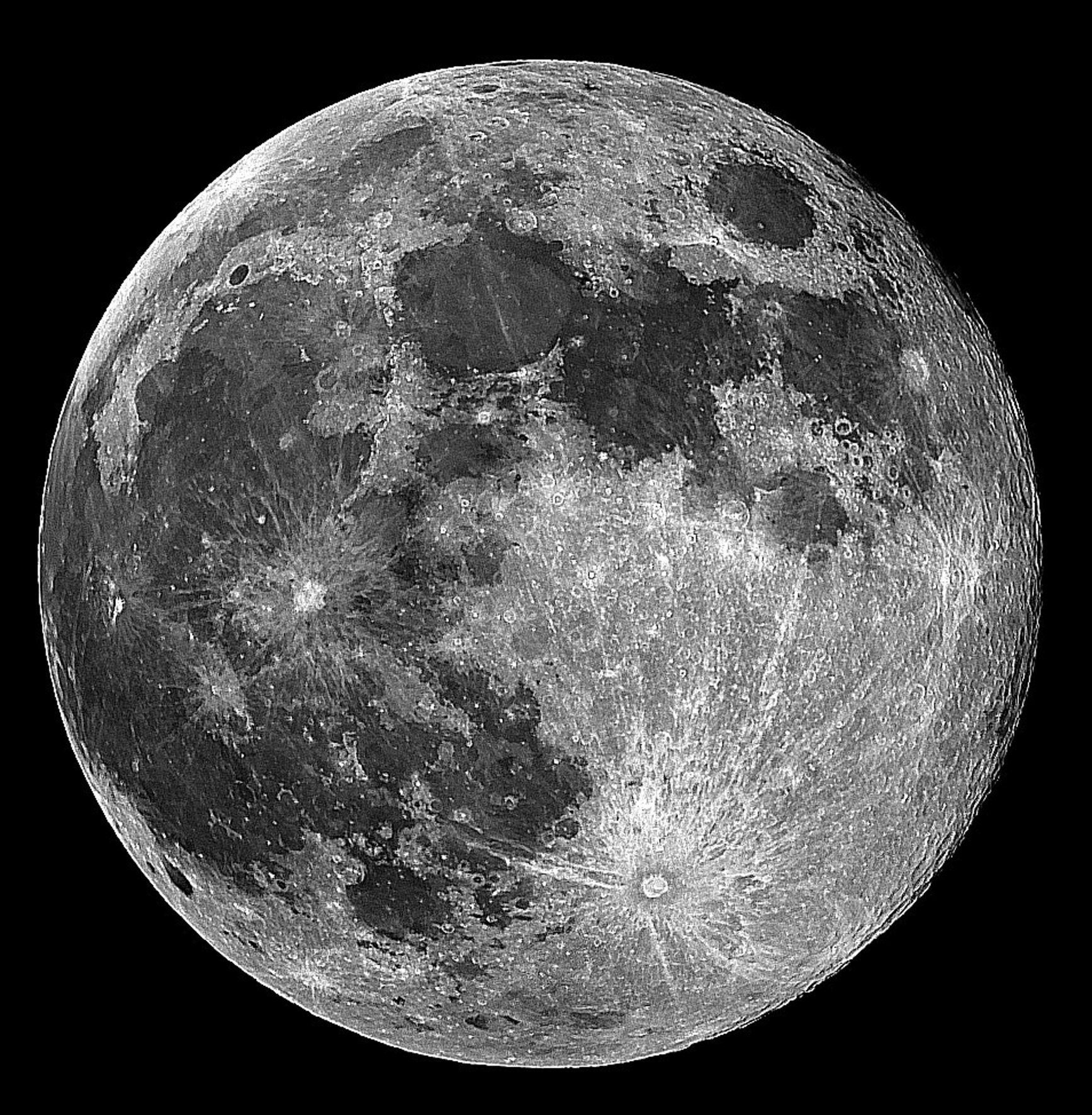
The one that stays the same no matter where you are.
Bass
Weight
Mass
Weather
The unit that goes with weight.
Kilogram
Newton
Milliliter
Mile
Grams and kilograms measure...
capacity
length
time
mass

