
 Worksheets
Y8 MYE REVISION
Total questions: 71
Worksheet time: 48mins
The process of breaking down of food in the cell with release of energy is called
Digestion
Cellular respiration
Circulation
Excretion
doesn't require CO2
requires CO2

When breakdown of glucose occurs with the use of oxygen it is called
aerobic respiration
anaerobic respiration
cellular respiration
anaerobes
During heavy exercise when supply of oxygen to our muscles is insufficient food breakdown is by
anaerobic respiration
aerobic respiration
cellular respiration
Where in the body does respiration take place? Select the best answer.
The lungs
The muscles
All cells
The blood
During inhalation diaphragm moves
Down
Left
Right
Up
What happens to the intercoastal muscle during exhalation?
Relax
Contract
Stretch
None

The airways that lead from the trachea into the lungs
Trachea
Larynx
Bronchi
Pharynx
It is also called as the voicebox
Larynx
Bronchi
Pharynx
Alveoli
During exhalation the diaphragm moves up and the volume of air decreases in the lungs.
True
False
Name the two body parts that work together to force air IN and OUT of the body:
Lungs and trachea
Rib cage and diaphragm
Rib cage and nasal passage
Diaphragm and nasal passage
The ____ carries air to the right and left bronchus.
esophagus
alveoli
bronchioles
trachea
Choose the flowchart with the proper order of airflow into the body.
nose->larynx->trachea->bronchi->bronchioles->alveoli
nose->larynx->trachea->bronchi->alveoli->bronchioles
nose->trachea->larynx->bronchioles->bronchi->alveoli
nose->bronchi->trachea->bronchioles->larynx->alveoli
The air sacs that are covered with capillaries where gas exchange takes place.
bronchi
oxygen
lungs
alveoli
what is found around alveoli?
capillaries
lymphatic nodes
pleura
saliva
Which of the following is not happening during inhalation?
the diaphragm contracts
the rib cage rises up
expands the volume of the chest cavity
diaphragm is relaxing
Respiration is the
Intake of oxygen and release of carbon dioxide over a membrane
Mechanical movement to inhale and exhale air
Release of energy from food inside cells
Feature that enable an animal to survive in its habitat
Which system carries the gases around your body?
Circulatory system
Skeletal System
Digestive System
What type of respiration requires oxygen?
Aerobic
Anaerobic
What are the products of aerobic respiration?
Glucose and oxygen
Lactic acid
Carbon dioxide and water
Carbon monoxide
What is the term used to describe the gas exchange movement in air sacs?
(a)

Look at the word equation for aerobic respiration.
What are the reactants in this reaction?
(a)
Look at the word equation for aerobic respiration.
What are the products in this reaction?
(a)
What are the 2 components to make a solution?
(a)

Which of the following is correct about solute being visible?
It is made up of groups of vibrating particles that are tightly packed together.
It is made up of groups of particles that move freely to fill in space.
It is made up of particles that are no longer in groups.
It is made up of particles of different sizes that are closely packed together.
All solutions are transparent.
Transparent means colorless.
True
False
What mass of salt solution is made when 9 g of salt is dissolved in 50 g of water?
9 g
50 g
41 g
59 g

Fill in the red box with the correct mathematical operation.
(a)

Which salt is the most soluble at 80°C.
sodium nitrate
potassium nitrate
copper sulfate
What is an independent variable?
The variable you change.
The variable you measure.
The variable you keep the same.
What is a dependent variable?
The variable you change.
The variable you measure.
The variable you keep the same.
What is the variable that you keep the same throughout an experiment?
(a)

Ink can be separated by a method of -----------------------------------------------
distillation
filtration
chromatography
sedimentation
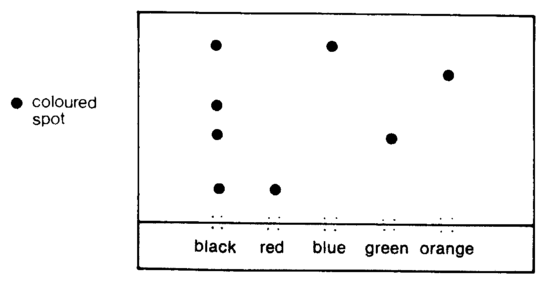
A pure substance shows ------------------ spot on chromatogram
0
1
2
3
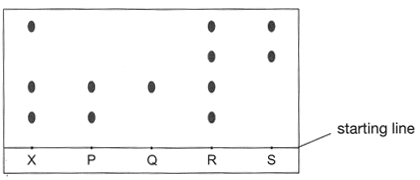
The diagram below shows a chromatogram obtained when a sample X was analysed together with four other known dyes P, Q, R and S. Dye Q was known to cause cancer. Which of the following dye(s) is/are safe for use?
P only
S only
P and S
P and X
Why must the baseline be drawn in pencil and not pen?
Pencil is good at keeping substances in place.
Pencil is soluble in water
Pencil is insoluble in water
Pencil is not colored
Something that CANNOT be dissolved is described as being…
solute
soluble
insoluble
solvent
saturated
The liquid that the solute will be dissolved into is the…
solute
soluble
insoluble
solvent
saturated
The solid that will be dissolved is the...
solute
soluble
insoluble
solvent
saturated
A solution that CAN’T dissolve anything else is…
solute
soluble
insoluble
solvent
saturated
What does it mean by "two forces are balanced"?
The forces are different in size and opposite in direction.
The forces are same in size and similar in direction.
The forces are equal in size and opposite in direction.
The forces are different in size and similar in direction.

What happens if the forces are balanced?
The object is moving.
The object is not moving.
The object might move.
The object moves and stops.
What is the standard unit of speed?
(a)
What is the word equation for speed?
(a)

The question gives the information of distance travelled and the speed.
How can we calculate the time?
distance / speed
speed * distance
speed / distance
Marcus rides his bicycle at a speed of 4 m/s for 60 s.
How far does he go in this time?
(a)
Sofia is in a car travelling at a speed of 5 m/s.
How long will the car take to travel 200 m?
(a)
A car travels a distance of 210 m in a time of 6 s.
Calculate the speed of the car in m/s.
(a)

The car is stopped in scenario:
A
B
C
The car is coming back in scenario:
A
B
C

How far was Edward from home when he visited Nicola?
20 miles
30 miles
40 miles

How long does it take the cyclist to cover 800 meter distance?
60 seconds
80 seconds
120 seconds
Match the description to the graph:
"The car is traveling at a constant speed."


What is the anticlockwise moment acting on this crane?
80,000Nm
100,000Nm
120,000Nm
140,000Nm
The easiest way to open a heavy door is by applying the force
Near the hinges
In the middle of the door
At the edge of the door far from the hinges
At the top of the door
How are weight, mass and g related
W=mg
m=Wg
g=Wm
When an object is in equilibrium, which equation is true?
Clockwise moment = anticlockwise moment
Clockwise moment + anticlockwise moment = 0
Clockwise moment / anticlockwise moment = 0
Clockwise moment + anticlockwise moment = resultant force

What is the moment acting on the seesaw?
1.6 Nm
15 Nm
16 N
4 Nm

The figure below shows a man lifting a heavy rock using a steel bar. He pushes downwards on the end of the bar with a force F.
Which pivot positions allows the greatest moment?
A
B
C
D
Force acting on per unit area is called?
force
contact force
non contact force
pressure
What is the standard unit of measure for pressure?
Joule
Ampere
Newton
Pascal
Which of these animals would probably cause the greatest pressure on the ground?
A fat cow with big feet
A fat cow with small feet
A cat with big feet
A cat with small feet
A cube of 200N has a base area of 25m2 and is resting on a table. What is the Pressure exerted by the cube on the table.
0.8 Pa
8 Pa
0.8 N/cm2
8 N/cm2

Which of the statements is true?
The bottom of the sneaker exerts more pressure than the high heel as a result of an increase in surface area.
The bottom of the high heel exerts more pressure than the sneaker as a result of a decrease in surface area.
The bottom of the high heel exerts the same pressure as the bottom of the sneaker.
The pressure depends on the weight, not the surface area of the shoe.
The standard unit of moment of force is?
Nm
N
kg
m

