
 Worksheets
TRADER Chemistry Semester 2 Final
Total questions: 76
Worksheet time: 39mins
If 2 atoms of the same type are bonded together in a molecule, it is considered a
Monoatomic element
Diatomic element
Compound
Mixture
CO is the symbol for Carbon Monoxide. This is a(n) ________.
Element
Mixture
Atom
What is the chemical symbol of Oxygen?
H
O
OH
Ox
How many carbon atoms (C) are in a CO2 molecule?
A) 0
B) 1
C) 2
D) 3
Which of the following is not true about one mole?
A) one mole contains 6.02 x 10^23 particles
B) 12 g of carbon equals one mole of carbon atoms
C) the mass of 1 mole of carbon atoms equals the mass of 1 mole of boron atoms
D) the number of atoms in 1 mole of carbon = the number of atoms in 1 mole of boron
The number of oxygen atoms represented by the formula Pb(C2O4)2 is
A) 2
B) 4
C) 6
D) 8
The molar mass of Na₂CO₃ is
51.0 g/mol
83.0 g/mol
96.0 g/mol
106.0 g/mol
Flammable materials, like alcohol, should never be used or dispensed near
an open door
an open flame
another student
a sink
Horseplay or practical jokes in the laboratory are
always against the rules
okay
not dangerous
okay if you are working alone
Hot glass looks the same as cold glass
True
False
All chemicals in the laboratory are to be considered dangerous.
True
False
After completing an experiment, all chemical waste should be:
left at your lab station for the next class
disposed of according to the instructor's directions
dumped into the sink
taken home
The following footwear is approved for the lab:
sandals
open-toed shoes
close-toed shoes
shoes appropriate for the weather
Approved eye protection devices (such as goggles) are worn in the laboratory:
to prevent eye strain
to improve your vision
only if you don't have glasses
any time heat, glass, or chemicals are used
If you do not understand a direction or part of the lab procedure, you should:
Figure it out as you do the lab
Try several methods until something works
Ask the instructor before proceeding
Skip it and go to the next part
You have been injured in the laboratory (cut, burn, etc), you should:
Visit the school nurse after class
See a doctor after school
Apply first aid to yourself
Tell your instructor at once
The following chemical equation is balanced: Fe2O3 → 2Fe + 3O2
True
False
What does 6.02 x 10^23 represent?
The number of moles in the molar mass of any substance
The number of particles in 12 grams of any substance
The number of particles in 1 mole of any substance
The number of grams in the molar mass of any substance
What is the actual yield?
The amount of error seen in the amount of product produced.
The calculated amount of product that should ideally be produced.
The difference between the calculated amount of product and actual amount.
The amount of product produced in an experimental reaction.
Why does heating a reaction increase the reaction rate?
It increases the number of particles.
It increases the number of collisions.
It increases the concentration of the particles.
It increases the activation energy.
How many carbon atoms are present in the molecule C₂H₆?
1
2
6
8
The following chemical equation is balanced: 2H₂O₂ → 2H₂O + O₂
True
False
What information can we get from looking at the percent yield?
How much product should have been produced during the reaction.
How much reactant is needed to run a chemical reaction.
How accurate the results of the chemical reaction are.
What equipment you will need to run a chemical reaction.
Which of the following is always equal on each side of the arrow in balanced chemical reaction?
Sum of the coefficients
Sum of the subscripts
Total number of molecules
Total number of atoms
How many total atoms are present in the molecule C₂H₆?
1
2
6
8
Through calculations you determined a theoretical yield of 2.05 g of salt. If your actual yield in the lab was 1.85 g, what was your percent yield?
A) 185%
B) 110%
C) 90%
D) 20%
Convert 25.0 g of Nitrogen (N) into moles.
A) 0.317 moles
B) 3.16 moles
C) 0.524 moles
D) 1.78 moles
Lead(II) Sulfide, PbS, reacts with 0.900 moles of oxygen gas. How much lead(II) oxide, PbO, would be produced by this reaction? The reaction is: 2PbS + 3O2 → 2PbO + 2SO2.
A) 0.600 moles
B) 0.450 moles
C) 1.80 moles
D) 0.900 moles
What is the type of reaction for the chemical equation: CaCO3 + KI → CaI2 + K2CO3?
Combustion
Double Replacement
Synthesis
Single Replacement
For the reaction below, if you start with 5.0 mol of Zn and 5.0 mol of HCl, what is your excess reactant? Zn + 2HCl → ZnCl2 + H2
HCl
Zn
H2
ZnCl2
What is the definition of a reactant?
Evidence that a chemical reaction has taken place
New substance formed in a chemical reaction
A substance that starts a chemical reaction
Numbers placed in front of chemical formulas
Which change of condition will decrease the rate of reaction between excess zinc granules and dilute hydrochloric acid?
Decreasing the temperature
Pulverize the zinc granules into powder
Increasing the concentration of the acid
Increasing the amount of zinc added
Balance the following equation: H₂ + Cl₂ → HCl
1, 1, 2
2, 2, 1
2, 1, 2
1, 2, 2
What is the molar mass of H₂O?
34.0 g/mol
17.0 g/mol
18.0 g/mol
33.0 g/mol
What is the type of reaction for the chemical equation N₂ + 3H₂ → 2NH₃?
Combustion
Synthesis
Double Replacement
Single Replacement
What does the limiting reactant do to a reaction?
It decreases the speed of the reaction.
It increases the speed of the reaction.
It starts the reaction once it is added.
It stops the reaction once it runs out.
What is the type of reaction for the chemical equation C₂H₅OH + O₂ → CO₂ + H₂O?
Synthesis
Single Replacement
Combustion
Decomposition

This balanced equation shows that ___ mole(s) of aluminum (Al) react with ___ mole(s) of oxygen (O2) to yield ___ mole(s) of aluminum oxide (Al2O3). If a chemist wanted to produce 4 moles of aluminum oxide (Al2O3), she would need to start with ___ moles of aluminum (Al) and ___ moles of oxygen (O2).
Type the numbers in order in the box below, and separate the numbers with a comma.
(a)
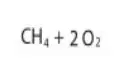
Combustion reactions always include elemental oxygen as a reactant. When a hydrocarbon (substance made up of carbon and hydrogen) reacts with oxygen, the products of the combustion reaction are carbon dioxide and water. Match the products to these reactants. (The correct products will create a balanced equation).


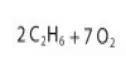
Combustion reactions always include elemental oxygen as a reactant. When a hydrocarbon (substance made up of carbon and hydrogen) reacts with oxygen, the products of the combustion reaction are carbon dioxide and water. Match the products to these reactants. (The correct products will create a balanced equation).
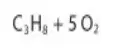
Combustion reactions always include elemental oxygen as a reactant. When a hydrocarbon (substance made up of carbon and hydrogen) reacts with oxygen, the products of the combustion reaction are carbon dioxide and water. Match the products to these reactants. (The correct products will create a balanced equation).
This is the balanced chemical equation for the reaction that produces ammonia (NH3) from nitrogen (N2) and hydrogen (H2): N2(g) + 3 H2(g) → 2 NH3(g). How many moles of ammonia (NH3) would be produced if 2.5 moles of nitrogen (N2) reacted with excess hydrogen (H2)?
A) 1.3 mol NH3
B) 2.5 mol NH3
C) 5.0 mol NH3
D) 7.5 mol NH3
What are the coefficients needed to balance this chemical reaction to show that matter is conserved? Fe + Cl₂ → FeCl₃
1, 1, 1
2, 3, 2
3, 2, 2
4, 2, 2
Jon follows the same steps demonstrated by his teacher. Which additional step would provide Jon with the BEST evidence to support his claim that matter is conserved during the chemical reaction between calcium chloride (CaCl₂) and sodium bicarbonate (NaHCO₃)?
collect and measure the mass of CO₂ gas released during the chemical reaction
measure and compare the total masses of the reactants and products
compare the mass of NaHCO₃ reacted to the mass of NaCl formed
measure and compare the masses of CaCl₂ and CaCO₃
Jon thinks about ways he could increase the rate of the chemical reaction between calcium chloride (CaCl2) and sodium bicarbonate (NaHCO3). Which change would MOST LIKELY increase the rate of the chemical reaction?
use 5 grams of calcium chloride powder instead of 10 grams
use a 1000 mL beaker instead of a 500-mL beaker
use a sodium bicarbonate-water solution that has a temperature of 30°C instead of 25°C
use slow stirring instead of rapid stirring
Jon thinks about ways he could increase the rate of the chemical reaction between calcium chloride (CaCl2) and sodium bicarbonate (NaHCO3).
Which statement BEST explains why an increase in temperature would increase the rate of the chemical reaction?
Fewer molecular collisions would be needed to form the same amount of product.
Molecular collisions would occur more often and with more energy.
Product molecules would have more energy and become a gas.
Reactant and product molecules would be closer together.
Jon does an experiment in which he varies the amount of calcium chloride (CaCl₂) powder used for the chemical reaction with sodium bicarbonate (NaHCO₃). He plans to observe whether the amount of CaCl₂ powder has an effect on reaction rate. Make the most logical prediction for the results of his experiment using the drop-down menus. I predict that using a larger amount of calcium chloride powder will ________ the reaction rate because the calcium chloride molecules will ________.
increase; have more kinetic energy
decrease; balance the number of product molecules
increase; collide more often with other reactant molecuoles
have no effect on; balance the number of product molecules
The balanced chemical equation for the observed reaction is shown: 2 NaHCO₃ + CaCl₂ → CaCO₃ + CO₂ + 2 NaCl + H₂O. Which statement BEST predicts the amount of product produced from a given reactant when the second reactant is in excess?
One mole of water (H₂O) is produced from every two moles of calcium chloride (CaCl₂).
One mole of calcium carbonate (CaCO₃) is produced from every one mole of calcium chloride (CaCl₂).
Two moles of carbon dioxide (CO₂) are produced from every two moles of sodium bicarbonate (NaHCO₃).
Two moles of sodium chloride (NaCl) are produced from every one mole of sodium bicarbonate (NaHCO₃).
Even before the plum pudding model, atoms were known to be neutrally charged. The cathode ray tube experiments provided evidence of ________ particles contained within atoms. These particles are now known as ________. Because atoms were known to be neutrally charged, Thomson concluded that the rest of the atom is ________.
small, negatively charged; electrons; positive
small, positively charged; protons; negative
large, negatively charged; neutrons; negative
large, positively charged; electrons; positive
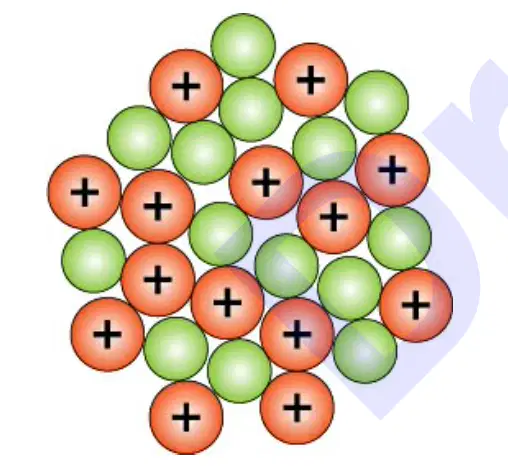
A student draws the nucleus shown.
How many electrons should be added to this model to show a neutrally-charged atom?
7
10
14
18
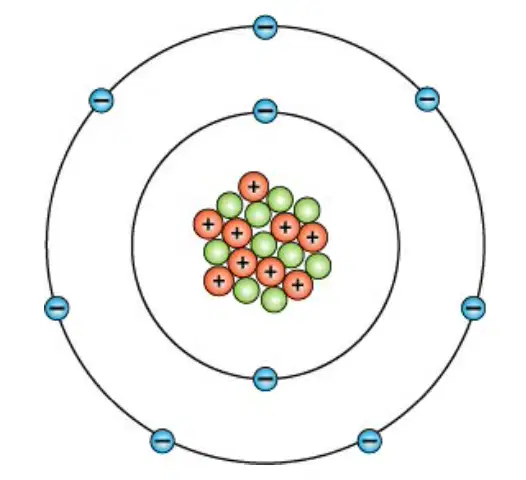
Which element is shown in this model?
Neon
Nickel
Fluorine
Potassium
Which of the following statements is true?
The total number of protons can be used to identify the element.
The total number of neutrons can be used to identify the element.
The total number of electrons can be used to identify the element.
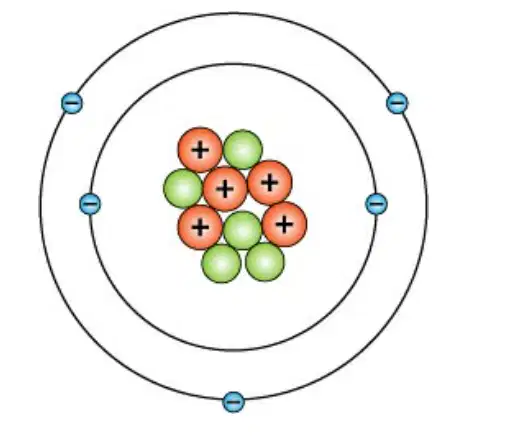
How could the student create a model that shows an isotope of this element?
The student could create a new model with one more proton.
The student could create a new model with one more neutron.
The student could create a new model with three fewer protons.
The student could create a new model with three fewer electrons.
The student wants to create a neutrally-charged carbon atom with an atomic mass of 13 amu. How many subatomic particles should he include in his model?
6 protons, 6 neutrons, and 6 electrons
7 protons, 6 neutrons, and 7 electrons
6 protons, 7 neutrons, and 6 electrons
7 protons, 7 neutrons, and 7 electrons
Which THREE observations would indicate that a chemical
reaction occurred during the investigation?
Bubbles beginning to form in the products.
A solid forming from combining two liquids.
No color change after mixing two clear liquids
A clear liquid turning cloudy after mixing with a powder.
A change in temperature after combining the reactants.
Which observation indicates that a chemical reaction occurred during an investigation?
A clear liquid turns cloudy after mixing with a powder.
A solid forms from combining two liquids.
No color change after mixing two clear liquids.
No change in temperature after combining the reactants.
Investigating Reaction Rates
A student is learning about factors that affect reaction rates. She is given two different tests to observe how substances can react at different rates.
In the first test, the student reacts iron with hydrochloric acid. To setup the reaction, she fills two test tubes with 10 mL of hydrochloric acid solution. She places an iron nail one one test tube and shaved iron filings to another test tube.
In the second test, the student observes the chemical reaction that takes place inside of glow sticks. Before the student starts the chemical reaction, she fills two beakers with water. The first beaker contains cold water, and the second beaker contains hot water. Next, the student cracks two identical glow sticks to start the chemical reaction. She places one of the glow sticks in the cold water and the other glow stick in the hot water. She observes the beakers as the reaction takes place. The picture shows both glow sticks after 60 seconds.
Which TWO questions can the student answer with their investigations?
How does the state of a substance affect the rate of a reaction?
How does the concentration of a substance affect the rate of a reaction?
How can the temperature of reactants affect the rate of reaction?
How does the ratio of reactants affect the rate of a reaction?
How can the surface area of a substance affect the rate of a reaction?
Fe(s) + 2 HCl(aq) → FeCl2 (aq) + H2 (g)
Which observation of this reaction provides the BEST evidence as to how fast the chemical reaction is taking place?
S= Solid, Aq= Aqueous, G= Gas
The rate at which bubbles form in the reaction
The rate at which a solid precipitate forms during the reaction.
The mass of contents in the test tube before the reaction takes place.
The temperature of the contents in the test tube after the reaction takes place.
Fe(s) + 2 HCl(aq) → FeCl2 (aq) + H2 (g)
Why would measuring the rate at which bubbles form during this reaction provide evidence of the rate in which the chemical reaction is taking place?
It shows how quickly hydrogen is forming.
It shows how quickly iron (II) chloride is forming.
It shows how quickly the mass in the beaker is increasing.
It shows how much energy is being released during the reaction.
Fill in the blanks: Increasing the ____________ of the reactants will ____________ the rate of the reaction.
concentration; decrease
temperature; decrease
concentration; not effect
temperature; increase
When an atom gains an electron, the atom will
lose a proton
reduce it's mass
become radioactive
have a negative charge
If an atom has five protons and four electrons, the atom is ____________.
Neutral
Radioactive
negatively charged
positively charged

The natural isotope abundance of copper is shown on the table.
What is the average atomic mass of copper based on this data?
63.1
63.6
64.0
64.4
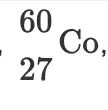
How many protons and neutrons are in this atom?
60 protons, 27 neutrons
27 protons, 60 neutrons
27 protons, 33 neutrons
87 protons, 60 neutrons
Select all of the radiation types that are emitted as a result of changes in an atomic nucleus.
alpha particle
beta particle
x-ray
gamma ray
visible light
What is the mass of 5.00 moles of K2SO4?
34.8 grams
174 grams
675 grams
870 grams
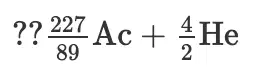
Which atom is the starting material of this nuclear decay process?


How many neutrons are contained in an atom of Sr-88?
50
38
88
36
If an atom has an equal number of protons and electrons, the net charge will be
Positive
Negative
Neutral
None of the above
Which of the following statements about isotopes is true?
Isotopes have the same number of protons but different number of neutrons
Isotopes have the same mass number but different atomic number
Isotopes have the same atomic mass but different chemical properties
Isotopes have the same percent abundance in nature
A nuclear reaction is likely to occur when the nucleus of an atom is
Stable
Unstable
Positively charged
Negatively charged
Which of the following isotopes of Fluorine (F) is most abundant?
F-16
F-21
F-14
F-19
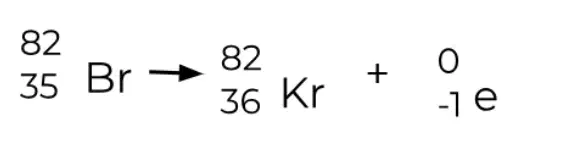
This reaction is an example of:
Alpha Decay
Beta Decay
Gamma Decay
Nuclear Fusion
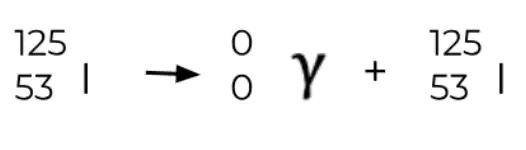
This reaction is an example of:
Alpha Decay
Beta Decay
Gamma Decay
Nuclear Fusion
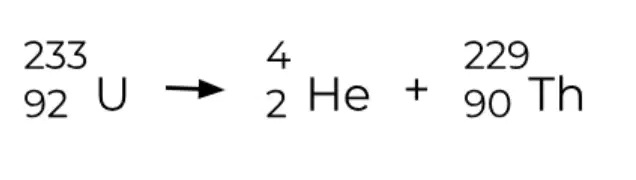
This reaction is an example of:
Alpha Decay
Beta Decay
Gamma Decay
Nuclear Fusion
Convert 25.0 g of Nitrogen (N) into moles.
0.317 moles
3.16 moles
0.524 moles
1.78 moles

