wayground logo

Free Printable Worksheets

Font size

S
M
L
XL
Worksheets

practice final exam

Total questions: 111

Worksheet time: 6hrs 2mins
Name
Class
Date
1.
A proton is a _____ charged particle.
a)
Negatively
b)
Positively
2.
An electron has a _____ charge.
a)
negative
b)
positive
c)
neutral
3.
What number on the element key tells you how many protons an element has?
a)
Atomic Mass
b)
Element name
c)
Atomic number
d)
Element Symbol
4.
Which particles make up the nucleus of an atom?
a)
protons and neutrons
b)
electrons and protons
c)
electrons, protons, and neutrons
d)
electrons and neutrons
5.
Elements can have the same number of protons?
a)
True
b)
False
6.
What is the charge of the neutron?
a)
Negative
b)
Positive
c)
electrical charge
d)
Neutral (no charge)
7.
A proton is a _____ charged particle.
a)
Negatively
b)
Positively
8.
An electron has a _____ charge.
a)
negative
b)
positive
c)
neutral
9.
What number on the element key tells you how many protons an element has?
a)
Atomic Mass
b)
Element name
c)
Atomic number
d)
Element Symbol
10.
Which particles make up the nucleus of an atom?
a)
protons and neutrons
b)
electrons and protons
c)
electrons, protons, and neutrons
d)
electrons and neutrons
11.
Elements can have the same number of protons?
a)
True
b)
False
12.
What is the charge of the neutron?
a)
Negative
b)
Positive
c)
electrical charge
d)
Neutral (no charge)
13.
The following element key shows how many protons?
a)
16
b)
15.999
c)
Oxygen
d)
8
14.
What is the formula to solve for the neutron?
a)
Mass + Atomic Number= Neutrons
b)
Mass x Atomic Number = Neutrons
c)
Mass - Atomic Number = Neutrons
d)
Mass + Number of Protons = Neutron
15.
How did Rutherford discover the proton?
a)
Cathode tube ray experiment
b)
Gold Foil Experiment
c)
Planetary Model
d)
Plum Pudding Model
16.
What scientist is best known for his "Plum Pudding" model of the atom?
a)
J.J. Tomson
b)
Ernest Rutherford
c)
John Dalton
d)
Democritus
17.
What is an isotope? 
a)
A charged atom
b)
An atom with different amounts of neutrons
c)
An atom with different amounts of protons
d)
A neutral atom
18.
As atoms of elements in group 16 are considered in order from top to bottom, the electronegativity of each successive element....
a)
decreases
b)
increases
c)
remains the same
d)
none of the above
19.
As you move down the periodic table atoms get bigger.  This is because ____________.
a)
The atoms have more mass.
b)
The atoms have more protons.
c)
The atoms have more energy levels
d)
The atoms have more nuetrons
20.
As you move across the periodic table atoms tend to get smaller because, ______________.
a)
the atoms have more mass.
b)
the atoms have less mass
c)
the atoms have more protons.
d)
the atoms have less electrons.
21.
Atoms that have a high electronegativity, _______________.
a)
give up their electrons more easily.
b)
hold on to their electrons more tightly.
c)
have more electron shells.
22.
Electronegativity is...
a)
how good an atom is at attracting electrons
b)
the ability of an atom to lose electrons
c)
the energy required to remove an electron from a specific atom
d)
how easy it is to make friends. 
23.
Ionization energy is...
a)
the energy required to add an electron to a specific atom
b)
how much energy it takes to remove an electron from an atom
c)
the energy required to shield the outer electrons from the nucleus
d)
a measure of the ability of an atom to attract electrons
24.

The chemical bond that forms when electrons are transferred is called:

a)

Ionic

b)

hydrogen

c)

covalent

25.

The chemical bond that forms when electrons are shared is called:

a)

Ionic

b)

hydrogen

c)

covalent

26.

When an atom loses or gains an electron it is called a(an)

a)

isotope

b)

compound

c)

ion

d)

molecule

27.

How many valence electrons are shown in the diagram?

a)

16

b)

7

c)

6

d)

2

28.
The ability of a material to be shaped in all directions without cracking or breaking.
a)
hardness
b)
ductility
c)
malleability
d)
conductivity
29.

What is the formula for sodium bromide?

a)

NaBr

b)

NaBr2

c)

Na2Br

d)

SoBr

30.

What is the formula for diphosphorus pentoxide?

a)

P2O5

b)

PO5

c)

P5O2

d)

Po2O5

31.

What is the chemical formula of sulfur hexabromide?

a)

SBr₆

b)

S₆Br

c)

S(VI)Br

d)

SBr4

32.

NaCl is the chemical formula for ______________________>

a)

sodium chloride

b)

sodium chlorine

c)

chlorine sodium

d)

chloride sodium.

33.

Ionic compounds are composed of a metal and non metal . In naming the compound we mention or write the name of the ______________________________first.

a)

metal

b)

non-metal

34.
Ca+2, O-2
a)
CaO
b)
OCa
c)
Ca-2O+2
d)
Ca2O2
35.

What is the formula for:

a)

KS2

b)

S2K

c)

SK2

d)

K2S

36.
At higher temperatures
a)
particles in an object have less energy
b)
particles in an object move faster
c)
a gas contracts
37.

What is happening when my ice cream changes from a solid to a liquid?

a)

freezing

b)

melting

c)

burning

38.

Particles in a ______________________ move quickly and are far apart.

a)

gas

b)

solid

c)

liquid

39.

The slower the particles in a substance move,

a)

the colder it is.

b)

the warmer it is.

c)

the more energy it has.

40.
The temperature of a substance increases as___.
a)
the substance expands
b)
the average kinetic energy of its particles increases
c)
the substance's volume increases
d)
the substance's mass increases
41.

Which of the following is true?

a)

A physical property can only be seen.

b)

A physical property describes how matter can change when exposed to air.

c)

A physical property is something that can be observed about the substance by itself.

d)

A physical property can only be observed when two types of matter interact.

42.

When a substance tarnishes/rust is an example of a

a)

physical property

b)

chemical property

43.
The number 6.02 x 10²³ is called...
a)
Obama's number
b)
Bohr's number
c)
Trump's number
d)
Avogadro's number
44.
What is the molar mass of C2H4O2?
a)
40g
b)
50g
c)
60g
d)
68g
45.
What is the mole used for? 
a)
To measure the amount of grams in a substance
b)
To measure the amount of atoms or molecules in a substance
c)
To measure the amount of energy in a substance
d)
To measure the amount of bonding in a substance 
46.
2 KClO3 → 2 KCl + 3 O2
How many moles of oxygen are produced when 6.7 moles of KClO3 decompose completely?
a)
6.7 mol
b)
1.0 mol
c)
10.1 mol
d)
4.5 mol
47.
2H2   +   O2  →  2H2O
How many moles of water can be produced if 8 moles H2 are used?
a)
4 moles
b)
8 moles
c)
16 moles
d)
2 moles
48.
Cl2 + 2KBr → Br2 + 2KCl
How many grams of potassium chloride (KCl) can be produced from 356 g of potassium bromide (KBr)?
a)
749 g
b)
223 g
c)
479 g
d)
814 g
49.
Balance the following reaction :
 
CaC₂(s)   +   H₂O(l)   -->   C₂H₂(g)   +   Ca(OH)₂(aq)
a)
1,2,2,2
b)
1,2,1,1
c)
2,1,1,1
d)
2,1,2,1
50.
Cations are...
a)
Positive
b)
Negative
c)
Neutral
d)
Purring
51.
Anions are...
a)
Positive
b)
Negative
c)
Neutral
d)
Crying
52.
An atom becomes _________ when it gains electrons.
a)
Positive
b)
Negative
c)
Neutral
d)
Invinsible
53.
An atom becomes _______ when it loses electrons.
a)
Positive
b)
Negative
c)
Neutral
d)
Invinsible
54.
If an element has 3 valence electrons, what charge will likely form on its ion ?
a)
+3
b)
+5
c)
-3
d)
-5
55.
Valence electrons are: 
a)
Electrons farthest away from the nucleus
b)
Electrons closest to the nucleus
c)
Electrons that just come and go - they don't stay with the atom
56.
If an atom has an equal number of protons and electrons it is a...
a)
Positive ion
b)
Negative ion
c)
Isotope
d)
Neutral atom
57.
How many neutrons does chlorine have?
a)
17
b)
35
c)
18
58.
Fill in the blank:
The law of conservation of mass states that matter cannot be created nor __________________.
a)
destroyed
b)
rearranged
c)
transferred
d)
changed
59.
Fill in the blank:
A __________________ chemical equation shows that the same number of atoms in the reactants are also in the product.
a)
balanced
b)
transferred
c)
rearranged
d)
beautiful
60.
The following chemical reaction occurs:
2S + 3O2 -> 2SO3
How many atoms of oxygen are there in the reactant?
a)
2 atoms of oxygen
b)
3 atoms of oxygen
c)
6 atoms of oxygen
d)
1 atom of oxygen
61.
The following chemical equation occurs:
CH+ 2O-> CO+ 2H2O
Does this equation follow the law of conservation of mass?  In other words, are there the same number of carbon, hydrogen, and oxygen atoms in the reactants and the products?
a)
Yes
b)
No
c)
You can't tell with the given information 
62.
KNO3 --> KNO2 + O2
What coefficients are needed to balance the reaction?
a)
2, 2, 1
b)
2, 3, 2
c)
1, 2, 2
d)
1, 3, 1
63.
Cu2O + C --> Cu + CO2
What coefficient goes in front of Cu?
a)
1
b)
2
c)
3
d)
4
64.
Ca + O2 --> CaO
What coefficient goes in front of CaO?
a)
1
b)
2
c)
3
d)
4
65.
Substance that consists of one type of atom.  It is a pure substance. Found on the Periodic Table. 
a)
Element
b)
Compound
c)
Mixture
d)
I don't know
66.
Combinations of 2 or more substances (elements and compounds) that are physically blended together. 
a)
Compound
b)
Mixture
c)
Element
d)
Substance
67.
Salad is an example of...
a)
a mixutre
b)
an element
c)
a compound
68.
Pure oxygen (O) is an example of...
a)
an element
b)
a mixture
c)
a compound
69.
An example of ...
a)
A mixture
b)
A compound
c)
An element 
70.
The SI unit for volume is the __________.
a)
liter
b)
meter
c)
ounce
d)
gram
e)
gallon
71.
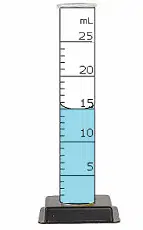
What is the correct volume of the liquid?
a)
15.1 ml
b)
15 ml
c)
16 ml
d)
14.9 ml
72.
Which is a correct measurement reading for the length of the screw?
a)
5.1 cm
b)
5.10 cm
c)
5.100 cm
d)
5.01 cm
73.
When a sample of gas is heated, its thermal energy ______ and the particles move_____.
a)
Increases; slower
b)
Decreases; slower
c)
Increases; faster
d)
Decreases; faster
74.
As the temperature of a liquid substance increases the average energy of the particles _________ and the space between the particles ____________.
a)
stays the same; increases
b)
increases; decreases
c)
increases; increases
d)
increases; stays the same
75.
What would be the correct nuclear notation for an atom with 7 neutrons and 8 protons?
a)
Option 1
b)
Option 2
c)
Option 3
d)
Option 4
76.
How many energy levels of electrons are occupied in a phosphorus atom?
a)
1
b)
4
c)
2
d)
3
77.
All elements in the same family or group have similar numbers of:
a)
total electrons
b)
inner electrons
c)
valence electrons
d)
protons
78.
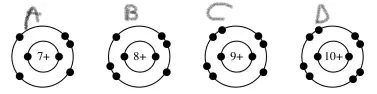
Oxygen is a gas important for life and represents about 21% of Earth’s atmosphere. Which of the following illustrations below best represents a Bohr diagram of an oxygen atom?
a)
A
b)
B
c)
C
d)
D
79.
Which is the correct electron dot representation of an atom of sulfur in the ground state?
a)
A
b)
B
c)
C
d)
D
80.
As you move down a group of the periodic table, the atomic radii of the elements
a)
increase
b)
decrease
c)
remain constant
d)
show no pattern
81.
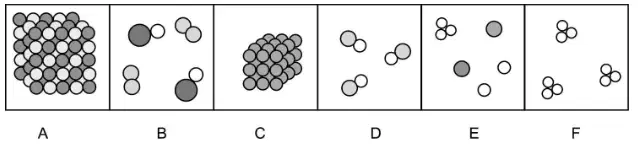
A mixture of elements
a)
E
b)
A
c)
B
d)
C
e)
D
82.
Which of the following is an example of a physical change?
a)
sugar and oxygen reacting to produce water and carbon dioxide
b)
honey dissolving in tea
c)
a raw egg being cooked
d)
metal rusting after being left out in the rain
83.

An unknown metal, X, combines with nitrogen to form the compound XN. Metal X also combines with oxygen to produce X2O3. Metal X is most likely which of the following elements?

a)

Lithium, Li

b)

Magnesium, Mg

c)

Tin, Sn

d)

Gallium, Ga

84.
The substances listed on the right side of a chemical equation are the
a)
Yields
b)
Reactants
c)
Products
d)
Precipitates
85.
In balancing chemical equations, we change
a)
Coefficients
b)
Subscripts
c)
Both can be changed
d)
None can be changed
86.
a)
Synthesis
b)
Decomposition
c)
Single replacement
d)
Combustion
87.
In what type of reaction do two or more substances come together to form a single product?
a)
Synthesis
b)
Decomposition
c)
Single replacement
d)
Combustion
88.

How many particles are found in a mole?

a)

6.022 x 10236.022\ x\ 10^{23}  

b)

6.022 x 10236.022\ x\ 1023  

c)

6022 x 10236022\ x\ 10^{23}  

d)

6022 x 10236022\ x\ 1023  

89.

What are the units used for Molar Mass

a)

grams

b)

mols

c)

g/mol

d)

mol/g

90.

How many grams are in 1 mole of Mg?

a)

12 grams

b)

24 grams

c)

36 grams

d)

6.022 x 10²³ grams

91.

How many grams are in 3 mol of carbon?

a)

6 grams

b)

12 grams

c)

18 grams

d)

36 grams

92.

Find the formula weight of Sugar - C12H22O11

a)

198.176 amu

b)

342.308 amu

c)

144.132 amu

d)

29.019

93.

When a question gives you moles and asks you to calculate mass, where do you find the mass to use?

a)

22.4 grams

b)

Periodic Table

grams

c)

Periodic Table

grams/mole

d)

6.02 x 10²³ grams

94.

When a question asks you to calculate molecules, your units should be

a)

liters

b)

grams

c)

molecules

d)

atoms

95.

How many moles are in 19.82 g Mg?

a)

1.226mol Mg

b)

1.000mol Mg

c)

481.7mol Mg

d)

0.8156mol Mg

96.

How many grams of Hydrogen are there in 25 moles of water?

a)

25

b)

450

c)

18

d)

50

97.
What is the mass of 2.50 mol of oxygen gas O2?
a)
40 g
b)
80 g
c)
16 g
d)
32 g
98.

Letter for heat energy...

a)

q

b)

m

c)

c

d)

ΔT

99.

Letter for specific heat

a)

q

b)

m

c)

c

d)

ΔT

100.

Letter for change in temperature

a)

q

b)

m

c)

c

d)

ΔT

101.

Letter for mass

a)

q

b)

m

c)

c

d)

ΔT

102.

Identify the given q in problem:

a)

15.75 g

b)

1086.75 J

c)

150°C

d)

unknown (aka ?)

103.

What is the unknown in this problem?

a)

q

b)

m

c)

c

d)

ΔT

104.

Calorimetry is the measurement of the ___________

(Choose the best answer below.)

a)

transfer of heat into or out of a system (reaction/process)

b)

change in temperature

c)

amount of energy required to raise the temperature of 1 gram of the substance by 1°C.

d)

change in the mass of a substance throughout a reaction.

105.

Shown are the units for....

a)

specific heat capacity

b)

mass

c)

temperature

d)

energy

106.

Q = mCpΔT , Q is....

a)

energy

b)

change in temperature

c)

specific heat

d)

mass

107.

When a  piece of aluminum foil is taken out of the oven and cools from 125° C to 53°C, What is the change in temperature?

a)

72°C

b)

178°C

c)

125°C

d)

53°C

108.
How does heat flow?
a)
Always from cold to warm
b)
Always from warm to cold
c)
Both warm to cold & cold to warm
d)
It depends on the temperature
109.
The Law of Conservation of Energy states:
a)
Energy can created or destroyed but not transformed 
b)
Energy cannot be created or destroyed, it can only transformed
c)
Energy can't be created, destroyed or transformed
110.
The specific heat of aluminum is 0.21 cal/g°C.  How much heat(Q) is released when a 10 g piece of aluminum foil is taken out of the oven and cools from 100° to 50°?
a)
105 J
b)
10.5 J
c)
1.05 J
111.
20 g of water. specific heat of water is 4.18 J/x°C.  temperature changes from 25° C to 20° Chow much heat energy (Q) moves from the water to the surroundings?
a)
418 Joules
b)
209 J
c)
83 J
d)
4.18 J