
 Worksheets
AP 5 Kinetics BANK
Total questions: 112
Worksheet time: 1hrs 6mins

Which of the following will most likely increase the rate of the reaction represented above?
Decreasing the temperature of the reaction system
Adding a heterogeneous catalyst to the reaction system
Increasing the volume of the reaction vessel using a piston
Removing some H2(g) from the reaction system

An experiment is performed to measure the mass percent of CaCO3(s) in eggshells. Five different samples of CaCO3(s) of known mass react with an excess of 2.0MHCl(aq) in identical sealed, rigid reaction vessels. The pressure of the gas produced is measured with a pressure gauge attached to the reaction vessel. Since the reaction is exothermic, the reaction system is cooled to its original temperature before the pressure is recorded.
Which of the following modifications will increase the rate of the reaction the most?
Using 2.0M CH3COOH(aq) instead of 2.0M HCl(aq)
Cooling the HCl(aq) to a lower temperature than it was in the original experiment
Reducing the volume of the reaction vessel
Using eggshells that are more finely powdered than those used in the original experiment
Two solid reactants of varying particle size are combined in a vessel. Assuming that the same mass of each reactant is used in each case, which of the following represents the conditions that will result in the fastest reaction rate?


Each student in a class placed a 2.00 g sample of a mixture of Cu and Al in a beaker and placed the beaker in a fume hood. The students slowly poured 15.0 mL of 15.8 M HNO3(aq) into their beakers. The reaction between the copper in the mixture and the HNO3(aq) is represented by the equation above. The students observed that a brown gas was released from the beakers and that the solutions turned blue, indicating the formation of Cu2+(aq). The solutions were then diluted with distilled water to known volumes. In one student’s experiment the reaction proceeded at a much slower rate than it did in the other students’ experiments. Cu(s)+4 HNO3→Cu(NO3)2+2NO2(g)+2H2O Which of the following could explain the slower reaction rate?
In the student’s sample the metal pieces were much smaller than those in the other students’ samples.
The student heated the reaction mixture as the HNO3(aq) was added.
The student used a 1.5 M solution of HNO3(aq) instead of a 15.8 M solution of HNO3(aq).
The student used a 3.00 g sample of the mixture instead of the 2.00 g sample that was used by the other students.
A 0.50g sample of Mg(s) was placed in a solution of HCl(aq), where it reacted completely.
In a third experiment, 0.10g samples of Mg(s) are placed in excess HCl(aq) of various concentrations: 0.050M, 0.10M, 0.25M, and 0.50M. The reactions are run in successive order from 0.050M to 0.50M, and the time required for each reaction to go to completion is recorded. As the concentration of HCl(aq) increases from 0.050M to 0.50M, which of the following is the expected result?
The reaction time increases, and the rate of the reaction decreases.
The reaction time decreases, and the rate of the reaction increases.
Both the reaction time and the rate of the reaction increase.
Both the reaction time and the rate of the reaction decrease.
H3AsO4 + 3 I– + 2 H3O+ → H3AsO3 + I3– + H2O
The oxidation of iodide ions by arsenic acid in acidic aqueous solution occurs according to the stoichiometry shown above. The experimental rate law of the reaction is:
Rate = k[H3AsO4] [I–] [H3O+]
According to the rate law for the reaction, an increase in the concentration of hydronium ion has what effect on this reaction?
The rate of reaction increases.
The rate of reaction decreases.
The value of the equilibrium constant increases.
The value of the equilibrium constant decreases.
Neither the rate nor the value of the equilibrium constant is changed.
Step 1: Cl(g) + O3(g) → ClO(g) + O2(g)
Step 2: ClO(g) + O(g) → Cl(g) + O2(g)
A proposed mechanism for destruction of ozone gas in the stratosphere is represented above. Which of the following is evidence that the mechanism is occurring?
The presence of Cl(g) increases the rate of the overall reaction.
The presence of Cl(g) decreases the rate of the overall reaction.
The presence of Cl(g) increases the equilibrium constant of the overall reaction.
The presence of Cl(g) decreases the equilibrium constant of the overall reaction.
C2H4(g) + H2(g) →platinum→ C2H6(g)
C2H4(g) is reduced by H2(g) in the presence of a solid platinum catalyst, as represented by the equation above. Factors that could affect the rate of the reaction include which of the following?
1. Changes in the partial pressure of H2(g)
2. Changes in the particle size of the platinum catalyst
3. Changes in the temperature of the reaction system
3 only
1 and 2 only
1 and 3 only
2 and 3 only
1, 2, and 3
5 H2O2(aq) + 2 MnO4-(aq) + 6 H+(aq) → 2 Mn2+(aq) + 8 H2O(l) + 5 O2(g)
In a titration experiment, H2O2(aq) reacts with aqueous MnO4-(aq) as represented by the equation above. The dark purple KMnO4 solution is added from a buret to a colorless, acidified solution of H2O2(aq) in an Erlenmeyer flask. (Note: At the end point of the titration, the solution is a pale pink color.)
At a certain time during the titration, the rate of appearance of O2(g) was 1.0 x 10⁻³ mol/(L⋅s). What was the rate of disappearance of MnO4- at the same time?
6.0 x 10⁻³ mol/(L⋅s)
4.0 x 10⁻³ mol/(L⋅s)
6.0 x 10⁻⁴ mol/(L⋅s)
4.0 x 10⁻⁴ mol/(L⋅s)
A kinetics experiment is set up to collect the gas that is generated when a sample of chalk, consisting primarily of solid CaCO3, is added to a solution of ethanoic acid, CH3COOH. The rate of reaction between CaCO3 and CH3COOH is determined by measuring the volume of gas generated at 22oC and 1 atm as a function of time. Which of the following experimental conditions is most likely to increase the rate of gas production?
Decreasing the volume of ethanoic acid solution used in the experiment
Decreasing the concentration of the ethanoic acid solution used in the experiment
Decreasing the temperature at which the experiment is performed
Decreasing the particle size of the CaCO3 by grinding it into a fine powder

2 H2O2(aq) →KI(s)→ 2 H2O(l) + O2(g)
Rate=k[H2O2]
A student performed an experiment to study the factors that affect the rate of the first-order catalytic decomposition of H2O2(aq), represented above.
The student monitored the volume of O2(g) produced over time as the reaction proceeded. The data from two trials are plotted in the graph above. Which of the following best explains the results of trial 2 compared with those of trial 1 ?
The reaction temperature in trial 2 was higher than it was in trial 1.
The volume of the reaction vessel was larger in trial 2 than it was in trial 1.
The student used a smaller amount of KI(s) in trial 2 compared with that used in trial 1.
The concentration of H2O2(aq) was lower in trial 2 than it was in trial 1.

A 0.35 g sample of Li(s) is placed in an Erlenmeyer flask containing 100 mL of water at 25°C. A balloon is placed over the mouth of the flask to collect the hydrogen gas that is generated.
After all of the Li(s) has reacted with H2O(l), the solution in the flask is added to a clean, dry buret and used to titrate an aqueous solution of a monoprotic acid. The pH curve for this titration is shown in the diagram below
Which of the following changes will most likely increase the rate of reaction between Li(s) and water?
Using 125 mL of water instead of 100 mL
Using a 0.25 g sample of Li(s) instead of a 0.35 g sample
Using a 0.35 g sample of Li(s) cut into small pieces
Decreasing the water temperature before adding the Li(s)

Two samples of Mg(s) of equal mass were placed in equal amounts of HCI(aq) contained in two separate reaction vessels. Particle representations of the mixing of Mg(s) and HCI(aq) in the two reaction vessels are shown in Figure 1 and Figure 2 above. Water molecules are not included in the particle representations. Which of the reactions will initially proceed faster, and why?
The reaction in Figure 1, because the atoms of Mg are more concentrated than those in Figure 2
The reaction in Figure 1, because the Mg(s) in Figure 1 has a larger mass than the Mg(s) in Figure 2
The reaction in Figure 2, because more Mg atoms are exposed to HCI(aq) in Figure 2 than in Figure 1
The reaction in Figure 2, because the Mg(s) in Figure 2 has less surface area than the Mg(s) in Figure 1

HCl(aq)+CaCO3(s)→CaCl2(aq)+CO2(g)+H2O(l)
The reaction between HCl(aq) and CaCO3(s) is represented by the equation above. Two separate trials were carried out using CaCO3(s) samples of the same mass, but one sample was a single piece of CaCO3(s), and one sample was composed of small pieces of CaCO3(s). The loss of mass of CaCO3(s) as a function of time for both trials is shown in the graph below.
Which of the curves, X or Y, represents the reaction with small pieces of CaCO3(s), and why?
Curve X, because it shows that the reaction proceeded at a uniform rate
Curve X, because it takes a shorter time for the reaction to go to completion due to the larger surface area of CaCO3(s).
Curve Y, because it shows that the reaction proceeded at a nonuniform rate.
Curve Y, because it takes a shorter time for the reaction to go to completion due to the larger surface area of CaCO3(s).
Relatively slow rates of chemical reaction are associated with which of the following?
The presence of a catalyst
High temperature
High concentration of reactants
Strong bonds in reactant molecules
Low activation energy
A kinetics experiment is set up to collect the gas that is generated when a sample of chalk, consisting primarily of solid CaCO3, is added to a solution of ethanoic acid, CH3COOH. The rate of reaction between CaCO3 and CH3COOH is determined by measuring the volume of gas generated at 25oC and 1 atm as a function of time. Which of the following experimental conditions is most likely to increase the rate of gas production?
Decreasing the volume of ethanoic acid solution used in the experiment
Decreasing the concentration of the ethanoic acid solution used in the experiment
Decreasing the temperature at which the experiment is performed
Decreasing the particle size of the CaCO3 by grinding it into a fine powder
X + 2 Y → Z + 3 Q
For the reaction represented above, the initial rate of decrease in [X] was 2.8 × 10⁻³ mol L-1 s-1. What was the initial rate of decrease in [Y] ?
7.0 × 10⁻⁴ mol L-1 s-1
1.4 × 10⁻³ mol L-1 s-1
2.8 × 10⁻³ mol L-1 s-1
5.6 × 10⁻³ mol L-1 s-1
1.1 × 10⁻² mol L-1 s-1

2 C2H4(g) + 13 O2(g) --> 8CO2(g) + 10H2O(l)
If butane is consumed at an average rate of -0.116 moles/s, determine the rate of production of CO2.
0.464 mol/s
-0.464 mol/s
0.0290 mol/s
-0.0290 mol/s

The initial-rate data in the table above were obtained for the reaction represented below. What is the experimental rate law for the reaction?
2 NO(g)+O2(g) → NO2(g)
Rate = k[NO][O2]
Rate = k[NO][O2]2
Rate = k[NO]2[O2]
Rate = k[NO]2[O2]2

The table above shows the results from a rate study of the reaction X + Y → Z. Starting with known concentrations of X and Y in experiment 1, the rate of formation of Z was measured. If the reaction was first order with respect to X and second order with respect to Y, the initial rate of formation of Z in experiment 2 would be
Rate/4
Rate/2
Rate
2Rate
4Rate

An experiment was conducted to determine the rate law for the reaction A2(g)+B(g) → A2B(g) . The table above shows the data collected. Based on the data in the table, which statement is correct?
Since the rate law can be expressed as rate=k[A2]2 , tripling the concentration of A2 will cause a 9-fold increase in the rate of the reaction.
Since the rate law can be expressed as rate = k[A2][B] , doubling the concentrations of A2A2 and BB will quadruple the rate of the reaction.
Since the rate law can be expressed as rate=[A2]2[B] , tripling the concentration of A2A2 while keeping the concentration of BB constant will triple the rate of the reaction.
Since the rate law can be expressed as rate=k[A2][B]2 , doubling the concentration of BB while keeping the concentration of A2A2 constant will double the rate of the reaction.

The initial rates of the reaction represented by the equation shown above were measured for different initial concentrations of NO(g) and Cl2(g). Based on the data given in the table above, which of the following is the rate law expression for the reaction, and why?
Rate=k[NO]2, because the initial rate quadrupled when [NO] was doubled but remained constant when [Cl2] was doubled.
Rate=k[NO][Cl2], because the initial rate doubled when either [NO] or [Cl2] was doubled.
Rate=k[NO][Cl2]2, because the initial rate doubled when [NO]was doubled and quadrupled when [Cl2] was doubled.
Rate=k[NO]2[Cl2], because the initial rate quadrupled when [NO] was doubled and doubled when [Cl2] was doubled.
S2O82−(aq)+3I−(aq) → 2 SO42−(aq)+I3−(aq)
In aqueous solution, the reaction represented by the balanced equation shown above has the experimentally determined rate law: rate=k[S2O8 2−][I −].
If the concentration of [S2O8 2−] is doubled while keeping [I −] constant, which of the following experimental results is predicted based on the rate law, and why?
The rate of reaction will remain the same, because k will decrease by half.
The rate of reaction will double, because the rate is directly proportional to [S2O8 2−].
The rate of reaction will increase by a factor of four, because two moles of SO4 2− are produced for each mole of S2O8 2− consumed.
The rate of reaction will increase by a factor of four, because the reaction is second order overall.
Rate = k[M][N]2
The rate of a certain chemical reaction between substances M and N obeys the rate law above. The reaction is first studied with [M] and [N] each 1 x 10⁻³ molar. If a new experiment is conducted with [M] and [N] each 2 x 10⁻³ molar, the reaction rate will increase by a factor of
2
4
6
8
16
The rate law for the reaction of nitrogen dioxide and chlorine is found to be rate = k [NO2]2[Cl2]. By what factor does the rate of the reaction change when the concentrations of both NO2 and Cl2 are doubled?
2
3
4
6
8

The data in the table above were obtained for the reaction X + Y → Z. Which of the following is the rate law for the reaction?
Rate = k[X]2
Rate = k[Y]2
Rate = k[X][Y]
Rate = k[X]2[Y]
Rate = k[X][Y]2
H3AsO4 + 3 I– + 2 H3O+ → H3AsO3 + I3– + H2O
The oxidation of iodide ions by arsenic acid in acidic aqueous solution occurs according to the stoichiometry shown above. The experimental rate law of the reaction is:
Rate = k[H3AsO4] [I–] [H3O+]
What is the order of the reaction with respect to I–?
1
2
3
5
6
What will happen to the rate of reaction if the concentration of A is doubled and the concentration of B is tripled?

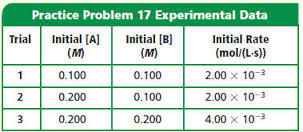

2ClO2(aq) + 2OH-(aq) —> ClO3(aq) + ClO2-(aq) + H2O(l) was studied with the following results:
Calculate the rate constant with proper units.

What is the rate law for the reaction?
What is the overall order of reaction?


X → products
Pure substance X decomposes according to the equation above. Which of the following graphs indicates that the rate of decomposition is second order in X ?


2 HO2 → H2O2+O2
The reaction represented by the chemical equation shown above occurs in Earth’s atmosphere. In an experiment, [HO2] was monitored over time and the data plotted as shown in the following graph.
Based on the information, which of the following is the rate law expression for the reaction?
Rate=k
Rate=k[HO2]
Rate=k[HO2]2
Rate=k[H2O2][O2]
After a certain pesticide compound is applied to crops, its decomposition is a first-order reaction with a half-life of 56 days. What is the rate constant, k, for the decomposition reaction?
0.012/day
0.018/day
56/day
81/day
After a certain pesticide compound is applied to crops, its decomposition is a first-order reaction with a half-life of 32.5 days. What is the rate constant, k, for the decomposition reaction?
0.0213 /day
0.0308 /day
32.5 /day
46.9 /day
If the oxygen isotope 20O has a half-life of 15 seconds, what fraction of a sample of pure 20O remains after 1.0 minute?
1/2
1/4
7/30
1/8
1/16
The isomerization of cyclopropane to propylene is a first-order process with a half-life of 19 minutes at 500oC. The time it takes for the partial pressure of cyclopropane to decrease from 1.0 atmosphere to 0.125 atmosphere at 500oC is closest to
38 minutes
57 minutes
76 minutes
152 minutes
190 minutes
The rate constant (k) for the decay of the radioactive isotope I-131 is 3.6E−3 /hour. The slope of which of the following graphs is correct for the decay and could be used to confirm the value of k ?


2 H2O2(aq) → 2 H2O(l) + O2(g) ΔH° = −196 kJ/molrxn
The decomposition of H2O2(aq) is represented by the equation above. A student monitored the decomposition of a 1.0 L sample of H2O2(aq) at a constant temperature of 300. K and recorded the concentration of H2O2 as a function of time. The results are given in the table below.
Which of the following statements is a correct interpretation of the data regarding how the order of the reaction can be determined?
The reaction must be first order because there is only one reactant species.
The reaction is first order if the plot of ln [H2O2] versus time is a straight line.
The reaction is first order if the plot of 1/[H2O2] versus time is a straight line.
The reaction is second order because 2 is the coefficient of H2O2 in the chemical equation.
Gaseous cyclobutene undergoes a first-order reaction to form gaseous butadiene. At a particular temperature, the partial pressure of cyclobutene in the reaction vessel drops to one-eighth its original value in 124 seconds. What is the half-life for this reaction at this temperature?
15.5 sec
31.0 sec
41.3 sec
62.0 sec
124 sec
If 87.5 percent of a sample of pure 131I decays in 24 days, what is the half-life of 131I?
6 days
8 days
12 days
14 days
21 days

X → Products
A student studied the kinetics of the reaction represented above by measuring the concentration of the reactant, X, over time. The data are plotted in the graph below.
Which of the following procedures will allow the student to determine the rate constant, k , for the reaction?
Plot ln [X] versus time and determine the magnitude of the slope.
Plot 1/[X] versus time and determine the magnitude of
the slope.
Run another trial of the experiment with a different initial concentration, plot the data on the same graph, and see where the curves intersect.
Run another trial of the experiment at a different temperature, plot the data on the same graph, and see where the curves have the same slope.
The half-life of 55Cr is about 2.0 hours. The delivery of a sample of this isotope from the reactor to a certain laboratory requires 12 hours. About what mass of such material should be shipped in order that 1.0 mg of 55Cr is delivered to the laboratory?
130 mg
64 mg
32 mg
11 mg
1.0 mg

2N2O5(g) → 4NO2(g) + O2(g)
A sample of N2O5 was placed in an evacuated container, and the reaction represented above occurred. The value of PN2O5 , the partial pressure of N2O5(g), was measured during the reaction and recorded in the table below.
Which of the following correctly describes the reaction?
The decomposition of N2O5 is a zero-order reaction.
The decomposition of N2O5 is a first-order reaction.
The decomposition of N2O5 is a second-order reaction.
The overall reaction order is 3.

H2O2 → H2O + 1/2 O2
Hydrogen peroxide decomposes to produce water and oxygen according to the equation above. An experimentally determined graph for the first-order decomposition of hydrogen peroxide is provided below.
Which of the following best identifies the rate constant k for the reaction based on the information in the plot of ln[H2O2] versus time (t) ?
k= ln[H2O2] at t=0s
k= ln[H2O2] at t=500s
k=−(slope of plot)
k=−1/(slope of plot)

A reaction was observed for 20 days and the percentage of the reactant remaining after each day was recorded in the table above. Which of the following best describes the order and the half-life of the reaction?
1st Reaction Order; 3 day Half-Life
1st Reaction Order; 10 day Half-Life
2nd Reaction Order; 3 day Half-Life
2nd Reaction Order; 10 day Half-Life

Consider the reaction represented by the equation 2 X + 2 Z → X2Z2. During a reaction in which a large excess of reactant X was present, the concentration of reactant Z was monitored over time. A plot of the natural logarithm of the concentration of Z versus time is shown in the figure above. The order of the reaction with respect to reactant Z is
zero order
first order
second order
third order

The graph above shows the results of a study of the reaction of X with a large excess of Y to yield Z. The concentrations of X and Y were measured over a period of time. According to the results, which of the following can be concluded about the rate law for the reaction under the conditions studied?
It is zero order in [X].
It is first order in [X].
It is second order in [X].
It is first order in [Y].
The overall order of the reaction is 2.

C25H30N3+ (violet) + OH- --> C25H30N3+ (colorless) is a first order reaction in the presence of excess OH-(aq). A 10.0 mL sample of 0.10 M NaOH(aq) is mixed with a 10.0 mL sample of 2.5 x 10⁻⁵ M C25H30N3+(aq). A 5.0 mL sample of the mixture is quickly transferred to a clean cuvette and placed in a spectrophotometer, and the progress of the reaction is measured. Approximately how long did it take for 75 percent of the initial amount of C25H30N3+ (aq) to react?
75 s
225 s
300 s
600 s

In the diagram above, where would the greatest number of successful collisions occur?
To the left of the activation energy line.
To the right of the activation energy line under curve T1.
To the right of the activation energy line under curve T2.
What effect will increasing [H+] at constant temperature have on the reaction below?
Cl-(aq) + ClO-(aq) + 2H+ (aq) → Cl2(g) + H2O (l)
The value of the rate constant will increase.
The frequency of collisions between H+(aq) ions and ClO-(aq) ions will increase.
The activation energy of the reaction will increase.
The activation energy of the reaction will decrease.
Lowering the temperature of a reaction will result in which of the following?
a decrease in the mass of the molecules which causes fewer successful collisions.
an increase in the number of successful collisions between molecules.
a decrease in the concentration of reacting molecules.
a decrease in the kinetic energy of the molecules which causes fewer successful collisions.
The energy needed by colliding molecules to break bonds.
start up energy
crash energy
collision energy
activation energy

Which curve on the diagram would produce more successful collisions?
the red curve because it represents a lower temperature
the purple curve because it represents a higher temperature
the red curve because it represent a higher temperature
the purple curve because is represents a lower temperature
A lower temperature in a lab would cause a reaction to slow for what reasons?
more collisions between molecules and a higher concentration of molecules
concentration of molecules would decrease and molecules would start to decay
the molecules would decay at a slower rate and molecules would lose kinetic energy
molecules would lose kinetic energy and there would be fewer collisions
For a collision to be successful, molecules must ..
have enough kinetic energy and mass.
never collide.
have enough kinetic energy and the correct orientation.
have the correct orientation and mass.
Cl−(aq) + ClO−(aq) + 2 H+(aq) → Cl2(g) + H2O(l)
What effect will increasing [H+] at constant temperature have on the reaction represented above?
The activation energy of the reaction will increase.
The activation energy of the reaction will decrease.
The frequency of collisions between H+(aq) ions and ClO−(aq) ions will increase.
The value of the rate constant will increase.
The gas-phase reaction A2(g)+B2(g)→2 AB(g) is assumed to occur in a single step. Two experiments were done at the same temperature inside rigid containers. The initial partial pressures of A2 and B2 used in experiment 1 were twice the initial pressures used in experiment 2. Which statement provides the best comparison of the initial rate of formation of AB in experiments 1 and 2 ?
The initial rate of formation of AB is the SAME in both experiments because they were done at the same temperature and the frequency and energy of the collisions between A2 and B2 would have been about the same.
The initial rate of formation of AB is SLOWER in experiment 1 than in with experiment 2 because at the same temperature, a higher pressure would reduce the volume available for A2 and B2 molecules to achieve the proper orientation for a successful collision.
The initial rate of formation of AB is FASTER in experiment 1 than in experiment 2 because at a higher pressure the collisions between A2 and B2 molecules would have been more frequent, increasing the probability of a successful collision.
The initial rate of formation of AB is FASTER in experiment 1 than in experiment 2 because at a higher pressure a larger fraction of the A2 and B2 molecules would have the minimum energy required to overcome the activation energy barrier.
Which of the following best helps explain why an increase in temperature increases the rate of a chemical reaction?
At higher temperatures, reactions have a lower activation energy.
At higher temperatures, reactions have a higher activation energy.
At higher temperatures, every collision results in the formation of product.
At higher temperatures, high-energy collisions happen more frequently.
Factors that affect the rate of a chemical reaction include which of the following?
1. Frequency of collisions of reactant particles
2. Kinetic energy of collisions of reactant particles
3. Orientation of reactant particles during collisions
2 only
1 and 2 only
1 and 3 only
2 and 3 only
1, 2, and 3

NO(g) + NO3(g) → 2 NO2(g)
The reaction between NO(g) and NO3(g) is represented by the equation above. Which of the
following orientations of collision between NO(g) and NO3(g) is most likely to be effective?


The proposed rate-determining step for a reaction is 2 NO2(g)→NO3(g)+NO(g). The graph above shows the distribution of energies for NO2(g) molecules at two temperatures. Based on the graph, which of the following statements best explains why the rates of disappearance of NO2(g) are different at temperature 2 and temperature 1 ?
NO2 is consumed at a faster rate at temperature 2 because more molecules possess energies at or above the minimum energy required for a collision to lead to a reaction compared to temperature 1.
NO2 is consumed at a faster rate at temperature 2 because the molecules have a wider range of energies allowing for a better orientation during a collision compared to temperature 1.
Fewer NO2 molecules have a relatively high energy at temperature 1, which favors collisions between molecules rather than between the molecules and the container, leading to a faster rate of disappearance compared to temperature 2.
More NO2 molecules have a relatively low energy at temperature 1, which increases the number of effective collisions taking place and the rate of disappearance compared to temperature 2.
NO(g) + NO3(g) → 2 NO2(g)
rate = k[NO][NO3]
The reaction represented above occurs in a single step that involves the collision between a particle of NO and a particle of NO3. A scientist correctly calculates the rate of collisions between NO and NO3 that have sufficient energy to overcome the activation energy. The observed reaction rate is only a small fraction of the calculated collision rate. Which of the following best explains the discrepancy?
The energy of collisions between two reactant particles is frequently absorbed by collision with a third particle.
The two reactant particles must collide with a particular orientation in order to react.
The activation energy for a reaction is dependent on the concentrations of the reactant particles.
The activation energy for a reaction is dependent on the temperature.
Step 1: H2+ICl→HI+HCl (slow)
Step 2: HI+ICl→HCl+I2 (fast)
The reaction is carried out at constant temperature inside a rigid container. Based on this mechanism, which of the following is the most likely reason for the different rates of step 1 and step 2 ?
The only factor determining the rate of step 2 is the orientation of the HI and ICl polar molecules during a collision, but it has a negligible effect when H2 and ICl molecules collide.
The amount of energy required for a successful collision between H2 and ICl is greater than the amount of energy required for a successful collision between HI and ICl.
The fraction of molecules with enough energy to overcome the activation energy barrier is lower for HI and ICl than for H2 and ICl.
The frequency of collisions between H2 and ICl is greater than the frequency of collisions between HI and ICl.
Which of the following best describes the role of the spark from the spark plug in an automobile engine?
The spark decreases the energy of activation for the slow step.
The spark increases the concentration of the volatile reactant.
The spark supplies some of the energy of activation for the combustion reaction.
The spark provides a more favorable activated complex for the combustion reaction.
The spark provides the heat of vaporization for the volatile hydrocarbon.
Which of the following statements best explains why an increase in temperature of 5-10 Celsius degrees can substantially increase the rate of a chemical reaction?
The activation energy for the reaction is lowered.
The number of effective collisions between reactant particles is increased.
The rate of the reverse reaction is increased.
∆H for the reaction is lowered.
∆G for the reaction becomes more positive.

The energy diagram for the reaction X + Y → Z is shown above. The addition of a catalyst to this reaction would cause a change in which of the indicated energy differences?
I only
II only
III only
I and II only
I, II, and III

The energy distribution profile (Curve C) for the Y2 molecules is shown in the graph above for the reaction X+Y2→XY2 when it is done under certain experimental conditions. Line A represents the most probable energy of the Y2 molecules, and Line B represents the activation energy. Which of the following changes should be made to the graph to explain the increase in the rate of the reaction if the only change in experimental conditions is the addition of a catalyst?
Curve C will broaden and Line B will move to the left, because more Y2 molecules will have an energy greater than the minimum energy needed to overcome the activation energy barrier.
Line B will move to the left because a larger fraction of the Y2 molecules will have the minimum energy to overcome the activation energy barrier.
Curve C and Line A will move to the right because the average energy of the Y2 molecules will increase.
Line A will move to the right because the most probable energy of the Y2 molecules will increase.

The slowest step in a reaction mechanism requires the collision represented above to occur. Which of the following most likely indicates how the addition of a solid catalyst could increase the rate of the reaction?
The catalyst could change the reaction from second order to third order.
The catalyst could increase the particles’ speed, thereby increasing the value of the rate constant, k.
The catalyst could decrease the particles’ speed, making it less likely that the particles will rebound without reacting when they collide.
The catalyst could adsorb one of the particles, making a successful (reaction-producing) collision with the other particle more likely.
To catalyze a biochemical reaction, an enzyme typically
drives the reaction to completion by consuming byproducts of the reaction
binds temporarily to reactant molecules to lower the activation energy of the reaction
dissociates into additional reactant molecules, thereby increasing the reaction rate
decomposes and releases energy to increase the number of successful collisions between reactant molecules
N2O(g) + CO(g) → N2(g) + CO2(g)
The rate of the reaction represented above increases significantly in the presence of Pd(s). Which of the following best explains this observation?
Pd increases the activation energy of the reaction.
Pd absorbs the heat produced in the reaction.
One of the reactants binds on the surface of Pd, which introduces an alternative reaction pathway with a lower activation energy.
One of the products binds on the surface of Pd, which increases the reaction rate by decreasing the concentration of products in the mixture.

The diagram above illustrates how the reaction N2(g)+3H2(g)→2NH3(g) occurs on the surface of Ru(s). The rate of this reaction is determined by the amount of energy required to break the bond in N2. This bond is weakened when N2 is adsorbed on Ru(s). Based on this information, which of the following provides the best reason for the use of Ru(s) for the synthesis of NH3 ?
It promotes the proper orientation of N and HH atoms to form new N−H bonds.
It provides a reaction path with a lower activation energy.
It forms a bond between Ru and N that is stronger than the bond in N2.
It decreases the frequency of collisions between N2(g) and H2(g).

The following questions relate to the below information.
XY2 → X + Y2
The equation above represents the decomposition of a compound XY2. The diagram below shows two reaction profiles (path one and path two) for the decomposition of XY2.
Which of the following most likely accounts for the difference between reaction path one and reaction path two?
A higher temperature in path one
A higher temperature in path two
The presence of a catalyst in path one
The presence of a catalyst in path two

The hydrolysis of sucrose is represented by the chemical equation above. This reaction is extremely slow in aqueous solution. However, when sucrase is added as shown in the diagram, the rate of the reaction is about 6,000,000 times faster. Based on this information, which of the following best explains the large increase in the rate of hydrolysis that occurs with the addition of sucrase?
The reaction proceeds through a different reaction path with a lower activation energy in which the sucrase-sucrose complex is formed as an intermediate.
The addition of the sucrase reduces the number of effective collisions between the water and sucrose molecules.
The reaction proceeds through a different reaction path that is independent of temperature and concentration.
The addition of the sucrase decreases the number of sucrose molecules that have the minimum energy required to overcome the activation energy barrier.
The role of a catalyst in a chemical reaction is to
decrease the amount of reactants that must be used
lower the activation energy for the reaction
supply the activation energy required for the reaction to proceed
increase the amounts of products formed at equilibrium
increase the entropy change for the reaction
Catalysts may be in the state of ___________.
Solid and liquid only
Liquid and gases only
Solid and gases only
Solid, liquid or gases
Which of the following is incorrect for a catalyst?
Bio-chemical reactions are mostly catalysed by enzymes
Catalyst does not start a reaction
Catalyst changes the equilibrium constant of a reaction
Co-enzymes increase the activity of an enzyme
Which of the following is used as a catalyst in the haber process?
V2O5
Fe
Ag2O
SO3
Which one of the following is NOT an example for heterogenous catalysis?
Reduction of Nitrogen Oxides from automobiles
Manufacture of ammonia by Haber's process
Manufacture of sulphuric acid by Contact process
Hydrolysis of sucrose in presence of dilute hydrochloric acid
surface of the catalyst must be
smooth
evenly spread out
cracks and peaks
none of the above
What is the name given to a catalyst in the human body?
Saliva
Lipid
Enzyme
Catalyst
In the diagram above, where would the greatest number of successful collisions occur?
To the left of the activation energy line.
To the right of the activation energy line under curve T1.
To the right of the activation energy line under curve T2.
What effect will increasing [H+] at constant temperature have on the reaction below?
Cl-(aq) + ClO-(aq) + 2H+ (aq) → Cl2(g) + H2O (l)
The value of the rate constant will increase.
The frequency of collisions between H+(aq) ions and ClO-(aq) ions will increase.
The activation energy of the reaction will increase.
The activation energy of the reaction will decrease.
Lowering the temperature of a reaction will result in which of the following?
a decrease in the mass of the molecules which causes fewer successful collisions.
an increase in the number of successful collisions between molecules.
a decrease in the concentration of reacting molecules.
a decrease in the kinetic energy of the molecules which causes fewer successful collisions.
The energy needed by colliding molecules to break bonds.
start up energy
crash energy
collision energy
activation energy
Which curve on the diagram would produce more successful collisions?
the red curve because it represents a lower temperature
the purple curve because it represents a higher temperature
the red curve because it represent a higher temperature
the purple curve because is represents a lower temperature
A lower temperature in a lab would cause a reaction to slow for what reasons?
more collisions between molecules and a higher concentration of molecules
concentration of molecules would decrease and molecules would start to decay
the molecules would decay at a slower rate and molecules would lose kinetic energy
molecules would lose kinetic energy and there would be fewer collisions
For a collision to be successful, molecules must ..
have enough kinetic energy and mass.
never collide.
have enough kinetic energy and the correct orientation.
have the correct orientation and mass.
Cl−(aq) + ClO−(aq) + 2 H+(aq) → Cl2(g) + H2O(l)
What effect will increasing [H+] at constant temperature have on the reaction represented above?
The activation energy of the reaction will increase.
The activation energy of the reaction will decrease.
The frequency of collisions between H+(aq) ions and ClO−(aq) ions will increase.
The value of the rate constant will increase.
The gas-phase reaction A2(g)+B2(g)→2 AB(g) is assumed to occur in a single step. Two experiments were done at the same temperature inside rigid containers. The initial partial pressures of A2 and B2 used in experiment 1 were twice the initial pressures used in experiment 2. Which statement provides the best comparison of the initial rate of formation of AB in experiments 1 and 2 ?
The initial rate of formation of AB is the SAME in both experiments because they were done at the same temperature and the frequency and energy of the collisions between A2 and B2 would have been about the same.
The initial rate of formation of AB is SLOWER in experiment 1 than in with experiment 2 because at the same temperature, a higher pressure would reduce the volume available for A2 and B2 molecules to achieve the proper orientation for a successful collision.
The initial rate of formation of AB is FASTER in experiment 1 than in experiment 2 because at a higher pressure the collisions between A2 and B2 molecules would have been more frequent, increasing the probability of a successful collision.
The initial rate of formation of AB is FASTER in experiment 1 than in experiment 2 because at a higher pressure a larger fraction of the A2 and B2 molecules would have the minimum energy required to overcome the activation energy barrier.
Which of the following best helps explain why an increase in temperature increases the rate of a chemical reaction?
At higher temperatures, reactions have a lower activation energy.
At higher temperatures, reactions have a higher activation energy.
At higher temperatures, every collision results in the formation of product.
At higher temperatures, high-energy collisions happen more frequently.
Factors that affect the rate of a chemical reaction include which of the following?
1. Frequency of collisions of reactant particles
2. Kinetic energy of collisions of reactant particles
3. Orientation of reactant particles during collisions
2 only
1 and 2 only
1 and 3 only
2 and 3 only
1, 2, and 3
NO(g) + NO3(g) → 2 NO2(g)
The reaction between NO(g) and NO3(g) is represented by the equation above. Which of the
following orientations of collision between NO(g) and NO3(g) is most likely to be effective?
The proposed rate-determining step for a reaction is 2 NO2(g)→NO3(g)+NO(g). The graph above shows the distribution of energies for NO2(g) molecules at two temperatures. Based on the graph, which of the following statements best explains why the rates of disappearance of NO2(g) are different at temperature 2 and temperature 1 ?
NO2 is consumed at a faster rate at temperature 2 because more molecules possess energies at or above the minimum energy required for a collision to lead to a reaction compared to temperature 1.
NO2 is consumed at a faster rate at temperature 2 because the molecules have a wider range of energies allowing for a better orientation during a collision compared to temperature 1.
Fewer NO2 molecules have a relatively high energy at temperature 1, which favors collisions between molecules rather than between the molecules and the container, leading to a faster rate of disappearance compared to temperature 2.
More NO2 molecules have a relatively low energy at temperature 1, which increases the number of effective collisions taking place and the rate of disappearance compared to temperature 2.
NO(g) + NO3(g) → 2 NO2(g)
rate = k[NO][NO3]
The reaction represented above occurs in a single step that involves the collision between a particle of NO and a particle of NO3. A scientist correctly calculates the rate of collisions between NO and NO3 that have sufficient energy to overcome the activation energy. The observed reaction rate is only a small fraction of the calculated collision rate. Which of the following best explains the discrepancy?
The energy of collisions between two reactant particles is frequently absorbed by collision with a third particle.
The two reactant particles must collide with a particular orientation in order to react.
The activation energy for a reaction is dependent on the concentrations of the reactant particles.
The activation energy for a reaction is dependent on the temperature.
Step 1: H2+ICl→HI+HCl (slow)
Step 2: HI+ICl→HCl+I2 (fast)
The reaction is carried out at constant temperature inside a rigid container. Based on this mechanism, which of the following is the most likely reason for the different rates of step 1 and step 2 ?
The only factor determining the rate of step 2 is the orientation of the HI and ICl polar molecules during a collision, but it has a negligible effect when H2 and ICl molecules collide.
The amount of energy required for a successful collision between H2 and ICl is greater than the amount of energy required for a successful collision between HI and ICl.
The fraction of molecules with enough energy to overcome the activation energy barrier is lower for HI and ICl than for H2 and ICl.
The frequency of collisions between H2 and ICl is greater than the frequency of collisions between HI and ICl.
Which of the following best describes the role of the spark from the spark plug in an automobile engine?
The spark decreases the energy of activation for the slow step.
The spark increases the concentration of the volatile reactant.
The spark supplies some of the energy of activation for the combustion reaction.
The spark provides a more favorable activated complex for the combustion reaction.
The spark provides the heat of vaporization for the volatile hydrocarbon.
Which of the following statements best explains why an increase in temperature of 5-10 Celsius degrees can substantially increase the rate of a chemical reaction?
The activation energy for the reaction is lowered.
The number of effective collisions between reactant particles is increased.
The rate of the reverse reaction is increased.
∆H for the reaction is lowered.
∆G for the reaction becomes more positive.

Which of the following reaction energy profiles best corresponds to the proposed mechanism?


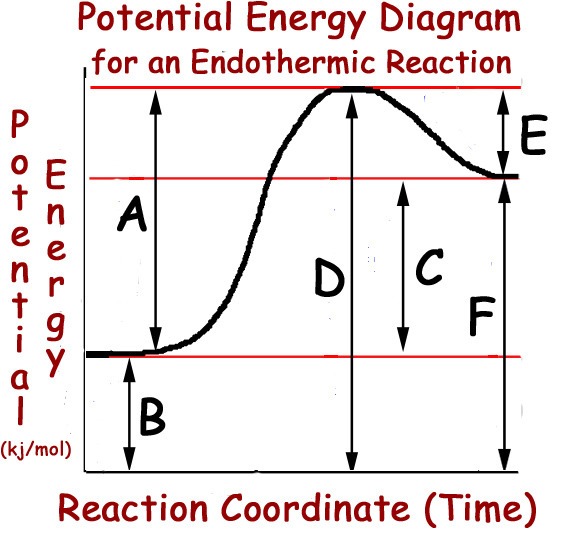
What letter represents the activation energy of the forward reaction?
A
B
C
D
What letter represents the enthalpy change of the reaction?
A
B
C
D

