
 Worksheets
Season 23 Final Immunity
Total questions: 51
Worksheet time: 26mins
Name
Class
Date
1.
A substance that cannot be broken down into a simpler substance is
a)
a compound
b)
an element
c)
a mixture
d)
a colloid
2.
Which of these substances is not an element?
a)
steel
b)
aluminum
c)
hydrogen
d)
iron
3.
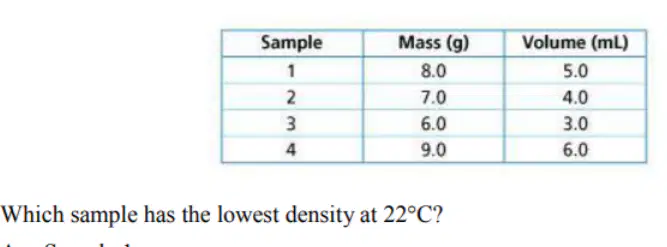
The mass and volume data for four liquid samples at 22ᴼC are given in the table below
a)
1
b)
2
c)
3
d)
4
4.
Chemical properties can be observed only when
a)
the substances in the sample are changing into different substances
b)
the substances are observer under conditions of extreme heat
c)
placed under a microscope
d)
the substances are in a liquid state
5.

Identify the mixture in the image below
a)
x
b)
y
c)
z
d)
w
6.
The number of which type of particle determines the identity of an element?
a)
electrons
b)
neutrons
c)
protons
d)
photons
7.
The sum of the protons and neutrons in an atom is called the _____________
a)
isotope number
b)
allotrope number
c)
mass number
d)
atomic number
8.
Which describes an atom with an atomic number of 29?
a)
10 protons, 9 neutrons
b)
9 protons, 10 neutrons
c)
20 protons, 9 neutrons
d)
29 protons, 35 neutrons
9.
Equal to the number of protons in a neutral atom
a)
electrons
b)
neutrons
c)
ions
d)
isotopes
10.
One _______ and ______ are added to each element as you move across the periodic table.
a)
electron and neutron
b)
proton and neutron
c)
proton and electron
d)
proton and quark
11.
What does the subscript in a chemical bond tell you?
a)
The charge on the ion
b)
The number of atoms of the specific element it beside
c)
The number of valence electrons
d)
The number of bonds in the bond
12.
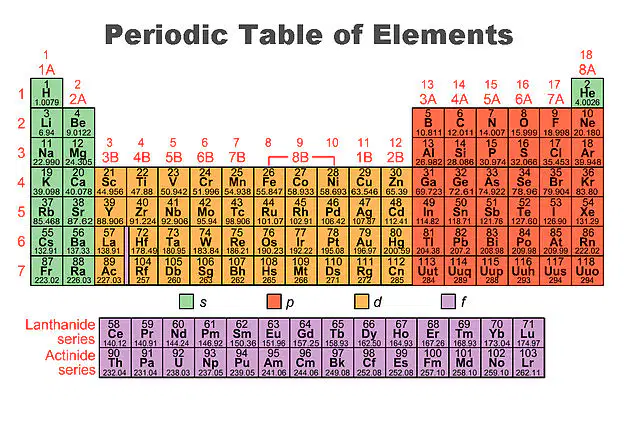
Which group has a 3- charge
a)
1a
b)
3a (13)
c)
5a (15)
d)
7a (17)
13.

Which element is an alkaline earth metal?
a)
Li
b)
O
c)
Ne
d)
Ca
14.
Which element has the same number of valence electrons as Oxygen (O)?
a)
neon (Ne)
b)
fluorine (F)
c)
chlorine (Cl)
d)
sulfur (S)
15.

How many oxygen atoms in the bond pictured below?
a)
1
b)
2
c)
3
d)
4
16.
Balance: __ NaCl -> __ Na + __ Cl2 (the 2 is a subscript)
a)
1,1,2
b)
1,2,1
c)
2,2,1
d)
2,1,2
17.
Newton's first law of motion is also called the "law of ____________"
a)
mass
b)
inertia
c)
force
d)
constant velocity
18.
Inertia varies depending on ____.
a)
force
b)
mass
c)
velocity
d)
motion
19.
The relationship among speed, distance, and time is ____.
a)
t = s/d
b)
d = t/s
c)
s = dt
d)
s = d/t
20.
3 m/s north is an example of a(n) ____.
a)
speed
b)
velocity
c)
position
d)
acceleration
21.
The moon is a nice place to study free-fall because it has no atmosphere. If an astronaut on the moon simultaneously drops a hammer and a feather from the same height, which one hits the ground first?
a)
the hammer
b)
the feather
c)
They hit at the same time.
d)
They don't fall.
22.
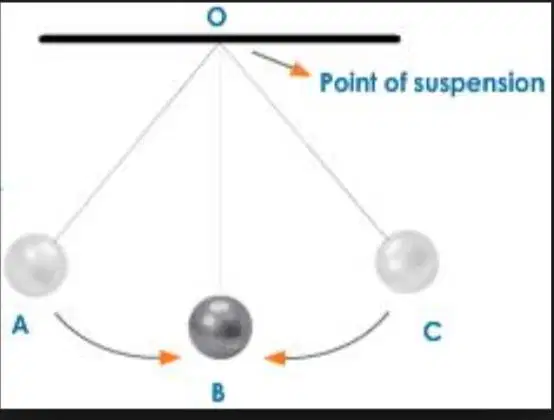
At which point (or points) of the swing did the pendulum have the greatest kinetic energy?
a)
A
b)
B
c)
C
d)
O
23.
According to the law of conservation of energy, the total amount of energy in the universe ____.
a)
changes constantly
b)
remains constant
c)
increases
d)
decreases
24.
Batteries not in use
a)
Chemical
b)
Gravitational
c)
Elastic
d)
Kinetic
e)
Sound
25.
Energy from the sun
a)
Radiant
b)
Chemical
c)
Gravitational
d)
Elastic
e)
Kinetic
26.
Which form of energy does a plant store when light is transformed during photosynthesis?
a)
chemical
b)
thermal
c)
mechanical
d)
nuclear
27.
The type of waves that require medium to pass:
a)
mechanical
b)
electromagnetic
c)
all waves
d)
waves can't travel through a medium
28.
When the frequency of a wave increases, what happens to the wavelength?
a)
The wavelength is not directly affected by the frequency of a wave.
b)
The wavelength decreases
c)
The wavelength increases.
d)
More specific information is needed to form a conclusion about the wavelength.
29.
Compressions are...
a)
associated with transverse waves
b)
light waves
c)
associated with longitudinal waves
d)
visible light
30.
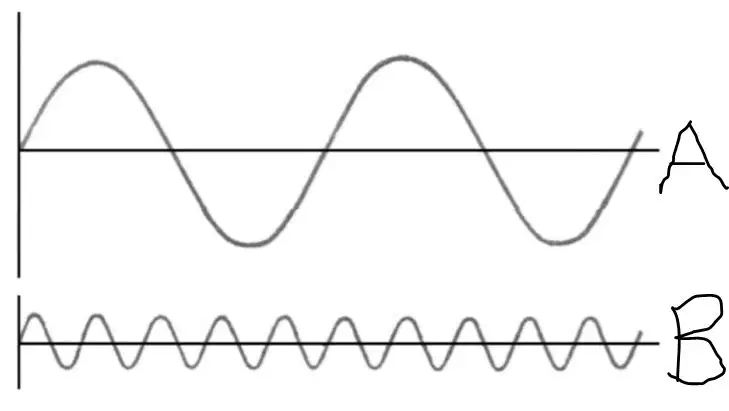
Which wave has the greatest frequency?
a)
A
b)
B
c)
They have the same frequency
d)
They have the same wavelength
31.
Which of the EM waves has the lowest energy?
a)
x rays
b)
infrared
c)
ultraviolet
d)
radio
32.
Which natural phenomenon occurs as a result of Earth rotating on its axis?
a)
movement of tectonic plates
b)
deep ocean currents
c)
seasonal changes
d)
day and night
33.
How does the tilt of the Earth’s axis affect the seasons?
a)
by changing the amount of direct solar energy reaching the surface of Earth
b)
by influencing the rate of chemical reactions occurring in the atmosphere
c)
by deflecting the harmful rays of radiation emitted by the sun
d)
by changing the speed of the rotation of Earth
34.
A day on Saturn takes about 10 Earth hours. Which fact would best explain this short day?
a)
Saturn is less dense than Earth.
b)
Saturn is much farther from the Sun than Earth
c)
Saturn rotates more rapidly than Earth.
d)
Saturn’s orbit has greater eccentricity than Earths
35.
Which planet has a runaway greenhouse effect?
a)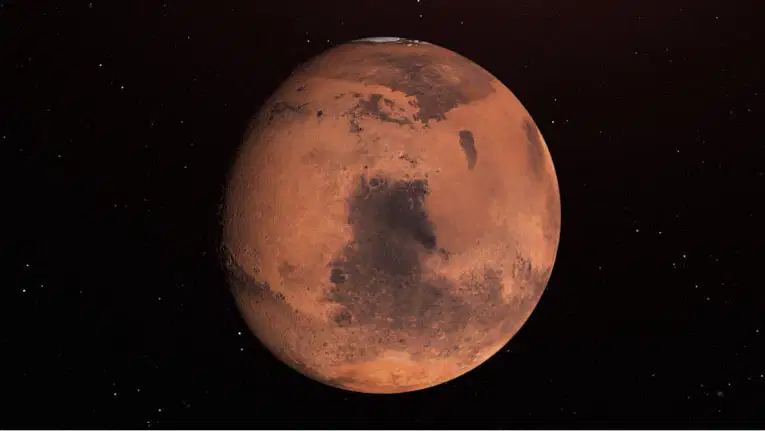
mars
b)
Venus
c)
Jupiter
d)
the moon
36.
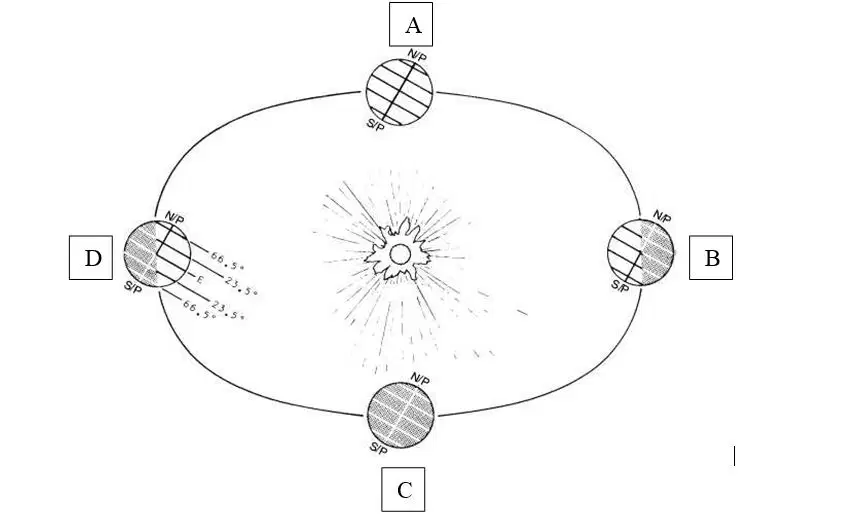
At which letter is the northern hemisphere experiencing the shortest daylight hours?
a)
A
b)
B
c)
C
d)
D
37.

What land feature is pictured below?
a)
An Atlantic hotspot
b)
A Pacific hotspot
c)
The Mid-Pacific ridge
d)
The Mid-Atlantic ridge
38.
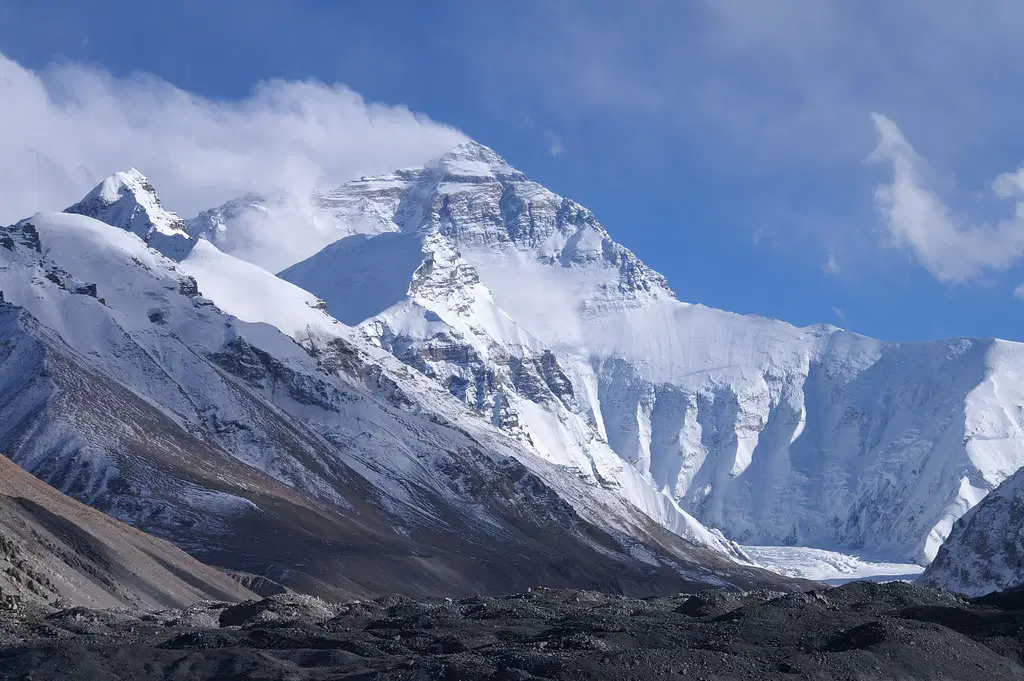
What type of plate boundary would cause the Himalayan mountains?
a)
Divergent-sea floor spreading
b)
Divergent- above water spreading
c)
Convergent- continent plate to continent plate
d)
Convergent- continent plate to oceanic Plate
39.
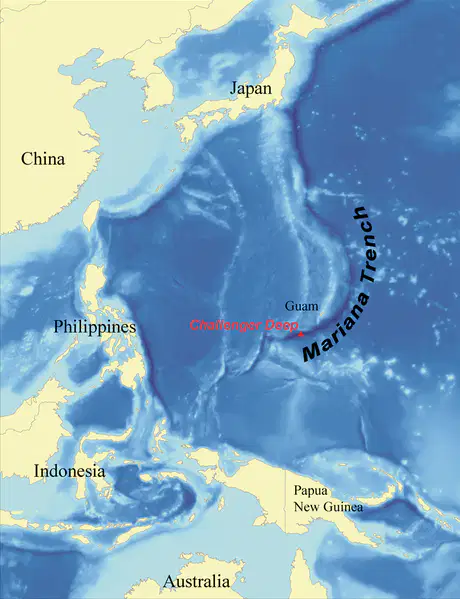
What type of plate boundary would create the Mariana trench?
a)
Transform
b)
Convergent/ subduction
c)
Divergent
40.
What feature is Hawaii located over?
a)
Oceanic Plate
b)
Continental plate
c)
Subduction zone
d)
Hot spot
41.
In an area where a river has cut deep into Earth, there are several layers of very different rock exposed. The oldest rock layer is most likely to be the layer that is
a)
below the other layers.
b)
the thickest layer.
c)
the most rich in fossils.
d)
igneous intrusive rock.
42.
What is surface water polluted by?
a)
human activity
b)
industrial activity
c)
power plants
d)
all of the above
43.
What is point source pollution?
a)
pollution you can point at
b)
pollution you cannot see
c)
pollution you cannot trace to a specific place
d)
pollution you can trace to a specific place
44.
What is non-point source pollution?
a)
pollution you can point at
b)
pollution you cannot see
c)
pollution you cannot trace to a specific place
d)
pollution you can trace to a specific place
45.
Which is an example of point source pollution
a)
urban runoff
b)
conventional septic tank systems
c)
oil refinery
d)
eroding stream banks
46.
Which is an example of nonpoint source pollution?
a)
Sewage Treatment Plants
b)
paper mills
c)
chemical manufacturing plant
d)
Excess fertilizers
47.
What are the two short term sinks for carbon dioxide?
a)
Plants, atmosphere
b)
Ocean, fossil fuels
c)
Atmosphere, fossil fuels
d)
Calcium Carbonate, ocean
48.
What are the two long term sinks for carbon dioxide?
a)
Plants, atmosphere
b)
Ocean, fossil fuels
c)
Atmosphere, fossil fuels
d)
Calcium Carbonate, fossil fuels
49.
What type of organism receives carbon present in dead plants and animals?
a)
producer
b)
primary consumer
c)
decomposer
d)
secondary consumer
50.
Which of the following is an example of human impact on the carbon cycle?
a)
The increased production of methane gases from cattle farms
b)
The burning of fossil fuels
c)
The cutting down of trees for lumber
d)
Driving automobiles
e)
All of the above
51.
What kind of organism takes out the most carbon from the atmosphere?
a)
Bacteria
b)
Animals
c)
Plants
d)
Humans
100 %

