Wayground logo

Free Printable Worksheets

Font size

S
M
L
XL
Worksheets

Biology Final Review

Total questions: 103

Worksheet time: 2hrs 51mins

Name
Class
Date
1.
What is a gene?
a)
A bundle (like a hot dog bun) that the DNA is packed into
b)
something inside the nucleus
c)
a piece of DNA
d)
all of your DNA
2.
What are the nucleotides made of?
a)
Sugar, Phosphate, nitrogen base
b)
Phosphate, Adenine, nitrogen base
c)
Thymine, Adenine, Cytomine
d)
Phosphate, Nitrogen, Adenine
3.
Which of the following best describes a DNA molecule?
a)
double helix
b)
contains ribose
c)
made of amino acids
d)
contains Uracil
4.
Adenine bonds with ______________.
a)
Guanine
b)
Thymine
c)
Cytosine
d)
Adenine
5.

Bundled up, organized DNA is called a

a)

gene

b)

trait

c)

chromosome

d)

nucleotide

6.

How many chromosomes do human cells have?

a)

46

b)

23

c)

2

d)

44

7.
Which shows the correct complementary base pairing for DNA?
a)
C-A, T-G
b)
A-G, C-T
c)
C-G, U-A
d)
T-A, G-C
8.
What are the 4 nitrogen bases?
a)
adenine, thymine, cytoplasm, and guanine
b)
adenine, thymine cytosine, and guanine
c)
adenine, thymine, cytosine, and gylcerol
d)
adenine, thymine, cytosine, and glucose
9.
Why is DNA important?
a)
it is very small and very complicated
b)
it's in everything
c)
it serves as the blueprint for traits of all living things
d)
because we eat it every day for energy
10.
Which 2 molecules form the sides (backbone) of the DNA ladder?
a)
deoxyribose sugar and adenine
b)
deoxyribose sugar and a hydrogen bond
c)
deoxyribose sugar and the nucleus
d)
deoxyribose sugar and phosphate
11.
DNA replication results in two DNA molecules,
a)
each one with two original strands
b)
each one with two new strands
c)
each one with one new strand and one original strand
d)
one with two new strands and the other with two original strands
12.
A process in which DNA has the unique ability to make an exact copy of itself.
a)
Replication
b)
Translation
c)
Transcription
13.
The two strands of a DNA molecule are held together by ________ bonds between their base pairs.
a)
covalent
b)
hydrogen
c)
ionic
d)
peptide
14.
If a segment of double-stranded DNA has 40 percent A, how much of it is C?
a)
40
b)
10
c)
15
d)
20
15.

Plants make their own energy molecules (food) using photosynthesis. What do we call this type of organism?

a)

Prokaryote

b)

Eukaryote

c)

Autotroph

d)

Heterotroph

16.

Unicellular organisms that lack a nucleus and other cellular organelles are known as...

a)

Prokaryote

b)

Eukaryote

c)

Heterotroph

d)

Autotroph

17.

The most specific level of biological classification is...

a)

kingdom

b)

genus

c)

phylum

d)

species

18.

Living organisms respond to changes in their environment called ________________.

a)

homeostasis

b)

stimuli

c)

cells

d)

adaptations

19.

Living things can _____________________, or make babies.

a)

breathe

b)

adapt

c)

walk

d)

reproduce

20.
In cells a large oval organelle that contains the cells genetic material in the form of DNA and controls many of the cells activities
a)
organelle
b)
ribosome
c)
cell wall
d)
nucleus
21.
an organelle in the cells of plants and some other organisms that captures energy from sunlight and changes it to an energy from that cells can use in making food
a)
vacuole
b)
chloroplasts
c)
cytoplasm
d)
mitochondria
22.
What is the name of the genetic material that is inside the nucleus?
a)
ER
b)
ATP
c)
YOLO
d)
DNA
23.
What is the name for all populations of species within an area
a)
Community
b)
Ecosystem
c)
Biosphere
d)
Biome
24.
The term biotic means;-
a)
Not a robot or robotic
b)
Living Things
c)
Water based environments
d)
Non-living things
25.
Requires water, sunlight, and carbon dioxide to take place.
a)
respiration
b)
species growth
c)
habitat
d)
photosynthesis
26.
The shrew provides energy for the _______?
a)
cricket
b)
grasshopper
c)
frog
d)
snake
27.
Where does the energy start in this food chain?
a)
Plant
b)
Sun
c)
Deer
d)
Wolf
28.

_____________ describes a trait that covers over, or masks another form of that trait.

a)

recessive

b)

gene

c)

allele

d)

dominant

29.

When writing an organism's scientific name, what is the correct order?

a)

Genus first, species second

b)

Species first, genus second

c)

Domain first, species second

d)

Species first, kingdom second

30.

Taxonomy is the branch of science that studies...

a)

cellular processes in organisms

b)

classification of organisms

c)

family lineage of organisms

d)

genetic material within organisms

31.
What is another term for "selectively permeable"?
a)
porous
b)
completely permeable
c)
permanent
d)
semipermeable
32.
Most of the cell membrane is made of...
a)
Lipids
b)
Carbohydrates
c)
Proteins
d)
Nucleic acids
33.
Hydrophilic means...
a)
water-loving
b)
water-fearing
c)
nonpolar
d)
lipid soluble
34.
I am a single strand.
a)
DNA
b)
RNA
35.
I am arranged as a double helix or "twisted ladder".
a)
DNA
b)
RNA
36.
I include the bases Guanine, Cytosine, Adenine and Uracil .
a)
DNA
b)
RNA
37.
I travel outside of the nucleus.
a)
DNA
b)
RNA
38.
The sugar in DNA is ____________________.
a)
deoxyribose
b)
ribose
39.
What is a mutation?
a)
a change in DNA
b)
a person who is bitten by a radioactive spider
40.

The results of mutations...

a)

are always bad

b)

are always good

c)

are always visible

d)
 can be good, bad or neutral. 
41.

Why is energy needed for active transport?

a)

Ions are negatively charged

b)

Ions are attached to large proteins

c)

Ions are trapped inside the plasma membrane

d)

Ions are moved against the concentration gradient

42.

The cell membrane does not use ATP to move oxygen. What type of transport is this?

a)

Passive transport

b)

Active transport

43.

Which part of the cell membrane is hydrophobic?

a)

Inside (tails)

b)

Outside (heads)

44.

What does semi-permeable mean?

a)

Only certain molecules can go in and out of the cell

b)

All molecules can pass through

c)

No molecules can go through

45.

What is the cell membrane made up of?

a)

Protein monolayer

b)

Phospholipid bilayer

c)

Phospholipid monolayer

d)

Protein bilayer

46.

What type of transport do molecules go from high to low concentration?

a)

Active transport

b)

Passive transport

47.

Which of the following explains how the cell maintains homeostasis?

a)

Controls materials that enter and exit the cell

b)

Converts ATP to glucose for energy storage

c)

Catalyzes protein synthesis

d)

Receives signals for DNA replication

48.

The movement of water across the phospholipid bilayer without the use of energy is what type of transport? (type in all lowercase)

(a)  

49.
Which of the following correctly describes viruses?
a)
non-living because they grow and develop
b)
living because they can use energy
c)
non-living because they cannot reproduce on their own
d)
living because they can maintain homeostasis
50.

Which is true regarding viruses and bacteria?

a)

Viruses are smaller than bacteria

b)

Both are living

c)

Both are non-living

d)

Bacteria need a host to reproduce

51.

Genes can be influenced by outside factors such as the environment

a)

True

b)

False

52.

What is a monomer (building block) of protein/ polypeptide chain?

a)

Amino acid

b)

Nucleotide

c)

Nitrogen base

d)

Monosaccharide

53.
All living things get their energy from which of the following sources?
a)
food
b)
water
c)
sun
54.
Which of the following is an organism that eats only meat?
a)
herbivore
b)
carnivore
c)
omnivore
55.
Which of the following terms describes an area where an organism lives?
a)
community
b)
habitat
c)
area
56.
What would most likely happen if the rabbit population was removed from the food chain grass —› rabbit —› fox?
a)
their would be more grass
b)
there would be less rabbits
c)
there would be more fox
57.
Which is an example of a parasitic relationship?
a)
a bee pollinates a flower
b)
a tapeworm takes nutrients from a dog
c)
an orchid lives in a tree but does not harm the tree
58.
In which type of relationship do both species benefit?
a)
parasitism
b)
mutualism
c)
commensalism
59.
Barnacles grow on whales.  Whales give the barnacles a place to live but the barnacles do not help or harm the whale.  Which type of relationship is this?
a)
commensalism
b)
mutualism
c)
parasitiesm
60.

Sea otter fur is the densest fur of any animal

a)

True

b)

False

61.

When otters are removed from an ecosystem..

a)

The urchin population rises

b)

The kelp population drops

c)

The kelp gets eaten more quickly than it can regrow

d)

All of the answers occur

62.

What is one reason that phytoplankton are important?

a)

they clean the water

b)

they make oxygen

c)

they are drifting animals

d)

they make the water warmer

63.

Which products contains seaweed?

a)

cosmetics

b)

dairy products - icecream, processed cheeses, yogurts

c)

fertilizers

d)

toothpaste, shampoos, etc.

e)

All of these

64.

Which of the following are in the correct order?

a)

organ system, cell, organ, tissue, organism

b)

cell, organ, tissue, organ system, organism

c)

cell, tissue, organelle, organ system, organism

d)

cell, tissue, organ, organ system, organism

65.
The "cause" for something to happen is the
a)
response
b)
effect
c)
stimulus
d)
homeostasis
66.

According to the model, what is a normal blood glucose (sugar) level?

a)

270 mg/100mL

b)

180 mg/100 mL

c)

45 mg/100 mL

d)

90 mg/100 mL

67.

According to the model, what is the response to HIGH blood glucose (sugar)?

a)

Pancreas releases insulin into blood

b)

Pancreas releases glucagon into blood

68.

According to the model, what is the response to LOW blood glucose (sugar)?

a)

Pancreas releases insulin into blood

b)

Pancreas releases glucagon into blood

69.

The ability to maintain body temperature within a certain range is ...

a)

thermodynamics

b)

thermoregulation

c)

thermostat

d)

thermometer

70.
Homeostasis
a)
allows for a wildly fluctuating internal environment
b)
is impossible in vertebrates
c)

is the maintenance of a relatively stable internal environment

d)

is the maintenance of a relatively stable external environment

71.
What describes a lack of water in the blood?
a)
Dehydration
b)
Rehydration
c)
Hydration
d)
Concentrated
72.

Your body is too hot. What senses your body temperature?

a)

nerve cells

b)

sweat cells

c)

blood cells

d)

muscle cells

73.

With low oxygen levels, your breathing rate will increase. When your oxygen levels rise, what is the appropriate response?

a)

stop breathing

b)

increase heart rate

c)

keep breathing rate high

d)

return breathing rate to baseline

74.

When you exercise, what gas does your body NEED more of?

a)

Blood

b)

Carbon dioxide

c)

Hydrogen

d)

Oxygen

75.

How does the body respond when more oxygen is required?

a)

Decreasing heart rate

b)

Increasing heart rate

c)

Decreasing blood pressure

d)

Increasing blood pressure

76.
If the environment gets cold, we will often shiver in order to:
a)
keep body temperature the same as the external temperature
b)
decrease body temperature
c)
increase body temperature
d)
regulate blood pressure
77.
What is another word that can be used to describe "homeostasis"?
a)
STABLE
b)
EQUAL
c)
COMPLETE
d)
CORRECT
78.

what is osmoregulation?

a)

Control of water and salt in the body

b)

Control of blood pressure in the body

c)

Control of blood glucose in the body

79.

Which area of the brain contains the receptors responsible for detecting changes in blood solute concentration (and water concentration)

a)

Hypothalamus

b)

Medulla Oblongata

c)

Amygdala

d)

Hippocampus

80.

If the dots represent sugar what direction will the water flow?

a)

Into the cell

b)

Out of the cell

c)

Both equally (equilibrium)

81.

Identify the term for the excessive loss of water from the body

a)

Over hydration

b)

Dehydration

c)

Isotonic

d)

Transpiration

82.
The movement of water through a semi-permeable membrane is called?
a)
cell membrane
b)
respiration
c)
osmosis
d)
diffusion
83.
When both inside and outside of a cell have the same amount of water it is said that the cell has reached a state of ___________.
a)
osmosis
b)
equilibrium
c)
diffusion
d)
hypertonic
84.
In a solution, salt is considered the _______.
a)
solvent
b)
solute
c)
solution
85.
A person would never have pure water put into their veins in a hospital because their cells would...
a)

Shrink/Dehydrate

b)

Expand too rapidly and maybe burst

c)

Multiply during mitosis too quickly

86.

A person should never drink salty water if trying to hydrate because their cells would

a)

shrink

b)

expand

c)

multiply too quickly

87.

The marathon runners' blood sodium was low, which means she was.....

a)

Not drinking enough water

b)

Drinking too much water

c)

Overheating rapidly

d)

Losing muscle tone

88.

Which of the following symptoms would be possible if you drink too much water (way, way, way too much)

a)

Lack of sweat

b)

Slow heart rate

c)

Brain cells swelling and bursting

d)

Dry skin

89.

What is the bottom layer of the an energy pyramid?

a)

producer

b)

tertiary consumer

c)

Secondary consumer

d)

primary consumer

90.
an animal that eats both plants and animals
a)
carnivore
b)
herbivore
c)
omnivore
d)
consumer
91.
an organism that makes its own food
a)
producer
b)
consumer
c)
herbivore
d)
scavenger
92.
In an energy pyramid, energy_______ as you move up the pyramid.
a)
Increases
b)
Decreases
c)
Stays the same
d)
Changes up and down
93.
This scientist came up with the idea of natural selection.
a)
Jean Baptiste Lamarck
b)
Gregor Mendel
c)
Charles Darwin
d)
Thomas Malthus
94.
Inherited trait that helps an organism survive is a(n) __________.
a)
Fossil
b)
Adaptation
c)
Ancestor
d)
Natural selection
95.
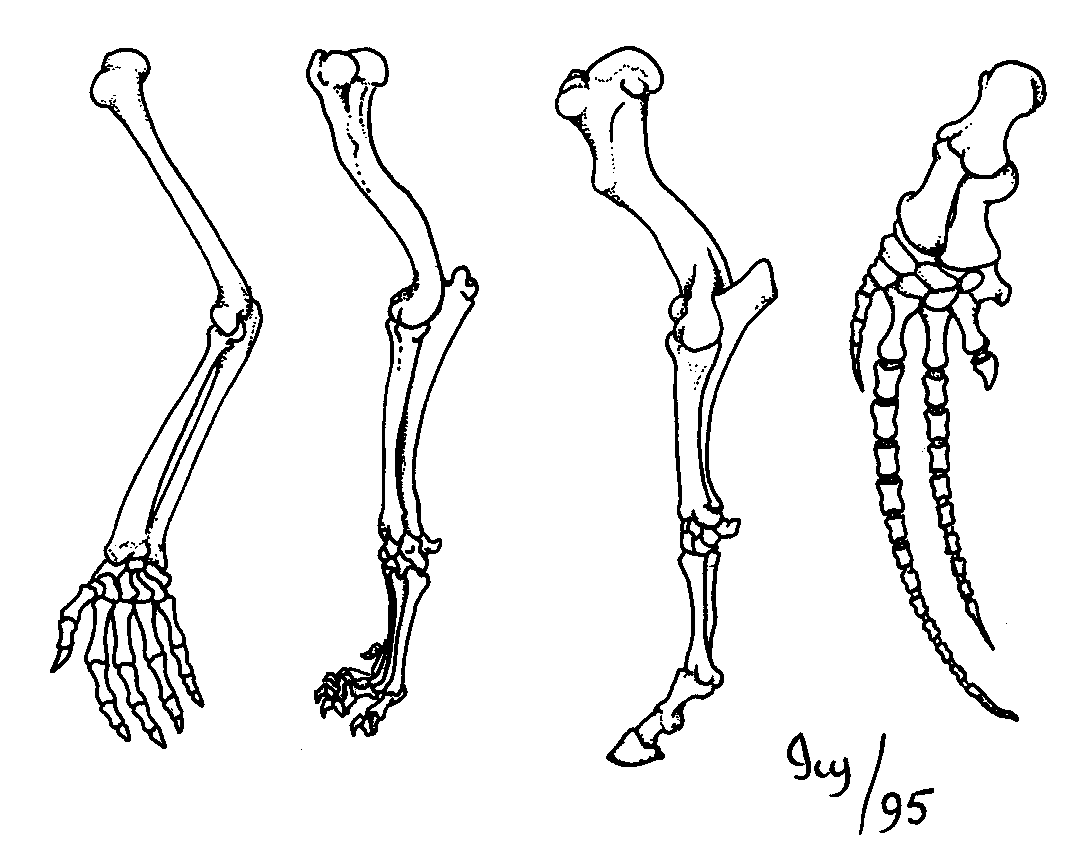
Structures with the same parts have different functions; suggests that organisms share a common ancestry
a)
vestigial structures
b)
homologous structures
c)
adaptive radiation
d)
fossil
96.
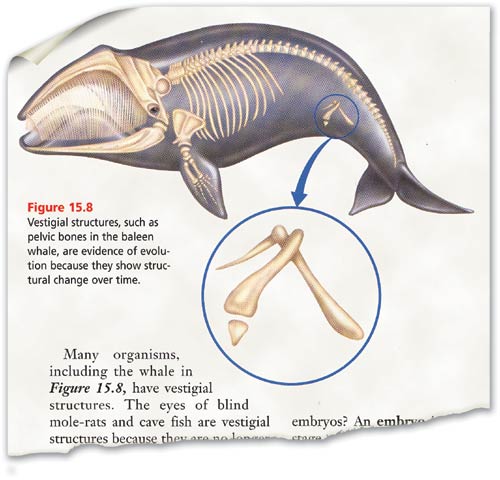
Which of the following is an example of a vestigial structure?
a)
the wings of a red-tailed hawk
b)
the hind limbs of a house cat
c)
the fins of sharks
d)
the tailbone of a human
97.
The diagram shows fossils in different rock layers. Which of these statements about the age of these fossils is most likely correct?
a)
Fossil A and C are the same age
b)
Fossil B is older than fossil C
c)
Fossils A is older than fossil B
d)
Fossil D is older than fossil C
98.

What do we call a change in a species over time?

a)

Adaptation

b)

Evolution

c)

Extinction

d)

Environmental influences

99.
Why do embryologist study embryos?
a)
to see if they are related
b)
to understand adaptations
c)
to determine the age
d)
to learn what parents are vestigial
100.
When an organism completely dies out, it is called.....
a)
Adaption
b)
Extinction
c)
Fossilization
d)
Mutation
101.
All the individuals of a species that live in a particular area are called a
a)
variation
b)
population
c)
fossil
d)
group
102.
The process of making changes in the DNA code of a living organism is called
a)
selective breeding 
b)
genetic engineering
c)
inbreeding
d)
hybridization
103.

What film did we watch about genetic engineering?

a)

GATTACA

b)

Planet Earth

c)

The Poisoner's Handbook

d)

Aladdin