
 Worksheets
Life Science Final
Total questions: 104
Worksheet time: 9hrs 45mins
Which environmental factors can influence the growth of both plants and animals according to the text?
Temperature, humidity, soil type, and air quality
Availability of food, light, space, and water
Genetic factors, diseases, predators, and climate change
Pesticides, herbicides, planting methods, and harvest times
What is the impact of increasing carbon dioxide in the atmosphere on poison ivy plants?
The plants become smaller and produce less urushiol
The plants grow less rapidly and are less affected by carbon dioxide
The plants grow more rapidly and become larger with increased carbon dioxide
The plants change color and produce more oxygen
What is tropism in plants?
The process of photosynthesis
A directed growth or movement in response to a stimulus
The decay of plant material
The transfer of pollen from one plant to another
What is positive tropism?
A growth away from a stimulus
A growth towards a stimulus
A growth in random directions
A growth that does not respond to any stimulus
What is negative tropism?
A growth towards a stimulus
A growth in random directions
A growth away from a stimulus
A growth that does not respond to any stimulus
What is phototropism?
Growth in response to water
Growth in response to touch
Growth in response to gravity
Growth in response to light
What is gravitropism?
Growth in response to light
Growth in response to gravity
Growth in response to touch
Growth in response to temperature
What is thigmotropism?
Growth in response to temperature
Growth in response to light
Growth in response to touch
Growth in response to water
What is heliotropism?
The growth of a plant in response to heat
The growth of a plant in response to water
The turning response of a plant to follow the Sun
The growth of a plant in response to soil nutrients
Look at the images below. Which type of behavioral response is best illustrated in each image?

Thigmotropism

Gravitropism

Phototropism
What do plants rely on to send signals within the plant in response to external stimuli?
Sunlight
Hormones
Water
Nutrients
What is one factor that can cause fish to grow larger in large ponds compared to small ponds?
Less genetic diversity
Smaller habitat size
More abundant resources
Increased competition
What must cattle have in addition to nutritious food to achieve a larger size for their breed?
The ability to digest grass
The genes for a large size
A mixture of micronutrients in their diet
Access to water
Who is known as the father of genetics?
Charles Darwin
Gregor Mendel
Isaac Newton
Louis Pasteur
What did Gregor Mendel use to discover the basic principle of heredity?
Fruit flies
Mice
Pea plants
Bacteria
Which factors affect the growth of organisms?
Only environmental factors
Only genetic factors
Both environmental and genetic factors
Neither environmental nor genetic factors

All living or once living things in an ecosystem are
None
biotic factors
abiotic factors

All nonliving things in an ecosystem are ____________
None
biotic factors
abiotic factors

Is a rain an abiotic or biotic factor?
abiotic
biotic

A zebra skeleton
Biotic factor
Abiotic factor
What happens to most plants that do not receive adequate light?
They will grow because of photosynthesis.
They will not grow because of photosynthesis.
They will use radiant energy from the Sun to make glucose.
They will feed off underground fungi.
What is photosynthesis?
A process where plants use chemical energy from glucose to make radiant energy.
A series of chemical reactions that animals use to make their own food.
A series of chemical reactions that produces glucose a sugar compound plants use as food and oxygen.
A process where plants convert chemical energy from the Sun into glucose molecules.
How do plants differ from animals in terms of energy usage?
Plants and animals both use radiant energy from the Sun to make glucose.
Plants use radiant energy from the Sun to make their own food, while animals must obtain energy from food.
Animals use radiant energy from the Sun to make glucose, while plants do not.
Both plants and animals get their energy feeding off underground fungi.
What is a unique characteristic of the underground orchid native to Western Australia?
It uses photosynthesis to make food above the surface.
It does not do photosynthesis and feeds off underground fungi.
It is the only plant that uses radiant energy from the Sun.
It thrives in darkness and has green leaves.
Who was one of the first scientists to observe a product of photosynthesis through an experiment?
Isaac Newton
Albert Einstein
Joseph Priestley
Charles Darwin
What did Joseph Priestley demonstrate with his experiment involving a plant under a glass dome?
That plants could produce carbon dioxide
That plants could produce oxygen
That plants could survive without light
That plants consume oxygen

Why did the mouse remain alive when the experiment was repeated with a plant present under the dome?
Because the plant provided food
Because the plant consumed carbon dioxide
Because the plant produced oxygen
Because the plant absorbed the smoke
Which are the reactants for photosynthesis?
Water, nitrogen, and oxygen
Hydrogen, carbon dioxide, and nitrogen
Carbon dioxide, water, and light
Oxygen, glucose, and water
What are the products of photosynthesis?
Oxygen and carbon dioxide
Water and glucose
Oxygen and glucose
Carbon dioxide and water
What is the chemical formula for glucose as mentioned in the context of photosynthesis?
(a)

How many molecules of water and carbon dioxide are used to make one molecule of glucose in photosynthesis?
6 molecules of water and 6 molecules of carbon dioxide
12 molecules of water and 6 molecules of carbon dioxide
6 molecules of water and 12 molecules of carbon dioxide
12 molecules of water and 12 molecules of carbon dioxide
What was the composition of Earth's atmosphere before oxygen gas became a part of it?
Made up of carbon dioxide
Had water only
Made up of nitrogen
Made up of ethane, ammonia, and oxygen
Why is photosynthesis considered necessary for life on Earth?
It produces carbon dioxide which is essential for plant growth
It generates oxygen and allows for the energy flow from the Sun to animals
It is the only process by which water is created
It helps to cool down the Earth's atmosphere
What negative effect can occur when cyanobacteria populations grow too quickly in a body of water?
Increase in water
Algal bloom
Acid rain
Ozone layer depletion
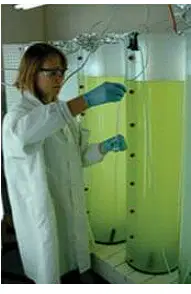
What is the potential future application of photosynthesis being researched by the scientist in the image?
To produce oxygen for space travel
To create new forms of plastic
To produce fuels for cars, planes, and trains
To generate electricity for homes
All organisms need glucose, or a source of __________, to carry out basic life functions.
photosynthesis
food
carbon dioxide
oxygen
Many plants obtain glucose through the process of __________.
photosynthesis
chemical energy
food
radiant energy
Animals obtain glucose from __________.
carbon dioxide
food
oxygen
glucose
Photosynthesizing organisms use __________ to produce glucose.
chemical energy
radiant energy
carbon dioxide
oxygen
The reactants of photosynthesis are __________ and __________.
glucose, oxygen
water, glucose
carbon dioxide, water
food, chemical energy
The products of photosynthesis are __________ and __________.
carbon dioxide, water
glucose, oxygen
food, chemical energy
radiant energy, glucose
The __________ is the source of energy used in photosynthesis.
sun
food
glucose
oxygen
Inside the leaves, there is an organelle called a (a)
_______ ________ from the air enters the plant through the leaves.
(a)

Select all the reactants in the reaction.


A reactant is always on the right
False
True
A product is on the left and right
False
True
What is the reaction for photosynthesis?
6O2
6CO2
6H2O
Light
C6H12O6
What do plants, animals, and bacteria have in common regarding their energy needs?
They all require sunlight to live and grow.
They all require energy for life.
They all perform photosynthesis.
They all consume other organisms for energy.
What is the major difference between how plants obtain energy and how bacteria and animals get energy?
Bacteria and animals absorb energy from the Sun.
Plants perform cellular respiration, while bacteria and animals do not.
Plants make their own food through photosynthesis, while bacteria and animals consume food to obtain energy.
Bacteria and animals release oxygen, while plants do not.
What is photosynthesis?
The process of obtaining energy from the breaking of chemical bonds in nutrients.
The chemical reactions in the body that produce energy from food.
A chemical reaction during which plants convert radiant energy from the Sun to chemical energy, converting carbon dioxide and water into sugar (glucose).
The process of breaking down food molecules to produce energy and release carbon dioxide and water.
What is cellular respiration?
The process of plants converting carbon dioxide and water into sugar.
The process of obtaining energy from the Sun and releasing oxygen.
The process of obtaining energy from the breaking of chemical bonds in nutrients.
The chemical reactions in the body that produce energy from sunlight.
What are the products of photosynthesis that become the reactants for cellular respiration?
Carbon dioxide and water
Oxygen and glucose
Sunlight and water
Carbon dioxide and glucose
What do animals require to release energy during cellular respiration (reactants)?
Carbon dioxide and water
Oxygen and glucose
Sunlight and chlorophyll
Nitrogen and minerals
What is the energy molecule called in plants and animals?
DNA
RNA
ATP
NADH
Where is ATP produced inside plant and animal cells?
Nucleus
Ribosome
Mitochondrion
Chloroplast
Which process is NOT a source of glucose and oxygen for the mitochondrion?
Digestion
Breathing and circulation
Photosynthesis
Cellular respiration
What are the products of cellular respiration?
Glucose and oxygen
Carbon dioxide, water, and energy
Amino acids and simple sugars
Fatty acids and glycerol
How many molecules of ATP are produced from one molecule of glucose during cellular respiration?
2 ATP
18 ATP
36 ATP
38 ATP
What are the two gases mentioned in the text that are very important to life on Earth?
Hydrogen and Nitrogen
Oxygen and Carbon Dioxide
Methane and Sulfur Dioxide
Helium and Argon
According to the text, what do plants use to make their own food?
Nitrogen
Oxygen
Carbon Dioxide
Argon
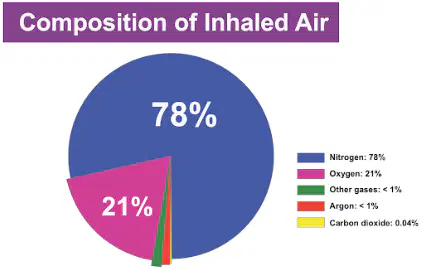
What percentage of air is oxygen, as stated in the text?
21%
78%
55%
1%
What is the main reason for the alarming amount of carbon dioxide entering the air, as mentioned in the text?
Deforestation
Pollution
Volcanic Eruptions
Ocean Acidification
What percentage of inhaled air is nitrogen?
21%
78%
55%
1%
How do animals and other living things contribute to the cycle of carbon dioxide and oxygen?
They produce oxygen for plants to use.
They release carbon dioxide when they make their own food.
They provide carbon dioxide that plants need to make their own food.
They absorb carbon dioxide directly from the soil.
What do organisms such as plants and green algae do during the process of making their own food?
They release nitrogen into the air.
They release oxygen into the air.
They absorb carbon dioxide from the water.
They produce argon as a byproduct.
What is one consequence of human activities that add too much carbon dioxide to the air?
It increases the oxygen levels in the atmosphere.
It can lead to global warming by increasing Earth's temperatures.
It makes plants grow larger and stronger.
It reduces the amount of sunlight reaching Earth.
What are two ways to generate electricity without burning fuels?
Nuclear power and hydroelectric dams.
Wind and solar power.
Coal and natural gas.
Biomass and geothermal energy.
What is the correct order of events that lead to cellular respiration, starting from eating a hamburger to using energy in cells?
1. You eat a hamburger and breathe in oxygen. 2. Food molecules in the hamburger are broken down into glucose in the digestive system. 3. Oxygen goes immediately from your lungs to blood vessels to cells. 4. Oxygen and glucose combine to form carbon dioxide, water, and ATP. 5. Energy is used by cells in your body to function and grow; you exhale carbon dioxide.
1. Oxygen and glucose combine to form carbon dioxide, water, and ATP. 2. You eat a hamburger and breathe in oxygen. 3. Energy is used by cells in your body to function and grow; you exhale carbon dioxide. 4. Food molecules in the hamburger are broken down into glucose in the digestive system. 5. Oxygen goes immediately from your lungs to blood vessels to cells.
1. Oxygen goes immediately from your lungs to blood vessels to cells. 2. You eat a hamburger and breathe in oxygen. 3. Food molecules in the hamburger are broken down into glucose in the digestive system. 4. Energy is used by cells in your body to function and grow; you exhale carbon dioxide. 5. Oxygen and glucose combine to form carbon dioxide, water, and ATP.
1. Energy is used by cells in your body to function and grow; you exhale carbon dioxide. 2. Oxygen goes immediately from your lungs to blood vessels to cells. 3. You eat a hamburger and breathe in oxygen. 4. Food molecules in the hamburger are broken down into glucose in the digestive system. 5. Oxygen and glucose combine to form carbon dioxide, water, and ATP.
Which of the following statements is true regarding energy production in organisms?
Both animals and plants perform cellular respiration to produce energy.
True
False
In detail describe the process of how we get energy from ATP.
In detail describe how energy is produced from ATP?
C6H12O6 + 6O2 -> 6CO2 + 6H2O + 36 ATP
6O2 + C6H12O6 + 36 ATP -> 6CO2 + 6H2O
6CO2 + 6H2O -> 6O2 + C6H12O6 + 36 ATP
What is the role of genes in the cells according to the text?
They provide energy to the cells.
They control cell structure and function by providing coded instructions.
They help in the digestion of food.
They protect the cell from external damage.
What is DNA?
A type of protein.
A cell component that provides energy.
A long, twisted, ladder-shaped molecule that carries genetic codes.
A part of the cell that helps in nutrient absorption.
How are chromosomes related to DNA?
Chromosomes create DNA.
Chromosomes assist DNA in moving around the cell.
Chromosomes are made up of DNA.
Chromosomes and DNA are unrelated.
What is the role of genes in the production of proteins?
Genes provide energy for protein synthesis.
Genes store proteins within the DNA.
Genes are the instructions to create proteins essential to cells.
Genes eliminate unwanted proteins from cells.
What do proteins form in the body?
Blood cells only.
DNA strands.
Skin, hair, and cells of the organism.
Only digestive enzymes.
What is the role of proteins in the human body?
They provide energy to cells.
They help in the digestion of food.
They provide structure/function and support for cells, work as enzymes, and regulate the body's tissues and organs.
They are involved in the storage of genetic information.
What are the building blocks of DNA?
Amino acids
Nucleotides
Fatty acids
Ribosomes
During which process is messenger RNA created from DNA?
Translation
Transcription
Replication
Mitosis
What happens during the process of translation in protein synthesis?
DNA is copied into RNA.
RNA is used to make a copy of DNA.
RNA is translated into a protein.
Proteins are used to create DNA.
Which base pairs with adenine in the DNA structure?
Cytosine
Guanine
Thymine
Uracil
Why don't all our cells function the same way if they have the same DNA?
The can create proteins from RNA
They have the ability to turn genes on and off
Because of the mutation of genes in a chromosome
Because of the replication of DNA during cell division
What is a gene mutation?
A temporary change in a gene
A permanent change in a gene or chromosome
A process where genes are turned off
The division of genetic material
What can cause mutations in genes?
Exposure to sunlight
Lack of nutrients
Harmful chemical agents, X-rays, high temperatures, and viruses
Normal cell growth
What is the main function of genes?
To provide energy to cells
To code for proteins
To create cell membranes
To help in cell division
Which organelle is the location where protein is made?
Ribosome
Nucleus
Cytoplasm
Nucleotide
When these bond together, they form a protein
Amino Acids
Peptide Bonds
Ribose
Nucleotides
What would the mRNA sequence be for the following DNA code; ATG GCA TTC ATG?
TAC CGT AAG TAC
UAG CGA AAG AAC
UAC CGU AAG UAC

The following codon is translated into which amino acid?
AUU
Methionine
Isoleucine
Histidine
Arginine

The following codon is translated into which amino acid?
UAA
STOP
Phenylalanine
Valine
Aspartic acid
The mutated DNA segment is TTCGCAAG. This is an example of ___ mutation.
GAG-CTC-GAC-AGA
Mutant
GAG CTC-CAC-AGA
What is a genetic mutation
the making of a zombie
any change in the DNA base pairs
the process of duplicating the DNA in a cell
An insertion/additon mutation occurs when
a base pair is missing from the DNA strand
a base pair is added to the DNA strand
a base pair is replaced with a different base pair
A deletion mutation occurs when
a base pair is missing from the DNA strand
a base pair is added to the DNA strand
a base pair is replaced with a different base pair

