wayground logo

Free Printable Worksheets

Font size

S
M
L
XL
Worksheets

Semester 2 Exam- Physical Science 2024

Total questions: 55

Worksheet time: 28mins
Name
Class
Date
1.
A ramp is an example of
a)
A lever
b)
A pulley
c)
A wheel and axle
d)
an inclined plane
2.
How are the frequency and wavelength of the electromagnetic waves related?
a)
As frequency goes up wavelengths stay the same
b)
Frequency is greater than wavelength
c)
Wavelength is greater than frequency
d)
As frequency goes up, wavelength decreases
3.
If you are sitting on a dock and count 10 waves passing in 8 seconds, what is the frequency of the waves?
a)
10 Hz
b)
80 Hz
c)
1.25 Hz
d)
0.8 Hz
4.
What is 860,000 in scientific notation?
a)
8.6 x 10⁵
b)
86.0 x 10⁴
c)
8.6 x 10⁻⁵
d)
8.6 x 10⁻⁴
5.
Convert 1.63 x 10⁻² to standard.
a)
163
b)
0.0163
c)
0.00163
d)
1.63
6.
Amplitude measures the amount of ______ in a wave.
a)
wavelength
b)
energy
c)
hertz
d)
sound
7.
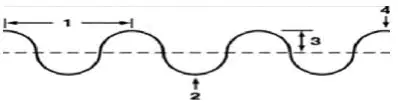
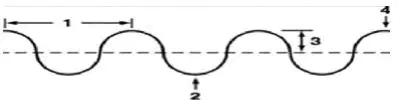
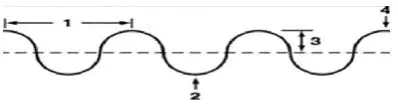
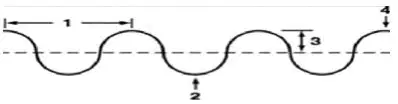
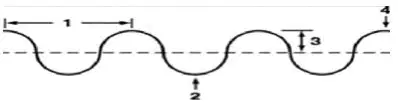
What is measured in the section labeled #1?
a)
wavelength
b)
compression
c)
frequency
d)
amplitude
8.
Which part of the wave is labeled #2?
a)
crest
b)
rarefaction
c)
amplitude
d)
trough
9.
What is measured in the section labeled #3?
a)
crest
b)
rarefaction
c)
amplitude
d)
trough
10.
Which part of the wave is labeled #4?
a)
trough
b)
refraction
c)
wavelength
d)
crest
11.
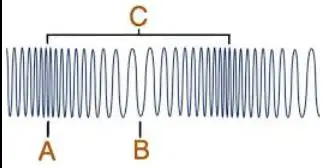
What type of wave is shown?
a)
sound wave
b)
compression wave
c)
transverse wave
d)
longitudinal wave
12.
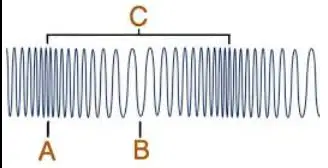
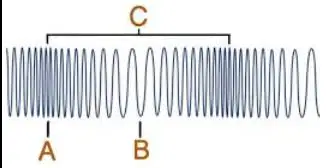
Which part of the wave is labeled A?
a)
trough
b)
compression
c)
rarefaction
d)
crest
13.
Which part of the wave is labeled B?
a)
trough
b)
compression
c)
rarefaction
d)
diffraction
14.
What type of wave is shown?
a)
radio wave
b)
light wave
c)
longitudinal wave
d)
transverse wave
15.
Sound waves are
a)
longitudinal waves.
b)
electromagnetic waves.
c)
transverse waves.
d)
all answers are correct
16.
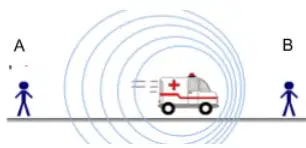
Which person will hear a higher pitch?
a)
A
b)
B
c)
neither
d)
both
17.
Which sound would have a high pitch?
a)
a sound with a high frequency
b)
a sound with high decibels
c)
a sound with high resonance
d)
a sound with high intensity
18.
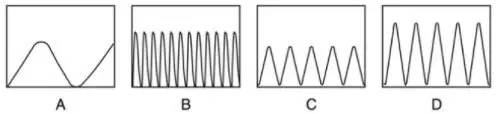
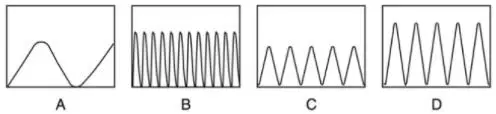
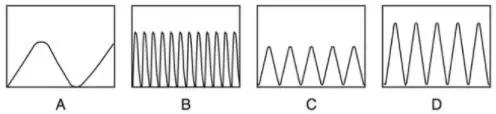
Which wave has the lowest frequency?
a)
A
b)
B
c)
C
d)
D
19.
Which wave has the shortest wavelength?
a)
A
b)
B
c)
C
d)
D
20.
Which wave has the greatest amount of energy?
a)
A
b)
B
c)
C
d)
D
21.
What makes up all matter?
a)
Fluids
b)
Volume
c)
Atoms
d)
liquids
22.
As you heat an object, what happens to the particles in the object?
a)
They move slower
b)
They stop moving
c)
They move faster
d)
They catch on fire
23.
If particles move more slowly, an object’s temperature
a)
Increases
b)
Decreases
c)
Cannot be calculated
d)
Will remain the same
24.
During which season would the air molecules have the most kinetic energy?
a)
Spring
b)
Summer
c)
Fall
d)
Winter
25.
Heat always transfers from
a)
a hotter object to a cooler object
b)
a cooler object to a hotter object
c)
a larger object to a smaller object
d)
a dense object to a less dense object
26.
Which part of the atom has a positive charge?
a)
Proton
b)
Electron
c)
Neutron
d)
All the above
27.
Which part of the atom has a negative charge?
a)
Proton
b)
Neutron
c)
Electron
d)
None of the above
28.
_____ is the transfer of thermal energy from one object to another.
a)
Mass
b)
Heat
c)
Cold
d)
Degrees
29.
A material in which electrons are able to move easily is
a)
An insulator
b)
A conductor
c)
An electric field
d)
A resistor
30.
Stored energy is also called
a)
kinetic energy
b)
potential energy
c)
sound energy
d)
radiant energy
31.
Newton’s first law of motion states
a)
An object in motion will remain in motion unless a force acts on it.
b)
When a force acts on an object, its acceleration is in the opposite direction of the force.
c)
When a force is applied to an object, there is an equal force applied by the object in the opposite direction.
d)
Acceleration equals force divided by mass.
32.
Newton’s first law is often called the Law of _______.
a)
Inertia
b)
Conservation
c)
Resistance
d)
Momentum
33.
Newton’s third law of motion states that...
a)
An object at rest tends to stay at rest
b)
Force is equal to mass times acceleration
c)
An object in motion tends to stay in motion
d)
For every action force there is an equal and opposite reaction force.
34.
If a feather and a brick are dropped from the same height in a vacuum, which will fall faster?
a)
Brick
b)
Both will fall at the same rate
c)
The will both float
d)
Feather
35.
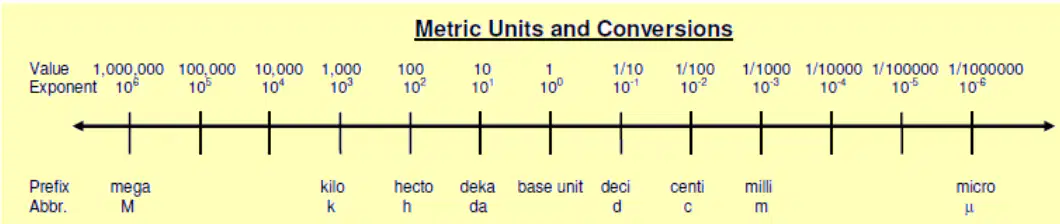
47.2 meters = ______kilometers?
a)
47,200
b)
0.0472
c)
0.000472
d)
4,720
36.
9,500 meters = _________millimeters?
a)
0.095
b)
9,500,000
c)
95
d)
9,500,000,000
37.
How is speed calculated?
a)
time divided by acceleration
b)
distance divided by time
c)
displacement divided by distance
d)
distance times velocity
38.
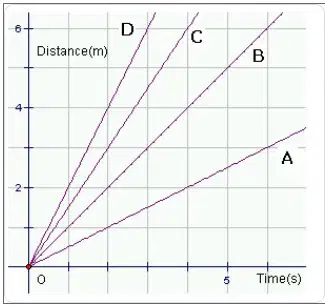
In the distance-time graph, which line represents the fastest speed?
a)
A
b)
B
c)
C
d)
D
39.

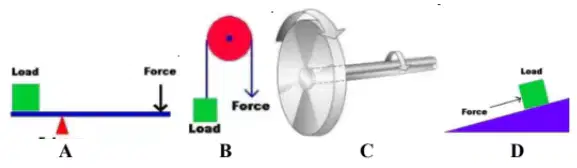
What simple machine is labeled with the letter C?

a)

Wheel and Axle

b)

Inclined Plane

c)

Lever

d)

Pulley

40.

What simple machine is labeled with the letter A?

a)

Wheel and Axle

b)

Inclined Plane

c)

Lever

d)

Pulley

41.

What simple machine is labeled with the letter D?

a)

Wheel and Axle

b)

Inclined Plane

c)

Lever

d)

Pulley

42.

What simple machine is labeled with the letter B?

a)

Wheel and Axle

b)

Inclined Plane

c)

Lever

d)

Pulley

43.

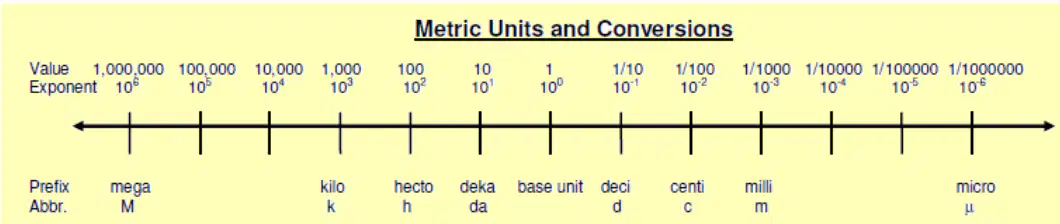
What unit do we use for mass?

a)

Grams

b)

m/s

c)

meters

d)

joules

44.

What unit do we use for distance?

a)

Grams

b)

m/s

c)

meters

d)

joules

45.

What unit do we use for speed?

a)

Grams

b)

m/s

c)

meters

d)

joules

46.

What unit do we use for work?

a)

Grams

b)

m/s

c)

meters

d)

joules

47.

What unit do we use for power?

a)

Watts

b)

Decibles

c)

calories

48.

What unit do we use for food energy?

a)

Watts

b)

Decibles

c)

calories

49.

What unit do we use for sound intensity?

a)

Watts

b)

Decibles

c)

calories

50.

Match the prefix with its meaning: milli

a)

1000

b)

1/100

c)

1/1000

51.

Match the prefix with its meaning: Kilo

a)

1000

b)

1/100

c)

1/1000

52.

Match the prefix with its meaning: centi

a)

1000

b)

1/100

c)

1/1000

53.

What happens when a positive and positive particle are by each other?

a)

attract

b)

repel

54.

What happens when a negative and positive particle are by each other?

a)

attract

b)

repel

55.

What happens when a negative and negative particle are by each other?

a)

attract

b)

repel