
Font size
 Worksheets
EOYE Chemistry retrieval practice
Total questions: 99
Worksheet time: 1hrs 7mins
To test for hydrogen you....
use a lit splint
use a glowing splint
add anhydrous copper sulphate
bubble the gas through limewater
The positive result for a lit splint test......
gives a squeaky pop
shows the presence of hydrogen
has the splint relights
has the splint goes out
When carbon dioxide is bubbled through limewater a positive result could be described as.....
colourless to milky
colourless to cloudy
a white precipitate forms
the solution goes clear

which gas is this testing for?
hydrogen
chlorine
oxygen
carbon dioxide

What liquid tests for CO2?
water
limewater
chlorine
acid
Which of the following is a test for carbon dioxide gas?
Burns with a squeaky pop.
Relights a glowing splint.
Turns limewater cloudy white.
Turns litmus paper red.
Which of the following is a test for hydrogen gas?
Burns with a squeaky pop.
Relights a glowing splint.
Turns limewater cloudy white.
Turns litmus paper red.
Which of the following statements is the correct test for carbon dioxide gas?
It turns limewater from colourless to cloudy white.
It turns limewater from cloudy white to colourless.
It relights a glowing splint.
It burns with a squeaky pop.
Which of the following statements is the correct test for hydrogen gas?
It relights a glowing splint.
It gives a pop sound with a glowing splint.
It gives a pop sound with a burning splint.
It turns limewater from cloudy white to colourless.

Alkali are so reactive to air they are generally stored in what?
Water
Oil
Vaults
Cotton
a vacuum


What happens to the reactivity of the alkali metals as you move down the group?
increases
decreases
Which of the following are alkali metals
Sodium
Caesium
Francium
Calcium
Potassium
What is the chemical symbol for Potassium?
K
Na
Po
So
Li
What is the chemical symbol for Sodium?
K
Na
Po
So
Li
Which of these elements are Halogens?
Fluorine
Helium
Zinc
Bromine
What group are the Halogens?
6.9
7
8
3
Which of the "Halogens" is found in liquid state at room temperature?
Flourine
Chlorine
Iodine
Bromine
Which of the "Halogens" has yellowish green color?
Chlorine
Bromine
Flourine
Iodine
As you move down the group, halogens' reactivity...
increases
decreases
doesn't change
shows no trend.
Which halogen is the most reactive?
iodine
chlorine
bromine
fluorine
Which halogen is the least reactive?
iodine
chlorine
bromine
fluorine
Which halogens can displace bromide ions to make bromine?
Fluorine and iodine.
Fluorine and bromine.
Fluorine and chlorine
Chlorine and iodine.

A displacement reaction involves...
a solution turning brown or yellow.
a less reactive element taking the place of a more reactive element.
a dislocated hip.
a more reactive element taking the place of a less reactive element.
Would a displacement reaction occur for Bromine + Potassium Iodide?
Yes
No
Maybe
Would a displacement reaction occur for Iodine + Potassium Bromide?
Yes
No
Maybe
Which of the following groups is inert?
Alkali
Transition Metals
Noble Gas


Transition Metals
Inner Transition Metals
Metals
Metalloids
6.15: Which of these is not a property of noble gases?
Colourless
Odourless
Flammable
Gas at room temperature

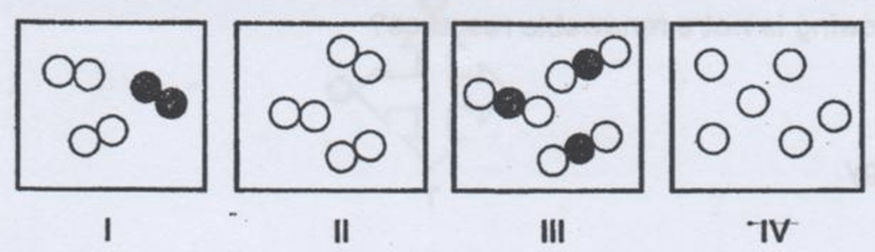
In the diagrams provided, the circles of different colors represent the atoms of different elements. Which diagram represents a mixture?
I
II
III
IV

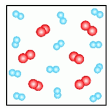

Which of the following is a mixture?
(circles of different colors represent different types of atoms)
(circles that are touching are chemically bonded)


Which method(s) below is suitable to obtain salt from a salt solution?
distillation
dissolving
filtration
evaporation
Which method(s) below is suitable to obtain pure water from a salt solution?
distillation
dissolving
filtration
evaporation
The colour of plant leaves is due to a mixture of pigments.
Which method is used to separate these pigments?
filtration
evaporation
distillation
chromatography

Ms Lenny wants to separate a mixture of sand and salt.
Which option below can she use to obtain the sand from the mixture?
filtration only by pouring mixture of sand and salt through filter paper
dissolving only by adding water to mixture
dissolving first then use filtration
dissolving first then use evaporation

Which processes take place during distillation?
Hint: There are 2 processes.
freezing
boiling
condensation
melting

Chromatography is commonly used in food testing to identify the presence of banned additives in food.
Which additive(s), P, Q, R or S is/are present in Chewy Candy?
P and R
P and S
Q and R
Q and S

What is the apparatus labelled X known as?
(a)

Muddy water is filtered using filter paper and filter funnel. The mud stays on the filter paper.
Why does the mud stay on the filter paper?
The mud reacts with the filter paper.
The particles of mud are too large to pass through the holes in the filter paper.
The particles of the water stop the mud going through.
The particles of water make the filter paper wet.

Which ink, W, X or Y is a pure substance based on the chromatogram shown?
W
X
Y
When a mixture of rock pieces, salt, and water is filtered, what is the residue?
Rock Pieces
Salt
Water
Salt and Water
When a mixture of rock pieces, salt, and water is filtered, what is the filtrate?
Rock Pieces
Salt
Water
Salt and Water
Out of salt and water, what is the solute?
Salt
Water
Out of salt and water, what is the solvent?
Salt
Water
What is the name of the process used to separate an insoluble substance from an a solution?
Filtration
Crystallisation
Sieving
1.What is the name of the process to separate a soluble substance from a solution?
Filtration
Crystallisation
Sieving

What is the separation technique in the picture?
Decantaion
Evaporation
Distillation
Using a magnet
H2 + O → H2O
H2 + O → H2O

2Mg + O2 ---> 2MgO, which are the reactants?

Dissolving salt is a
Chemical change
Physical change
Which is not a chemical reaction?
Mixing baking soda and vinegar, bubbles are formed
Boiling water, bubbles are formed
Alkaseltzer tablet in water, bubbles are formed
Cake baking in over, bubbles are formed

When a metal is shiny, we say it is ___________.
lustrous
malleable
ductile
conductive
When a metal can be pounded into thin sheets, we say it is ___________.
lustrous
malleable
ductile
conductive
When a metal can be made into thin wires, we say it is ___________.
lustrous
malleable
ductile
conductive
When a metal can allow heat or electricity to flow through it, we say it is ___________.
lustrous
malleable
ductile
conductive
Which state of matter are most metals at room temperature?
solid
liquid
gas
degrees
Which of the following metals are magnetic? (Choose all that apply.)
iron
nickel
copper
aluminum
gold
Which of the following materials would make a good conductor of heat and electricity? (Choose all that apply.)
pots and pans
rubber tubing
copper wires
iron nails
a plastic handle
The chemical symbol for iron
Ir
Fe
I
Fn
The only liquid metal at the room temperature
Francium
Sodium
Mercury
Cobalt
Chemical symbol for Gold
Go
G
Au
Mn
Which one is not a metal?
Magnesium
Nickel
Mercury
Nitrogen
What is an alloy
A mixture of metals and gas
A mixture of carbon and steel
A homogenus mixture of metals and non metals
mixture of metals and non metals
Define alloys
Metals
Mixture of two or more elements
A group of non-metals
Carbon compound
A mixture of metals is called an (a) .

