wayground logo

Free Printable Worksheets

Font size

S
M
L
XL
Worksheets

Reflection and refraction of light

Total questions: 90

Worksheet time: 6hrs 32mins

Name
Class
Date
1.

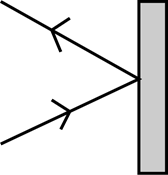
In the diagram, which letter represents the angle of incidence?

a)

A

b)

B

c)

C

d)

D

2.

Which diagram represents specular reflection?

a)

A

b)

B

3.
Law of reflection state that - The angle of incidence is .................. to the angle of reflection.
a)
equal
b)
double
c)
half
4.
........... – the angle between the normal and the reflected ray.
a)
Angle of incidence
b)
Angle of reflection
c)
Angle of coincidence
d)
Angle of direction
5.
What is reflection?
a)
Reflection is the bouncing  of light off the surface that it strikes on.
b)
Reflection is the absorbing of light off the surface that it strikes on.
c)
Reflection is the bending of light off the surface that it strikes on.
d)
Reflection is the scattering of light off the surface that it strikes on.
6.
........... – the angle between the normal and the incident ray.
a)
Angle of incidence
b)
Angle of reflection
c)
Angle of coincidence
d)
Angle of direction
7.
How does light travel
a)
It curves around corners
b)
Really slow
c)
In a straight line
d)
In circles
8.
Which term describes when light bounces off of a smooth surface?  
a)
Refraction
b)
Transmission
c)
Absorption
d)
Reflection
9.

Which diagram represents diffuse reflection?

a)

A

b)

B

c)

C

d)

D

10.
The ray of light that strikes a reflecting surface is called ________.
a)
incident ray
b)
reflected ray
c)
normal ray
d)
none of the above
11.
The imaginary line perpendicular to a reflecting surface is called _____.
a)
crooked line
b)
parallel line
c)
angular line
d)
normal line
12.
The illustration shows a light ray striking an object.
In the illustration, the light ray striking the object is-
a)
absorbed
b)
stopped
c)
reflected
d)
refracted
13.
The bouncing off of light rays from the surface of an object such as a mirror or other shiny surface is called:
a)
mirror
b)
laser
c)
reflection
d)
refraction
14.
The ray of light that strikes a reflecting surface is called ________.
a)
incident ray
b)
reflected ray
c)
normal ray
d)
none of the above
15.
The angle produced as a source of light bounces off a reflecting surface is called ______.
a)
angle of crookedness
b)
angle of reflection
c)
angle of incidence
d)
angle of bounce
16.
MCQ 02
Why can you see most objects?
a)
A. they emit light
b)
B. light refracts through them
c)
C. light reflects off them
d)
D. they absorb light
17.
Section B1a
Given that the angle of incidence = 30 degrees
a. Draw a ray diagram, labelling clearly the normal, incident ray, angle of incidence, reflected ray and angle of reflection accurately.
Which is the correct diagam? 
a)
A
b)
B
c)
C
d)
D
18.

Which is NOT a source of light?

a)

sun

b)

lightbulb

c)

fire

d)

car

19.

Your light-sensing organ is your

a)

ear

b)

finger

c)

brain

d)

eye

20.

In order to see a picture it must

a)

produce light

b)

reflect light

c)

absorb light

21.

To get the best reflection from a mirror you need

a)

a very shiny surface to reflect lots of light

b)

to stand right in front of it

c)

to shine a bright light on it

d)

it to produce light

22.
MCQ 011
According to the laws of reflection, if i = angle of incidence and r = angle of reflection,
a)
A. i =  r
b)
B. i >  r
c)
C. r >  i
d)
D. i is not equal to r
23.
MCQ 08
If a capital letter R is seen in an ordinary mirror, what does it look like?
a)
A
b)
B
c)
C
d)
D
24.
Which of the following is not a source of light? 
a)
A. candle
b)
B. caver’s lamp
c)
C. mirror
d)
D. sun
25.
Law of reflection state that - The angle of incidence is .................. to the angle of reflection.
a)
equal
b)
double
c)
half
26.
What is reflection?
a)
Reflection is the bouncing  of light off the surface that it strikes on.
b)
Reflection is the absorbing of light off the surface that it strikes on.
c)
Reflection is the bending of light off the surface that it strikes on.
d)
Reflection is the scattering of light off the surface that it strikes on.
27.

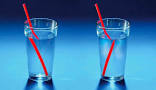
A student placed a pencil in a cup of water. The pencil appears broken because light

a)

always travels in a straight line.

b)

bends when it passes through water.

c)

makes the water in the glass evaporate.

d)

reflects the pencil on the water's surface.

28.

When light passes at an angle to the normal from one medium into another in which its speed is higher

a)

it is bent toward the normal.

b)

it always lies along the normal.

c)

it is unaffected.

d)

it is bent away from the normal.

29.

When light passes at an angle to the normal from one medium into another in which its speed is lower

a)

it is bent towards the normal.

b)

it always lies along the normal.

c)

it is unaffected.

d)

it is bent away from the normal.

30.
How is light affected by an increase in the index of refraction?
a)
Its frequency increases
b)
Its frequency decreases
c)
Its speed increases
d)
Its speed decreases
31.
Light has the lowest velocity in which medium?
flint glass n=1.70
barium glass n=1.60
crown glass n=1.523
water n=1.33
diamond n=2.45
a)
diamond
b)
water
c)
flint glass
d)
barium glass
32.
Glass has a _____________ index of refraction than air.
a)
Equal
b)
Greater
c)
Less
d)
Impossible to say
33.

If all other variables are held constant, what happens to the angle of refraction if the angle of incidence increases?

a)

the angle of refraction stays the same

b)

the angle of refraction decreases

c)

the angle of refraction increases

d)

cannot be determined from the information provided

34.

Based on the image, which medium has a larger index of refraction?

a)

Medium 1 has a larger index of refraction.

b)

Medium 2 has a larger index of refraction.

c)

Both mediums have the same index of refraction.

d)

Cannot be determined.

35.

Based on the image, as light passes from medium 1 to medium 2

a)

light speeds up and bends towards the normal

b)

light speeds up and bends away from the normal

c)

light slows down and bends towards the normal

d)

light slows down and bends away from the normal

36.

Based on the image, as light passes from medium 1 to medium 2

a)

light speeds up and bends towards the normal

b)

light speeds up and bends away from the normal

c)

light slows down and bends towards the normal

d)

light slows down and bends away from the normal

37.

Will light change direction toward or away from the perpendicular when it goes from air to water?

a)

away from the perpendicular

b)

toward the perpendicular

38.

Will light change direction toward or away from the perpendicular when it goes from glass to water?

a)

away from the perpendicular

b)

toward the perpendicular

39.

A student placed a pencil in a cup of water. The pencil appears broken because light

a)

always travels in a straight line.

b)

slows down when it passes through water.

c)

makes the water in the glass evaporate.

d)

reflects the pencil on the water's surface.

40.

When light goes from a less dense to a more dense medium,

a)

it is bent towards the normal.

b)

it always lies along the normal.

c)

it is unaffected.

d)

it is bent away from the normal.

41.

Glass has a _____________ level of refraction than air.

a)
Equal
b)
Greater
c)
Less
d)
Impossible to say
42.

Based on the image, which medium has a higher density?

a)

Medium 1 has a higher density.

b)

Medium 2 has a higher density.

c)

Both mediums have the same densities.

d)

Cannot be determined.

43.

Based on the image, as light passes from medium 1 to medium 2

a)

light speeds up and bends towards the normal

b)

light speeds up and bends away from the normal

c)

light slows down and bends towards the normal

d)

light slows down and bends away from the normal
44.
The velocity of light in vacuum is _______ m/s
a)
3x10⁸
b)
3x10¹²
c)
3x10⁶
d)
3x10¹⁰
45.
How does light behave as it enters these mediums?
a)
continue its path as straight line.
b)
bends toward the normal
c)
bends away from the normal
d)
reflects
46.
What is this called?
a)
refraction
b)
reflection
c)
reconstroction
d)
retraction
47.

When light passes from a dense medium into a less dense medium

a)

it is bent toward the normal.

b)

it always lies along the normal.

c)

it is unaffected.

d)

it is bent away from the normal.

48.
In what medium does light travel the fastest?
a)
vacuum
b)
air
c)
water
d)
glass
49.
Swimming pools and the ocean look shallower than they really are due to:
a)
reflection 
b)
dispersion
c)
refraction
d)
total internal reflection
50.
What is the difference between reflection and refraction? 
a)
Both involve light bending through a medium
b)
Reflection is light bouncing off a medium's surface and refraction is light bending through a medium
c)
Reflection is light bending through a medium's surface and refraction is light bouncing off a medium
d)
Refraction is light being absorbed in a medium and reflection is light being bent through a different medium
51.
Refraction is the bending of a wave disturbance as it passes from one _________ into another.
a)
glass
b)
medium
c)
area
d)
boundary
52.
When light bounces back it is _____
a)
Reflected
b)
Refracted
c)
Absorbed
d)
Optical Density
53.
The velocity of light in vacuum is _______ m/s
a)
3x10⁸
b)
3x10¹²
c)
3x10⁶
d)
3x10¹⁰
54.
Glass has a _____________ index of refraction than air.
a)
Equal
b)
Greater
c)
Less
d)
Impossible to say
55.
If a pulse of red light and a pulse of blue light travel in vacuum
a)
The red pulse travels faster because its index of refraction is smaller
b)
The blue pulse travels faster
c)
The two pulses travel at the same speed
d)
The relative speed depends on the exact wavelengths of the red and blue pulses
56.
This shows the phenomenon known as....
a)
reflection
b)
refraction
c)
mirrors
d)
focal point
57.
Which color of light is most refracted during dispersion by a prism?
a)
red
b)
yellow
c)
green
d)
violet
58.
In what medium does light travel the fastest?
a)
vacuum
b)
air
c)
water
d)
glass
59.

Which letter represents the angle of incidence?

a)

A

b)

B

c)

C

d)

D

60.

What is the angle of reflection?

a)

650

b)

500

c)

250

d)

400

61.

What type of image is formed?

a)

virtual and inverted

b)

virtual and upright

c)

real and upright

d)

real and inverted

62.
What type of lens is your eye?
a)
convex
b)
concave
c)
it is not a lens
63.

How does a concave lens differ from a convex lens?

a)

A convex lens is another way to describe a plane mirror; a concave lens is curved

b)

A concave lens is curved inward on both sides; a convex lens is on only one side

c)

A convex lens has a thick center and thin edges, a concave lens has a thin center and thicker edges

d)

A convex lens has a thin center and thick edges. a concave lens has a thick center and thinner edges

64.

A concave lens has an inward curved shape. It refracts light outward from the lens. They light rays spread apart as they exit the lens. Which represents a concave lens?

a)

A

b)

B

c)

A and B

d)

neither A or B

65.

What do a prism, a magnifying glass, a microscope, and eyeglasses ALL have in common.

a)

They are opaque

b)

They refract light

c)

They reflect light

d)

That are translucent

66.

A ____ lens is sometimes called a converging lens because it_____.

a)

convex; makes parallel light rays curve outward or diverge

b)

concave; makes parallel light rays travel at a faster speed than before they encountered the lens

c)

convex, makes parallel light rays passing through it bend inward and meet (converge) at a spot just beyond the lens known as the focal point.

d)

concave; makes parallel light rays passing through it bend inward and meet (converge) at a spot just beyond the lend known as the focal point.

67.
In the thin lens equation, do represents 
a)
Distance of the object from the lens
b)
Distance of the image from the lens
68.
If the distance of the image from the lens (di) is positive. The image is considered....
a)
Real 
b)
Virtual
69.
A diverging lens is also known as a ____lens.
a)
refracted
b)
diffracted
c)
convex
d)
concave
70.
___ is when light travels through a material and bends.
a)
Diffraction
b)
Dispersion
c)
Mirage
d)
Refraction
71.
The point where the rays meet is known as....
a)
Fire
b)
the focal point
c)
refraction
d)
Plane of the lens
72.
Is a convex lens thicker or thinner in the middle?
a)
Thicker 
b)
Thinner 
73.
Is a concave lens thicker or thinner in the middle? 
a)
Thicker 
b)
Thinner 
74.
What does the word "converging" mean?
a)
to separate
b)
to come together
c)
parallel 
d)
perpendicular
75.
A converging lens is also known as a ____ lens.
a)
convex
b)
concave
c)
double
d)
refracted
76.
What does the word "diverging" mean?
a)
to spread apart
b)
to come together
c)
parallel
d)
perpendicular
77.
A diverging lens is also known as a ____lens.
a)
refracted
b)
diffracted
c)
convex
d)
concave
78.
___ is when light travels through a material and bends.
a)
Diffraction
b)
Dispersion
c)
Mirage
d)
Refraction
79.
The point where the rays meet is known as....
a)
Fire
b)
the focal point
c)
refraction
d)
Plane of the lens
80.
Which describes a convex lens?
a)
triangular in shape
b)
more transparent in the middle
c)
thicker on the edges than in the middle
d)
thicker in the middle than on the edges
81.

When light waves move from passing through air to passing through a glass lens when happens to them?

a)

They slow down and change direction

b)

They speed up and change direction

c)

They maintain the same speed and change direction

d)

They maintain their same speed and direction

82.
This diagram best represents 
a)
reflection
b)
refraction
c)
absorption
d)
diffusion
83.

How does a concave lens differ from a convex lens?

a)

A convex lens is another way to describe a plane mirror; a concave lens is curved

b)

A concave lens is curved inward on both sides; a convex lens is on only one side

c)

A convex lens has a thick center and thin edges, a concave lens has a thin center and thicker edges

d)

A convex lens has a thin center and thick edges. a concave lens has a thick center and thinner edges

84.
A _______ breaks white light into colors.
a)
prism
b)
visible spectrum
c)
shadow
d)
lens
85.
White light is made up of:
a)
red, yellow, and blue
b)
no colors
c)
all colors
d)
red, green, and blue
86.
What does the word "diverging" mean?
a)
to spread apart
b)
to come together
c)
parallel
d)
perpendicular
87.

The above lens is a type of ___.

a)

diverging lens

b)

converging lens

c)

divergent lens

d)

convergent lens

88.

Where are lenses used? (multiple correct)

a)

Telescopes

b)

Tables

c)

Eye-glasses

d)

Binoculars

89.

Which one of these is a convex lens?

a)
b)
c)

None of the above

90.

Concave lenses are thick in the middle and thin in the edges.

a)

TRUE

b)

FALSE