
 Worksheets
Periodic Motion Quiz
Total questions: 94
Worksheet time: 2hrs 23mins
The time taken by a pendulum to complete one oscillation is its _____.
frequency
period
amplitude
speed
The number of cycles or repetitions per second is _________.
frequency
period
amplitude
speed
The pendulum shown below undergoes a periodic motion. The maximum distance the pendulum bob moves from its equilibrium position is its ___.
amplitude
period
frequency
speed
Which of the following quantities describing an oscillation can be negative?
Displacement
Amplitude
Period
Frequency
Hooke’s law is stated mathematically as: F=-kx. What does the negative sign represent?
I. The force is in the opposite direction to
the displacement
II. The force is in the same direction as the
displacement
III. The force tries to restore the object to its
equilibrium position
I only
II only
I and III
II and III
What is the magnitude of the force acting on a spring with a spring constant of 275 N/m that is stretched 14.3 cm?
2.81 N
19.2 N
39.3 N
3932 N

The figure below demonstrates Hooke’s law. What is the extension for a mass of 50 g attached to the spring below?
x/4
x/2
2x
4x
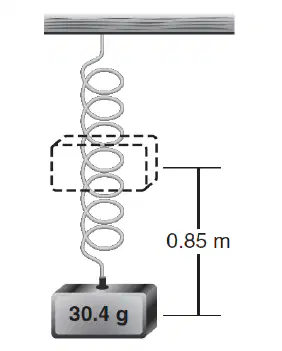
A mass stretches a spring as it hangs from the spring as shown in the figure below. What is the spring constant?
0.25 N/m
0.35 N/m
26 N/m
350 N/m
A spring with a spring constant of 27 N/m, is stretched 16 cm. What is the spring's potential energy?
0.35 J
1.7 J
2.2 J
4.3 J
What is the value of the spring constant of a spring with a potential energy of 8.67 J when it’s stretched 247 mm?
70.2 N/m
71.1 N/m
142 N/m
284 N/m
A pendulum of mass 3 and length 4 oscillates between the labeled positions in the figure, with a period 5. What would be its period if its mass is increased to 43?
5
25
45
85
What is the correct rearrangement of the formula for the period of a pendulum to find the length of the pendulum?
7=48 ! 9 5 !
7=95 48 !
7=5 ! 9 (28) !
7=59 28
What is the length of a pendulum that has a period of 4.89 =?
5.94 m
11.9 m
24.0 m
37.3 m
Rank the following pendulums according to period, from least to greatest.
10 cm long, mass = 0.25 kg
10 cm long, mass = 0.35 kg
20 cm long, mass = 0.25 kg
20 cm long, mass = 0.35 kg
Which phenomenon occurs when an object absorbs wave energy that matches the object’s natural frequency?
Reflection
Resonance
Refraction
Interference
Explain why a pendulum is an example of periodic motion.
What is periodic motion? Give three examples of periodic motion.
What is simple harmonic motion? Give an example of simple harmonic motion.
If a spring obeys Hooke’s law, how does it behave?
How can you determine the following from a graph of force magnitude versus displacement? a. the spring constant of a spring?
Does the period of a pendulum depend on a. the mass of the bob?
What conditions are necessary for resonance to occur?
What is the period of the wave?
0.2 s
0.3 s
0.4 s
0.6 s
What is the wavelength of the wave?
0.2 m
0.3 m
0.4 m
0.6 m
What is the speed of the wave?
0.24 m/s
0.67 m/s
1.5 m/s
3.0 m/s
Which of the following is/are true for a mechanical wave?
I. It is a disturbance in matter
II. It transfers energy
III. It needs a medium to travel
What do mechanical waves transfer?
Energy only
Matter only
Both energy and Matter
Neither energy nor matter
As a longitudinal wave moves through a medium, the particles of the medium move______.
perpendicular to the direction of wave travel
parallel to the direction of wave travel
in circles
in ellipses
What is the name for an area of low pressure in a longitudinal wave?
Crest
Trough
Compression
Rarefaction
As a transverse wave moves through a medium, the particles of the medium______.
vibrate parallel to the direction of the wave’s propagation
vibrate perpendicular to the direction of the wave’s propagation
are transferred in the direction of the wave’s motion, only
are stationary
A transverse wave has _____.
Crests and troughs
Crests and compressions
Compressions and rarefactions
Rarefactions and troughs
In which of the waves below, do the particles of the medium vibrate perpendicular to the direction of the wave?
I. Transverse waves
II. Longitudinal waves
III. Surface waves
The wave on the slinky below is a _____ wave.
transverse
longitudinal
surface
electromagnetic
Identify the quantities labeled > and A in the figure below.
Period Amplitude
Period Wavelength
Amplitude Period
Wavelength Amplitude
The diagram below shows two points, A and B, on a wave train. How many wavelengths separate point A and point B?
1.0
1.5
2.0
3.0
Which of the following wave diagrams have both wavelength (Y) and amplitude (>) labeled correctly?
A.
B.
C.
D.
A microwave with a frequency of 5.0×10 has a period of _____.
2.0×10
6.0×10
1.7×10
1.5×10
What is the frequency of a wave with a period of 3 s?
0.3 Hz
3/π Hz
π/3 Hz
3 Hz
What is the time period of a wave of frequency 20 Hz?
0.05 =
5.0 =
17 =
20 =
What is the amplitude of the wave?
0.20 m
0.40 m
2.0 m
6.0 m
What is the wavelength of the wave?
0.20 m
0.40 m
2.0 m
6.0 m
What is the speed of the wave if its frequency is 8.0 hertz?
1.6 m/s
3.2 m/s
16 m/s
48 m/s
The wave shown in the figure below travels 11.2 m to a wall and back again in 4 s. What is the wave’s frequency?
0.2 Hz
2 Hz
5 Hz
9 Hz
What is the frequency of the wave?
0.25 Hz
0.50 Hz
2.0 Hz
4.0 Hz
A wave has a frequency of K=150Z[ and travels a distance of 30.0 ,, in 0.100 =. a. Calculate the speed of the wave.
Find the wavelength of the wave.
What is the period of the wave?
If the wave continued to travel in the same medium, but with double its original frequency, i. What would its new wavelength be?
ii. Which of the two waves have a larger wavelength? Justify your answer.
Identify the type of wave.
Longitudinal wave
Transverse wave
If the wavelength of the wave is 6.0 , and the wave travels with a speed of 300 , find the frequency of the wave.
Calculate the wave period.
If the frequency were doubled, what would the new wavelength be?
As the wave moves toward G, point E on the string will move vertically down and then vertically up. What type of wave is represented by the diagram?
Transverse wave
Longitudinal wave
What is the wavelength of this wave?
If the waves were produced at a faster rate, the distance between points D and E would _____.
increase
decrease
Differentiate between transverse and longitudinal waves, giving one example of each.
A wave pulse reaches an end that is fixed as shown below. The wave is _____ in the opposite direction.
inverted and maintains the same shape
not inverted and maintains the same shape
inverted and gets bigger in shape
not inverted and gets bigger in shape
As the wave pulses meet and are superposed, the maximum displacement of the medium is ____.
-6 1
0 1
3 1
6 1
Which diagram best represents the resultant displacement of the medium as the pulses pass through each other?
Diagram A
Diagram B
Diagram C
Diagram D
Which diagram shows the pulse produced due to the superposition of pulse X and pulse Y?
Diagram A
Diagram B
Diagram C
Diagram D
What is the amplitude of the resultant wave if the interference is constructive?
0.22 m
0.53 m
0.75 m
1.28 m
Maximum destructive interference will occur when the phase difference between the waves is ____.
0°
90°
180°
270°
Which arrow represents the direction of travel for the wave fronts after being reflected from the barrier?
Arrow A
Arrow B
Arrow C
Arrow D
Which of the following describes the changes shown in the figure below when waves travel from deeper water to shallow water in a ripple tank?
Reflection
Refraction
Diffraction
Interference
Which of the statements below is true regarding the relationship between wavefronts and rays?
Wavefronts are always perpendicular to the rays
Wavefronts are always parallel to the rays
Wavefronts are always tangential to the rays
There is no relationship between the wavefronts and the rays
What is the name given to the wave behavior in which a wave changes direction as it moves from one medium to another medium?
Reflection
Refraction
Interference
Rarefaction
When water waves enter a shallow region from a deep region, there must be a change in the wave’s____.
color
period
speed
frequency
Which option describes a standing wave?
Option A
Option B
Option C
Option D
Maximum constructive interference occurs at the __.
antinodes A, C and E
antinodes B and D
nodes A, C and E
nodes B and D
What is the wavelength of this standing wave?
While playing, two children create a standing wave in a rope, as shown in the diagram below. A third child participates by jumping the rope. What is the wavelength of this standing wave?
2.15 m
4.30 m
6.45 m
8.60 m
What is the total number of nodes and antinodes in the standing wave?
3 nodes and 2 antinodes
2 nodes and 3 antinodes
5 nodes and 4 antinodes
4 nodes and 5 antinodes
The second harmonic of a guitar string has a frequency of 60 Hz. If the speed of waves on the string is 120 m/s, what is the string’s length?
1.0 m
2.0 m
3.0 m
4.0 m
Constructive and destructive interference are a result of superposition of two or more waves. What is the difference between constructive and destructive interference?
The diagram below represents two pulses traveling toward each other in a uniform medium. Is the interference between points A and B constructive or destructive?
What is the resultant amplitude?
The diagrams in the table below represent two identical wave pulses approaching each other in a uniform medium. Complete the table below, identifying the type of interference, the resulting amplitude and the formation of node/antinode at P when the waves are superposed.
A ripple tank was used to produce plane waves in water which were then reflected by a barrier as shown in figure 1 below. In figure 2 above, draw the waves reflected by the barrier, clearly showing the following: the normal to the barrier, direction of the reflected waves, angle of incident, angle of reflection, reflected wave fronts.
When a water wave meets a boundary, it either reflects or refracts. Identify and draw ray diagrams to show what happens to the water waves in a ripple tank in each of the pictures below (show the wave fronts as well as the direction in your diagram).
A wave with a frequency of 1.1 Hz travels through deep water at a speed of 5.7 m/s. When the wave enters a shallow region, its speed slows down to 3.2 m/s. What is the wavelength of the wave in the shallow water?
The wave fronts below formed in a ripple tank move from region A to region B of different depth. Explain why the waves change direction?
Which region A or B is less deep (shallow)?
What are the quantities that change for the waves that enter from region A to region B?
What will happen to each of the quantities below as the waves move from region A to B? Speed: Wavelength: Frequency: Direction:
A boy creates standing waves on a rope by shaking one end of it vertically. The other end of the rope is fixed to a wall. The distance from the boy’s hand to the wall is 2.4, and he shakes the end of the rope with a period of 0.5 =. Answer the questions in the table below regarding the standing waves formed on the rope. What is the wavelength of the waves?
What is the frequency of the waves?
The standing wave represents which harmonic?
What is its fundamental frequency?
Calculate the speed of the waves traveling along the rope.
Mark all the nodes with the letter b and all the antinodes with the letter W on the figure above.
The diagram shows standing waves formed on a stretched string of length 4=12,. The speed of waves on this string is \=24,/=. Calculate the wavelength of the waves.
Calculate the frequency of the harmonic shown in the figure above.
Find the fundamental frequency of the oscillations.

