
 Worksheets
Waves Grade X
Total questions: 90
Worksheet time: 1hrs 6mins


Which point is sitting on a rarefaction?
A
B
C
D
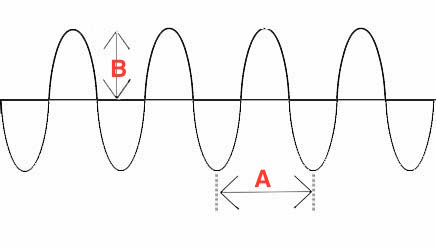
What property of this wave is represented by the letter "A"
amplitude
crest
trough
wavelength
A wave carries...?
energy only
matter only
nothing. The matter carries the energy
neither


What energy is the shortest wavelength?
Radio
Infrared
X rays
Gamma

As the siren goes off in the PARKED car, the young felon at position X hears
a higher pitch than if he were standing still
a lower pitch than if he were standing still
the same pitch he would if he were standing still
As the siren goes off in the PARKED car, the young felon at position Y hears
a higher pitch than if she were standing still
a lower pitch than if she were standing still
the same pitch he would if she were standing still

From the perspective of the camera's position, the ambulance's siren sound should
rise in pitch.
fall in pitch.
stay the same pitch.

A child on a swing moves through positions A-E, while being observed from position F. Assuming the child screams at the same pitch continuously, at which of the marked positions is the child when the observer hears the highest pitch?
A
B
C
D
E

As dad escapes from his kids, he hears them yelling
lower pitched than they would normally.
higher pitched than they would normally.
the same pitch they would normally.
As dad escapes from his kids, he hears them yelling
lower pitched than they would normally.
higher pitched than they would normally.
the same pitch they would normally.
The pitch of a sound wave relates to the wave's _________________.
Amplitude
Frequency
Wavelength
Period
What is the Doppler Effect?
A change in frequency due to the relative motion of a wave source and an observer
When a wave overlaps with another wave
When a wave bounces off of another object
When a wave bends due to traveling through a different medium
An ambulance is driving towards you as you stand on the sidewalk. What happens to the pitch of the siren as it comes towards you?
It increases
It decreases
You are driving in a car and honk the horn at a person standing in the street. As you approach the person, what happens to the pitch of the horn according to you in the car?
It increases
It decreases
It stays the same because you are in the car moving with the sound.
You are standing on the side of the road when a police car races past you with its siren on. After the police car passes you, what happens to the pitch of the siren?
It increases
It decreases
It turns red
A car is not moving but the horn is on. You run towards the car to investigate what's going on. As you approach the car, what happens to the frequency of the sound waves from the horn?
They increase
They decrease
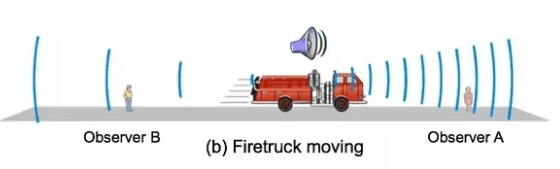
Look at the picture. Who is experiencing a higher pitched sound?
Observer A
Observer B
There's no difference

You stand on the sidewalk next to the street. A fire truck is away from you. The frequency of the siren on the fire truck is 600 Hz.
What should you hear?
Frequency higher than 600 Hz
Frequency lower than 600 Hz
Exactly 600 Hz
No sound, silence.

A car moves at 20 m/s away from a whistle. The whistle is stationary. The whistle makes a sound with a frequency of 500 Hz. The speed of sound in air is 330 m/s.
What is the frequency observed by the driver of the car?
530 Hz
470 Hz
520 Hz

A car moves at 20 m/s towards a whistle. The whistle is stationary. The whistle makes a sound with a frequency of 500 Hz. The speed of sound in air is 330 m/s.
What is the frequency observed by the driver of the car?
530 Hz
470 Hz
480 Hz
An ambulance is moving towards a stationary listener at a constant speed of 30 m∙s-1 . The siren of the ambulance emits sound waves having a wavelength of 0,28 m. Take the speed of sound in air as 340 m∙s-1
Calculate the frequency of the sound waves emitted by the siren as heard by the ambulance driver.
1 213 Hz
1 214,29 Hz
1 215 Hz
An ambulance is moving towards a stationary listener at a constant speed of 30 m∙s-1 . The siren of the ambulance emits sound waves having a wavelength of 0,28 m. Take the speed of sound in air as 340 m∙s-1 .
Calculate the frequency of the sound waves emitted by the siren as heard by the listener.
Choose the correct answer.
1331,80 Hz
1 332 Hz
1 331,7 Hz
A train approaches a station at a constant speed of 20 m.s−1 with its whistle blowing at a frequency of 458 Hz . An observer, standing on the platform, hears a change in pitch as the train approaches him, passes him and moves away from him.
Calculate frequency of the sound that the observer hear while the train is approaching him. Use the speed of sound in air as 340 m.s−1 .
486,63 Hz
487 Hz
458 Hz
A Polarizing filter is used to reduce glare on reflective surfaces including glass, windows, and water.
True
False
Which of the following statements about waves is correct?
Both longitudinal and transverse waves can be polarised.
Neither longitudinal nor transverse waves can be polarised.
Only longitudinal waves can be polarised.
Only transverse waves can be polarised.
Which of the following types of wave cannot be plane polarised?
light
microwaves
ultrasound
ultraviolet
Light from a lamp passes through two polarising filters, P1 and P2, before reaching a
detector. The filters initially have their planes of polarisation parallel.
If the second polarising filter is now rotated 45 degrees, what intensity of lamp light passes through both filters?
25%
35%
50%
71%
What is polarisation by transmission?
The process of changing the color of light waves
The process of amplifying light waves
The process of converting light waves into sound waves
Process of filtering out light waves oscillating in a specific direction
Explain the concept of polarisation of transverse waves.
The speed at which transverse waves travel through a medium.
The process of converting longitudinal waves into transverse waves.
The orientation of the oscillations of the wave in a specific direction.
The amplitude of the wave as it travels through a medium.
What type of waves can be polarised?
Infrared waves and ultraviolet waves
X-rays and gamma rays
Light and electromagnetic waves
Sound waves and radio waves
How does polarisation by transmission occur?
Polarisation is the result of light waves passing through a magnifying glass
Light waves pass through a polarising filter, allowing only light waves oscillating in a particular direction to pass through.
Polarisation occurs when light waves reflect off a smooth surface
Light waves pass through a prism, separating the different polarisations
What are the applications of polarisation in everyday life?
Umbrellas, raincoats, and waterproof shoes
Cooking pots, pans, and utensils
Mobile phones, laptops, and tablets
Sunglasses, LCD screens, and 3D glasses
What is the difference between polarised and unpolarised light?
Polarised light waves vibrate in a single plane.
Polarised light waves have random vibration patterns.
Unpolarised light waves have a specific direction of vibration.
Polarised light waves vibrate in multiple planes.
Explain Malus's law in the context of polarisation.
The intensity of polarized light is inversely proportional to the angle between the transmission axis of the analyzer and the plane of polarization
The intensity of polarized light is directly proportional to the angle between the transmission axis of the analyzer and the plane of polarization
The intensity of polarized light transmitted through an analyzer is proportional to the square of the cosine of the angle between the transmission axis of the analyzer and the plane of polarization of the incident light.
Malus's law only applies to unpolarized light
What are the factors affecting polarisation of light?
Temperature, pressure, and density
Velocity, acceleration, and force
Angle of incidence, material, and wavelength
Color, shape, and size
Discuss the phenomenon of polarisation in sunglasses.
Polarisation in sunglasses helps reduce glare and improve visibility.
Polarisation in sunglasses has no effect on reducing glare or improving visibility.
Polarisation in sunglasses causes the lenses to fog up easily.
Polarisation in sunglasses makes the lenses darker and harder to see through.
How does polarisation play a role in reducing glare from water surfaces?
Polarised sunglasses block out horizontally polarised light
Polarised sunglasses enhance glare from water surfaces
Polarisation has no effect on reducing glare from water surfaces
Polarised sunglasses block out vertically polarised light
Approximately how much light is blocked by two polarizing filters that are perpendicular to each other?
0%
50%
75%
100%
The intensity of the polarized light coming out from the second polarizing filter is 60cd .Calculate the intensity of polarized light coming out from filter 1 if the angle between the two axis of filters is 30 degree?
80 cd
30 cd
60 cd
0 cd
Two polarizing filters are used to reduce the intensity of light. After passing through the first filter, the intensity reduced to 4 candelas. The second filter reduced it to 2 candela. This means that the second filter is turned at a degree angle from the first?
0
30
45
90

. Suppose that light passes through two Polaroid filters whose polarization axes are parallel to each other. What would be the result?
I2=I1
I2 =0
I1 =0

Two polarizing filters are set up so the transmitted light is at a maximum intensity.
Through which angle should polariser 2 be rotated so that no light is transmitted?
45º
60º
90º
180º

Which EM waves have the longest wavelength?
radio
x-rays
ultraviolet
gamma rays
Which EM waves have the shortest wavelength?
radio
x-rays
ultraviolet
gamma rays
Which EM waves are invisible? (more than one correct answer)
radio
visible
ultraviolet
gamma rays
Which EM waves are have a SHORTER wavelength than visible?
radio
none
infrared
x-rays
Which EM waves are have the lowest frequency?
radio
none
infrared
x-rays
Which EM waves are have the highest energy & are the most dangerous?
radio
gamma rays
infrared
x-rays
Which color waves have the lowest frequency?
red
yellow
green
violet
Which color waves have the shortest wavelength?
red
yellow
green
violet
What happens to frequency when wavelength decreases?
stays the same
decreases
increases
There is no relationship between wavelength & frequency.

The diagram shows a person observing a thunderstorm located several kilometers away. The person hears the thunder several seconds after seeing the lightning. Which statement accurately explains the difference in observations of sound and light by the observer?
Human eyes see light faster than their ears can hear sound.
The medium the waves are traveling through is different for each type of wave.
Light waves travel faster than sound waves.
Sound waves travel faster than light waves.

The diagram below shows a light ray. In this diagram, the light ray is being
transmitted
absorbed
reflected
refracted
What do electromagnetic waves NOT need to transfer energy?
matter
speed
wavelength
frequency
The number of waves that pass a given point every second
Frequency
Wavelength
Energy
Electromagnetic Spectrum
Carried in different amounts by all waves
Frequency
Wavelength
Energy
Electromagnetic Spectrum
Broad range of radiation that carries energy as waves
Frequency
Wavelength
Energy
Electromagnetic Spectrum
Which two variables of the electromagnetic spectrum have a direct relationship?
Crests and trough
energy and frequency
wavelength and energy
frequency and wavelength

Based on the picture, which of the following types of electromagnetic radiation has the LOWEST energy?
microwave
ultraviolet
infrared
x-rays
Which of the following best explains why ultraviolet rays can cause sunburn but visible light from a light bulb does not damage skin?
Ultraviolet rays come before the light rays in the electromagnetic spectrum, which means anything before visible light automatically causes cancer.
Ultraviolet rays have lower frequencies than visible light rays and thus have higher energy than light rays from a light bulb.
Ultraviolet rays have higher frequency than visible light rays and thus have more energy than light rays from a light bulb.
Ultraviolet rays have higher frequencies than visible light rays and thus have less energy than light rays from a light bulb.
On the electromagnetic spectrum, radio waves are found on the end of the spectrum considered to possess a low amount of energy. Which statement most accurately describes the wavelength/frequency relationship present in radio waves?
Radio waves possess both low frequencies and small wavelengths.
Radio waves possess both high frequencies and large wavelengths.
Radio waves possess high frequencies and small wavelengths.
Radio waves possess low frequencies and large wavelengths.

Describe the waves the arrow is pointing at.
long wavelength / low energy
long wavelength / high energy
short wavelength / low energy
short wavelength / high energy
How much of the electromagnetic spectrum is made up of visible light?
only a small portion
a very large portion
about half

When comparing infrared waves to X-rays, what relationships would you expect to see in terms of wavelength, energy, frequency, and why?
Because of their inverse relationship, infrared waves will have longer wavelengths with lower frequencies than that of X-rays.
Wavelength and frequency are directly related, so infrared waves will have longer wavelengths with higher frequencies than that of X-rays.
Wavelength and frequency are inversely related, so infrared waves will have longer wavelengths with higher frequencies than that of X-rays. Their energies will be the same.
Wavelength and frequency are directly related, so infrared waves will have longer wavelengths with lower frequencies than that of X-rays. Their energies will be the same.
The visible light that we can see travels in waves. Blue light has a wavelength of 450 nm and orange light has a wavelength of 600 nm. Based on this information, what is true about the energies of blue and orange light?
Energy of blue light will be higher than that of orange light.
Energy of blue light will be lower than that of orange light.
Energy of blue light and orange light will be the same.
Wavelengths of light and energy of light are independent of each other.

