
NEW
Font size
 Worksheets
Anatomy of the Cranium Quiz
Total questions: 51
Worksheet time: 26mins
What does the skull rest on?
The rib cage
The vertebral column
The pelvis
The clavicle
How many separate bones make up the skull?
20
22
24
26
How many cranial bones are there in the skull?
6
8
10
12
What is the function of the cranial bones?
To support the jaw
To form a protective housing for the brain
To assist in hearing
To aid in digestion
What is the name of the spongy tissue layer found between the two plates of compact tissue in the cranial vault?
DIPLOE
EPIDERMIS
PERIOSTEUM
ENDOSTEUM
What are the names of the sutures that join the bones of the cranium and face?
Coronal, Sagittal, Squamosal, and Lambdoidal
Mandible, Coronal, Squamosal, and Lambdoidal
Coronal, Sagittal, Mandible, and Lambdoidal
Coronal, Sagittal, Squamosal, and Mandible
Where is the coronal suture found?
Between the frontal and parietal bones
Between the temporal and occipital bones
Between the maxilla and mandible bones
Between the sphenoid and ethmoid bones
Where is the sagittal suture located?
On the side of the head between the temporal bones
On the top of the head between the 2 parietal bones
At the base of the skull near the occipital bone
On the front of the head between the frontal bones
What is the junction of the coronal and sagittal sutures called?
Lambda
Pterion
Bregma
Asterion
What are the sutures called that are located between the temporal bones and parietal bones?
Coronal sutures
Lambdoid sutures
Squamosal sutures
Sagittal sutures
What is located between the occipital bone and the parietal bones?
Coronal suture
Sagittal suture
Lambdoidal suture
Squamosal suture
What is the junction of the lambdoidal and sagittal sutures called?
Bregma
Lambda
Pterion
Asterion
What is the junction of the parietal bone, squamosal suture, and greater wing of the sphenoid called?
Asterion
Fontanels
Pterion
Occipital
Where is the asterion located?
At the junction of the parietal bone, squamosal suture, and greater wing of the sphenoid
At the junction of the occipital bone, parietal bone, and mastoid portion of the temporal bone
At the junction of the frontal bone, parietal bone, and sphenoid bone
At the junction of the temporal bone, parietal bone, and zygomatic bone
What are the areas of incomplete ossification in newborn infants called?
Pterion
Asterion
Fontanels
Sutures
Where is the anterior fontanel located?
At the lambda
At the bregma
In the midsagittal plane
At the occipital bone
Where is the posterior fontanel located?
At the bregma
At the coronal suture
At the lambda
At the frontal bone
Where is each sphenoidal fontanel found?
At the asteria
At the pterion
At the anterior
At the posterior
Where are the mastoid fontanels found?
At the pterion
At the anterior
At the asteria
At the posterior
When do the posterior fontanels close after birth?
In the first month
In the third month
During the second year
In the first week
When do the sphenoidal fontanels close after birth?
In the first month
In the third month
During the second year
In the first week
When do the anterior and mastoid fontanels close?
In the first month
In the third month
During the second year
In the first week
At what age does the cranium usually achieve adult size and density?
5 years
6 years
12 years
18 years
What is the general shape of the average or so-called Normal cranium?
Round
Oval
Square
Triangular
How wide is the average cranium at its widest point from side to side?
5 inches
6 inches
7 inches
8 inches
What is the length of the average cranium from front to back?
6 inches
7 inches
8 inches
9 inches
What is the depth of the average cranium from the vertex to the submental region?
6 inches
7 inches
8 inches
9 inches
By how much can the length and width of the head vary?
Half an inch
One inch
Two inches
Three inches
What is the term for the line that runs between the pupils of the eyes?
Interpupillary line
Sagittal line
Frontal line
Temporal line
Which landmark is located at the base of the nasal spine?
Acanthion
Nasion
Outer canthus
Infraorbital margin
What is the name of the landmark located at the junction of the frontal and nasal bones?
Nasion
Acanthion
Outer canthus
Infraorbital margin
Which landmark is found at the outer corner of the eye?
Outer canthus
Nasion
Acanthion
Infraorbital margin
What is the term for the lower edge of the eye socket?
Infraorbital margin
Outer canthus
Nasion
Acanthion
What does the abbreviation OML stand for in skull topography?
Orbitomeatal line
Infraorbitomeatal line
Acanthiomeatal line
Mentomeatal line
Which line in skull topography is abbreviated as IOML?
Infraorbitomeatal line
Glabellomeatal line
Mentomeatal line
Acanthiomeatal line
The abbreviation AML in skull topography stands for which of the following?
Acanthiomeatal line
Mentomeatal line
Glabellomeatal line
Orbitomeatal line
Which line is referred to as GML in skull topography?
Glabellomeatal line
Mentomeatal line
Infraorbitomeatal line
Orbitomeatal line
Which anatomical landmark is located at the midpoint between the eyebrows?
Glabella
Nasion
Acanthion
Mental point
Which anatomical landmark is found at the base of the nose?
Glabella
Nasion
Acanthion
Mental point
Where is the mental point located?
At the midpoint between the eyebrows
At the base of the nose
At the tip of the chin
At the outer corner of the eye
What is the anatomical term for the external opening of the ear?
Auricle
External acoustic meatus
Angle of mandible
Mental point
Which anatomical landmark is located at the tip of the chin?
Glabella
Nasion
Acanthion
Mental point
What is the average angle difference between the OML and IOML in adults?
5 degrees
6 degrees
7 degrees
8 degrees
What is the average angle difference between the OML and glabellomeatal line in adults?
6 degrees
7 degrees
8 degrees
9 degrees
Where does the cribriform plate of the ethmoid sit?
into the perpendicular plate
into the vertical plate of the frontal bone
into the sella turcica of sphenoid
into the ethmoidal notch of frontal bone
What part of the sphenoid houses the sphenoid sinuses?
sella turcica
body
lesser wings
greater wings
What part of the occipital bone joins with the body of the sphenoid to make up the CLIVUS?
condyles
hypoglossal canals
squama
basilar portion
Where does the condyle of the mandible sit to make up the TMJ?
styloid process
articular tubercle
sella turcica
mandibular fossa
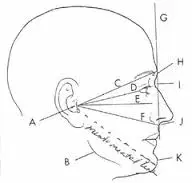
letter J
nasion
acanthion
glabella
mental point
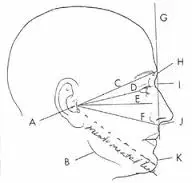
Letter E
IOML
OML
GML
MML

Letter E
nasion
acanthion
supraorbital margin
glabella

