
 Worksheets
Segment 3 Test Bank
Total questions: 74
Worksheet time: 50mins
Coal
Non-renewable
Renewable
Hydro-electric Power
Non-renewable
Renewable
Oil
Non-renewable
Renewable
Geothermal
Non-renewable
Renewable
Wind
Non-renewable
Renewable
Fuelwood
Non-renewable
Renewable
Waves
Non-renewable
Renewable
Natural Gas
Non-renewable
Renewable
Solar
Non-renewable
Renewable
Nuclear
Non-renewable
Renewable
Tidal
Non-renewable
Renewable
Biomass
Non-renewable
Renewable
What type of energy produces no greenhouse gases, but leaves behind harmful waste?
Coal
Nuclear
Natural Gas
Petroleum
What are the 3 main types of fossil fuels?
Coal, Natural Gas, and Oil
Natural Gas, Uranium, Oil
Oil, Natural Gas, Solar
Coal, Petroleum, Wind
What is renewable energy?
Sources of energy that will take years to deplete.
Sources of energy that humans can manufacture.
Sources of energy that are constantly being formed.
Sources of energy that were once living organisms.
What is the main problem with solar energy?
Solar panels are very expensive and large areas are needed to put them.
Replacement parts are hard to find and systems are difficult to install.
Solar panels will collect more energy than can be stored, causing a system overload.
Solar energy will cause cancer in organisms living near the panels.
What are two examples of renewable energy?
Geothermal and Wind
Solar and Coal
Wind and Natural Gas
Geothermal and Nuclear
What element is primarily used in nuclear fission?
Uranium
Carbon
Manganese
Lead
What is the dirtiest type of fuel that creates lots of pollution?
Coal
Nuclear
Solar
Petroleum
How does the use of fossil fuels affect the atmosphere?
Burning fossil fuels releases large amounts of carbon dioxide into the atmosphere.
Burning fossil fuels helps heal the ozone layer.
Burning fossil fuels adds a protective layer around the Earth.
Burning fossil fuels clears the atmosphere of carcinogens.
Thick black liquid hydrocarbon that is extracted through drilling.
Causes great environmental damage when spilled.
Coal
Oil
Natural Gas
Uranium
Energy generated by splitting large atoms of uranium or plutonium apart.
Nuclear
Geothermal
Hydroelectric
Solar
What is one advantage of generating electricity at nuclear power plants?
Low air pollution.
No raw materials needed.
Power plants are expensive to build.
Uranium mining contaminates the environment.
This type of renewable energy is produced when flowing water turns the blades of a turbine, which in turn powers an electrical generator.
Wind
Solar
Geothermal
Hydroelectric

As the north pole of the magnet is moved into the coil, the magnetic flux is _________.
increasing
decreasing
remains constant
depends on the speed of the magnet

When you thrust a bar magnet to and fro into a coil of wire, you induce
alternating current
direct current
both of the above
A transformer consists of
Metal Core
Metal core and coiled wire
Metal core and polymer wire
Polymer core and metal wire

Which coil has more flux and why?
A, because it it bigger.
B, because it has more space
A, because it has stronger magnetic field
B, because it is bigger.

How can a wire become magnetic?
point it north
add a resistor
heat it up
run a current through it
An electric current flowing in one direction only
fluctuating current
direct current
alternating current
simple current

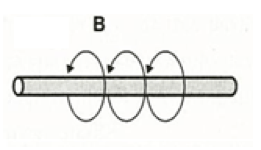
1) A wire carries a current, creating a magnetic field around itself as shown. The current in the wire is:
A. Directed to the right
A. Directed to the left
A. Equal to the magnetic field
In the same direction as the magnetic field
What must occur for a magnetic field to induce an electric current?
The magnetic field must be really big
The magnetic field must be stable
The magnetic field must be changing
The magnetic field must be from a permanent magnet

Direction of current in the wire is
Upwards
Downwards

Magnetic field near to the wire is stronger.
True
False

Two metal spheres, each with a charge, interact through an electric field. The energy of the electric field will be changed by doing which of the following?
Rotating/spinning A along one axis and B along another
Moving both A and B the same distance and direction
Increasing or decreasing the distance between A and B
Observing A and B from a different angle

A copper wire is placed within a magnetic field but there is no current flowing through the copper wire. In which situation would a current be created/generated in the wire?
When the wire is moving relative to the magnetic field
When the wire is replaced with a non-metal wire
When a magnet is replaced with a more powerful one
When poles of the magnet are reversed
The evidence that shows that magnetic fields have stored energy would be
Forces need to be applied to separate a nail from a magnet
Magnets have a north and a south pole
Iron and steel bond to magnets
Magnets have mass and respond to the pull of gravity
The region of space surrounding a body in which another body experience a force of gravitational attraction.
Gravitational Field
Magnetic Field
Electrical Field
Electrostatic Attraction
What are the units for energy?
Watts
Joules
Newtons
meters
What has to be true about an object for it to have kinetic energy?
it must be moving
it must be elevated
it must be experiencing a net force
it must be accelerating
Does your desk have kinetic energy right now? Explain and justify your answer.
yes because it is sliding across the room right now
no because it is not moving
yes because it has someone sitting in it
no because it is here on earth


Which of the following objects has the most kinetic energy?
A 20 kg toddler running at 5 m/s
A 50 kg toddler running at 30 m/s
A 90 kg toddler running at 30 m/s
A 100 kg toddler running at 2 m/s

A 5 kg ball is lifted 12 m above the ground. It's gravitational potential energy is
60 J
600 J
17 J
2.4 J


How much KE does a moving 6 kilogram object have if it moves with a velocity of 3 m/s?
27 J
18 J
9 J
2 J

A cheetah can run briefly with a speed of 31.0 m/s. Suppose a cheetah with a mass of 47.0 kg runs at this speed. What is the cheetah’s kinetic energy?
1457 Joules
22,584 Joules
15 Joules
45,167Joules


What is the KE at the bottom?
15,000 J
3,750 J
7,500 J
11,250 J
What is the KE 3/4th of the way down?
15,000 J
3,750 J
7,500 J
11,250 J
What is the KE 1/4th of the way down?
15,000 J
3,750 J
7,500 J
11,250 J

What is the Total Energy at the bottom?
50 J
25 J
0 J
100 J
What is the KE half way down?
50 J
25 J
0 J
100 J
What is the GPE at the top?
50 J
25 J
0 J
100 J

What are the energy transformations taking place in this image?
Light->Electrical->Mechanical
Thermal->Mechanical->Electrical
Light->Mechanical->Electrical


What type of energy is in this picture?
Kinetic
Elastic
Chemical
Thermal
The higher above the ground I get, the ...
More gravitational energy
less gravitational energy
gravitational energy has nothing to do with height
What is the primary disadvantage of using coal as an energy source?
It is expensive to extract
It releases large amounts of carbon dioxide
It is difficult to transport
It is a renewable resource
Which of the following is an example of kinetic energy?
A rock at the top of a hill
A compressed spring
A moving car
A charged battery

