wayground logo

Free Printable Worksheets

Font size

S
M
L
XL
Worksheets

Earth Science Final Exam

Total questions: 110

Worksheet time: 1hrs 24mins

Name
Class
Date
1.
The following increases the rate of erosion
a)
slow moving wind/water
b)
fast moving wind/water
2.
We live in the Chesapeake Bay Watershed. What is a watershed?
a)
Land that separates different river systems.
b)
Land that separates different river channels
c)
A land that drains all run-off water to a single bay.
3.
The wide curves in the river in the diagram are
a)
tributaries.
b)
oxbows.
c)
meanders.
4.
Deltas can be found ______.
a)
where river enters ocean
b)
at the base of a mountain
5.
A natural flow of water that forms when the water table intersects the ground surface is called
a)
a geyser
b)
a spring
6.
An aquifer that allows water to flow easily is said to have
a)
low porosity.
b)
high permeability.
c)
poor sorting.
7.
Location A is known as a
a)
Confined aquifer
b)
Unconfined aquifer
8.
Location B is known as a
a)
Confined aquifer
b)
Unconfined aquifer
9.
Location B is suddenly polluted by landfill waste. What will most likely happen to the well at this person's house?
a)
The well will become polluted affected the house water supply
b)
The well will not become polluted. The water stays safe.
10.

Three lawns in your neighborhood put fertlizer on their grass and the water table gets polluted. What type of pollution is this?

a)
Point
b)
Non-point
11.
This liquid is formed from landfill waste accumulating water.
a)
Leachate
b)
Eutrophication
c)
Sorbents
12.

Which of the following is most likely to occur when pesticides and fertilizers seep into soil from farms?

a)
severe drought
b)
acid rain formation
c)
groundwater contamination
13.
The object pictured below could cause what type of water pollution?
a)
Eutrophication
b)
Gas and Oil
c)
Surface mines
14.
The trees planted along this stream are known as a
a)
Forest
b)
Berm
c)
Riparian buffer
15.

Pollution that occurs from this factory?

a)
point source pollution
b)
non point source pollution
16.
_____ is the most abundant element in Earth's atmosphere.
a)
Oxygen
b)
Hydrogen
c)
Nitrogen
17.
Temperatures _____ as you travel higher into Earth's troposphere.
a)
increase
b)
decrease
c)
remain the same
18.
_____ is the transfer of energy by electromagnetic radiation (the sun's energy).
a)
Conduction
b)
Convection
c)
Radiation
19.
The _____ is an apparent force that results from Earth's eastward rotation.
a)
Jet Stream
b)
Coriolis effect
c)
Sea breeze
20.
High pressure typically brings _______ weather.
a)
sunny
b)
rainy
21.
Much of the ultraviolet (UV) radiation reaching Earth from the Sun is absorbed by _____ in Earth’s atmosphere. it also protects humans from harmful rays of sunlight.
a)
ozone
b)
nitrogen
c)
hydrogen
22.
The albedo of the Earth’s surface is the percent of solar radiation that is
a)
scattered.
b)
reflected.
c)
absorbed.
23.
The transfer of heat through the mixing of unevenly heated liquids or gases is called what?
a)
conduction
b)
radiation
c)
convection
24.
What global wind pattern is responsible for the movement of weather across the United States?
a)
Westerlies
b)
Trade winds
c)
Polar Easterlies
25.
The wind pattern at the equator causes what type of pressure system?
a)
High pressure
b)
Low pressure
26.
The wind pattern at the poles causes what type of pressure system?
a)
High pressure
b)
Low pressure
27.
Weather systems travel _____ across the North American continent.
a)
north to south
b)
east to west
c)
west to east
28.
Which state is experiencing the highest wind speeds?
a)
Idaho
b)
Pennsylvania
c)
Kansas
29.
Which direction are the winds blowing?
a)
From Montana to Idaho
b)
From Idaho to Montana
30.
What instrument measures relative humidity?
a)
Barometer
b)
Anemometer
c)
Psychrometer
31.
Which type of cloud forms overcast?
a)
cumulus
b)
stratus
c)
cirrus
32.
The amount of water vapor in the air is known as
a)
dew point
b)
humidity
c)
temperature
33.
What is the name given to the temperature at which condensation forms?
a)
dew point
b)
humidity
c)
condensation level
34.
Which type of cloud is composed entirely of ice crystals?
a)
Stratus
b)
Nimbus
c)
Cirrus
d)
Cumulus
35.
Cloud type shown:
a)
Cumulonimbus
b)
Stratus
c)
Cirrus
36.
When air contains all the water vapor it possibly can, we say it is _____.
a)
filled
b)
saturated
c)
condensed
37.
Type of cloud pictured here:
a)
Stratus
b)
Cirrus
c)
Cumulus
38.
_____ form where two air masses meet.
a)
Fronts
b)
Anticyclones
c)
Hurricanes
39.
A dry, hot air mass is called a _____ air mass.
a)
maritime tropical
b)
continental tropical
c)
continental polar
40.
What feature is shown on the weather map below?
a)
warm front
b)
hurricane
c)
cold front
41.
The orange arrow is pointing towards what type of front?
a)
Cold front
b)
Warm front
42.
The weather at location A is most likely
a)
Warm, rainy, not windy
b)
Cool, sunny, windy
c)
Warm, rainy, windy
43.
Why are hurricanes rare in winter and spring?
a)
The ocean is too cold.
b)
The winds are too weak
c)
The hurricane forecasters are on vacation.
44.
What conditions most likely form tornadoes?
a)
Warm ocean air converging with cool land air.
b)
Cold polar air converging with hot tropical air.
c)
Hot land air converging with warm land air.
45.
Tornado duration is ________ compared to hurricane.
a)
longer
b)
shorter
46.
The weather in the eye of a hurricane is ____.
a)
the worst
b)
clear and calm
c)
heavily cloudy but not raining
47.
Nearby ocean causes land to have a ______ temperature range.
a)
large
b)
small
48.
Tropical climates are generally near _______.
a)
The equator
b)
The poles
c)
Mid-latitudes
49.
During the summer solstice their is ____ daylight than the winter solstice.
a)
more
b)
less
c)
equal amounts of
50.
Earth's seasons are caused by
a)
the distance from the Sun
b)
the tilt of Earth's axis
c)
climate
51.
This diagram is showing a
a)
solar eclipse
b)
lunar eclipse
52.
What moon phase is this?
a)
Crescent
b)
Gibbous
c)
Quarter
53.
The phases of the moon are caused by
a)
The Moon's revolution around the Earth
b)
The Moon's rotation on its axis.
c)
The Earth's rotation on its axis.
54.
Using the diagram below, the earth reaches point A in its orbit during the month of _____.
a)
December
b)
September
c)
July
d)

January

55.
If the northern hemisphere is experiencing summer, than the southern hemisphere is experiencing ___.
a)
Winter
b)
Summer
c)
Fall
56.
What season is it at Point D in the diagram for the Northern Hemisphere?
a)
Winter
b)
Spring
c)
Summer
57.
Moon phase seen here.
a)
Waxing crescent
b)
First quarter
c)
Waning gibbous
58.
Our sun, which has a solar mass of 1, will most likely end up as what type of star at the end of its life?
a)
Supernova
b)
Neutron star
c)
White dwarf
59.
The Sun’s tremendous energy is produced by fusing what element?
a)
hydrogen
b)
helium
c)
neon
60.
Stars form in
a)
nebula.
b)
protoplanet.
c)
supernova.
61.
When the sun grows into a red giant, what will it use for its fuel source?
a)
Hydrogen
b)
Helium
c)
Gold
62.
A device for separating light into different colors is known as a
a)
bright line emission.
b)
spectroscope.
c)
HR diagram.
63.

This person is holding a ______ in their hand.

a)

meteor

b)

meteorite

c)

meteoroid

64.
In which region of the diagram does the Sun lie?
a)
A
b)
B
c)
C
65.
What type of star is generally located in region A of this Hertzsprung Russell diagram?
a)
main sequence
b)
giant
c)
white dwarf
66.
What is the correct path of our sun through it's life cycle?
a)
A - B - C - D
b)
B - A - C
c)
B - C - A
67.
Our Sun is an average star in terms of brightness and temperature.
a)
True
b)
False
68.
Supermassive stars will most likely experience what ending?
a)
Nebula
b)
Black dwarf
c)
Black hole
69.

What is an underground water?

a)

Ocean

b)

Aquifer

c)

Lake

d)

River

70.

Soil pollution can lead to which of the following?

a)

Cleaner air

b)

Increased plant growth

c)

Contaminated crops

d)

Quieter environment

71.

Which of the following is NOT a source of water pollution?

a)

Oil spills

b)

Agricultural runoff

c)

Drinking water

d)

Industrial waste

72.
What is the type of water that moves underground?
a)
surface water
b)
water table
c)
groundwater
d)
watershed
73.

This pond in Northern Lancaster county is being affected by what type of pollution

a)

leachate

b)

eutrophication

c)

oil spill explosion

d)

trash dump

74.
Why does warm air rise?
a)
Warm air is more dense than cooler air.
b)
Warm air has more pressure than cooler air.
c)
Warm air is less dense than cooler air.
d)
Warm air has a higher dew point than cooler air.
75.
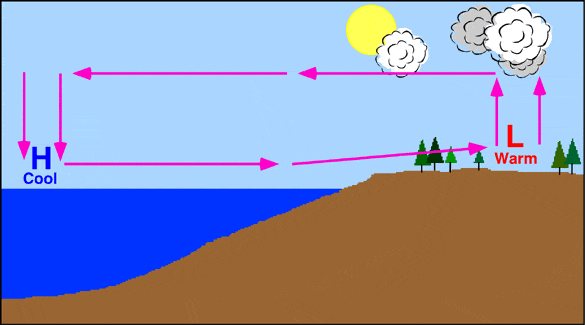
Is this a land or a sea breeze?
a)
land breeze
b)
sea breeze
76.

With a steeper slope, we would expect to see...

a)

less erosion

b)

more erosion

c)

the same amount of erosion

d)

no erosion at all

77.
What landform can you see in the picture?
a)
Floodplain
b)
Delta
c)
Waterfall
d)
Oxbow lake
78.

What step of the water cycle does this picture show?

a)

Condensation

b)

Runoff

c)

Precipitation

d)

Evaporation

79.

Plants exhaling water into atmosphere.

a)

Evaporation

b)

Transpiration

c)

Condensation

d)

Precipitation

80.

Which sample has the LEAST porosity?

a)

tight pack

b)

loose pack

81.

Which sample is MOST permeable?

a)

round

b)

flat

c)

oval

82.
Which layer of the atmosphere do we live in?
a)
troposphere
b)
mesosphere
c)
thermosphere
d)
exosphere
83.
As the air temperature increases, the air's capacity for water vapor: 
a)
increases
b)
decreases
c)
remains the same
d)
is unrelated to air temperature and can either increase or decrease
84.

Using the wet and dry bulb chart, what is the dew point if the dry-bulb temperature is 16° and the difference is 5° between wet-bulb and dry-bulb?

a)

16°

b)

c)

11°

d)

85.
Which type of air would you find at air mass A?
a)
cold, dry
b)
warm, humid
c)
warm, dry
d)
cold, humid
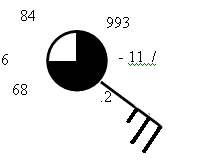
86.

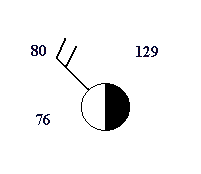
What is the temperature for the following station model?

a)

4 ºF

b)

76 ºF

c)

80 ºF

d)

129 ºF

87.

What is the wind direction for the following station model?

a)

north

b)

east

c)

northwest

d)

northeast

88.

What is the amount of cloud cover for the following station model?

a)

25%

b)

50%

c)

75%

d)

100%

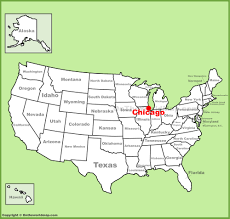
89.

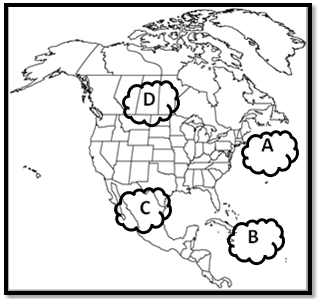
What type of air mass is found over CHICAGO?

a)

Maritime Polar

b)

Maritime Tropical

c)

Continental Polar

d)

Continental Tropical

90.
Warm air mass overtakes cold air mass and rises above. 
a)
warm front
b)
cold front
c)
occluded front
d)
stationary front
91.

Which would you expect to have the lowest albedo?

a)

dark soil

b)

white sand

c)

ice and snow

d)

deep sea water

92.
Question Image

Match the following Layer to the correct number from the Diagram

a)

Stratosphere

1.

2

b)

Mesosphere

2.

3

c)

Troposphere

3.

1

d)

Thermosphere

4.

4

93.

The picture shows different positions of the Moon around the Earth.

What is the position of the moon when high tide has maximum height?

a)

P

b)

Q

c)

R

d)

S

94.

What type of weather could be expected where the H's are located?

a)

Clear

b)

rainy

c)

stormy

95.

Look at the map and explain what front is located in Texas.

a)

warm front

b)

cold front

c)

occluded front

d)

stationary front

96.

Air sinking down toward the Earth's surface causes a...

a)

High Pressure area

b)

Low Pressure area

97.

What type of weather does a high pressure system bring to an area?

a)

happy, sunny clear weather

b)

lousy, cold, rainy weather

c)

fog, lots of fog

d)

lightning

98.

counterclockwise and inward

a)

high pressure

b)

low pressure

99.

The most abundant greenhouse gas in the atmosphere is ___________________.

a)

oxygen

b)

nitrogen

c)

carbon dioxide

d)

argon

100.

Which of the following is an image that best depicts sunspots?

a)

b)

c)

d)

101.

Where are most asteroids found?

a)

Asteroid belt

b)

Asteroid region

c)

Kuiper belt

d)

Orion's belt

102.

A rock that burns up in the Earth's atmosphere

a)

meteor

b)

asteroid

c)

meteroite

103.

What part of the water cycle does this picture show?

a)

condensation

b)

precipitation

c)

evaporation

d)

transpiration

104.
What source of energy evaporates the most water from Earth’s surface?
a)
volcanoes
b)
the sun
c)
lightning
d)
wind
105.

This is the symbol for which type of front?

a)

occluded front

b)

stationary front

c)

warm front

d)

cold front

106.
What layer does weather occur in?
a)
mesosphere
b)
troposphere
c)
thermosphere
d)
stratosphere
107.

Which map information indicates that the wind velocity is greater at location Z than at location X?

a)

Location Z is closer to the ocean

b)

The isobars are closer together at Z

c)

The latitude of location X is greater

d)

Location X is closer to the front

108.
The black arrows on the picture represents the:
a)
Westerlies
b)
Trade winds
c)
Polar Easterlies
109.

What does "equinox" mean?

a)

It’s when there’s the least amount of nighttime in one day.

b)

It’s when there’s the least amount of daytime in one day.

c)

It’s when there’s equal amounts of daytime and nighttime in one day.

d)

It's when there's 11 hours of daylight and 13 hours of darkness in one day.

110.

The sun transfers energy to Earth by radiation

a)

True

b)

False