
 Worksheets
7R Final Review
Total questions: 127
Worksheet time: 3hrs 30mins

Which beaker contains molecules that are moving the SLOWEST ?
Left beaker (Solid)
Middle beaker (Liquid)
Right beaker (Gas)
Which beaker contains molecules that would expand to fill their container ?
Left beaker (Solid)
Middle beaker
Right beaker
Which beaker contains molecules that are close together and has a shape that changes ?
Left beaker
Middle beaker
Right beaker
A material is tested in the lab and found to react with vinegar and is flammable. These two properties would be considered....
Chemical properties
Physical properties

Students collected data on four substances. If the same students were then given a mystery substance made of white crystals that DO NOT dissolve in water. Which of the following could it be ?
Iron
brown sugar
Salt
Corn Starch
Matter is anything that has....
mass and takes up space
Mass ONLY
energy
volume ONLY

Based on the data in the chart. Which two liquids could be the same ? (Write your answer in a CER format)
1 and 2
2 and 3
3 and 4
Reacts with acid
color
Is flammable
Reacts with oxygen
Reacts with sodium and calcium
It's clear
It's a liquid
Has a density of 1
Mr. Krieg is carrying an umbrella
Observation
Inference

An unknown material has a mass of 57.2 grams and a volume of 52.1 cm3. What would this unknown substance be ?
Cork
Mercury
Rubber
Water
Which of the following would measure the mass of an object ?


What is volume ?
the force of an object caused by gravity
the amount of space something takes up
the amount of matter in an object
how fast something is moving
Which quantity would be used to identify an unknown material ?
volume
mass
density

Find the volume of this figure.
15 cm3
120 cm3
50 cm3
54 cm3

Calculate the volume of the rock based on the diagram.
10.0 mL
16.0 mL
30.0 mL
40.0 mL

Which two objects could be made from the same material?
A and B
B and C
C and D
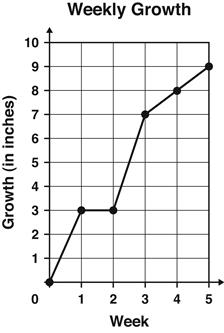
The graph shows the number of inches a plant grew each week.
Between which 2 weeks did the plant grow the MOST?
Week 1 and Week 2
Week 2 and Week 3
Week 3 and Week 4
Week 4 and Week 5
According to the graph, when did the plant reach a height of 5 inches tall ?
2.5 weeks
2 weeks
9 weeks

What conclusions can you draw from this graph?
The number of highway accidents has increased since 2000
The number of highway accidents has decreased since 2000
The number of highway accidents has stayed the same since 2000

What was the approximate deer population after 3 months ?
37
27
47


What is the mass on this triple beam?
272.0 g
202.0 g
272.5 g


Based on Mr. Krabbs results (He sold 25 burgers on regular buns and 27 burgers with multi-colored buns), which of the following is a possible conclusion?
Customers liked blue buns best.
The colored buns did not increase sales.
The colored buns increased sales.
Will colored patties improve sales?
What is the effect of salt water on the height of grass ?
What is the dependent variable in the above question?
salt water
height of grass
average
effect

Students used various temperatures of water to see which one dissolved candy faster.
What was the Dependent Variable?
Amount of Candy
Amount of Water
Temperature of Water
Time for Candy to Dissolve
Which of the following would be an observation.
The hydroflask is red
Hydroflask make the water taste better
Hydroflasks are way too expensive

Which of these is an inference ?
The barrel is brown
Homer has blue pants on
Homer spilled the barrel of green liquid
There is a green liquid on the floor


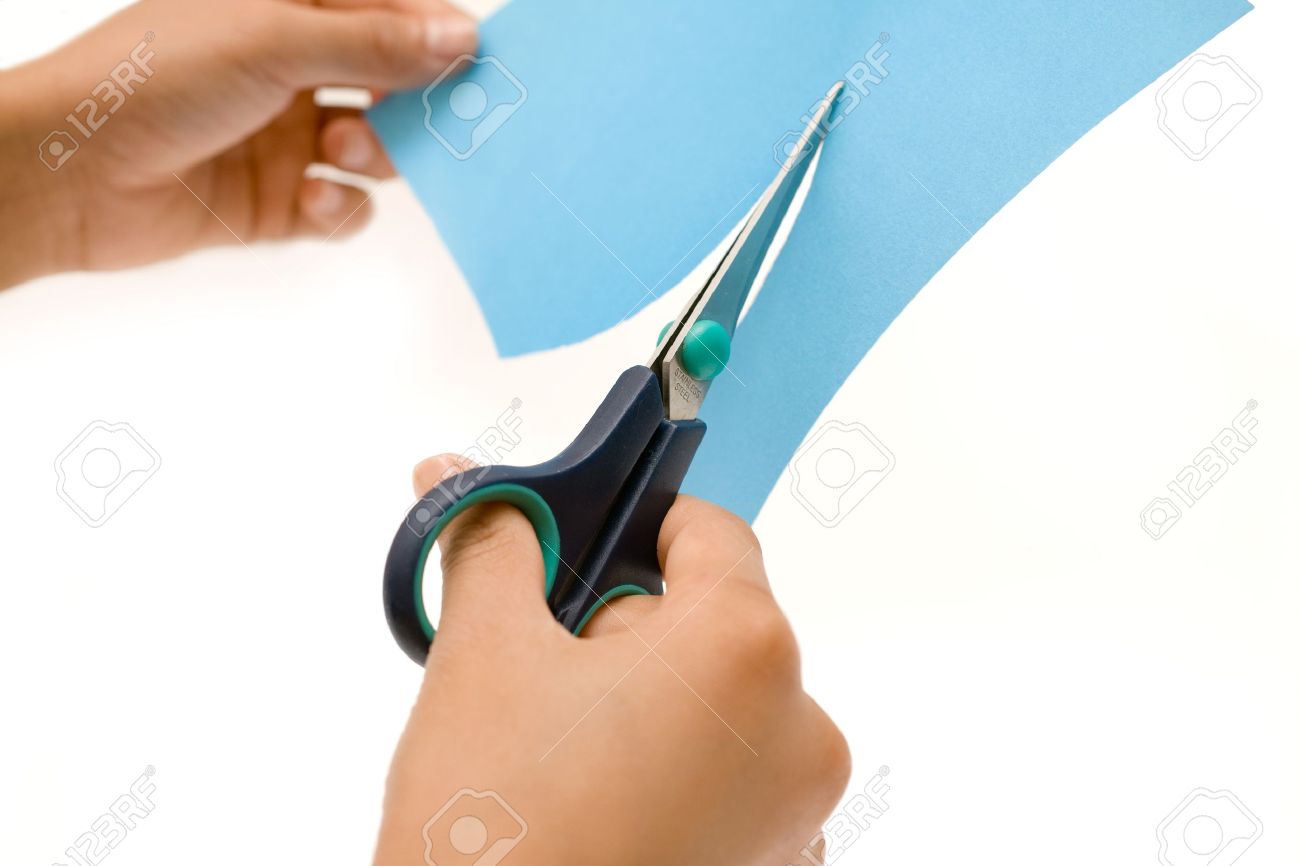
What kind of change is cutting paper?
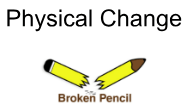
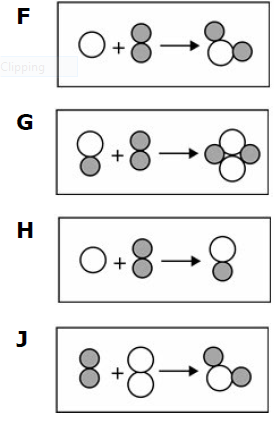
Which of the following models best demonstrates Conservation of Mass during a chemical reaction ?
The student observed that the temperature changed from 25 •C to 23 •C when the solutions were combined and that a white substance rapidly formed and settled to the bottom of the container. What most likely happened to produce these results?
Which of the following BEST describes a chemical reaction?
A compound is crushed into a fine powder.
Atoms break apart into protons, electrons, and neutrons
Atoms are rearranged into new substances
Molecules move faster until they fly apart from each other
In a ___________change, a substance changes into a different substance.
Physical
Chemical
Which of these is a sign that a chemical change has occurred?
A change in size
An unexpected color change
A temperature change
A change of state
Bubbles or gas produced
The Law of Conservation of Mass states
that matter exists in all states and reacts the same
that matter can only be changed into new substances by introducing a catalyst
that matter exists in the same state throughout any chemical change
that matter cannot be created or destroyed and that the mass of the products must equal the mass of the reactants

a copper penny turning greenish after a few years.
Physical change
Chemical change
Which of the following IS a physical change?
Getting a haircut
Rusty metal
sour milk
A compound
The materials AFTER a chemical reaction are called the....
Reactants
Products
Quotient
The Law of Conservation of Mass states that the total mass of the reactants should be
More than the mass of the products
Equal to the mass of the products
Ignored during the reaction
Less than the mass of the products
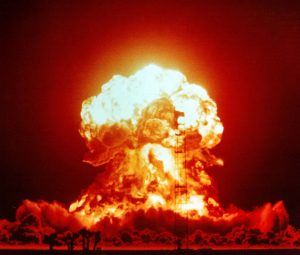
What type of chemical reaction absorbs heat and feels cold ?
(Chemical ice pack)
exothermic
endothermic
The materials to the RIGHT of the arrow in a chemical reaction are known as......
Reactants
Products

Which of the following would react the SLOWEST ?
A
B
C
D
Which of the following would react the FASTEST ?
A
B
C
D
In a chemical reaction which of the following is TRUE ?
Matter is gained
Matter is lost
Atoms are rearranged
When experimenting with the growth of a plant, a scientist uses three (of the same type of) plants, two different fertilizers, equal light, and equal water. What type of variable is the fertilizer?
Dependent
Independent
Control
Compound

When experimenting with the growth of a plant, a scientist uses three (of the same type of) plants, two different fertilizers, equal light, and equal water. What type of variable is the fertilizer?
Dependent
Independent
Because they are cool
Because those traits hurt organisms' chance for survival
Which of the following is NOT an example of natural selection?
People selectively breeding dogs to create designer breeds
Giraffes developing long necks to eat food from trees
Finches developing different beaks depending upon the food available
Male birds of certain species developing colorful feathers to attract female mates.
a very similar DNA sequence

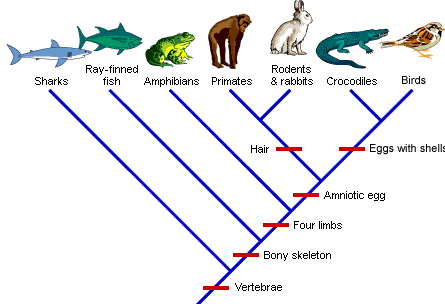
According to this cladogram, birds are most closely related to -
A group of zebras are all different. This would be an example of......
Competition
Overproduction
Variation
Trees fighting for water and sunlight sunlight would be considered.....
Competition
Overproduction
Variation
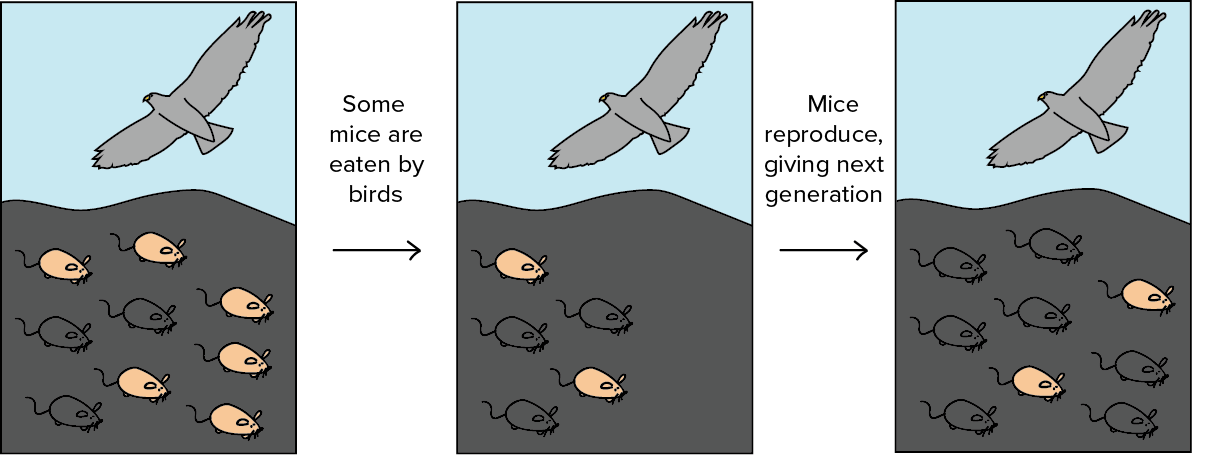
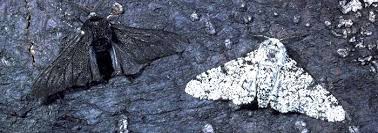
Why is the mouse population changing over time?
The hawks eat more dark mice than light mice because the dark mice taste better
The hawks eat more light mice than dark mice because they can see the light mice more easily
The hawks eat more dark mice than light mice because they can see the dark mice more easily
Which of the following is an important part of natural selection?
All individuals in a species are the same.
There is no competition for resources among organisms.
Individuals with better adaptations survive and pass on those traits to their offspring

The image shows light and dark colored moths that live on a tree. Which result is most likely to occur to the moth population over time due to predation?
The number of light colored moths in the population will increase
There will be more dark colored moths than light colored moths
The dark colored moths will move to a different type of tree

All connections of energy flow throughout all organisms in a habitat.
The specific ways that mutualism is carried out.
A single pathway or energy flow between organisms.
How carnivores get their food.
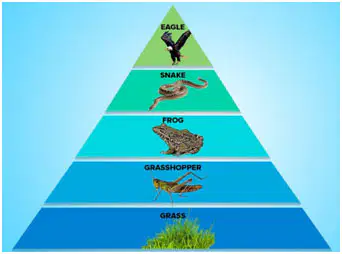
increases
decreases
stays the same
increases only a little bit

What is the main source of energy in this food chain?
Plant
Sun
Deer
Wolf
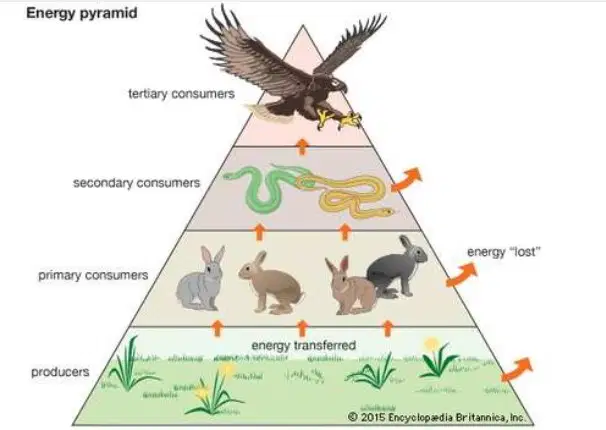
What does an energy pyramid represents ?
How much sunlight is available for the ecosystem to use.
How much energy a particular organism needs.
How much energy is needed to build a pyramid.
The amount of energy available to the next 'feeder' in a food web.
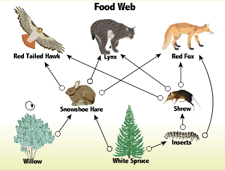
What may happen if the red tailed hawk was removed from the food web pictured?
The population of insects in the habitat would increase.
The rabbit and shrew population would increase
The willow tree population would increase.

Mushrooms, bacteria, and maggots (fly larvae) are all examples of.....
producers
consumers
decomposers
If it weren't for _______________ in our ecosystem,plants would not get essential nutrients, and dead matter and waste would pile up.
producers
consumers
predators
decomposers
Which two organisms compete for the same food ?
Snowshow hare (rabbit) and shrew
Lynx and shrew
Lynx and Red-Tailed Hawk
Red fox and Snowshoe hare (rabbit)

Which organism might decompose the mountain lion and hawk when they die ?
Squirrel
Bacteria
Snake
Tree

The role (job) an organism plays in its ecosystem.
habitat
niche
heterotrogh
biosphere

Which of the following is NOT an example of natural selection?
People selectively breeding dogs to create designer breeds
Insect populations developing resistance to certain pesticides.
Bacteria becoming resistant to antibiotics.
Male birds of certain species developing colorful feathers to attract female mates.

What evidence for evolution is shown in the picture ?
fossil record
similar embryological development
homologous structures
If i eat breakfast, then I will do better in school because I have more energy. This statement would be considered a....
hypothesis
problem
conclusion
Testing a hypothesis is done by.....
making a guess
conducting an experiment
drawing a conclusion
Liquid Water changing into ice...
evaporation
freezing
melting
condensation
Liquid Water changing into a gas
evaporation
freezing
melting
condensation
All matter is made up of ....
atoms
cells
DNA

This change is a
physical change
musical change

A change in temperature is an indication of which type of change?
Physical Change
Chemical Change
This change is a
chemical reaction
physical change
musical change
Ice Ice baby
What is evaporation?
The process of a liquid becoming a solid
The process of a solid becoming a liquid
The process of a liquid becoming a gas
The process of a gas becoming a liquid
Which of the following is an example of a chemical change?
Salt dissolving in water
Water boiling into steam
A nail rusting
Ice melting


gas

liquid

solid
An atom has 25 protons and 30 neutrons. How many electrons are needed to make the atom neutral?
0
25
30
35
The smallest particle of an element is known as the
Periodic Table
Atom
Group
Period
Each neutron has a _________________ charge.
positive
negative
neutral
shocking

In 1904 JJ Thompson discovered that atoms actually contained particles called electrons. Which of these best describes an electron?
Much much smaller than the other particles, positively-charged
Much much smaller than the other particles, negatively-charged
Make up most of the mass of the atom, negatively-charged
Contain most of the mass of the atom, no charge

A subatomic particle that has a negative charge is called --
a proton
a neutron
an electron
the nucleus
When an atom has the same number of protons and electrons, the atom is __________?
neutron
neutral
newton
nutella

Letter A is showing
Neutrons
Electrons
Protons
Nucleus
Which subatomic particles make up the mass of an atom?
protons only
protons and neutrons
protons, neutrons and electrons
protons and electrons

