
 Worksheets
Unit 3 Final Quizziz
Total questions: 83
Worksheet time: 2hrs 51mins
Unlike a mechanical wave, Electromagnetic waves do not need a (a) to travel.
If a wave has a frequecy of 440 Hz, that means that 440 waves pass by a certain point every (a)
The portion of the electromagnetic spectrum that humans can see is called:
radio waves
visible light
gamma rays
x-rays
When wavelength increases...
energy decreases
energy increases
As wavelength decreases...
energy increases
energy decreases
the distance between peaks of electromagnetic waves is called:
wavelength
frequency
energy
Planck's Constant
Which type of electromagnetic energy carries the least energy?
X-Rays
Visible Light
Ultraviolet
Microwaves
We perceive various wavelengths within the visible light spectrum as:
sound
color
time
smell
Light is:
a star and a galaxy
a wave and a particle
sound and energy
unable to be measured
A light particle is called a(n):
electromagnetic wave
photon
electron
atom
We see a "rainbow of colors" that when perceived together produce:
black light
white light
gamma rays
x-ray images
Light can bounce off matter, leading to ______.
emssion
reflection
absorption
transmission
If you see an object that is "red", what does this mean?
The object is absorbing only red wavelengths
The object is reflecting only red wavelengths
Which has a longer wavelength?
infrared
ultraviolet
Which color has the highest frequency?
green
blue
red
yellow
Which color has the longest waves?
red
orange
yellow
green

which of the following lists shows EMR correctly arranged in order of increasing frequency?
gamma rays, X-rays, microwaves, radio waves.
X-rays, gamma rays, microwaves, radio waves.
microwaves, radio waves, X-rays, gamma rays.
radio waves, microwaves, X-rays, gamma rays.
A material through which light does not pass
Transparent
Translucent
Opaque
A material that allows almost all of the light striking it to pass through, and through which objects can be seen clearly
Transparent
Translucent
Opaque
A material that allows most of the light that strikes it to pass through, but through which objects appear blurry
Transparent
Translucent
Opaque
Frosted glass is an example of which type of material?
Translucent
Transparent
Opaque
Radiant
Light passes through glass windows because of ______________.
Absorption
Transfusion
Transmission
Reflection
The brightness of a light is determined by ______________.
intensity of light waves
wavelength
air temperature
wave speed

Which of these provides the best explanation for why the pencil appears broken?
The pencil absorbs the light rays that hit it.
Water reflects light rays away from the pencil.
Light rays are bent by the water in the glass.
The surface of the water reflects the light rays.
Caleb is sitting near the window on a sunny day. When he closes the curtain, the room becomes darker. What property of the curtain allows it to make the room darker?
The curtain absorbs light.
The curtain is brightly colored.
The curtain folds easily.
The curtain is rectangular shape.

At what point is the laser being reflected?
A
B
C
D
Light travels in straight lines until reflected by another object. Which illustration best shows the light being reflected?


Which of the following is the best example of an object absorbing light?
A black sweater in the sun.
A clean window in the sun.
A curved mirror in the sun.
A long shadow in the sun.
Light rays from any light source travel outward in all directions along a straight path until they hit something. which of the following best represents what occurs when light rays hit a glass of water?
The light rays will pass straight through from air to water.
The water absorbs the light, and it will no longer be seen.
The light rays will bend at the boundary of air and water.
The surface of the water will reflect the light off the water.
Which illustration best shows light being refracted?


Which object refracted the laser beam?
Silver locket
Picture frame
Glass marble
Notebook
Which of the following is demonstrated when light bounces off of mirrors or shiny surfaces?
Scattering
Refraction
Absorption
Reflection
Adrian is observing a piece of white paper. His eye perceives the paper to be white because his eye is receiving what kind of light?
Light in all the colors of the visible spectrum.
Light mostly at the ultraviolet end of the spectrum.
Light mostly at the infrared end of the spectrum.
Light the paper produces when heated by the Sun.

Which portion can be detected by the human eye?
A
B
C
D
What determines if light will be reflected, refracted, or absorbed by an object?
How strong the light source is
What the object is made of
How big the object is
How smooth the object is
How does light travel?
In circles
In waves
In zigzags
In curves
What object would best reflect a ray of light?
Mirror
Wood Table
Bottle of Water
Window
What is the difference between wavelength and frequency?
Wavelength measures distance between crests and frequency measures number of crests
Wavelength measures number of crests and frequency measures distance between crests
They are the same, there are no differences
Wavelength measures vertically while frequency measures horizontally
This lens will make the object appear squashed, but it will appear always right side up. The object is just smaller. (Side View Mirror of Vehicle)
Concave Mirrors
Convex Mirrors
Flat Mirrors
Wavy Mirrors
To soak up or take something in
Light
Transmitted
Light Path
Absorbed
The direction in which light travels
Electromagnetic Radiation
Reflected Path
Refracted Path
Straight Light Path

Which number image shows a translucent form of wave transmission?
1
3
2
Light waves that have been emitted (released) or reflected by an object, enter the eye and first pass through the transparent layer called the ____________ where they are _____________.
cornea; reflected
retina; refracted
cornea; refracted
lens; refracted
What type of lens does the eye use to focus light?
Concave
Convex
Circlular
Convent
How does light travel?
Light travels in curves.
Light travels in a straight line.
Light does not travel.
Which is the correct way to represent light?


Shadows are formed when light is (a) by an (b) object

when we use plane mirror, the image is (a) , laterally inverted, (b) , (c)
Reflection
The bouncing of the light off a surface
Refraction
The bending of light as it travels from one medium to another of a different density
Dispersion
splitting up of white light into its component colours

concave mirror

convex mirror

plane mirror
the image is virtual and magnified
the image is upright, distorted, smaller
the image is upright, laterally inverted, virtual, same size
primary color
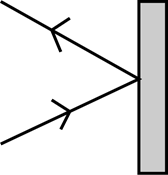
In the illustration, the light ray striking the object is-
Best regular reflection of light takes place when it strikes
Smooth opaque surface
Rough opaque surface
Smooth transparent surface
Smooth & silvered opaque surface

In the given figure , which angle represents angle of incidence ?
a
b
c
d
A dentist uses a small dental mirror to help magnify teeth in your mouth. What type of mirror is this?
a convex mirror
a concave mirror
a plane mirror
a concave lens
What is the perpendicular drawn at any point on a mirror called?
A) Incident ray
B) Reflected ray
C) Normal
D) Image
We see the moon because
light from the sun travels in a straight line and is blocked by the moon.
the moon surface reflects light from the sun into our eyes.
The moon gives off moonlight.
The laws of reflection states that the angle of incidence _______ angle of reflection. The incident ray, the reflected ray and the __________ lie on the same plane.
equals ........ normal
is larger than ......... smooth surface
is smaller than ....... smooth surface
equals ...... rough surface

The angle of reflection in the diagram is
90 °
10 °
80 °
170 °

Choose all the options that are true for the diagram.
It shows how light is reflected by a mirror.
The angle of incidence of each ray is equal to the angle of reflection.
The normal of each ray is different due to the rough surface.

A ___________ mirror ____________ the image of the teeth.
concave ......... magnifies
convex ....... diminishes
concave ...... diminishes
convex .... magnifies

A student placed a white ball and a black ball in a completely dark room. Which of the following statements about this experiment is/are true?
Both balls cannot be seen as there is no light reaching his eyes.
Only the white ball can be seen because white reflects the most light.
Only the black ball can be seen because black absorbs the most light.
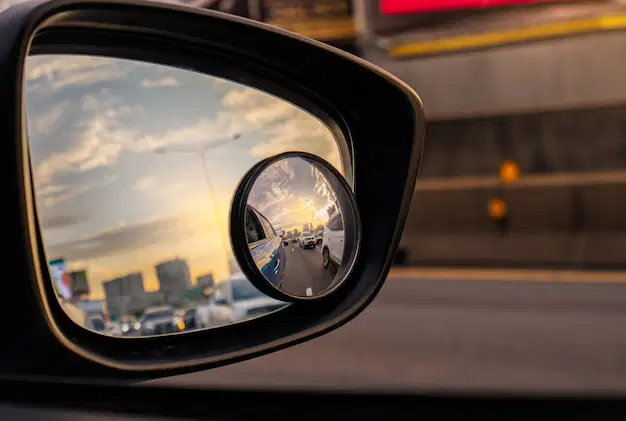
The photo shows 2 mirrors mounted on the side of the car. Which of the following is correct?
Both are concave mirrors.
Both are convex mirrors.
The larger mirror is concave and the small one is convex.
The larger mirror is convex and the smaller one is concave.
When light bounces off a rough surface, it
transmits
scatters
is absorbed
bends
Which of the following is a concave mirror?


If the angle of incidence is 25 degrees, the angle of reflection is
20 degrees
25 degrees
50 degrees
90 degrees
Which of the following is the main source of light on Earth?


#3 Refers to the circular structure that surrounds the pupil and regulates the amount of light entering the eye.
Cornea
Pupil
Retina
Iris

#1 Refers to the clear tissue that covers the front of the eye
Retina
Cornea
Pupil
Iris
The colorful part of the eye, controls light going into the pupil
lens
iris
sclera
retina
black circle, allows light to enter the eye
iris
pupil
optic nerve
retina


Rods are light sensitive cells in the retina that
give you color vision in dim light
respond in dim light
give you color vision in bright light
respond in bright light

What is responsible for allowing us to see black/white?
choroid
rods
lens
cones
My teacher looks like...


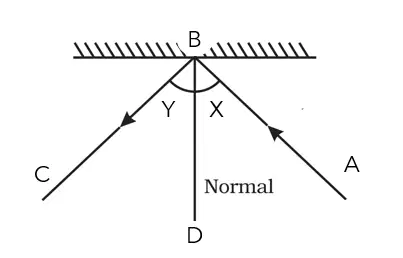
Identify BD
Incident ray
Reflected ray
Normal
Emergent ray
Label the diagram using the words from the options

