
 Worksheets
Ecology
Total questions: 70
Worksheet time: 1hrs 19mins

Look carefully at the image. If energy is lost as it moves up the food chain, what trophic level has the most amount of energy?
1st level - producers
2nd level - primary consumers
3rd level - secondary consumers
4th level - tertiary consumers
They show what direction the energy is moving between organisms.
Producers get energy from (a)
primary consumers eat (b)
secondary consumers eat (c)
tertiary consumers eat (d)
organisms that no one else eats are (e)


What is the source of energy for all living things?
water
air (oxygen)
the sun
electricity
Correctly label each trophic level
apex predator
producers
primary consumers
secondary consumers
tertiary consumers
A diagram that shows the amount of energy that moves from one feeding level to another is termed a(n) _________.
energy pyramid
adaptation
autotroph
food web
A system of food chains that shows the transfer of energy is termed a ____________.
food web
food chain
prey
predator
An organism that can produce its own food through photosynthesis is a(n) ______________.
consumer
heterotroph
autotroph
herbivore


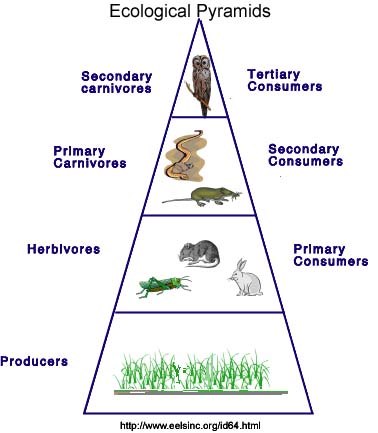

What does an energy pyramid show?
Energy flow in a community
Longest lifespans
The stronger animal the higher it is on the pyramid
What would happen if their were no producers?
Every population would grow larger
Everything would die out
The animals would make their own food
What is the main reason for the energy loss at each trophic level in an energy pyramid?
Energy is lost as heat due to metabolic processes.
Organisms use all the energy they consume for growth.
Energy is stored and not lost.
Energy is converted to light and radiated away.

Many ecosystems can be sustained by chemosynthesis that starts at undewater thermal vents and isolated cave water.
True
False
What is climate?
the condition of the atmosphere at any given time and place
cloud cover and temperature
precipitation and humidity at a given time and place
weather patterns and average conditions in an area over a long period of time
If an organism is extinct, that means
It has good reaction times
It is close to having no alive members of its species
It has too many individuals living in the same ecosystem
its population declines to zero: no living members remain. (zero)
Having a variety of organisms in an ecosystem would be
endangered
Biological diversity
ecosystem
Abiotic
Carrying Compacity
How many organisms an ecosystem can hold and sustain.
Means the ecosystem is overpopulated
How much candy you can carry
Is an endangered species
A limiting factor...
is extinct
means overpopulated
Is endangered
is Something that stops the growth or causes a decline in population.
Biotic means...
Living
nonliving
Biotic and abiotic factors working together
Organisms competing for the same resources
Abiotic means....
Living
squirrels
nonliving
Adaptations
Biological competition is....
Organisms competing for different resources.
Organisms competing for the same resources
living things
nonliving things
An example of a biotic organism is
Fire
Rivers
Fallen tree
Rock
The non-living parts of an organism's environment are called...
community
biotic factors
habitat
abiotic factors
Choose the correct levels of Organization from lowest to highest...
population, community, ecosystem, organism
organism, population, community, ecosystem
organism, population, ecosystem, community
A community is a level in organization that is....
made of populations of different species that live in the same place and interact.
a single individual species of organisms that are similar.
all the individual organisms of the same species in the same place.
When organisms move into a certain population they are ____________________ .
emigrating
sampling
habitating
immigrating
When an organism leaves a population they are ____________________
emigrating
immigrating
unpopulating
Food, Water, Space and Weather are all examples of a ___________________ in an environment.
population
limiting factor
carrying capacity
True or False: A organism is a single individual of a species that are physically similar and can reproduce.
True
False
Which of the following conditions would lead to logistic population growth?
Parasitism
unlimited food
No predators
No disease
What adds carbon to the atmosphere?
volacnoes
cellular respiration
burning fossil fuels
all of the above

What is the carrying capacity of the graph?
1000
8000
800
600
A scientist was studying a population of fish in a pond over a period of 10 years. He observed that
the population increased each year for 3 years, and then remained nearly constant for the rest of
the study. The best explanation for this observation is that the population had
stopped reproducing
reached carrying capacity
mutated into a different species
run out of food and all died

What happens if a population grows past its carrying capacity?
The population keeps growing
The population starts to die off
The entire species will go extinct
The carrying capacity just increases

What type of growth is demonstrated in the graph?
Exponential
Carrying capacity
Linear
Negative
Logistic population growth can be described as
growth when resources are limited
a s-shaped curve
reaching carrying capacity
all of the above

Exponential Growth occurs when-
populations have plenty of food/space
home to keystone species
have few evasive species in a habitat
have little to no competition or predators

Logistic growth displays a ____-shaped curve which indicates a population size capped at carrying capacity.
J
S
C
V

The sum of a species' use of the biotic and abiotic resources in its environment (think about the role that the species may have)
ecological niche
habitat
home
area


Which limiting factor is density independent?
water
food
natural disasters
An environmental factor such as amount of space, disease, and availability of mates that depends on the number of members in a population is called
density- dependent factor
density- independent factor

What best describes the term succession?
rapid changes that create an ecosystem overnight
gradual changes over time to fully create or restore and ecosystem
forest with the tallest trees
the rate species produce offspring

