
NEW
Font size
 Worksheets
Topic 10 MCQs IGCSE Review
Total questions: 15
Worksheet time: 8mins
The immune system recognises which part of a pathogen?
Antibiotic
Antigen
Active site
Antibody
What is a pathogen?
A transmissible disease.
A phagocyte that engulfs bacteria.
A disease-causing organism.
A bacterial cell.
In many multicellular animals, pathogens are recognised as foreign and are attacked by the immune system. Which of the following may be produced during an immune response?
Antigens
Antibiotics
Pathogens
Antibodies
Which body defence listed below acts as a chemical barrier?
Mucus lining the airways.
Antibody production.
Hairs in the nose.
Phagocytosis.
Which of the options below is an example of a transmissible disease?
Obesity.
Tooth decay.
Cholera.
Rickets.
The human body has a number of barriers to prevent infection by pathogens some of which are listed below.
1. Skin
2. Mucus
3. Hairs in the nose
4. Antibodies
5. Stomach acid
Which of these are examples of mechanical barriers?
1 and 3
1, 2 and 4
2 and 4
1, 3 and 5
Which of the following diseases listed below are not caused by infectious pathogens?
1. Coronary Heart Disease
2. Cholera
3. AIDS
4. Scurvy
2 only
1 and 4
2 and 3
2, 3 and 4
Which of the following diseases can be transmitted by contact with contaminated surfaces?
Athletes foot and malaria.
Salmonella and typhoid.
Influenza and dengue fever.
Salmonella and athletes foot.
When a tissue is transplanted from a female donor to a male recipient, it may be rejected. What is the main cause of this rejection?
The presence of an X chromosome.
The action of platelets.
The action of antibiotics.
Antibody production.
Components of the blood from a mammal are shown in the diagram below. In which component would you expect to find the remains of the breakdown of bacterial cells.


Which of the following is an effect of a cholera infection?
1. Loss of salts from the blood
2. Loss of water from the blood
3 .Blockage of the small intestine
4. Persistent diarrhoea
1 and 4
1, 2 and 4
3 and 4
All 4
There are numerous ways in which a person can acquire antibodies, giving immunity to a disease. Some of these are:
1. Vaccination
2. Infection by disease
3. A baby feeding on breast milk
Which of the options would give a person active immunity?
1 and 2 only
1, 2 and 3
1 and 3 only
2 and 3 only
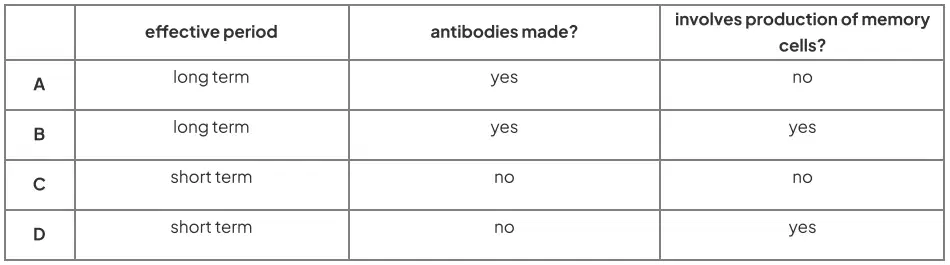
Which row in the table correctly describes the attributes of passive immunity?
A
B
C
D
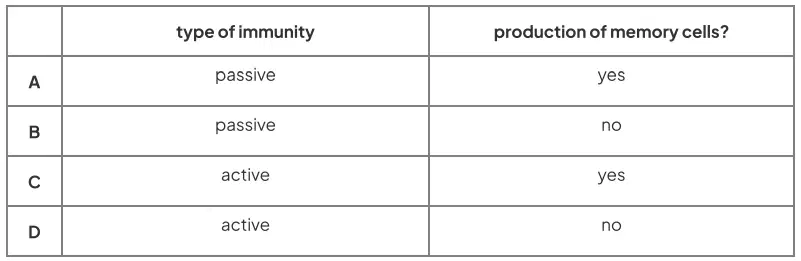
What happens when a person is vaccinated against measles?
A
B
C
D
Passive and active immunity have which of the following features in common?
1. They are always long-term.
2. They always involve the activity of memory cells.
3. They involve antibodies.
4. They can be acquired by vaccination.
1 and 2
3 only
2 and 3
3 and 4

