
 Worksheets
4th BATCH LONG QUIZ
Total questions: 100
Worksheet time: 50mins
What is the function of the eyepiece in a microscope?
To adjust the focus of the microscope
To hold the microscope steady
To provide lighting for the specimen
To magnify the image produced by the objective lens
Which part of the microscope supports the objective lenses and allows for their movement?
rotating base
adjustable arm
sliding stage
revolving nosepiece
What is the purpose of the stage in a microscope?
To adjust the magnification level
To provide lighting for the specimen
To regulate the temperature of the specimen
To hold the specimen in place and allow for precise movement and positioning for observation.
Which part of the microscope controls the amount of light passing through the specimen?
Mirror
Diaphragm or Iris Diaphragm
Objective lens
Stage
What is the function of the diaphragm in a microscope?
Regulates the temperature of the microscope
Enhances the resolution of the image
Adjusts the focus of the specimen
Controls the amount of light passing through the specimen
Which part of the microscope is used to focus on the specimen?
Fine adjustment knob
Coarse adjustment knob
Objective lens
Eyepiece lens
What is the purpose of the arm in a microscope?
Adjust the focus
Support the tube and connect it to the base
Hold the slide in place
Illuminate the specimen
Which part of the microscope connects the eyepiece to the objective lenses?
Objective connector
Eyepiece holder
Body tube
Lens tube
What is the function of the base in a microscope?
Decoration and aesthetics
Temperature regulation
Stability and support
Enhancing magnification
Which part of the microscope is used to adjust the magnification of the specimen?
Eyepiece lens
Stage clips
Objective lens
Coarse adjustment knob
What is the purpose of the coarse adjustment knob in a microscope?
To quickly move the stage up or down to bring the specimen into rough focus.
To adjust the lighting of the microscope
To change the magnification of the microscope
To rotate the objective lenses
Which part of the microscope houses the illuminator?
Base or lower part
Eyepiece
Lens
Stage
What is the function of the fine adjustment knob in a microscope?
To make small, precise focusing adjustments
To move the stage up and down
To change the magnification level
To adjust the light intensity
Which part of the microscope provides support and stability?
stage
base
lens
arm
What is the purpose of the revolving nosepiece in a microscope?
To hold multiple objective lenses for easy switching between different magnifications.
To regulate the temperature of the microscope
To hold the light source for illumination
To adjust the focus of the microscope
7. If you place a x10 eyepiece and a x40 objective, how much magnification can you observe?
4
40
400
4000
If a student wants to observe a larger view of the specimen, which mechanical part shall he/she manipulate?
coarse adjustment knob
revolving nose piece
eyepiece
fine adjustment knob
If you need to transfer a microscope from one place to another, which parts do you need to consider?
arm
base
eyepiece
both arm and base
10. Which tool is used to observe the smallest units of life?
hand lens
microscope
telescope
microphone

The part of a compound microscope where objective lenses are attached.
Revolving nosepiece
Body tube
Base
As you begin focusing the onion cells, which power objective will you use first?
High Power objective lense
Low Power objective lense
Medium Power objective lense
Which knob will you use in the PREPARATION of focusing the specimen?
Fine adjustment knob
Inclination joint
Coarse adjustment knob
For a total magnification of 600X, what eyepiece and objective would be used?
15X eyepiece with a 40X objective
10X eyepiece with a 40X objective
6X eyepiece with a 40X objective
What will be the total magnification if your eyepiece is 4X and your objective lense is 10X?
400X
4000X
40X
Part of the microscope that holds the slide in place.
Base
Arm
Stage Clip

Which parts will you hold if you want to transfer the microscope?
Arm and Stage
Arm and Base
Base and Stage
Which of the following should we AVOID doing?
Carrying the microscope from one place to another
Touching the glass part of the lenses using our fingers
Keeping the microscope covered when not in use
The lens at the top on which we look through.
Ocular lens
Objectives
Body tube
Zaccharias Janssen and Hans Janssen created a magnifying device that served as the forerunner of the compound microscope and the telescope.
True
False
If the ocular lens' magnification if 10x, and you observing a specimen using LPO, what is the total magnification?
10x
100x
1000x
10000x
What part of the microscope controls the amount of light going through the specimen?
diaphragm
ocular lens
objectives
mirror
What is used to fine focus the image when viewing at the higher magnifications?
coarse adjustment knob
fine adjustment knob
stage
objectives
The _______ is the smallest structural and functional unit of a living thing.
atom
cell
bone
blood
Both prokaryotes and eukaryotes have DNA.
True
False
Prokaryotic cells do not have…….
membrane bound organelles
cell membrane
DNA
genetic material

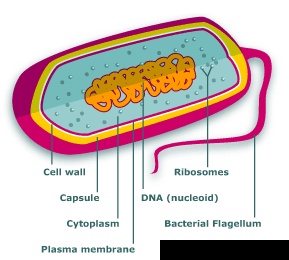
Which type of cell?
Prokaryote
Eukaryote
Both
Neither

Which type of cells has a chloroplast?
Prokaryote
Plant Cell
Animal Cell
Bacteria
Plants and animal cells are examples of ___ cells
prokaryotic cells
eukaryotic cells
both eukaryotic and prokaryotic
neither
Which organelle is responsible for storing a eukaryotic cells genetic material?
Cytoplasm
Nucleus
Mitochondria
Chloroplast
Which of the following is NOT a characteristic of a Prokaryotic cell?
unicellular
floating DNA
very small
complex

How are eukaryotic cells different from prokaryotic cells?
Eukaryotic cells have nuclei; prokaryotic cells don't
Eukaryotic cells are microscopic; prokaryotic cells are not
Eukaryotic cells contain genetic material; prokaryotic cells don't
Eukaryotic cells include bacteria; prokaryotic cells don't Prokaryotic


Which level of organization is the basic unit of life?
A. Cell
B. Tissue
C. Organ
D. System
Who coined the term cell for the box like structure he observed when viewing cork tissue?
A. Matthias Schleiden
B. Theodor Schwann
C. Rudolf Virchow
D. Robert Hooke
In many cells, the structure that controls the cell activities is the _.
A. Cell Membrane
B. Organelle
C. Nucleolus
D. Nucleus
Which part of the cell serves as venue for cellular respiration and is known as the powerhouse of the cell?
A. Nucleolus
B. Chromosome
C. Mitochondrion
D. Nucleus
A type of passive transport which relies on carrier proteins in order for the substances to move down their concentration gradient.
A. Active transport
B. Facilitated diffusion
C. Osmosis
D. Sodium-potassium pump
Which of the following is an example of passive transport which occurs when particles move from an area of higher concentration to an area of lower concentration?
A. Phagocytosis
B. Pinocytosis
C. Diffusion
D. Osmosis
This process utilizes additional metabolic energy against the concentration gradient to move molecules across the membrane from a region of lower concentration to a region of higher concentration.
A. Active Transport
B. Passive Transport
C. Osmosis
D. Exocytosis


Active transport is movement of particles through the cell membrane from a region of ...1... to a region of ...2... using energy in the form of ...3...
1: lower concentration, 2: higher concentration, 3: NADPH
1: higher concentration, 2: lower concentration, 3: NADPH
1: higher concentration, 2: lower concentration, 3: ATP
1: lower concentration, 2: higher concentration, 3: ATP


6CO2 + 6H2O ® C6H12O6 + 6O2
This chemical equation describes:
Cellular respiration
Glycolysis
Photosynthesis
Photolysis
Electron Transport Chain
•Plants and plant-like organisms make their own food or energy (glucose) from sunlight.
Chemotrophs
Heterotrophs
Autotrophs
Saprophytes
•The organelle responsible for photosynthesis:
Vacuole
Chloroplast
nuclear membrane
mitochondria
Cytoplasm
What do you call organisms that can make their own food?
heterotophs
autotrophs
trophies

Organisms that cannot make their own food and must get energy from eating other organisms are called...
autotrophs
heterotrophs
plants
What is a decomposer?
Eats dead plants or animals and breaks down to put nutrients back into the ecosystem
Eats plants or other animals for food
Makes its own food
Machine that gathers trash

________________ are consumers that eat ONLY PLANTS.
Herbivores
Carnivores
Omnivores
Producers

__________________ are consumers that eat ONLY MEAT (other animals)?
Omnivores
Carnivores
Producers
Herbivores

__________________ are consumers that eat BOTH Plants and Animals for food.
Omnivores
Producers
Herbivores
Carnivores

Deer are ______________________.
herbivores
carnivores
omnivores

Hawks are __________________________.
herbivores
carnivores
omnivores

Giant Pandas are ____________.
Carnivores
Herbivores
Omnivores


which one is a Producer?


Where do all life forms get their energy?
Earth's Core
Water
Plants
The Sun
The shortgrass prairie is an ecosystem found in the Great Plains. Many different populations of animals depend on the prairie ecosystem for survival. A typical community includes animals such as snakes, birds, mice, rodents, and insects.
Which food chain most accurately demonstrates the flow of energy in a shortgrass prairie ecosystem?
grasshopper → bird → rodent → buffalo
hawk → snake → mouse → grasshopper
grasshopper → mouse → snake → hawk
snake → hawk → skunk → mouse

Observe the food chain above. Which organism’s population would increase if finches were removed from the ecosystem?
Grass
Grasshopper
Snake
Hawk

