
NEW
Font size
 Worksheets
SSHS Physics 1
Total questions: 56
Worksheet time: 1hrs 26mins
Which state of matter is the most dense?
Solid
Liquid
Gas
Plasma
When a substance changes state, there is a change in mass. True or false?
True
False
What happens to the particles in a gas when it is heated?
Particles average kinetic energy increases
Particles move more randomly
They hit into each other less frequently
The pressure of the gas decreases

Which state of matter does this particle diagram most closely represent?
Solid
Liquid
Gas
Plasma


The average kinetic energy of the particles in a substance
internal energy
temperature
heat
thermodynamics
The direction of heat flow
cold to hot
hot to cold
up
out

In an isolated system, the amount of heat gained by one substance is exactly equal to the amount of heat lost by the second substance.
work equals change in kinetic energy
The law of conservation of energy
internal energy
Hubble's Law
Convert 35⁰F to Celsius (5/9 x (0F - 32))
1.6⁰
1.7⁰C
2.0⁰
16.6⁰C
Convert 72⁰F to Celsius (5/9 x (0F - 32))
2.2⁰C
222⁰C
22.2⁰C
161.6⁰C
Convert 99.6°F to Celsius (5/9 x (0F - 32))
37.6°C
37.5°C
73.1°C
375°C
Convert 103°F to Celsius (5/9 x (0F - 32))
39°C
394°F
75°C
39.4°C
Convert 30°C to Fahrenheit (1.8 x 0C) + 32
860°F
86°F
63.8°F
56°F
Convert 25.6°C to Fahrenheit (1.8 x 0C) + 32
48.1°F
781°F
78.1°F
14.1
Convert 15°C to Fahrenheit (1.8 x 0C) + 32
63.8°F
84.6°F
-9.4°F
59°F
100 Celsius is ? Kelvin (K = Celsius + 273)
173 K
373K
273 K
0 K
Convert 70°F to Kelvin, °C = 5/9 (°F-32), K = °C + 273
(hint: convert to Celsius, then Kelvin)
325
280
7
52
Convert 100°F to Kelvin, °C = 5/9 (°F-32), K = °C + 273
(hint: convert to Celsius, then Kelvin)
355
82
24
297
Convert 100°K to Fahrenheit, °C = 5/9 (°F-32), K = °C + 273
(hint convert to Celsius first, then Fahrenheit)
-279
-173
-311
-191
Convert 150 °K to Fahrenheit, °C = 5/9 (°F-32), K = °C + 273 (hint convert to Celsius first, then Fahrenheit)
-189
-123
423
793
The specific heat of platinum is 0.133 J/g°C. How much heat(Q) is released when a 10 g piece of platinum cools from 100°C to 50°C?
66.5 J
665 J
0.0266 J
0.665 J
The specific heat(c) of copper is 0.39 J/g °C. What is the temperature change(∆t) when 100 Joules of heat(Q) is added to 20 grams?
12.82 °C
24.12°C
1.95 °C
5128 °C
20 g of water. specific heat of water is 4.18 J/g°C. temperature changes from 25° C to 20° C, how much heat energy (Q) moves from the water to the surroundings?
418 J
209 J
83 J
4.18 J
Determine the heat energy needed to heat the water in the pot to boiling.
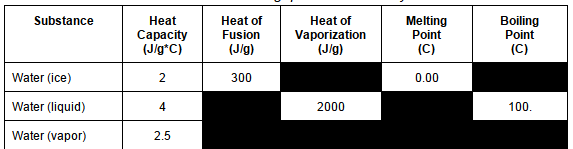
How many Joules of energy are required to change 10 gram of water from 20 oC to 90 oC?
1400 J
2800 J
210,000 J
1,400,000 J
A 20g stainless steel spoon at room temperature (20°C) is placed in 200mL of coffee at 70°C in a foam cup. Assume the foam cup doesn’t absorb any energy. Calculate the temperature when thermal equilibrium is established. The specific heat capacity of stainless steel is 500 J kg –1 K –1 .
68° C
21° C
70° C
45° C
A 70.0g copper block at a temperature of 80.0°C is placed in contact with another copper block of the same mass at a temperature of 20.0°C. Calculate the final temperature when the blocks have reached thermal equilibrium.
50° C
30° C
20° C
80° C

A substance is heated in an enclosed space until it becomes a gas.
After the heater is removed, the temperature is recorded at regular intervals. The graph shows
temperature plotted against time.
What does the section PQ represent?
boiling
condensing
melting
solidifying
A 2 kW kettle containing boiling water is placed on a balance. It is left there and continues to boil
for 5 minutes. The balance reading changes by 0.2 kg.
What does this information give as a value for the specific latent heat of vaporisation of water?
2000 J/kg
3000 J/kg
50 000 J/kg
3 000 000 J/kg
Ice at –10 °C is heated at a constant rate until it is water at +10 °C.
Which graph shows how the temperature changes with time?


Some ice cubes are taken from a deep-freeze and placed in a metal container. The container is
heated at a constant rate and readings of temperature and time are taken. The results are
recorded on a graph.
Which temperature corresponds to 0 °C?
A
B
C
D

The graph shows the cooling curve of a substance. At which stages the specific latent heat released?
AB and CD
BC and DE
AB and EF
BC and CD

How much energy is required to freeze 150 g of water? ( LVapourisation=2260 and LFusion=334)
50 100 cal
339 000 J
339 000 cal
50 100 J
How much energy is required to melt down a 2000 g of mercury?(latent heat of fusion is 1.14 x 10⁴ J/kg)
2.55 x undefinedJ
2.28 x undefinedJ
2,280 x undefinedJ
3.28 x undefinedJ
Calculate the energy absorbed by 30 g of 100 ⁰C water that is turned into 100 ⁰C.
67 800 J
6 7800 J
678 J
67.8 J
When you place the metal in boiling water, heat flows from the _________ to the _______.
metal to the boiling water
bottom of the metal to the top half of the metal
bottom of the water to the top of the water
boiling water to the metal
The Law of Conservation of Energy states:
Energy can created or destroyed but not transformed
Energy cannot be created or destroyed, it can only transformed from one form to another form
Energy can't be created, destroyed or transformed
All the above
A heat engine gives out 500 J of heat energy as useful work. If the energy supplied has a value of 1250 J, what is the engine's efficiency?
40%
2.5 %

How much useful light energy is there in this diagram?
90 J
10 J
100 J
80 J
1200 J of heat are added to a sample of gas while the gas does 400 J of work on the environment. What is the change in internal energy of the gas?
800 J
1600 J
-800 J
-1600 J

