
 Worksheets
CELL & TISSUE
Total questions: 70
Worksheet time: 43mins
Who discovered cell ?
Robert Koch
Isaac Newton
Robert Hooke
None of above
Who discovered cell ?
Robert Koch
Isaac Newton
Robert Hooke
None of above
Cells which lack nuclear membrane are
A) Eukaryotic cells
B} Prokaryotic cells
C] Single cells
D] None of these
Genes are located in
Plastid
Cytoplasm
Chromosomes
Lysosomes
4. The other name of cell membrane is
a) Plasma Membrane
(b) Cell Wall
(c) Nuclear Membrane
(d) None of These
The basic structural and functional unit of all living organism is
(a) Cell
(b) Cell Wall
(c) Cell Membrane
(d) Chloroplasts
Which of the following is found in plant cells but not animal cells
chloroplast
DNA
cell membrane
ribosomes
All cells need energy (ATP) to function. Which cell organelle is responsible for producing energy in the cell? "The Powerhouse"
chloroplasts
mitochondria
nucleus
vacuoles

The longest cell in the human body is
Muscle cell
Nerve cell
Kidney cell
Liver cell
Which among the following has a variable and irregular shape
Euglena
Plasmodium
Paramoecium
Amoeba
Plasma membrane is
permeable
semi permeable
selectively permeable
impermeable
Cell wall in plant cells is made of
starch
glycogen
cellulose
chitin
Cell arise from pre existing cell was stated by
Robert Hooke
Leeuwenhoek
Schleiden and Schwann
Virchow
Cell theory was given by
Robert Hooke
Leeuwenhoek
Schleiden and Schwann
Virchow
Well defined nucleus is absent in
plant cell
animal cell
eukaryotic cell
prokaryotic cell
Living cells were first observed by
Robert Hooke
Robert Brown
A.V Leeuwenhoek
R. Virchow
Unic ellular organisms take in oxygen and give out carbondioxide through
diffusion
exosmosis
endosmosis
active transport
"Envelopes" of the cell, used for transporting material:
ER
Golgi Body
Mitochondria
Chloroplast
"Post office" of the cell that packages proteins and fats:
ER
Golgi Body
Nucleus
Cytoplasm

Choose the correct statement
Genes are located on the chromosomes
The cell is located in the nucleus
Chromosomes are found in the cytoplasm
Cell membrane surrounds the nucleus
Cheek cells do not have
Cell membrane
Nucleus
Golgi bodies
Plastids
What are the examples Uneicellur cells
Bacteria
Amoeba
Plants
Insects
How do Amoeba move and capture the food
Cellouse
Pseudopodia
What are the size of Cell ?
Macrometre
Micrometre
Centimetre
Milimetre
Which is the Largest Cell ?
Bacteria
Egg of an Ostrich
Nerve Cell


Tissues are
Group of cells that perform similar functions
Groups of organelles that perform similar functions
Groups of organs.
Important for the survival of living organisms
There is more Intercellular space found in this tissue
Collenchyma
Sclerenchyma
Parenchyma
Epidermis
Epidermis is an example of
Xylem tissue
Simple permanent tissue
Phloem tissue
Meristematic tissue
These type of tissue are dead
Parenchyma
Sclerenchyma
Collenchyma
An example of a complex permanent tissue---
parenchyma
collenchyma
Phloem

Which tissue provides flexibility to the plants?
Sclerenchyma tissue
Collenchyma tissue
Parenchyma tissue
None of the above
The study of tissue is called _______?
Zoology
Histology
Botany
Entomology
Meristem responsible for the increase in girth of the plant
Lateral meristem
Root apical meristem
Shoot apical meristem
Intercalary meristem
Which of the following is a complex tissue that transports water, minerals, and sugars to different parts of the plant?
Dermal tissue
Ground tissue
Permanent tissue
Vascular tissue
The husk of coconut is a ________ tissue.
Meristematic
Sclerenchyma
Epithelial
Vascular
Parenchyma cells performing photosynthesis are called:
Sclerenchyma
Aerenchyma
Collenchyma
Chlorenchyma
Which hard and stiff tissue is present around vascular bundles, veins of leaves and hard covering of seeds?
Collenchyma
Sclerenchyma
Chlorenchyma
Xylem

Simple tissues are these
parenchyma, xylem and collenchyma
parenchyma, collenchyma and sclerenchyma
parenchyma, xylem and sclerenchyma
parenchyma, xylem and phloem

Guard cells are present in
cork
cortex
stomata
vascular bundle
The cells of cork are dead and have a chemical in their walls that makes them impervious to gases and water. The chemical is
lignin
suberin
cutin
wax
Sieve tubes and companion cells are present in
xylem
phloem
cambium
cork
Xylem and phloem are examples of
epidermal tissue
connective tissue
protective tissue
vascular tissue
A tissue whose cells are capable of dividing and re-dividing is called
complex tissue
permanent tissue
connective tissue
meristematic tissue
The only dead cells in phloem
companion
sieve
phloem fibres
phloem parenchyma
Packaging tissue
parenchyma
collenchyma
xylem
phloem

Plant grows in height due to
Lateral meristem
Intercalary meristem
Apical meristem
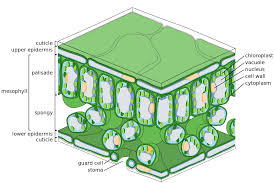
Schlerenchyma tissues have tepering ends which are thickened due to presence of a complex substance :
Cellulose
Pectin
Lignin
Cutin
None of the above
Which of the following is a waxy substance that covers epidermal surfaces of plants?
Thorn
Lignin
Cutin
Sclereids

Phloem consists of ........ elements
Sieve tube
Companion cells
Phloem fibers
Phloem parenchyma
Tissues commonly found in the fruit wall of nuts and seed coat is
Parenchyma
Sclerenchyma
Collenchyma
all of these

