
 Worksheets
5.12B Food Webs
Total questions: 128
Worksheet time: 3hrs 3mins
What is the original source of Energy in a food web?
Decomposers (Bacteria and Fungi)
Producers (Plants)
Consumers (Animals)
Sun

Which of the following gets it's energy directly from a producer?
Sun
Plants
Deer
Snake

The diagram shows a prairie food web. In the food web shown, all of the following are consumers EXCEPT –
Prairie Grass
Mountain Lion
Squirrel
Robin
Decomposers like mushrooms get energy by –
producing their own food
eating grass, fruit, and seeds
breaking down dead organisms
absorbing carbon dioxide from the air

In the food web diagram, what do the arrows represent?
Life Cycle
Metamorphosis
How food is produced by organisms
The flow of energy through an ecosystem
Green plants are producers that begin the flow of energy between organisms in a food web when they-
reproduce by generating seeds
absorb water and nutrients through the soil
release oxygen into the air
make their own food using sunlight
Mold, fungi, and some types of bacteria are classified as decomposers. What is the role of a decomposer in a food web?
break down waste and dead organisms
use sunlight and water to produce their own food
release oxygen into the atmosphere for respiration
to provide the energy animals need for food

The diagram shows a pond food web. What two organisms get their energy directly from insect larvae?
algae and minnows
sunfish and bass
minnows and sunfish
snails and snapping turtles
The diagram shows a woodlands food chain. What is the role of the tree in the food chain?
Sun → Tree → Squirrel → Hawk
make energy available directly to the Hawk
To use Sun's energy to produce food
to break down waste left by squirrels
to provide a place for the hawk to build it's nest

The prairie food web illustrated here has producers and consumers. In this food web, how many more consumers than producers are there?
2
5
7
9

The diagram shows a food web. What is the original source for all the energy in this food web?
Algae
Sun
Minnows
Insect Larvae

The diagram shows an incomplete food chain. Which of the following would best complete this food chain?
Producer
Consumer
Decomposer
Animal

The diagram illustrates a gulf food web. Which of the following organisms provides energy for more than one other organism in the food web?
Otter
Herring Gull
Blue Crab
Diamondback Terrapin

The diagram shows a prairie food web. Which organism in the food web would be classified as a producer?
Deer
Squirrel
Plant Seeds
Field Mouse
Which way does the arrow point??
Energy to Organism
Organism to Energy
North
South
All food webs start with this!
energy
the sun
decomposers
soil
Herbivores get their energy from eating
they don't need energy
other animals
plants
they make their own food
An example of an herbivore is
sun
fox
deer
grass
Which one is NOT a consumer?
producer
herbivore
carnivore
omnivore
Carnivores get their energy from eating
plants
other animals
nothing, they don't need energy
nothing, they use photosynthesis
An example of a carnivore is
the sun
a tree
a fox
a rabbit
These things break down dead plants and animals.
carnivores
herbivores
decomposers
producers
When decomposers break down dead plants and animals it
helps the sun shine brighter
gives nutrients to the soil
makes roots stronger
helps speed up photosynthesis
An example of a decomposer is
the sun
fungi
a rabbit
a lion
When one animal in a food web is altered,
it becomes endangered.
it becomes extinct.
it doesn't affect anything else.
it affects other animals in the web.
Producers
make their own food
eat herbivores
use photosynthesis
use energy from the sun
Examples of producers are
grass
fox
tree
rabbit
The original source of energy for a food web is...
plants
sun
producers
decomposers
Decomposers get energy from...
the sun
eating plants
eating animals
dead things and waste

Arrows in a food web represent...
eating
sunlight
energy
matter
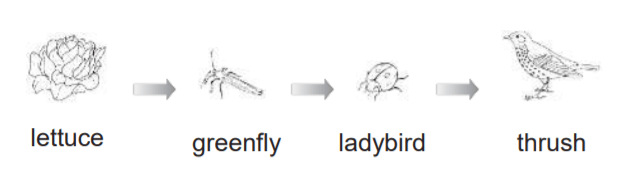
Who is the producer?
lettuce
greenfly
ladybird
thrush

Which type of organism should replace the X in the food web?
an omnivore
an herbivore
a carnivore
a producer

Which list contains only animals that receive energy transferred directly from consumers in this food web?
Red-tailed hawks, snowshoe hares, and caterpillars
Snowshoe hares and caterpillars
Snowshoe hares and shrews
Shrews and red foxes

ow many types of organisms in this food web obtain energy directly from producers?
two
three
four
five

Which statement correctly describes the transfer of energy in a food chain in this wetland?
Energy is transferred from hawks to shrews to grasshoppers to marsh grasses.
Energy is transferred from marsh grasses to crickets to hawks to frogs.
Energy is transferred from grasshoppers to crickets to frogs to hawks.
Energy is transferred from cattails to crickets to shrews to hawks.
Bacteria, fungi, and worms typically serve what role in an ecosystem?


Which of these completes the food chain correctly?
a rock
a fox
a plant
an egg

Which of these is a possible food chain for this environment?
Sun → grass → fly → frog
frog → fly → grass → Sun
Sun ← grass ← fly ← frog
Sun → fly → frog → snake


If the mouse population becomes sick and decreases, which statement about the food web will be true?
The grass population will decrease.
The hawk population will increase.
The grass population will increase.
The wildflower population will decrease.

What organism would most likely fit in the box?
A. Cactus
B. Snake
C. Worm
D. Frog

What is eaten by both the owl and the bird?
A. Grass
B. Mice
C. Grasshopper
D. Grain

What is the role of mushrooms?
A. producer
B. comsumer
C. decomposer
D. prey

What is the role of sunflowers?
A. producer
B. consumer
C. decomposer
D. prey

What would happen if the owl population decreased?
A. The owl population would increase
B. The insect population would decrease
C. The mouse population would decrease
D. The mouse population would increase

What is the role of the bearded dragon?
A. producer
B. consumer
C. decomposer
D. prey

Which type of organism is missing from this food web?
A. prodcuer
B. consumer
C. decomposer
D. prey
Which of the following food chains are in the correct order?
A. Eagle > Snake > Sun > Mouse > Grass
B. Sun > Grass > Mouse > Eagle > Snake
C. Eagle > Snake > Mouse > Grass > Sun
D. Sun > Grass > Mouse > Snake > Eagle

What is the role of algae?
A. Producer
B. Consumer
C. Decomposer
D. Prey

In this food web, energy is transferred directly between which two organisms?
A. Conifer leaves and northern goshawks
B. Elk and red crossbills
C. Conifer leaves and blue grouse
D. Blue grouse and wolves

Suppose that a fire in the African savanna kills many of the grasses and trees in that area. What is likely to happen to the population of herbivores that live there?
A. Herbivore population will decrease
B. Herbivore population will increase
C. Herbivore population will remain the same
D. Carnivore population will decrease

What would happen to the population of snakes if the population of mice increased?
A. the population of snakes would decrease
B. the population of snakes would increase
C. the population of snakes would not change
D. the population of snakes does not depend on the mice

What would happen to the population of grasshoppers and to the population of snakes if the bluebirds became sick and killed by a disease?
A. grasshoppers increase; snakes increase
B. grasshoppers decrease; snakes increase
C. grasshoppers increase; snakes decrease
D. grasshoppers decrease; snakes decrease

What is the role of mold?
A. producer
B. consumer
C. decomposer
D. prey

What are the predators of the goat?
A. Lion
B. Wild cat
C. Jackal
D. Lion and Jackal

Which change would most likely occur if all the producers in this ecosystem were removed?
A. the mice would become the new producers
B. all the animals would either die or move away
C. the number of mice would increase
D. all the animal populations would increase

What is the role of a butterfly?
A. producer
B. consumer
C. decomposer
D. prey
Peter has a hamburger and a salad for lunch? Which term describes Peter?
A. carnivore
B. scavenger
C. herbivore
D. omnivore
Which is the initial source of energy in most ecosystems?
A. oxygen in the air
B. nutrients in the soil
C. decomposer
D. sunlight

This diagram shows the movement of energy through ecosystem. Which statement is the best description of how energy derived from the sun flows through this food web?
A. consumer > producer > decomposer
B. producer > decomposer > consumer
C. producer > consumer > decomposer
D. decomposer > producer > consumer

What role do bobcats play in a forest food web?
Bobcats break down dead plants and animals and return nutrients to the soil
Bobcats are consumers of marmots and grouses
Bobcats produce their own energy
Bobcats are predators of grasses and berries

A wetlands food chain is shown, which table show the correct role of each organism?


Which type of organism is missing from this food web?
Decomposer
Predator
Consumer
Producer

How many types of organisms in this food web obtain energy directly from producers?
One
Two
Three
Four

What role do turkeys play in this food web?
Decomposer
Predator
Consumer
Producer

Which table shows the correct role of organisms in the food web?


In this food web, energy is transferred directly between--
mosquitoes and mudskippers
kingfishers and mangrove crabs
prawns and mosquito larvae
kingfishers and mangrove trees

Based on the information in the food web, which of the following food chains shows one way energy flows in this ecosystem?


which statement correctly describes the transfer of energy in a food chain in this ecosystem?
energy is transferred from berries to bears to elk
energy is transferred from grasses to marmots to bobcats
energy is transferred from bobcats to grouses to grasses
energy is transferred from grasses to elk to grouses

Based on the information in the table, which of the following food chains shows one way energy flows in this ecosystem?


Which organisms in this food web only eats producers?
Fruit bats and bandicoots only
insects and fruit bats
rufous owls, bandicoots and pythons only
insects only

Which organisms in this food web eat only consumers?
spider monkey and butterfly only
spider, poison dart frog and butterfly only
jaguar, carcara, spider and poison dart frog only
poison dart frog and jaguar only

Which change would most likely occur if all the producers in this ecosystem were removed?
The populations of consumers would increase
the producers would move to a new location
to populations of consumers would decrease
Pacus would become producers.

Which organisms do not directly consume another organism for energy?
Ravens and Quails
Kangaroo rats and crickets
cacti and seeds
gila monsters and desert tortoises
What is an organism that only gets its energy from producers called?
Herbivore
Carnivore
Omnivore
Where do decomposers get their energy from?
The Sun
Living organisms
Producers
Dead organisms or waste
Producers get their energy from (a) .

What do the ARROWS in a food web represent?
eating
energy
sunlight
organisms

Where does the wild cat get its energy from?
Lion
Mouse and Rabbit
Rabbit Only
Green plant
What role do plants play in a food web?
Decomposers
Consumers
Producers
Predators
How is energy transferred within an ecosystem?
Through water
By air
Through consumption of producers, consumers, and decomposers
By sunlight

Who is/are the producer(s) in this food web?
Mussels
Zooplankton
Phytoplankton and Algae
Limpets
An organism that gets energy from eating other organisms is called a ______________.
Producer
Consumer
Decomposer

What is a carnivore?
An animal that gets energy through producers.
An animal that gets energy through other consumers.
An animal that gets energy through both producers and consumers.

Who is the first level consumer in this food chain?
wolf
mushroom
arctic moss
caribou
The (a) is the decomposer for this tundra food chain.

Who is the top predator in this tundra food chain?
wolf
caribou
reindeer moss
bird

Click on the producers in this food web.
oak acorns
kinglet
red-tailed hawk
pine tree

Click on all of the primary consumers in this food chain.
corn snake
pine-borer insect
mouse
red-tailed hawk

Write one food chain within this web. START with a producer.

Why do you think the arrows pointing toward the decomposers are blue?


How many predators eat the rabbit for energy in this food web?
2
3
4
5

A fire destroyed the habitat of the Houston Toad.
The loss of habitat for the Houston Toad most likely affected
the food web by -
causing a decrease in the number
of wildflowers
causing an increase in the number
of insects
causing a decrease in the number
of armadillos
causing an increase in the number
of opossums

Look at the food web of a pond ecosystem.
Which food chain shows the correct flow of energy in the pond
of the food web?


The diagram shows an incomplete food chain. Which of the following would best complete this food chain?
Producer
Consumer
Decomposer
Animal

Which is the correct transfer of energy or Food Chain?
Sun > prairie grass > deer > snake
Sun > plant seeds > robin > eagle
Sun > plant seeds > robin > mountain lion
Sun > plant seeds > field mouse > deer

Which organism DOES NOT pass energy directly to the eagle?
rat
thrush
frog
dragonfly

Which type of organism uses sunlight directly for its energy?
producers
consumers
decomposers
apex predators


All of the living and nonliving things interacting in an environment is called
a species.
an ecosystem.
energy.
a habitat.
The process of a plant getting energy from the sun and converting it into food is known as
mitosis.
photosynthesis.
meiosis
symbiosis.

In a food chain or food web, herbivores are known as
producers.
primary consumers.
secondary consumers.
decomposers.

In a food chain or food web, organisms like fungi and bacteria are known as
producers.
primary consumers.
secondary consumers.
decomposers.

Which organism in the food chain is a secondary consumer?
grass
antelope
lion
dung beetle

A food web shows you...
which organisms consume each other
which organisms are in an ecosystem
how energy moves through an ecosystem
all of these
When you consume chicken, where did the energy in that chicken originally come from?
from the chicken itself
from the sun
from the grain the chicken ate
from the eggs the chicken laid

Humans are considered to be...
consumers
decomposers
producers

Turtles eat earthworms, grubs, bugs, grasses, fruits and berries. Turtles are ______________.
carnivores
herbivores
omnivores
decomposers


What does a food chain represent?
How plants create their own food.
A single path of energy transfer within an ecosystem.
All of the things that a particular animal eats.
How all living organisms within an ecosystem are connected.

What do you call an animal that hunts and eats other animals?
predator
prey
herbivore
producer

Polar bears will eat seals, walruses and fish to survive. Unlike other bears, polar bears are said to be mainly...
herbivores
carnivores
omnivores
decomposers

An animal that cannot make its own food and needs to eat to get energy is called
consumer
prey
a plant
producer

What would happen in this food web if the population of the frogs increases?
the population of the grasshoppers will increase
the population of the hawks will decrease
nothing will happen
the population of the grasshoppers will decrease

