
Font size
 Worksheets
MM2 First Quiz
Total questions: 63
Worksheet time: 32mins
What is Multimedia?
Multi - Many, Multiple
Media - Distribution tool & information presentation – text, graphic, voice, images, music and etc.
Multi - combination
Media - news, magazine, journals, etc.
Defined as an online, interactive experience that incorporates two or more media elements including text, graphics, sound, animation and video.
Multimedia
Web-based Multimedia
Online Interactive Multimedia
Interactive Multimedia
5 Elements of Multimedia? (Use commas to separate)
(a)
A broad term for something that contains words to express something
Text
Graphics
Audio
Animation
Video
-Two-dimensional figure or illustration.
-Could be produced manually (by drawing, painting, carving, etc.) or by computer technology.
Text
Graphics
Audio
Animation
Video
-Produced by vibration, as perceived by the sense of hearing
-In multimedia, this could come in the form of speech, sound effects and also music score.
Text
Graphics
Audio
Animation
Video
-The illusion of motion created by the consecutive display of images of static elements.
-is used to further enhance / enriched the experience of the user to further understand the information conveyed to them.
Text
Graphics
Audio
Animation
Video
Is the technology of capturing, recording, processing, transmitting, and reconstructing moving pictures.
Text
Graphics
Audio
Animation
Video
is an application which uses a collection of multiple media sources e.g. text, graphics, images, sound/audio, animation and/or video.
Multimedia Application
Digitized Multimedia
Interactive Multimedia
Hypermedia
Today, this integration is accomplished by using different media elements and then manipulating them with computer software.
Multimedia Application
Digitized Multimedia
Interactive Multimedia
Hypermedia
When the user is given the option of controlling the elements. It enables the user to directly respond to and control any or all of the media elements. Hence, users of this become active participants instead of the passive recipients of information
Multimedia Application
Digitized Multimedia
Interactive Multimedia
Hypermedia
A combination of hypertext, graphics, audio, video, (linked elements) and interactivity culminating in a complete, non-linear computer-based experience.
Multimedia Application
Digitized Multimedia
Interactive Multimedia
Hypermedia
- It is not interactive
- User have no control over the content that is being showed to them.
- Users start at the beginning and progress through a set sequence of events until they reach the end.
Linear
Non - Linear
- It is interactive
- Users have control over the content that is being showed to them.
- Users are given navigational control
- users have more control over what they are interested in pursuing.
Linear
Non - Linear
Used to merge multimedia elements (text, audio, graphic, animation, video) into a project.
Authoring Tools
Authoring Multimedia
Multimedia Authoring
Directing Tools
Which of these is the right Chinese Proverb?
“Tell me and I will forget; show me and I may remember; involve me and I will understand”
“Involve me and I will remember; show me and I will forget; tell me and I will understand."
“Tell me and I may remember; show me and I understand; involve me and I will ponder”
“Tell me and I will not remember; show me and I may understand; involve me and I will never forget”
Involves using web to serve clients and customers and is one way to provide solutions for companies that wish to sell products or services online.
Electronic Commerce (E-Commerce)
Web-Based Training and Distance Learning
Research and References
Entertainment and Games
Offers many options for delivering and receiving education over the distance. Is an instructions delivered over the Internet.
Electronic Commerce (E-Commerce)
Web-Based Training and Distance Learning
Research and References
Entertainment and Games
Newspaper, newsletters, magazines, books, encyclopedias and other reference materials are being offered online via Web.
Electronic Commerce (E-Commerce)
Web-Based Training and Distance Learning
Research and References
Entertainment and Games
They are the examples of some of the most popular and most varied interactive multimedia sites available.
Electronic Commerce (E-Commerce)
Web-Based Training and Distance Learning
Research and References
Entertainment and Games
Small, straightforward, linear products used to present information quickly and concisely.
Briefing Products
Reference Products
Database Products
Education and Training Products
Kiosk Products
Often used for answering specific questions or for general browsing of information. (stored on CD/ DVD ROM)
Briefing Products
Reference Products
Database Products
Education and Training Products
Kiosk Products
Focused on storing and accessing the actual data (multimedia data such as text, graphic, audio, animation and video)
Briefing Products
Reference Products
Database Products
Education and Training Products
Kiosk Products
Make up a significant share of the multimedia market ranging from pre-kindergarten to postgraduate offerings from technical to corporate.
Briefing Products
Reference Products
Database Products
Education and Training Products
Kiosk Products
A product which is usually stationed at public places and allow the user to find information interactively and also other types of transaction.
Briefing Products
Reference Products
Database Products
Education and Training Products
Kiosk Products
Category of Kiosk Products where: Provide certain information (example map, timetable etc)
Point of Information
Point of Sales System
Allow users to purchase or make orders
Point of Information
Point of Sales System
Move a project into an through production
Executive Producer
Project Manager
Forming a project, moving it into production and overseeing its creation
Executive Producer
Project Manager
– Music scores, sound effects, voice overs, vocals and transitional sounds, recording, editing and selecting voices, sounds and music
Audio Specialist
Computer Programmer
Video Specialist
Web Designer
Web Developer
Creates the underlying code that makes the website interactive and responsive to user’s actions
Audio Specialist
Computer Programmer
Video Specialist
Web Designer
Web Developer
Manages the process of capturing and editing original video
Audio Specialist
Computer Programmer
Video Specialist
Web Designer
Web Developer
Develops or refines a design process and efficiently creates a cohesive and well-planned website from the front end
Audio Specialist
Computer Programmer
Video Specialist
Web Designer
Web Developer
Ensures the communication between the front end of the website and its back end is working
Audio Specialist
Computer Programmer
Video Specialist
Web Designer
Web Developer
Creates 2D/3D animation by taking a sequence of static images and displaying them in rapid succession on the computer screen
Animation Specialist
Art Director
Graphic Artist/Designer
Interface Designer
Coordinate the creation of the artwork for the project
Animation Specialist
Art Director
Graphic Artist/Designer
Interface Designer
Creating and designing all of the graphic images for a project
Animation Specialist
Art Director
Graphic Artist/Designer
Interface Designer
Responsible for the look of the website interface and navigation methods
Animation Specialist
Art Director
Graphic Artist/Designer
Interface Designer
Building mental representations from words and pictures
Multimedia Learning
Multimedia Instruction
Multimedia
Presenting words and pictures that are intended to promote learning
Multimedia Learning
Multimedia Instruction
Multimedia
According to Mayer, people have two separate channels for processing auditory and visual information
Dual Channels
Limited capacity
Active processing
The theory recognizes that individuals have a limited ability to absorb information at any one time.
Dual Channels
Limited capacity
Active processing
The multimedia learning theory suggests that people should be actively engaged in the learning process rather than passive receivers of information.
Dual Channels
Limited capacity
Active processing
Memory store holding images on the eyes and sounds on the ears for a brief period
Sensory memory
Working memory
Limited-capacity memory store for storing sounds/images in active consciousness
Sensory memory
Working memory
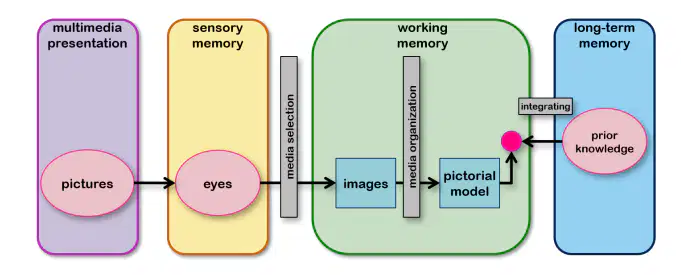
What type of Cognitive Process is this?
Processing Pictures
Processing Spoken Words
Processing Printed Words
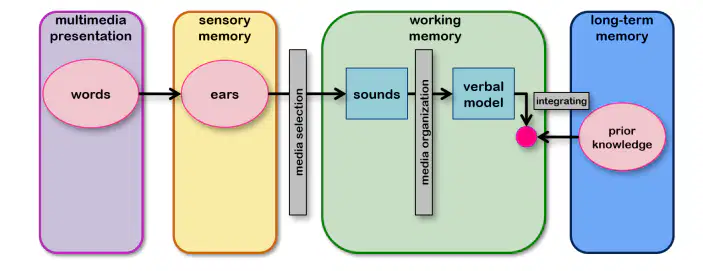
What type of Cognitive Process is this?
Processing Pictures
Processing Spoken Words
Processing Printed Words
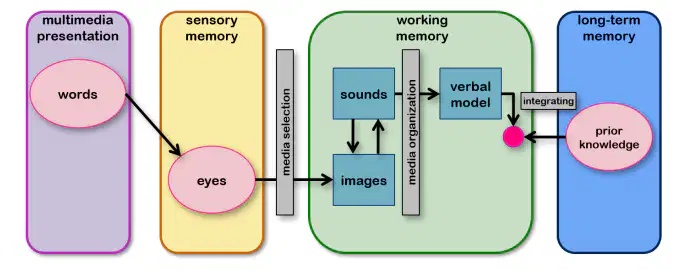
What type of Cognitive Process is this?
Processing Pictures
Processing Spoken Words
Processing Printed Words
- Born December 1, 1941
- Professor of Psychology at University of Western Ontario
- Author of Dual Coding Theory
Allan Paivio
Richard Mayer
Anderson
Bower
Verbal information can be enhanced when paired with a visual image, real or imagined.
Anderson & Bower (1973)
Stone & Glock (1981)
Levie & Lentz (1982
Mayer & Sims (1994)
• College students were given written assembly instruction
• Fewer errors when shown pictures with text
Anderson & Bower (1973)
Stone & Glock (1981)
Levie & Lentz (1982
Mayer & Sims (1994)
• Children learned more from text that was presented with illustrations
• Learning increased by one-third with illustrations
Anderson & Bower (1973)
Stone & Glock (1981)
Levie & Lentz (1982
Mayer & Sims (1994)
• Multimedia can be effective when used for education but only if used in appropriate ways
Anderson & Bower (1973)
Stone & Glock (1981)
Levie & Lentz (1982)
Mayer & Sims (1994)
Principle which says that humans learn best from a more informal, conversational voice than an overly formal voice. Having a more casual voice actually improves the learning experience.
Personalization Principle
Voice Principle
Signaling Principle
Interactivity Principle
Pre-training Principle
Principle which says that people learn better when the words are spoken in a standard-accented human voice rather than a machine voice or foreign-accented human voice.
Personalization Principle
Voice Principle
Signaling Principle
Interactivity Principle
Pre-training Principle
Principle which says that people learn better when cues that highlight the organization of the essential material are added.
Personalization Principle
Voice Principle
Signaling Principle
Interactivity Principle
Pre-training Principle
Principle which says that people learn better when they can control the speed of the learning assets.
Personalization Principle
Voice Principle
Signaling Principle
Interactivity Principle
Pre-training Principle
Principle which says that people learn better from a multimedia lesson when they know the names and characteristics of the main concepts.
Personalization Principle
Voice Principle
Signaling Principle
Interactivity Principle
Pre-training Principle
Principle which says that people learn better from words and pictures than from words alone, words (such as spoken text or printed text), and graphic (such as illustrations, charts, photos, animation, or video).
Segmenting Principle
Modality Principle
Coherence Principle
Contiguity Principle
Multimedia Principle
Principle which says that people learn better when relevant text and visuals are physically close together and corresponding words and visuals are presented together, instead of in consecutive order.
Segmenting Principle
Modality Principle
Coherence Principle
Contiguity Principle
Multimedia Principle
Principle which says that people learn better when extraneous words, pictures and sounds are excluded rather than included.
Segmenting Principle
Modality Principle
Coherence Principle
Contiguity Principle
Multimedia Principle
Principle which says that people learn better from graphics and narration than graphics and printed text
Segmenting Principle
Modality Principle
Coherence Principle
Contiguity Principle
Multimedia Principle
Principle which says that people learn better from a multimedia lesson is presented in user-paced segments rather than as a continuous unit.
Segmenting Principle
Modality Principle
Coherence Principle
Contiguity Principle
Multimedia Principle

