
Font size
 Worksheets
BI.U1.L1 Test Review
Total questions: 95
Worksheet time: 2hrs 57mins
A ball is sitting at the top of a ramp. As the ball rolls down the ramp, the potential energy of the ball decreases. What happens to the potential energy as the ball moves?
It is lost as gravitational energy
It is converted to kinetic energy
It is destroyed as the ball moves
It is used to make the ball slow down
A toy robot can walk and talk and runs on batteries. Which type of energy is stored in the batteries?
Nuclear
Chemical
Electrical
Mechanical
Which of these is an example of the conversion of kinetic energy into gravitational potential energy?
A person walking up a hill
A person skiing down a hill
A car racing around an oval track
A person parachuting out of an airplane
Which of these statements is an example of energy transfer?
An open flame heating a pan of water
A plant using sunlight to create glucose
Turning on a flashlight to create a beam of light
A child rubbing her hands together to warm them
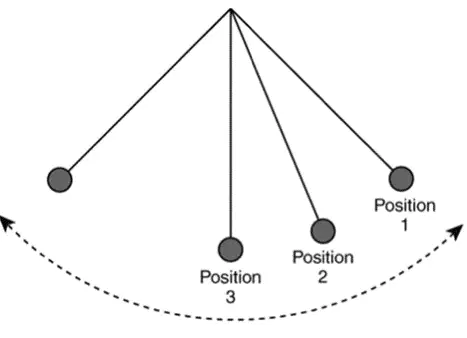
The diagram shows a swinging pendulum. During every swing, the pendulum's speed and position change. Three positions during the swing are identified as position 1, position 2, and position 3. At which point would most of the pendulum's potential energy have been turned into kinetic energy?
Position 3
Position 1
Position 2
The potential and kinetic energy are equal in all positions.
Which term describes the energy that is stored due to the height of an object above the ground?
Kinetic energy
Chemical energy
Mechanical energy
Gravitational potential energy
Describe how potential energy is different from work.
Potential energy is stored energy, while work is the energy transferred by a force.
Potential energy and work are both forms of kinetic energy.
Potential energy is the energy of motion, while work is stored energy.
Potential energy and work are unrelated concepts in physics.
Tammy moves a crate 500 meters while doing 60,000 Joules of work. How much does the crate weigh?
120 N
150 N
100 N
200 N
Scientific notation, change the scientific notation into regular notation: 1 x 10^6
1000000
10000
100000
100
Scientific notation, change the scientific notation into regular notation: 4.6 x 10^3
4600
460
46000
46
I have the most potential energy if I am:
5 feet high
10 feet high
15 feet high
20 feet high
What is the unit of measurement for potential energy?
Watts
Joules
Newtons
Meters


What is an example of kinetic energy?
A bird sitting in a tree
A bouncy ball on the table
A car driving on the highway
A book on shelf
The faster an object moves, the ________ kinetic energy it has.
more
less
If a football player wants to become better at tackling by increasing his or her kinetic energy, how can the player do this?
Increase his/her height
Increase his/her speed
Increase his/her mass
Decrease his/her speed
Which is the best example of kinetic energy?
A car sitting on top of a hill
A skateboard on the sidewalk
A wagon rolling down a hill
A powerwheel parked in the yard
When something is dropped, what type of energy transfer takes place?
Kinetic -> Gravitational Potential
Gravitational Potential -> Kinetic -> Sound
Electrical -> Chemical
Heat -> Nuclear
Which is the type of energy used when burning gasoline?
Magnetic
Electrical
Nuclear
Chemical


When you rub your hands together on a cold day, you use friction to convert
Mechanical energy into thermal energy
Thermal energy into nuclear energy
Nuclear energy into electrical energy.
Electrical energy into radiant energy

The football player uses the body to play the sport. Which type of energy does a carpenter use with her body to get the job done?
Mechanical
Electrical
Light
Solar
What is Mechanical Energy a sum of?
Kinetic Energy and Thermal Energy
Potential Energy and Chemical Energy
Kinetic Energy and Potential Energy
Thermal Energy and Chemical Energy
In electrical circuits, electrical energy is often converted into which type of energy?
Mechanical Energy
Thermal Energy
Chemical Energy
All of the above
Which example below uses only mechanical energy?
A. Watching your favorite TV show with your family
B. Hitting a baseball with a baseball bat in the front yard
C. Talking to your grandmother on the telephone
D. Heating up hot water on the stove for hot chocolate

When force is used to move an object across a distance, this is called...
effort
power
energy
work
If the object does not move then what is happening
nothing
work
power
no work is being done on the object
What is the equation for work?
W = mass x acceleration
W = force x distance
W = force/distance
W = speed/time
Which of the following scenarios involves work being done?
Holding a book stationary above the ground.
Pushing a wall with no movement.
Lifting a bag from the floor to a table.
A satellite orbiting Earth in space.
If a force of 10 N is applied over a distance of 4 meters, what is the total work done?
40 J
20 J
10 J
14 J
What is the work done when a force of 20 N is applied to move an object 3 meters against a frictional force of 5 N?
45 J
60 J
15 J
75 J
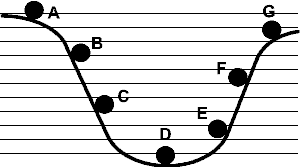
At which point does the ball has the greatest gravitational potential energy (GPE)?
A
G
D
C
G

In order to increase the gravitational potential energy of a roller coaster car, you could...
increase the car's height
decrease the car's height
increase the car's velocity
decrease the car's mass

A girl throws a ball up into the air and watches it fall back down to the ground. At what point does the ball have the most GPE?
A
B
C
The ball has the same GPE at all points.
At what point does the baseball have ALL gravitational potential energy?
Which is the correct unit for expressing gravitational potential energy?
Joule
Newton
m/s2
meter
Energy stored because of gravity is called:
Gravitational Potential Energy
Kinetic Energy
Mechanical Advantage
Chemical Energy
What kind of energy does a marble at the top of a hill have?
gravitational potential
chemical potential
kinetic
thermal
How could you increase the gravitational potential energy of an object without changing its mass and gravity?
Make the object larger
Lower the object towards the ground
Raise the object farther off the ground
Allow the object to roll on the ground
When a pendulum swings from its highest point to its lowest point, what happens to its potential and kinetic energy?
Potential energy increases, kinetic energy decreases
Potential energy decreases, kinetic energy increases
Both potential and kinetic energy remain constant
Both potential and kinetic energy increase
Which of the following scenarios best illustrates the conversion of chemical energy to mechanical energy?
A battery powering a flashlight
A person running a marathon
A wind turbine generating electricity
A solar panel absorbing sunlight
What is energy?
Energy is something that is moving.
Energy is something that builds up when something is at rest.
Energy describes the ability of things to change themselves or to cause change to other things.
All of the above accurately describe ENERGY.
TRUE or FALSE. Kinetic energy is relative to its position and location, and it is a form of stored energy.
True
False: Kinetic energy is energy in motion.
When you consume food, is that a form of chemical potential energy?
Yes, because the food chemically breaks down inside your body helping your body store energy to use when needed.
No, because your body digests the food you eat and does not store the energy for future consumption.
Which one of the following is NOT a type of potential energy
Mechanical energy
Nuclear energy
Elastic energy
Chemical energy
Ryan rubs two sticks together quickly. When he stops rubbing the sticks, he notices that they are warm where he rubbed them. What type of energy has been produced?
Sound energy
Thermal energy
Light energy
Which one of these is NOT a type of kinetic energy?
Thermal energy
Gravitational energy
Sound energy
Electrical energy
What is the main type of energy shown by a person running?
Electrical
Mechanical
Sound
Chemical
What is the type of energy in food?
Thermal
Kinetic
Sound
Chemical
What is the type of energy when someone is speaking?
Thermal
Kinetic
Sound
Chemical
What is the type of energy when you use an oven?
Thermal
Elastic
Sound
Chemical
What is the type of energy shown by a torch in the dark?
Sound
Light
Electrical
Elastic

What is the type of energy that comes out of a power socket?
Sound
Light
Electrical
Potential
Nuclear energy, which is energy stored in atoms, is an example of ______
Kinetic energy
Potential energy
Elastic energy, which is energy stored in compressed gases or springs, is an example of ______
Kinetic energy
Potential energy
Electrical energy, which is energy of moving electrons, is an example of ______
Kinetic energy
Potential energy
Thermal energy, which is energy of moving particles, is an example of ______
Kinetic energy
Potential energy
Radiant energy, which is energy of electromagnetic waves, is an example of ______
Kinetic energy
Potential energy
A tree performing photosynthesis
Mechanical Energy
Chemical Energy
Sound Energy
Elastic Energy
Heat energy from the movement of atoms
Sound Energy
Elastic Energy
Chemical Energy
Thermal Energy
Energy stored in chemical bonds like food fuel, and batteries
Sound Energy
Nuclear Energy
Chemical Energy
Light Energy
Movement of electrons to transmit electricity
Thermal Energy
Electrical Energy
Chemical Energy
Elastic Energy
The sum of potential and kinetic energy
Mechanical Energy
Elastic Energy
Thermal Energy
Electrical Energy
Hairdryer that is plugged into the wall
Nuclear Energy
Chemical Energy
Electrical Energy
Elastic Energy
Camp Fire burning
Thermal Energy
Elastic Energy
Electrical Energy
Mechanical Energy
A rubber band pulled back
Elastic Energy
Sound Energy
Thermal Energy
Nuclear Energy
Splitting the nuclei of atoms in a process called fission
Sound Energy
Electrical Energy
Mechanical Energy
Nuclear Energy
A push or pull on an object.
distance
force
work
How far an object moves.
distance
force
work
Units for distance.
Newtons
Joules
Meters
Units for force
Newtons
Joules
Meters
Units for work
Newtons
Joules
Meters
What formula?
F=10 N
d=5m
W=?
W=f × d
F=dW
d=FW
What formula?
F= 7 N
d= ?
W=9 J
W=f × d
F=dW
d=FW
What formula?
F= ?
d= 5
W=9 J
W=f × d
F=dW
d=FW
Solve
F= ?
d= 25m
W=100 J
F=dW
4 N
0.25 N
2500 N
Solve
F= 50 N
d= 5 m
W= ?
W=F×d
250 J
0.1 J
10 J
Solve
F= 40 N
d= ?
W= 5 J
d=FW
200 m
0.125 m
8 m
Solve
F= ?
d=10 m
W=20 J
F=dW
200 N
0.5 N
2 N
Solve
F= 0.25 N
d= 60 m
W= ?
W=F×d
0.004 J
15 J
240 J
Solve
F= 100 N
d= 10 m
W= ?
W=F×d
1000 J
0.1 J
10 J
You are moving a couch across the living room. The couch weighs 420 N and you need to move it 6 meters. Calculate the work.
420 j
2520 j
2400 j
1600 j

