wayground logo

Free Printable Worksheets

Font size

S
M
L
XL
Worksheets

Chemistry Unit 2 Review

Total questions: 105

Worksheet time: 3hrs 50mins

Name
Class
Date
1.
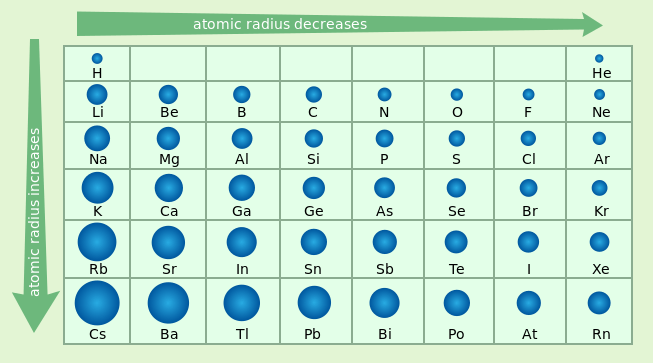
As you move down the periodic table, atoms get bigger.  This is because ____________.
a)
The atoms have more mass.
b)
The atoms have more protons.
c)
The atoms have more energy levels
d)
The atoms have more nuetrons
2.

As you move across the periodic table atoms tend to get smaller because, ______________.

a)

the atoms have more mass.

b)

the atoms have more protons and increased electron shielding.

c)

the atoms have more protons and electrons are added to the same energy level.

d)

the atoms have more protons, electrons, and increased electron shielding.

3.

Which atom has the largest atomic radius?

a)

potassium (K, #19)

b)

rubidium (Rb, #37)

c)

francium (Fr, #87)

d)

cesium (Cs, #55)

4.

Subatomic particles with a negative charge

a)

Electrons

b)

Neutrons

c)

Protons

d)

Quarks

5.
Subatomic particles with a positive charge
a)
neutrons
b)
atomic mass
c)
protons
d)
isotopes
6.
Value representing the number of protons in an element
a)
Atomic Mass
b)
Mass Number
c)
Valence Electrons
d)
Atomic Number
7.
Subatomic particles that are neutral in charge
a)
Neutrons
b)
Protons
c)
Nucleus 
d)
Electrons
8.
Which two subatomic particles make up the nucleus of an atom?
a)
Protons and Electrons
b)
Neutrons and Electrons
c)
Electrons and Protons
d)
Protons and Neutrons
9.
Where are the Electrons found in the structure of an atom?
a)
In the nucleus
b)
In spaces around the nucleus
10.

What is the mass number?

a)

the number of protons in the nucleus

b)

the number of protons and neutrons in the nucleus

c)

the number of neutrons in the nucleus

d)

the number of protons and electrons in the atom
11.
In order for an atom to be neutral what has to be true?
a)
The atom has more protons than neutrons
b)
The atom has more neutrons than protons
c)
The atom has the same number of protons and neutrons
d)
The atom has the same number of protons and electrons
12.
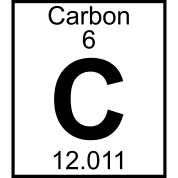
What does the C represent?
a)
atomic mass
b)
atomic number
c)
element name
d)
chemical symbol 
13.

What does the 6 represent?

a)

Atomic mass

b)

atomic number

c)

chemical symbol

d)

element name

14.
How is the number of neutrons in the nucleus of an atom calculated?
a)
Add the number of e- and p+ together
b)
Subtract the number of e- from p+
c)
Subtract the number of p+ from the mass number
d)
Add the mass number to the number of e-
15.
If an atom has 12 positively charged subatomic particles, which of the following must it also have to be considered a neutral atom?
a)
12 neutrons
b)
12 electrons
c)
12 protons
d)
24 protons and neutrons
16.

An atom has 10 protons, 15 neutrons and 10 electrons what is its mass number.

a)

20

b)

10

c)

35

d)

25

17.
The atomic number of an element that has 9 protons, 9 electrons, and 10 neutrons is _____.
a)
9
b)
10
c)
19
d)
28
18.
Where is most of the mass in an atom located?
a)
in the nucleus
b)
in the protons
c)
in the neutrons
d)
in the electrons
19.
An element with a mass number of 11 and an atomic number of 5 has how many neutrons?
a)
11
b)
5
c)
6
d)
16
20.
An atom has an atomic number of 15 and a mass number of 31. How many protons are there in the atom?
a)
15
b)
31
c)
16
d)
47
21.

Which of the following determines the identity of an element?

a)

number of protons

b)

atomic mass

c)

number of neutrons

d)

number of shells

22.
What is the atomic number of the atom pictured? 
a)
9
b)
10
c)
18
d)
19
23.

How many protons does indium have?

a)

49

b)

66

c)

114

d)

115

24.

Neutral atoms have no electric charge because they

a)

have an equal number of charged and noncharged particles

b)

have neutrons in their nuclei

c)

have an equal number of electrons and protons

d)

have an equal number of neutrons and protons
25.
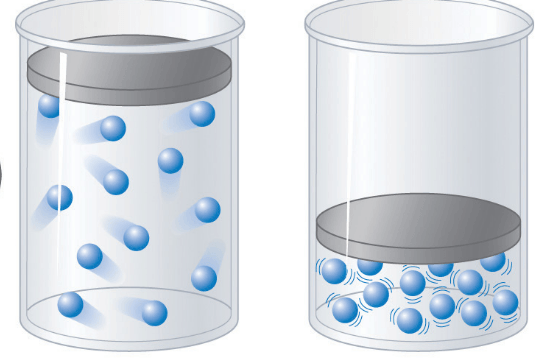
Which container will have a lower pressure?
a)
left
b)
right
c)
they both have the same pressure
d)
I don't know
26.
A mixture of hydrogen, nitrogen, and water vapor has a total pressure of 864 mmHg. The partial pressure of hydrogen is 220 mmHg and that of nitrogen is 410 mmHg. What is the partial pressure of water vapor?
a)
234 mmHg
b)
1.37 mmHg
c)
2.64 mmHg
d)
1, 494 mmHg
27.
What was the name of J.J Thomsons' model of atomic structure. 
a)
Electron Cloud Model 
b)
Electron Sea Model
c)
Plum Pudding Model 
d)
Bohr Model
28.
What does the Bohr model suggest?
a)
Atoms are small, hard, indivisible objects. 
b)
That protons in the nucleus are attracted to electrons in the electron clouds. 
c)
That electrons travel around the nucleus of an atom in orbits or definite paths.
29.
Who proposed that the atom consists mostly of empty space?
a)
Bohr
b)
Dalton
c)
Rutherford
d)
Chadwick
30.
Developed the very first atomic theory
a)
Ernest Rutherford
b)
Schrodinger & Heisenberg
c)
Niels Bohr
d)
John Dalton
31.
Discovered the electron
a)
Bohr
b)
Dalton
c)
Rutherford
d)
Thomson
32.

Which of the following shows the correct order of Atomic Theory Timeline

a)

Rutherford, Bohr, Dalton, Democritus, Thomson

b)

Bohr, Democritus, Thomson, Rutherford, Dalton

c)

Dalton, Thomson, Rutherford, Bohr, Democritus

d)

Democritus, Dalton, Thomson, Rutherford, Bohr

33.

What was the basis for Dalton's atomic theory?

a)

The law of conservation of mass and the law of constant composition

b)

The discovery of subatomic particles and isotopes

c)

The law of definite proportions

d)

The rearrangement of atoms in a chemical reaction

34.

According to Dalton's atomic theory, all matter is made of ________.

a)

Molecules

b)

Protons, neutrons, and electrons

c)

Atoms

d)

Subatomic particles

35.

Dalton proposed that all atoms of a given element are ________ in mass and properties.

a)

Different

b)

Similar

c)

Identical

d)

Varied

36.

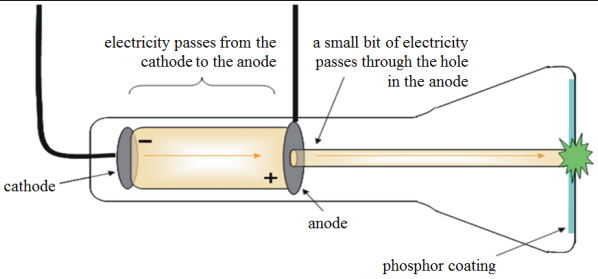
Which device did JJ Thomson use to discover the electron?

a)

X-ray machine

b)

scanning tunneling electron microscope

c)

spectrometer

d)

cathode ray tube

37.

In what location did Rutherford suggest the electrons were located?

a)

in the nucleus.

b)

outside the nucleus.

c)

only where the alpha particles were deflected.

d)

outside the atom after they collided with the alpha particle.

38.

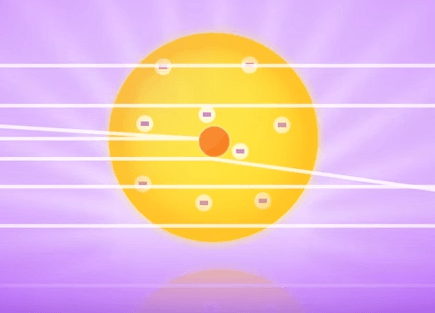
Rutherford used what type of radiation to bombard the gold foil?

a)

alpha particles.

b)

beta particles.

c)

gamma radiation.

d)

neutrinos.

39.
Who developed the wave theory?
a)
DeBrogile
b)
Heisenberg
c)
Thompson
d)
Dalton
40.
Who created the uncertainty principle?
a)
Heisenberg
b)
DeBrogile
c)
Dalton
d)
Bohr
41.
J.J. Thomson provided evidence that an atom...
a)
is the smallest particle of matter
b)
contains negatively charged particles
c)
has an overall negative charge
d)
has an overall positive charge
42.
Rutherford discovered the...
a)
electron
b)
proton
c)
neutron
d)
nucleus
43.
Isotopes are elements with a different amount of
a)
protons
b)
neutrons
c)
electrons
d)
atoms
44.
What scientist first developed 4 rules for atomic theory, and helped kick start modern chemistry?
a)
J.J. Thomson
b)
Ernest Rutherford
c)
John Dalton
d)
Democritus
45.
How many protons are in this element?
a)
79
b)
196
c)
117
d)
Cannot be determined
46.
How many protons are in this element?
a)
79
b)
196
c)
117
d)
Cannot be determined
47.
What is the atomic mass (rounded to the nearest whole number) of this element
a)
196
b)
196.95
c)
197
d)
79
48.

Calculate the average atomic mass of silver.

a)

106.38649amu

b)

111.91896amu

c)

107.8677amu

d)

121

49.
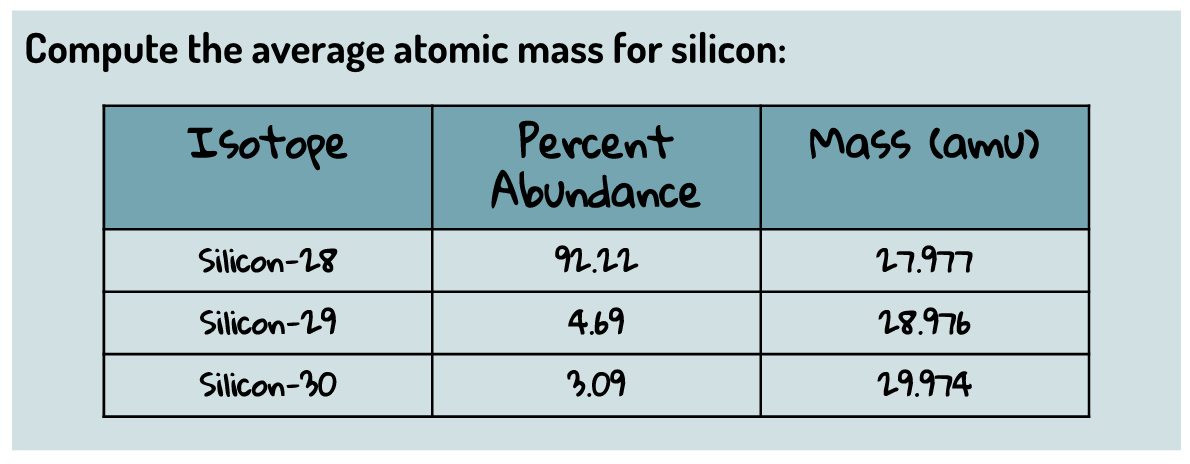
Compute the average atomic mass for silicon:
a)
27.977
b)
28.09
c)
28.976
d)
The average mass cannot be determined from provided information.
50.
An element has two naturally occurring isotopes. One is 10.013 amu and is 19.9% abundant. The other is 11.01 amu and is 80.1% abundant. What is the average atomic mass? What element is it?
a)
9.012, Beryllium
b)
12.011, Carbon
c)
6.941, Lithium
d)
10.812, Boron
51.
An isotope has three forms.  30% have a mass of 4 amu, 20% have a mass of 5 amu and 50% have a mass of 3 amu.  Average atomic mass will be closest to
a)
2 amu
b)
3 amu
c)
4 amu
d)
5 amu
52.

An element has three isotopes. Given the abundances and relative masses, calculate the average atomic mass and determine (from the periodic table) which element it is.


Abundances | Relative masses

0.005% | 234.04 amu

0.720% | 235.04 amu

99.275% | 238.05 amu

a)

Uranium (#92, Atomic Mass: 238.03 amu)

b)

Fluorine (#9, Atomic Mass: 19.00 amu)

c)

Mercury (#89, Atomic Mass: 200.59 amu)

d)

Polonium (#84 209 amu)

53.
What is an isotope? 
a)
A charged atom
b)
An atom with different amounts of neutrons
c)
An atom with different amounts of protons
d)
A neutral atom
54.
If X is the symbol for an element, which of the following two symbols represent    isotopes of the same element?     I. 7735X  II. 7733X  III. 8137X  IV. 8135 X
a)
I and II
b)
III and IV
c)
I and IV
d)
I and III
55.
How many neutrons does the isotope of lithium have?
a)
8
b)
3
c)
4
d)
5
56.
Isotopes are atoms of the same element with different #’s of __________ & therefore different __________.
a)
n0 ;  atomic #’s
b)
p+ ; atomic #’s
c)
e- ; atomic masses
d)
n0 ; atomic masses
57.
What atom matches this electron configuration?
1s22s22p63s23p64s23d10
a)
Zinc
b)
Copper
c)
Nickel
d)
Germanium
58.
What is the shorthand electron configuration for Sulfur atom?
a)
[Ar] 3p4
b)
[He] 3s23p4
c)
[Ne] 3s23p4
d)
[Na] 3s23p3
59.
What is the noble gas configuration for phosphorus?
a)
[Ar] 3p5
b)
[He] 3s2 3p5
c)
[Ne] 3s2 3p3
d)
[Na] 3s2 3p5
60.

Write the electron configuration for the element.

a)

1s12s12p33s1

b)

1s22s22p53s1

c)

1s2s2p3s

d)

1s22s22p63s1

61.

What is the correct electron configuration for Phosphorus (15)?

a)

1s22s22p63s23p4

b)

1s22s22p63s23d3

c)

1s22s22p63s23p3

d)

1s2s2p3s3p

62.
What is the electronic configuration of sodium?
a)
1s22s22p63s1
b)
[Ne]3s1
c)
1s22s22p7
d)
Both A and B are correct
63.

This Lewis dot structure for Nitrogen is accurate

a)

True

b)

False

64.

This Lewis dot structure for Oxygen is accurate

a)

True

b)

False

65.
Put these in increasing order:
C, H, and O
a)
H < C < O
b)
H < O < C
c)
O < C < H
d)
C < H < O
66.
Choose the set that goes from lowest to highest electronegativity?
a)
Cu, Mg, Sr, Ca
b)
F, Cl, Br, Si
c)
Cs, Rb, Ca, Mg
d)
Zn, Cd, Ag, Cu
67.
Electronegativity is...
a)
how good an atom is at attracting electrons
b)
the ability of an atom to lose electrons
c)
the energy required to remove an electron from a specific atom
d)
how easy it is to make friends. 
68.
The electron configuration of an atom is 1s22s22p6.  The number of electrons in the atom is 
a)
3
b)
6
c)
8
d)
10
69.

What charge does Nitrogen want to form to have a full valance shell?

a)

5+

b)

5-

c)

8

d)

3-

e)

3+

70.
How many electrons should Lithium have around its Lewis dot model?
a)
1
b)
2
c)
3
d)
4
71.

Which of these is correct?

a)
b)
c)
72.

What element has this electron configuration?

a)

helium

b)

lithium

c)

beryllium

d)

boron

73.
Which element is pictured?
a)
neon
b)
fluorine
c)
magnesium
d)
argon
74.
Which element is depicted from this orbital diagram
a)
Fluorine
b)
Neon
c)
Chlorine
d)
Argon
75.
Which element is pictured?
a)
neon
b)
fluorine
c)
magnesium
d)
argon
76.

Choose the correct electron configuration for Chlorine (Cl).

a)

1s2 2s2 2p1

b)

1s2 2s2 2p6 3s2

c)

1s2 2s2 2p6 3s2 3p5

77.

Name this element.

a)

Neon

b)

Magnesium

c)

Sodium

d)

Manganese

78.

___________ simplify the Bohr Model by showing only the outer valence electrons used for bonding.

a)

Lewis Dot Diagrams

b)

Bohr Models

c)

Electron Clouds

d)

Periodic Tables

79.

The highest point of the wave is called the ____________.

a)

crest

b)

trough

c)

wavelength

d)

amplitude

80.

The lowest point of the wave is called the ______________.

a)

crest

b)

trough

c)

wavelength

d)

amplitude

81.

The distance from one crest or trough to the next crest or trough is called the _____________.

a)

amplitude

b)

wavelength

c)

circular

82.

Of the two waves presented, which wave has the greatest energy?

a)

Top wave (higher frequency/shorter wavelength)

b)

Bottom wave (lower frequency/longer wavelength)

c)

Both waves have the same amplitude, therefore the same energy.

83.

Wavelength is

a)

The distance between two crests

b)

The distance from rest to crest

c)

The number of waves per second

d)

The speed of a wave

84.

Amplitude and wavelength can be the same.

a)

True

b)

False

85.

Which letter represents the trough of a wave?

a)

A

b)

B

c)

C

d)

D

e)

E

86.

Which letter represents the rest position of a wave?

a)

A

b)

B

c)

C

d)

D

e)

E

87.

What is the unit for frequency?

a)

cm

b)

m

c)

units2

d)

Hz

88.

How many waves are represented here?

a)

2

b)

3

c)

0

d)

1

89.

The amplitude of this wave is

a)

1 m

b)

2 m

c)

3 m

d)

4 m

90.

The wavelength of this wave is

a)

25 cm

b)

85 cm

c)

65 cm

d)

40 cm

91.

This wave represents 10 seconds. What is the frequency of the wave?

a)

0.2 Hz

b)

2 Hz

c)

-2 Hz

d)

20 Hz

92.

Waves with high frequencies must have ________________.

a)

short wavelengths

b)

long wavelengths

c)

large amplitudes

d)

small amplitudes

93.
Put the visible light colors in order from longest wavelength to shortest wavelength
a)
Violet, Indigo, Blue, Green, Orange, Yellow, Red
b)
Red, Yellow, Green, Orange, Violet, Blue, Indigo
c)
Red, Orange, Yellow, Green, Blue, Indigo, Violet
d)
Yellow, Blue, Orange, Violet, Red
94.

Which of the following are units of frequency?

a)

Newtons

b)

Hertz

c)

Joules

d)

Seconds

95.

Calculate the energy of light with a frequency of 5.10 x 10¹⁴ Hz.

a)

3.38 x 10⁻¹⁹ J

b)

5.88 x 10⁻⁷ J

c)

9.62 x 10¹² J

d)

1.04 x 10⁻¹³ J

96.

The frequency of light is 7.14 x 10¹⁴ Hz. What is the wavelength?

a)

3.00 x 10⁸ m

b)

4.20 x 10⁻⁷ m

c)

2.25 x 10²³ m

d)

3.90 x 10⁻⁹ m

97.

Select the correct order of waves on the EMS from low to high energy

a)

Radio wave, Microwave, Infrared, Visible, Ultraviolet, X-ray, Gamma

b)

Visible, Microwave, Infrared, Ultraviolet, X-ray, Gamma, Radio wave

c)

Gamma, X-ray, Ultraviolet, Visible, Infrared, Microwave, Radio wave

d)

Microwave, Radio wave, Visible, Infrared, Ultraviolet, X-ray, Gamma

98.

What happens to frequency when the energy increases?

a)

it increases

b)

it stays the same

c)

it decreases

99.
Cell phones use_____________waves.
a)
Microwaves
b)
Gamma
c)
XRays
d)
Radio 
100.
Infrared waves are used in__________________.
a)
Bath tubs
b)
Microwaves
c)
Remote Controls
d)
Tanning
101.
Cancer can be treated with_______________waves.
a)
Penicillin
b)
Radio
c)
Infrared
d)
Gamma
102.
The relationship between wavelength and frequency is λ=c/f.  Calculate the wavelength of light that has a frequency of 5.2 x 10¹² 1/s. The speed of of light is 3.0x 10⁸ m/s.
a)
5.8 x 10 -5 m
b)
5.8 x 10 -7 m
c)
5.19 x 10 14 m
d)
1.56 x 10 23 m
103.
Solve this problems using the equation: 
C = λν
If an AM radio station broadcasts at
9.95 x 10⁵ Hz, what is the wavelength of this radiation?
a)
6.59 x 10⁻²⁸ m
b)
1.01 x 10⁻⁶ m
c)
3.32 x 10⁻³ m
d)
302 m
104.

Calculate the wavelength of light that has a frequency of 5.2 x 10¹² 1/s.

a)

5.8 x 10 -5 m

b)

5.8 x 10 -7 m

c)

5.19 x 10 14 m

d)

1.56 x 10 23 m

105.
What is the frequency of a photon whose energy is 3.4x10⁻¹⁹J?
a)
8.8x1026 Hz
b)
5.1x10¹⁴ Hz
c)
1.9x10⁻¹⁵ Hz
d)
2.3x10-52 Hz