
 Worksheets
Chemistry Unit 1 Exam
Total questions: 75
Worksheet time: 2hrs 47mins
Which of the following would be considered a PURE SUBSTANCE? (Choose all that apply)
Oxygen (O)
Salt Water (NaCl + H2O)
Carbon Dioxide (CO2)
Water (H2O)
The Atmosphere
Which statement best describes the liquid and gas states?
both take the shape of their container and only liquids expand to fill the volume of their container
both take on the shape of their container and only gases fill the volume of their container
both expand to fill the volume of their container and only gases take on the shape of their container
both expand to fill the volume of their container and only liquids take on the shape of their container

Some examples of a chemical change are bubbling,color change, and fizzing.


What is a significant figure?
Numbers that are reliable, necessary, and precise.
The number with the most digits.
The number with the least digits.
The number with the least amount of zeros.
ALL non-zero digits are ALWAYS significant!
True
False
ALL zero’s in-between non-zero digits are NEVER significant
True
False
Zero’s at the end of a number WITH at decimal point ARE NOT significant
True
False
Zero’s at the end of a number WITH a decimal point ARE significant
True
False
Zero’s that are before a non-zero digit ARE significant
True
False
How many significant digits are in the 0.00808?
6
4
1
3
How many significant digits are in 0.10003
3
6
5
2
How many significant digits are in 15.000
4
5
3
2
What is the unit of measurement for volume?
Kilogram
Meter
Liter
Kelvin
Celcuis


How much liquid is in this graduated cylinder? Include units and precision.
(a)

Classify each of the pictures below by placing the correct letter label in the blanks below. You may use the letters more than once or not at all.
A = Element
B = Compound
C = Mixture of elements
D = Mixture of compounds
E = Mixture of elements and compounds
A:__, B:__, C:__,D:__, E:__
(a)
Anything with definite volume, but not definite shape is a
gas
solid
liquid
mass

Identify the particles.
solid
liquid
gas
none

Identify the particles .
solid
liquid
gas
none


An element contains
one kind of atom
two or more kinds of atoms
one kind of molecule
two or more kinds of molecules
Which of the following is not a property of a material?
flexibility
luster
shape
texture
An element contains
One kind of atom
One kind of molecule
Two or more kinds of atoms
Two or more kinds of molecules

What is the density?
(Make sure you're subtracting to find volume BEFORE you do Mass divided by Volume)
(a)
What is the density?
(a)

Let's practice! Before reads 50 mL. After we drop in the object, the new water level goes up to 60 mL. What is the volume of the blocks?
8 mL
10 mL
60 mL
5 mL
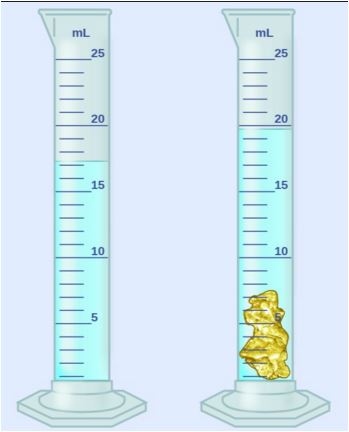
An irregularly shaped piece of gold was lowered into a graduated cylinder holding a volume of water equal to 17 ml. The height of the water rose to 20 ml. If the mass of the gold was 27 g, what was its density?
(a)
What is the measure of the total amount of matter in an object or substance.
Density
Length
Mass
Temperature
Volume
What is the measure of the amount of space an object or substance takes up? (In other words, it’s how big an object or substance is.)
Density
Length
Mass
Temperature
Volume
To measure mass, you would use _____________.
a balance
a ruler
a thermometer
mass ÷ volume
water displacement (with a graduated cylinder)
To measure volume (of an irregularly-shaped object), you would use _____________.
a balance
a ruler
a thermometer
mass ÷ volume
water displacement (with a graduated cylinder)
To measure density, you would use _____________.
a balance
a ruler
a thermometer
mass ÷ volume
water displacement (with a graduated cylinder)
A block of wood has a density of 0.7 g/cm3. If that block were placed in a cup of water, which picture most closely represents how that block would be positioned in the water?


A block of ironwood has a density of 1.2 g/cm3. If that block were placed in a cup of water, which picture most closely represents how that block would be positioned in the water?
Matter is anything that _______________.
can float on any liquid.
made of atoms with atomic numbers higher than 1.
has volume (occupies space) and mass.
that can be separated into multiple substances.
What are the two major categories which matter can be broken up into?
Elements and Compounds
Liquids and Gases
Metals and Nonmetals
Mixtures and Pure Substances
What type of matter is composed of two or more substances that are mixed together, but are not chemically combined (In other words, the substances do not chemically change each other and they can be physically separated.)?
Element
Compound
Mixture
Pure Substance
What type of matter is made of only one kind of matter that has characteristic (consistent) properties.
Element
Compound
Mixture
Pure Substance
Why is salt water a mixture (and not a pure substance)?
The salt and water can be physically separated.
The salt and water do not change their chemical properties. (The salt is still salt and the water is still water.)
Salt water does not have characteristic properties. (Not all salt water samples are the same; some are saltier than others.)
All of the answers on this page explain why salt water is a mixture.
An element...
Properties that DO depend on the amount of matter present.
Mass
Hardness
Extensive
Intensive
Properties that depend on the identity of substance.
Mass
Hardness
Extensive
Intensive
Which of the following is an extensive property?
Color
Mass
Odor
Luster
Which of the following is an extensive property?
Hardness
Boiling Point
Density
Weight
Which of the following is an intensive property?
Color
Mass
Volume
Weight
What kind of physical property is this? Odor
intensive
extensive
Which of the following is an intensive property?
Color
Mass
Volume
Weight
What is the boiling point of water
0 °C
100 °F
50 °C
100 °C
What is water's freezing point?
0 °F
32 °C
50 °C
0 °C

