wayground logo

Free Printable Worksheets

Font size

S
M
L
XL
Worksheets

8th Grade 1st nine weeks review

Total questions: 136

Worksheet time: 4hrs 37mins

Name
Class
Date
1.
A train travels 25 km in .5 hrs. How fast is the train going?
a)
25 miles/hr
b)
5 miles/hr
c)
125 km/hr
d)
50 km/hr
2.
What is the equation to calculate distance?
a)
distance = speed/time
b)
distance = time/speed
c)
distance = speed/distance
d)
distance = speed x time 
3.
A car travels 30 miles/hr for 3 hours, calculate the distance it will travel
a)
90 miles
b)
10 miles
c)
600 miles
d)
90 km
4.
What is the speed of a man who runs 10 miles in 1 hr?
a)
20 miles
b)
10 m/min
c)
10 miles/hr
d)
20 hrs
5.
A speed boat travels 200 miles at a speed of 20 miles/hr. How much time will it take to travel the 200 miles?
a)
10 hrs
b)
10 miles
c)
400 hrs
d)
100 km
6.
Which of the following is a unit of speed?
a)
km/hr
b)
hr
c)
km
d)
s
7.
Which of the following is a unit of distance ?
a)
miles/hr
b)
hr
c)
km
d)
min
8.
Which of the following is a unit of distance ?
a)
miles/hr
b)
mi
c)
s
d)
min
9.
Which of the following is a unit of time?
a)
sec
b)
mi
c)
m/s
d)
km
10.
Which of the following is a unit of speed ?
a)
sec
b)
mi
c)
m/s
d)
min
11.
What is the equation to calculate speed?
a)
speed = distance/time
b)
speed = time/distance
c)
speed = time x distance 
d)
speed = speed/time 
12.
What is the equation to calculate time?
a)
time = speed/distance
b)
time = distance/speed 
c)
time = speed x distance 
d)
time = distance x speed
13.
A bee can fly at an average rate of 7 miles/hour.  If a bee flew nonstop for 18 hours, how far will it have traveled?
a)
126 miles
b)
25 meters
c)
25 miles
d)
0.38 miles/hour
14.
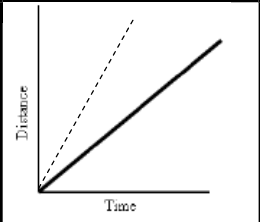
What does this graph represent?
a)

Constant Speed

b)

Acceleration

c)

Not moving

15.
How long did it take this object to travel 10 m?
a)

0 s

b)

10 s

c)

15 s

d)

20 s

16.
At 60 seconds, how far had this object traveled? 
a)

0 m

b)

10 m

c)

20 m

d)

40 m

17.
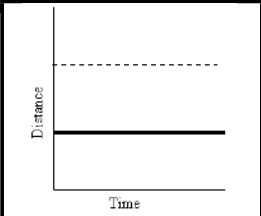
What does this graph represent?
a)

Constant speed

b)

Acceleration

c)

Not moving

18.

Match the description to the graph:

"The car is coming back."

a)
b)
c)
d)
19.

Match the description to the graph:

"The car is traveling at a constant speed away from start."

a)
b)
c)
d)
20.

Match the description to the graph:

"The car is slowing down."

a)
b)
c)
d)
21.
What is happening at D?
a)

Stationary

b)

Accelerating

c)

Fast steady speed; moving away from the starting position

d)

Slower steady speed; moving away from the starting position

22.
What is happening at C?
a)

Stationary

b)

Accelerating

c)

Fast steady speed; moving away from the starting position

d)

Slower steady speed; moving away from the starting position

23.

Which runner won the race?

a)

Albert

b)

Bob

c)

Charlie

24.

Which runner stopped for a rest?

a)

Albert

b)

Bob

c)

Charlie

25.

How long did Charlie stop for a rest?

a)

2.5 seconds

b)

2 seconds

c)

3 seconds

d)

5 seconds

26.
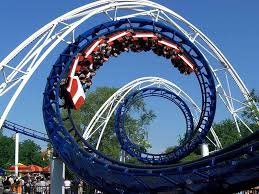
A roller coasters accelerates from an initial velocity of of 6.0 m/s to a final velocity of 70 m/s over 4 seconds.  What's the acceleration?
a)
24 m/s2
b)
18 m/s2
c)
16 m/s2
d)
16 m/s
27.
A car starts from rest at a stop light and reaches 20 m/s in 3.5 s. Determine the acceleration of the car.
a)
2.2m/s2
b)
7.0m/s2
c)
5.7m/s2
d)
70m/s2
28.
Acceleration is defined as the CHANGE in 
a)
time it takes for one place to move to another place. 
b)
velocity of an object.
c)
distance divided by the time interval 
d)
velocity divided by the time interval 
29.
Why does a car accelerate as it round a corner at a constant speed?
a)
Its direction changes
b)
It doesn't
c)
It slows down
d)
Its speeds up  
30.
Which graph represents zero acceleration (constant velocity)?
a)
A
b)
B
c)
C
d)
D
31.
What type of force is shown in the picture?
a)
The Cat force
b)
Star Wars Force
c)
Unbalanced force
d)
Balanced  force
32.
What is a Force?
a)
The distance
b)
Mass
c)
A push or pull
d)
Give me a  failing grade 
33.
An _______ force must act on an object for it to CHANGE it's motion
a)
balanced
b)
unbalanced
c)
gravitational
d)
electrical
34.

If the net force is equal to zero, the forces acting on the object are

a)

balanced

b)

unbalanced

35.
Balanced forces do not change the objects speed or 
a)
direction
b)
distance 
c)
time
d)
mass
36.
The unit of force is
a)
m/s
b)
m/s^2
c)
newton
d)
kg
37.
What is the net force?
a)
5000 N right
b)
4000 N right
c)
40 N left
d)
4000 N left
38.
What is the net force in this picture?
a)
50 Newtons to the right
b)
950 Newtons to the right
c)
950 Newtons to the left
d)
50 Newtons to the left
39.
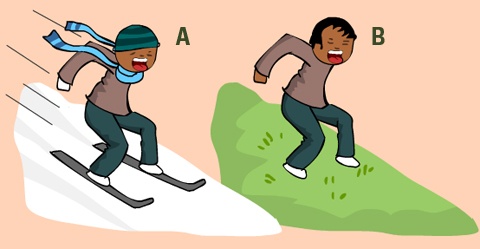
Why is it harder for the boy in Image B to get down the hill?
a)
Motion
b)
Friction
c)
Work
d)
Displacement
40.
It takes more force to accelerate the iron man on the left than the iron man on the right because the iron man on the left has more mass. This best describes
a)
Newton's first law, the law of inertia
b)
Newton's second law, the law of acceleration
c)
Newton's third law, the law of action reaction 
d)
The law of universal gravitation
41.
The formula 
? = mass x acceleration
or 
? = m x a 
is used to find 
a)
Force
b)
Velocity
c)
Momentum
d)
Gravity
42.
For every action, there is an equal and opposite reaction.
a)
Newton's
1st
Law of Motion
b)
Newton's
2nd
Law of Motion
c)
Newton's
3rd
Law of Motion
43.
An automobile you are riding in suddenly stops, but you continue to go forward.
a)
Newton's
1st
Law of Motion
b)
Newton's
2nd
Law of Motion
c)
Newton's
3rd
Law of Motion
44.
a)
1st
b)
2nd
c)
3rd
45.
a)
1st
b)
2nd
c)
3rd
46.
a)
1st
b)
2nd
c)
3rd
47.

One object has twice as much mass as another object. That object also has also twice as much...

a)
velocity
b)
gravitational acceleration
c)
inertia
d)
all of these
48.
When you push a boat off from the dock, you are demonstrating Newton's 3rd Law of Motion. It simply states that for every action there is an equal and opposite _______________?
a)
Motion
b)
Change
c)
Reaction
d)
Push
49.
What subatomic particles would you find in the nucleus of an atom?
a)
Protons only
b)
Protons and Neutrons
c)
Neutrons and Electrons
d)
Protons and Electrons 
50.
Electric charges that are different _______ each other.
a)
Attract
b)
Repel
51.
Electric charges that are alike _______ each other.
a)
Attract
b)
Repel
52.
What charge does a proton have?
a)
negative (-)
b)
positive (+)
c)
neutral or no charge (0)
53.
What charge does an electron have?
a)
negative (-)
b)
positive (+)
c)
neutral or no charge (0)
54.
If a substance has a higher number of electrons than protons on its surface, what type of charge does it have?
a)
A positive charge.
b)
A negative charge.
c)
A neutral charge
d)
No charge at all
55.
Ms Jo Jo rubbed two balloons with a piece of wool. What will happen when the balloons are brought near each other?
a)
The balloons will repel each other.
b)
The balloons will attract each other.
c)
The balloons will become positively (+) charged.
d)
The balloons will pop.
56.
If an object has the same number of positive and negative charges, its electrical charge is...
a)
positive
b)
negative
c)
neutral or no charge
d)
opposite
57.

Which diagram correctly shows the electric field around a negative charge?

a)

A

b)

B

c)

they are both positive

58.
The electrical force between charges is strongest when the charges are
a)
close together
b)
far apart
c)
 the electric force is constant everywhere.
d)
there is no pattern
59.
The subatomic particle with a neutral charge is:
a)
protons
b)
electrons
c)
neutrons
d)
cloud
60.
What is a insulator?
a)
a material that slows the transfer of heat
b)
a material that transfers heat easily
c)
a material that is fluffy
d)
a material that is temperature controlled
61.

Which is NOT an insulator.

a)

Wool

b)

Plastic

c)

Iron

d)

Glass

62.

Materials which can conduct electricity better than insulator,but not as well as conductors. This is the definition of

a)

diode

b)

semiconductor

c)

conductor

d)

insulator

e)

superconductor

63.

___________________ are materials that ALLOW heat and electricity to move easily through them.

a)

Conductors

b)

Insulators

64.

What is the difference between insulators and conductors?

a)

Insulators are used only for electricity and conductors are used only for heat

b)

Insulators allow electricity to flow easily and conductors do not.

c)

Conductors allow electricity to flow easily and insulators do not

d)

Conductors are used only for electricity and insulators are used only for heat

65.

Select all that apply: How can you make an electric force STORNGER?

a)

Increase the amount of Charge

b)

Bring the charged objects Closer together

c)

Decrease the amount of charge

d)

Move the Charged objects further away

66.

Transfer of electrons between 2 surfaces with direct contact is (a)______

a)

Conduction

b)

induction

c)

polarization

d)

Friction

67.

Transfer of electrons between two conductors due to two objects sliding against each other.

a)

Friction

b)

Induction

c)

conduction

d)

Polarization

68.

Glass, rubber, wood and plastic are all examples of (a) ______ since electricity cannot pass through them

a)

insulators

b)

materials

c)

conductors

d)

Thermal Conductivity

69.

_________ is when objects do not touch but become charged.

a)

Induction

b)

Friction

c)

Conduction

70.

Select all: Examples of good conductors

a)

Copper

b)

Glass

c)

Aluminium

d)

Rubber

71.
Current is...
a)
moving protons
b)
moving electrons
c)
measured in volts
d)
measured in ohms
72.
current is measured in....
a)
volts
b)
amps
c)
watts
d)
mph
73.
The two types of current are...
a)
AC/DC
b)
Alternating Current
c)
Direct Current
d)
All of the above
74.
Voltage is simply defined as...
a)
what 'pushes' electrons
b)
what 'stops' electrons
c)
moving electrons
75.
In the U.S most electrical outlets supply a voltage of....
a)
240 Volts
b)
120 Volts
c)
100 watts
d)
60 amps
76.
Resistance is...
a)
What "slows down" electrons
b)
What "speeds up" electrons
c)
Moving electrons
d)
What "pushes" electrons
77.
What characteristics impact resistance of a material?
a)
Thickness 
b)
Temperature
c)
Length
d)
All of these
78.
If the voltage stays the same, but the resistance goes up, the current will....
a)
increase (speed up)
b)
decrease (slow down)
c)
stay the same
79.
If the current increases it could be because of...
a)
increasing voltage
b)
decreasing resistance
c)
both
80.

What is the area around a magnet beyond the metal itself that is also magnetized?

a)

The poles

b)

The magnetic field

c)

The voltage

d)

The conductor

81.

Where is the magnetic field the strongest?

a)

The middle

b)

The poles

c)

The entire magnet is equally powerful in all locations.

82.

When does the force between 2 magnets get weaker?

a)

When they move apart from each other

b)

When they move closer together

c)

When opposite ends come in contact with each other

d)

When one has more mass than the other.

83.

Which statement is correct? (2 answers)

a)

Opposite ends of a magnet attract.

b)

Opposite end of a magnet repel.

c)

Similar ends of a magnet attract.

d)

Similar ends of a magnet repel.

84.
Magnets have a north and a south ___________
a)
shape
b)
color
c)
pole
d)
region
85.
Magnetism is a type of ____________
a)
force
b)
book
c)
plant
d)
animal
86.

You can increase the strength of an electromagnet by:

a)

Decreasing the battery charge

b)

Decreasing the amount of loops in the solenoid

c)

Winding the coils more closely

d)

Winding the coils more loosely

87.

What type of core is best for electromagnets?

a)

Steel

b)

Iron

c)

Plastic

d)

Copper

88.
Electrical charge built up on the surface of an object is called _________________.
a)
static electricity
b)
current electricity
c)
lightning
d)
electrons
89.

Which of the following can waves transfer energy through?

a)

solid

b)

liquid

c)

gas

d)

empty space

e)

all of the above

90.

What does #2 represent?

a)

Period

b)

Frequency

c)

Wavelength

d)

Amplitude

91.

Which of the following can waves transfer energy through?

a)

solid

b)

liquid

c)

gas

d)

empty space

e)

all of the above

92.

What does #2 represent?

a)

Period

b)

Frequency

c)

Wavelength

d)

Amplitude

93.

What property of the wave is represented by the letter "A"?

a)

amplitude

b)

crest

c)

trough

d)

wavelength

94.

The highest point on a wave is:

a)

the crest

b)

the trough

c)

the top

d)

the coast

95.
What kind of wave is pictured below?
a)
compressional wave
b)
transverse wave
c)
sound wave
d)
mechanical wave
96.

All waves carry ________ as they travel from one place to another.

a)

matter

b)

space

c)

energy

d)

water

97.
What type of wave is this?
a)
Transverse
b)
Longitudinal
98.
What type of wave is this?
a)
Transverse
b)
Longitudinal
99.
What is represented by the  letter 'y'?
a)
Compression
b)
Rarefaction
c)
Wavelength
d)
Amplitude
100.
What is represented by the letter 'x'?
a)
Crest
b)
Compression
c)
Rarefaction
d)
Wavelength
101.
What kind of wave is pictured?
a)
Transverse
b)
Longitudinal
c)
surface
d)
none of the above
102.

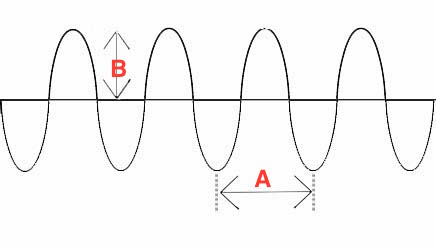
In this diagram of a transverse wave, A is showing the wave's _____ and B is showing the wave's _____.

a)

amplitude, trough

b)

amplitude, crest

c)

wavelength, trough

d)

wavelength, crest

103.

In the diagram of a compressional wave, A is showing a ___ while B is showing a ___.

a)

compression, rarefaction

b)

trough, crest

c)

rarefaction, compression

d)

crest, trough

104.

Which is an example of a longitudinal wave?

a)

x ray

b)

microwave

c)

sound wave

d)

water wave

105.

Which letter represents the trough?

a)

A

b)

B

c)

C

d)

D

106.

The distance from one crest to the next crest in a wave is

a)

wavelength

b)

crest

c)

trough

d)

amplitude

107.
In longitudinal waves, the parts where the coils are spread apart are called what?
a)
rarefactions
b)
compressions
c)
mechanicals
d)
longitudes
108.
In a longitudinal wave, the parts where the coils are close together are called what?
a)
longitudes
b)
rarefactions
c)
compressions
d)
contractions
109.

A _____________ is any disturbance that transmits energy.

a)

Amplitude

b)

Frequency

c)

Transverse

d)

Wave

110.

A __________ is a substance through which a wave travels.

a)

Medium

b)

Longitudinal wave

c)

Transverse Wave

d)

Wave speed

111.
all matter is made of what 
a)
energy 
b)
atoms 
c)
electrons 
d)
compounds 
112.
The positive particles of an atom are 
a)
electrons 
b)
positrons 
c)
neutrons 
d)
protons 
113.
the central region of an atom where its neutrons and protons are is its 
a)
nucleus 
b)
electron cloud
c)
core 
d)
center 
114.
electrons have this type of charge?
a)
negative
b)
positive
c)
neutral
115.

The smallest particle with characteristics of an element is known as the

a)

Periodic Table

b)

Atom

c)

Proton

d)

Electron

116.
How does the size of a proton compare to the size of a neutron?
a)
larger
b)
smaller
c)
equal
117.
These particles orbit around the nucleus of an atom.  What are they called?
a)
electrons
b)
protons
c)
neutrons
d)
photons
118.
Where are electrons of an atom found?
a)
Nucleus
b)
Electron Cloud
c)
Some are in the nucleus and some in the electron cloud.
d)
They are moving everywhere.
119.
From the diagram, which particles are indicated with the arrow?
a)
electrons and protons
b)
protons and neutrons
c)
electrons and neutrons
d)
photons and nucleons
120.

Why is the overall charge of an atom neutral (0)?

a)

They have the same number of protons and neutrons.

b)

They have the same number of protons and electrons.

c)

They have the same number of electrons and neutrons.

121.
In nuclear fusion, smaller atoms are forced together to create larger atoms. Does this process release, absorb or maintain energy?
a)
Absorb energy
b)
Maintain energy
c)
Release energy
122.
Do all stars make energy through fusion?
a)
Yes
b)
No
c)
Just our sun
d)
Only large stars
123.

This process, called nuclear fusion, is the energy source of all __________.

There may be more than one answer for this questions.

a)

planets

b)

suns

c)

stars

d)

plants

124.

When hydrogen is "fused" together on the Sun, what new element is created?

a)

Helium

b)

Carbon Dioxide

c)

Oxygen

d)

Light

125.
When is a star born?
a)
when the nebula starts spinning
b)
nuclear fusion starts
c)
when gas and dust starts to contract
d)
when x rays get emitted
126.
Stars can take different paths due to having different _____________
a)
temperature
b)
mass
c)
brightness
d)
color
127.
After the main sequence, a low mass star becomes a
a)
black dwarf
b)
protostar
c)
red giant
d)
supergiant
128.
After the main sequence, a high mass star becomes a
a)
black dwarf
b)
protostar
c)
red giant
d)
supergiant
129.
What color of star is the hottest?
a)
Blue
b)
Red
c)
Yellow
d)
Orange
130.
What color of star is the coolest?
a)
Red
b)
Yellow
c)
Blue
d)
White
131.
What is the name of the largest stars?
a)
Protostars
b)
Supergiants
c)
Red Giants
d)
Dwarf Stars
132.
What is the name of the gas/dust clouds that form stars?
a)
Nebulas
b)
Protostars 
c)
Supernova
d)
Neutron Star
133.
The H-R diagram is a graph that shows the relationship between ______________ for stars. 
a)
temperature and color
b)
temperature and brightness
c)
brightness and color
d)
distance and brightness
134.
All stars begin their life in a
a)
Main Sequence
b)
Nebula
c)
Protostar
d)
Black Dwarf
135.
______ is a force that causes dust particles to stick together in a nebula.
a)
nuclear fusion
b)
gravity
c)
hydrogen
d)
friction
136.
Most stars are made of which elements?
a)
Hydrogen only
b)
Hydrogen and Lithium
c)
Hydrogen and Sodium
d)
Hydrogen and Helium