
 Worksheets
G8 Lesson 1 Homework introduction to waves
Total questions: 186
Worksheet time: 7hrs 13mins
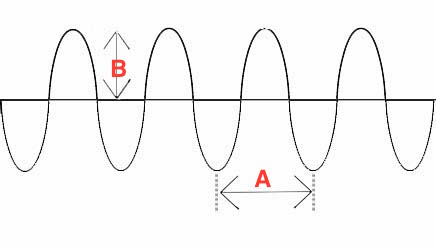
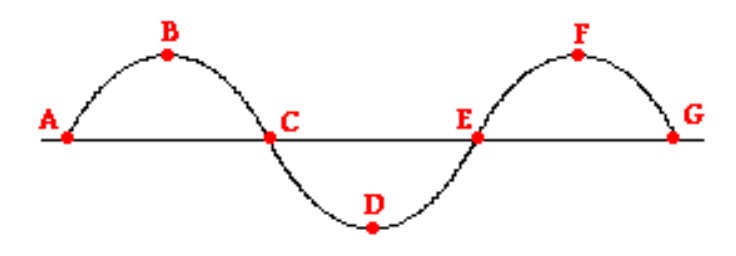
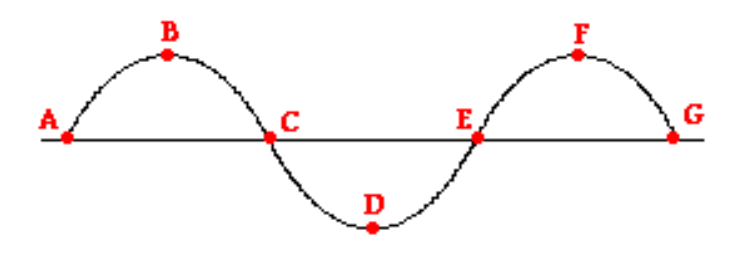
What is transferred from place to place by waves?
matter
energy
particles
waves
When energy increases, amplitude _______?
increases
decreases
stays the same
When placed in water, a ball moves from one place to another with the waves.
True
False
Waves are a pattern of motion that transfer energy.
True
False
Waves DO NOT transfer ______?
Matter
Energy

What kind of wave is pictured below?
compressional wave
transverse wave
sound wave
mechanical wave

In a transverse wave, the vibrations are (a) to the direction of the wave.
The vibrations in a longitudinal wave are (a) to the direction of energy transfer.
Sound waves are (a) waves.
Seismic waves can be...
longitudinal
transverse
Sound waves can travel through a vacuum because they don't require particles.
True
False
Jimmy's shouts have ____ amplitude than/as his whispers.
the same
a lesser
a greater
none of the choices given

What do all waves transfer?
Matter
Heat
Electricity
Energy

Which of the following can waves transfer energy through?
solid
liquid
gas
empty space
all of the above

What are the two types of waves?
longitudinal and transverse
sound and light

What is the number of complete waves passing a fixed point in a given amount of time?
Amplitude
Intensity
Wavelength
Frequency

What is frequency measured in?
Milliseconds
Miles
Hertz
Kilograms

Wavelengths are usually measured in ....
seconds
Hz
inches
meters

What is the distance between the calm sea and the highest wave called?
Wave
Frequency
Amplitude
Magnitude

What does #1 represent?
Period
Frequency
Wavelength
Amplitude

What does #2 represent?
Period
Frequency
Wavelength
Amplitude
What do all waves transfer?
(a)


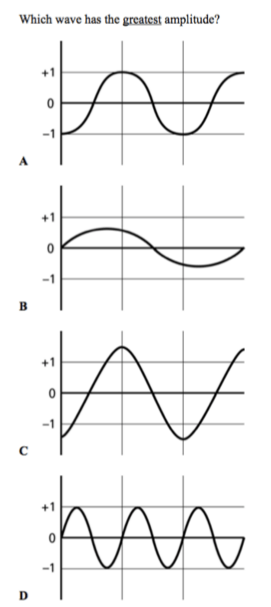

What is the amplitude of this wave?
4
8
2
6.3
What type of wave move in a back and forth motion?
Compression wave
Light wave
Transverse wave
Hicks-Riddick Wave
A pattern of disturbance that travels through a substance from one location to another location.
Wave
Amplitude
Wave Crest
Wave Trough
Wave Height
The distance from the wave crest or trough to the equilibrium Level
Wave
Amplitude
Wave Crest
Wave Trough
Wave Height
The highest part of a wave.
Wave
Amplitude
Wave Crest
Wave Trough
Wave Height

The lowest part of a wave.
Wave
Amplitude
Wave Crest
Wave Trough
Wave Height

distance between two consecutive wave crests or between two consecutive wave troughs.
Wave
Amplitude
Wave Length
Wave Trough
Wave Height

The part of a wave that the particles are more pushed together.
Compression
Rarefaction
Particles
Wave

The part of a wave that the particles are pulled apart
Compression
Rarefaction
Particles
Wave
Ultrasonic waves are a form of _______ waves
sound
ocean
radio
seismic
True or False: Sound needs a medium.
True
False
What unit is the intensity of sound measured in?
decibels (dB)
Hertz (Hz)
meters per second (m/s)
meters
Sound waves that are beyond the range of human ear are known as ----
Infrasonic waves
Ultrasonic waves
If you want to change the pitch of a sound, you have to change the ___
speed
amplitude
volume
frequency
When a sound is louder what measurement gets bigger?
Frequency
Amplitude
Wavelength
Crest
INFRASONIC , AUDIBLE RANGE, ULTRASONIC
A whale produces a sound with a frequency of 120 000 Hz when it whistles
(a)
Ultrasonic waves are a form of _______ waves
sound
ocean
radio
seismic
Hearing range of humans
20 - 20 000 Hz
under 20 Hz
16 - 16 000 Hz
Above 20 000 Hz
The frequency of ultrasound is
Over 20 000 Hz
Under 20 000 Hz
20 - 20 000 Hz
Under 20 Hz
When a wave strikes a surface and bounces off (ex: echo)
medium
refraction
reflection
absorption
This is the term that describes when a wave passes through matter.
Transmission
Absorption
Reflection
Diffraction
Movie theaters use sound proofing to reduce echoes. Soundproofing materials are designed to ________________ the sound.
Absorb
Transmit
Diffract
Reflect
Sound travels faster in ________________ than in liquids
solids
gas
water
air

Which type of interaction is this?
absorption
reflection
diffraction
transmission

Which type of interaction is this?
transmission
absorption
diffraction
reflection
Sound travels FASTEST through which of these materials?
Air
Empty space
Solid
Water

The image represents which of the following wave interations?
Reflection
Absorption
Transmission
Diffraction
What best defines diffraction?
The bouncing of a wave off an object or boundary
The spreading of a wave around an obstacle
The bending of a wave as it enters a new medium
The overlapping of waves

What are echos an example of?
Reflection
Refraction
Diffraction
Resonance

What is the picture an example of?
Reflection
Refraction
Diffraction
If a sound waves moves from a solid to a liquid, the sound wave will
speed up
slow down
not change speed

When light bounces of a mirror,it is
Reflected
Corrected
Absorbed
Refracted

What happen to the light as it passess from air to the transparent window
Light changes speed but not direction
All light is reflected
Light changes speed and direction
All light pass through
Latif wakes up one morning and sees that it is foggy outside.Whcih term best describe the fog he sees
Opaque
Reflective
Transparent
Translucent
Energy from visible light travels in...
Transverse waves
Longitudinal waves
When light is blocked by an object
shadows form
a reflection occurs
diffraction occurs
nothing happens

What type of wave is a light wave?
A sound wave
A seismic wave
A electromagnetic wave
A mechanical wave
what does the word “vacuum” mean?
travel
space
air

Which is true about the speed of light waves? They are...
the speed of light (300,000,000 m/s)
the speed of light (300,000 km/s)
Light waves travel the fastest in
solid
liquid
gas
vacuum of empty space
As the wavelength of a light wave decreases, what happens to the frequency of the wave?
Frequency increases
Frequency decreases
It remains constant
Ait what speed do electromagnetic waves travel in empty space?
30 m/s
3,000 m/s
300,000 m/s
300,000,000 m/s
_________________ materials transmit some light, but cause the light to to be scattered so no clear image is seen.
Transparent
Translucent
Opaque
____________ materials allow no light waves to be transmitted through
Transparent
Translucent
Opaque

Which number image shows a translucent form of wave transmission?
1
3
2
Which type of behavior does light display when striking a transparent object?
scattering
reflection
transmission
absorption
What type of behavior does light display when striking an opaque object?
scattering
transmission
refraction
absorption

What classification is this magnifying glass?
Transparent
Translucent
Opaque

What classification off light would this object be?
Transparent
Translucent
Opaque

Sunglasses lenses are normally darker colored so they can __________ light getting to your eyes, but it is also important they can ___________ light since you need to see through them.
absorb; transmit
refract; diffract
reflect; transmit
diffract; absorb
Which wave behavior describes the process that occurs when a wave enters a new substance but stays in the new substance?
Absorption
Reflection
Transmission
Which wave behavior describes the process that occurs when a wave goes through a new substance?
Absorption
Reflection
Transmission

Which two wave behaviors are responsible for us seeing different colors?
Reflection
Transmission
Absorption
Shorter Wavelengths have ____Energy,Longer Wavelengths___Energy?
Lower,Higher
Higher,Lower

Type of mirror used by a dentist to get magnified view of a patient's teeth...
Plane
Convex
Concave

Type of mirror found in a bathroom...
Plane
Convex
Concave
Type of mirror that can produce a real image...
Plane
Convex
Concave

Type of mirror that can produce an inverted image...
Plane
Convex
Concave

The size of an object and its image are the same in this type of mirror...
Plane
Convex
Concave

According to the law of reflection the angle of incidence is ____________ the angle of reflection.
less than
greater than
equal to
Type of mirror that can produce a virtual image...
Plane
Convex
Concave
All of the above
Spherical mirrors are part of a
Rectangle
Cube
Sphere
Cone
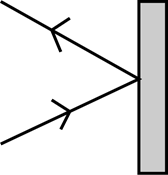
In the illustration, the light ray striking the object is-
What is the ray of light that strikes the surface ?
Incident ray
reflected ray
normal ray
normal
A flat mirror is an example of a ___.
plane mirror
concave mirror
convex mirror
spherical mirror

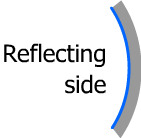
Which of the following best describes the image formed by a plane mirror?
virtual, inverted and enlarged
real, inverted and reduced
virtual, upright and the same size as object
real, upright and the same size as object
The image of an object as formed by a plane mirror is located ____.
in front of the mirror surface
on the mirror surface
behind the mirror surface
any of the above, depending on the object's locaiton
A real image is always
virtual
upright
behind the mirror
in front of the mirror
Reflection is a wave bouncing off of a surface
True
False

The reflection of light waves from a rough surface is reflection.
(a)
diffuse
regular
concave
convex
A regular reflection occurs when when light reflects from a(n)__________
concave mirror
rough surface
smooth surface
concave mirror
You can see yourself in a mirror because light ______________ off the surface of a mirror
absorbs
reflects
trasmits
transfers

The angle of incidence and the angle of reflection will always be unequal angles.
True
False
When parallel light rays strike a concave mirror, they converge at one point called the_____________.
normal point
focal point
converging point
none of these

Which type of mirror is this?
plane
concave
convex
wait, that's a mirror?
An image that forms where rays diverge is a(an) _______________ image.
virtual
real
Image formed in this mirror is the same size as actual object but Image is flipped around (left to right).
Concave
Plane
Convex

Which type of mirror is this? (inside of spoon)
plane
convex
Wait that's a mirror?
concave
When waves traveling in one direction are made to travel in many different directions, it's called _________________.
plane mirror
convex mirror
scattering
regular

Which type of mirror is this?
convex
plane
concave
Wait, that's a mirror?

Which type of mirror is this?
concave
plane
convex
Wait, that's a mirror?
A convex mirror always produces a virtual image that is upright and smaller
True
False


Why it is written in this manner?
Mirrors in front vehicles invert it upside down
Mirrors in front vehicles invert it left to right
Mirrors wont invert
According to the law of reflection the angle of incidence is ____________ the angle of reflection.
less than
greater than
equal to
Which of the following is demonstrated when light bounces off of mirrors or shiny surfaces?
Scattering
Refraction
Absorption
Reflection
when a light ray falls on a reflecting surface by an angle equals 45 , the angle of reflection equals ...........
35
45
55
What type of lens is wider in the middle than on the edges?
Concave
Convex
Objective
Ocular
What type of lens is thinner in the middle than at the edges?
Convex
Concave
Objective
Magnifying
When light passes through a convex lens, it does this.....
Diverge, or spread apart
Converge, or come together
Reflect, or bounce off
Create a rainbow
The point at which light rays converge after passing through a convex lens is called what.
The Horizon Point
The Point Break
The Focal Point
The Perspective
Light bends as it passes through a lens. This is called what?
Reflection
Diffraction
Refraction
Dilation
When light waves move from passing through air to passing through a glass lens when happens to them?
They slow down and change direction
They speed up and change direction
They maintain the same speed and change direction
They maintain their same speed and direction
The distance between a convex lens and its focal point is called what?
The focus
The focal length
The wave length
The amplitude
When light passes from air into glass it:
Becomes faster
Becomes slower
Its speed does not change
When a laser beam is refracted as it passes from air into water, it is bent:
Towards the abnormal
Away from the normal
Away from the abnormal
Towards the normal
Light rays which are hitting different parts of a particular lens' surface either: (choose two)
diverse
diverge
converse
converge
Concave lenses cause light rays to:
diverge
converge
The focal length of a lens is the distance between the lens': (choose 2)
centre
divergence
convergence
focal point


A concave lens has an inward curved shape. It refracts light outward from the lens. They light rays spread apart as they exit the lens. Which represents a concave lens?
A
B
A and B
neither A or B

If you look through a magnifying glass at an object that is more than one focal length away, the image you see will be ______ than the object.
upright and larger
inverted and smaller
inverted and larger
upright and smaller

When light travels from a medium with a high refractive index to a material with a low refractive index, it bends towards the normal.
True
False
Bends light rays away and spreads them out. Make objects appear smaller.
Convex Lenses
Concave Lenses
Convex Mirrors
Concave Mirrors
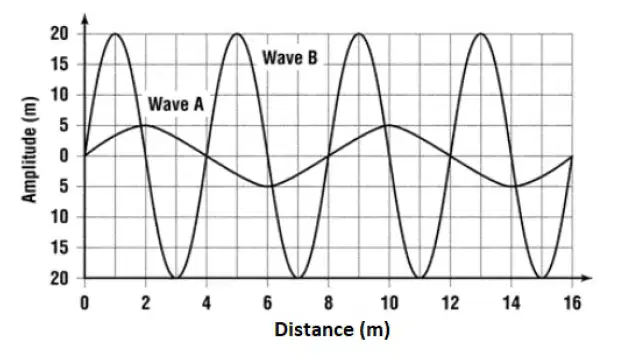
Wave _ has the greater frequency.
(a)
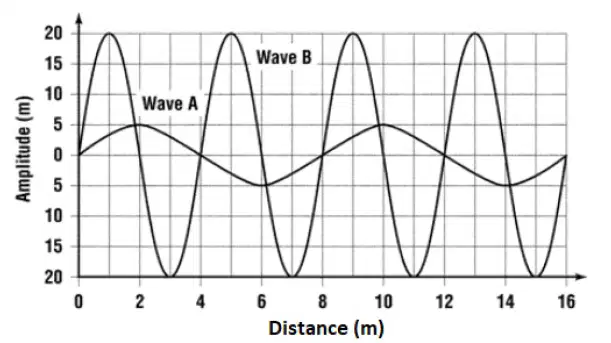
What is the amplitude of Wave B?
4 m
5 m
8 m
20 m
What is the amplitude of Wave B?
4 m
5 m
8 m
20 m
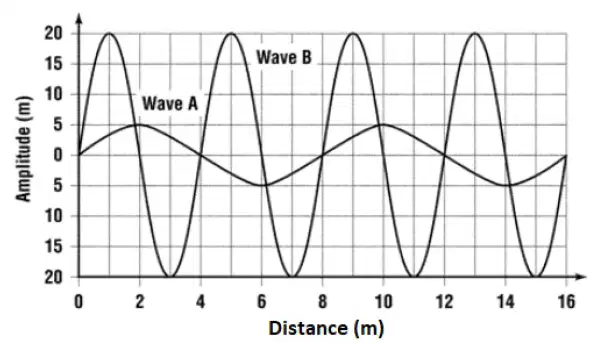
What is the amplitude of Wave A?
4 m
5 m
8 m
20 m
Which letter(s) represent the trough of the wave?
A
B & D
D
C & G
The amount of energy a sound wave carries per second through a unit of area is its ______________.
pitch
intensity
loudness
frequency
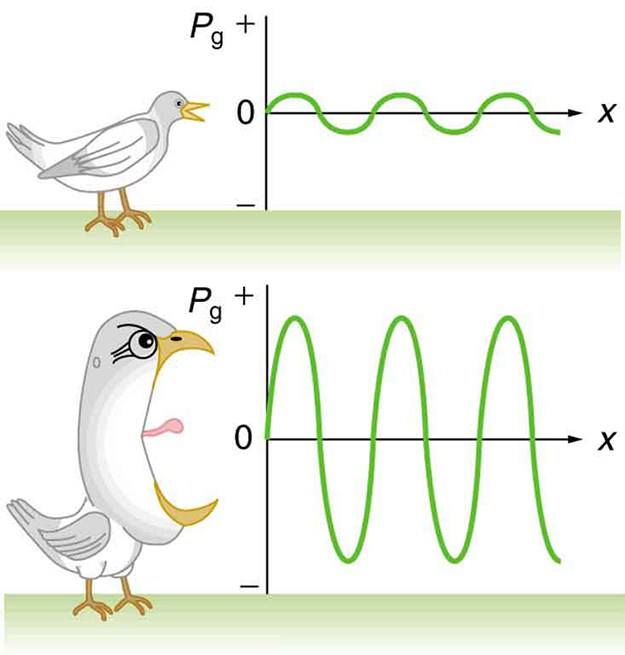

Which sound is louder?
Sound A
Sound B

Which sound has a higher pitch?
Sound A
Sound B
Sound travels FASTEST through which of these materials?
Air
Empty space
Solid
Water
The change in direction of a wave when it travels by the edge of an object or through an opening.
transmission
diffraction
absorption
reflection
____________ materials allow no light waves to be transmitted through
Transparent
Translucent
Opaque
_________________ materials transmit some light, but cause the light to to be scattered so no clear image is seen.
Transparent
Translucent
Opaque

What type of behavior is represented by the diagram?
reflection
refraction
scattering
absorption

What behavior does this diagram represent?
transmission
reflection
absorption
refraction

What behavior does this diagram represent?
reflection
scattering
absorption
transmission
What behavior does this diagram represent?
transmission
reflection
absorption
refraction
In what context would would light travel even faster than through air?
Through vacuum/empty space
Through glass
Through water
Through a solid
What is the angle of reflection equal to?
The angle of refraction
The angle of absorption
The angle of light
The angle of incidence
Which figure represents the path light takes through a converging lens?
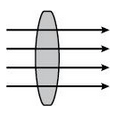
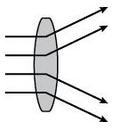
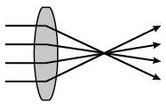
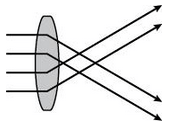
Which lens represents the path light takes through a diverging lens?


The picture shows reflection from two different surface. The angle of incidence will be equal to the angle of reflection in
only (a)
only (b)
both (a) and (b)
Cannot be said
A real image is always
virtual
upright
behind the mirror
in front of the mirror

