wayground logo

Free Printable Worksheets

Font size

S
M
L
XL
Worksheets

Introduction to Biology Review

Total questions: 60

Worksheet time: 53mins

Name
Class
Date
1.

The sky was blue and filled with clouds today.

a)

quantitative

b)

qualitative

c)

both

d)

neither

2.

There were 5 children on the playground.

a)

quantitative

b)

qualitative

c)

both

d)

neither

3.
An experiment is performed on plants to see how different liquids affect plant growth. Each plant in the experiment is given a different liquid; water, apple juice, or milk. Each plant has the same amount of soil, sunlight, and listens to the same music. In this investigation, the independent variable is ...
a)
The type of plant
b)
The amount of sunlight
c)
The type of music
d)
The type of liquid
4.
An experiment is performed on plants to see how different liquids affect plant growth. Each plant in the experiment is given a different liquid; water, apple juice, or milk. Each plant has the same amount of soil, sunlight, and listens to the same music. In this investigation, what are the controlled variables?
a)
Type of plant, amount of music, and sunlight
b)
Water, apple juice, milk
c)
Plant growth
5.
An experiment is performed on plants to see how different liquids affect plant growth. Each plant in the experiment is given a different liquid; water, apple juice, or milk. Each plant has the same amount of soil, sunlight, and listens to the same music. In this investigation, what is the dependent variable?
a)
Type of plant
b)
Water, apple juice, milk
c)
Plant growth
6.
The variable that is being measured
a)
independent variable
b)
dependent variable
c)
control variable
7.
The variable that is being tested or changed
a)
independent variable
b)
dependent variable
c)
control variable
8.
Scientific Question:  Does playing video games improve reaction time?
What is the dependent variable?
a)
playing video games
b)
reaction time
c)
type of video game
9.
Mr. S. normally uses praise as a reward to train his dog.  He wants to know the best way to train his dog, so he sets up an experiment to find out if there is a better way to get his dog to respond to commands.  Identify the dependent variable.
a)
amount of times the dog follows the command
b)
type of reward
c)
praise
d)
type of dog
10.
The diagram shows the general structure of an amino acid. Which type of molecule is formed from amino acids?
a)
lipids
b)
proteins
c)
carbohydrates
d)
nucleic acids
11.
You are analyzing a compound in the laboratory. You find that it is made up of carbon, hydrogen, and oxygen in a ratio of two hydrogen atoms for each carbon atom. How will you classify the compound?
a)
lipid
b)
protein
c)
carbohydrate
d)
nucleic acid
12.
Fats, oils and cholesterol are all types of what?
a)
cell membranes
b)
hormones
hormones
c)
lipids
d)
fatty acids
13.
RNA and DNA are which type of macromolecules?
a)
carbohydrate
b)
lipid
c)
nucleic acid
d)
protein
14.
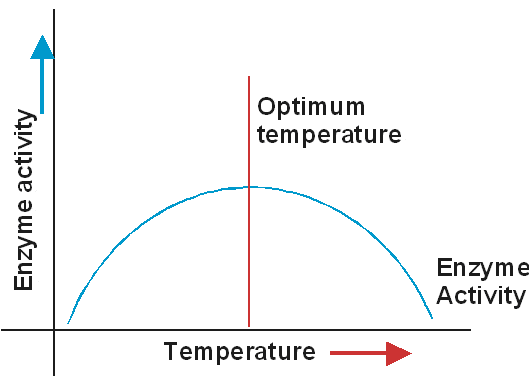
The human body maintains a temperature of around 98.6 degrees at all times. Enzymes are involved in almost every chemical reaction in the body. Which of the following describes the connection between these two statements? 
a)
Enzymes function best at a specific temperature.
b)
The body needs to be warm to prevent hypothermia.
c)
The body is kept relatively warm to prevent too much enzyme action. 
d)
There is no connection between the two statements. 
15.
Like complex carbohydrates, proteins are macromolecules that serve many functions and can be chemically broken down and restructured. Both proteins and complex carbohydrates are which of the following?
a)
 polymers of smaller subunits
b)
sequence of sugars
c)
lipids of large molecules
d)
nucleotides of DNA
16.
 In living organisms, lipids function mainly as:
a)
Sources of stored energy and transmitters of genetic information
b)
Sources of stored energy and components of cellular membranes
c)
Transmitters of genetic information and catalysts of chemical reactions
d)
Catalysts of chemical reactions and components of cellular membranes
17.
What is the function of macromolecule subunit below?
a)
energy
b)
catalyst
c)
stores genetic information
d)
composes the majority of the cell membrane
18.
The picture indicates which macromolecule? 
a)

Carbohydrates

b)

Lipids

c)

Proteins

d)

Nucleic Acids 

19.
The picture indicates which Macromolecule? 
a)

Carbohydrates

b)

Lipids

c)

Proteins

d)

Nucleic Acids

20.

If available, the body will always digest which macromolecule for energy first?

a)

lipids

b)

proteins

c)

enzymes

d)

carbohydrates

21.

The macromolecules that make up the majority of the cell membrane’s structure are....

a)

lipids

b)

proteins

c)

enzymes

d)

carbohydrates

22.

What are the smallest basic units of matter?

a)

molecules

b)

atoms

c)

elements

d)

7th graders

23.

Exothermic reactions

a)

absorb more energy than they release

b)

are cold

c)

do not use bond energy for activation

d)

release more energy than they absorb

24.

Activation energy

a)

is the term for the amount of energy in each reactant

b)

helps the enzyme to increase the rate of the reaction

c)

is the term for the amount of energy that needs to be added for a chemical reaction to start

d)

is the term for the amount of energy released by the reaction after it starts

25.

What is happening in this picture?

a)

an enzyme is binding a substrate together to form a product

b)

an enzyme is breaking down a substrate to release new products

c)

the active site of the enzyme does not fit the substrate

d)

a change in pH has damaged the enzyme

26.
What word describes when water is attracted to other substances?
a)
cohesion
b)
adhesion
c)
capillary action
d)
surface tension
27.
What two elements make up water?
a)
Helium and oxygen
b)
Hydrogen and oxygen
c)
helium and carbon
d)
oxygen and carbon
28.
molecule in which opposite ends have opposite electric charges
a)
cohesion
b)
polar molecule
c)
hydrogen bond
d)
solution
29.
Why does ice float?
a)
As water freezes, it expands and its density decreases.
b)
As water freezes, it takes up more hydrogen from the atmosphere, causing it to have a greater buoyancy.
c)
As water freezes, air becomes trapped between the hydrogen bonds of water molecules.
d)
As water freezes, it takes up more oxygen from the atmosphere, causing it to have a greater buoyancy.
30.
Water is a universal solvent because it...
a)
It can be found anywhere
b)
It freezes when it gets cold
c)
floats when frozen
d)
Dissolves most substances
31.
A general definition of cohesion is the attraction of:
a)
particles of the same substance
b)
particles of a different substance
c)
particles of both the same and different substances
d)
particles of neither the same or different substances
32.
Which term refers to water having partial positive and a partial negative charge?
a)
cohesion
b)
surface tension
c)
polarity
d)
adhesion
33.

What do you call any substance that dissolves another substance?

a)

Solvent

b)

Height

c)

Atoms

d)

Oxygen

34.

What property of water allows water to flow against gravity?

a)

Polarity

b)

Cohesion

c)

Capillary Action

d)

Adhesion

35.

Which particles determine the identity of an element?

a)

protons only

b)

neutrons only

c)

protons and neutrons

d)

protons and electrons

36.

When placed in water, oil does not dissolve and stays separate. This means oil is and .

a)

hydrophilic and polar

b)

hydrophilic and nonpolar

c)

hydrophobic and polar

d)

hydrophobic and nonpolar

37.

Order the following words from smallest to largest.

a)

Cell

b)

Tissue

c)

Organ

d)

Organ System

1)
2)
3)
4)
38.

Order the following words from smallest to largest.

a)

Atom

b)

Element

c)

Molecule

d)

Macromolecule

e)

Organelle

1)
2)
3)
4)
5)
39.
The part of the atom that determines the identity of the atom is the ____________.
a)
proton
b)
nucleus
c)
electron
d)
neutron
40.
A _____ is something in the environment that causes an organism to respond.
a)
stimulus
b)
response
c)
cause
d)
effect
41.
When a baby kitten becomes an adult cat, this is an example of...
a)
energy metabolism
b)
growth and development
c)
response to stimuli
d)
having cells
42.

Living things are based on a universal genetic

code. What molecule is responsible for that code?

a)

RNA

b)

Lipid

c)

Protein

d)

DNA

43.

Identify the characteristic: when you step out into the cold, your body shivers in order to keep its temperature at 98.6oF.

a)

All living things use energy

b)

All living things contain cells

c)

All living things maintain homeostasis

d)

All living things grow and develop

44.

Identify the characteristic: green plants produce their own food through the process of photosynthesis.

a)

All living things use energy

b)

All living things contain cells

c)

All living things maintain homeostasis

d)

All living things grow and develop

45.

Identify the characteristic: a caterpillar hibernates in a cocoon and emerges as a butterfly.

a)

All living things adapt to their environment

b)

All living things use energy

c)

All living things respond to their environment

d)

All living things grow and develop

46.

Identify the characteristic: A camel has eyelashes that work to keep the dust and sand out of its eyes.

a)

All living things adapt/respond to their environment

b)

All living things grow

c)

All living things have cells

d)

All living things use energy

47.
A worm turns away from light is an example of a worm
a)
reproducing
b)
doing cellular respiration
c)
having cells
d)
responding to its environment
48.

Enzymes are what macromolecule?

a)

Nucleic Acid

b)

Lipid

c)

Protein

d)

Carbohydrate

49.

Enzymes

a)

speed up chemical reactions

b)

slow down chemical reactions

c)

do nothing to a chemical reaction

50.

An enzyme ________ the activation energy needed for a reaction to occur.

a)

decreases

b)

increases

c)

does nothing to

d)

increases then decreases

51.
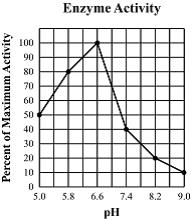
Which of the following conclusions can be drawn from this graph?
a)
The optimum pH of the enzyme is 6.6.
b)
The optimum pH of the enzyme is 5.8
c)
The enzyme’s activity increases as pH increases 5.0 to 9.0
d)
The enzyme’s activity is greater around pH of 8.0 .
52.
What happens when enzymes are heated to a high temperature?
a)
The enzymes die.
b)
The shapes of the enzyme are altered denature
c)
The enzymes' amino acid sequence changes.
d)
The enzymes remain the same
53.
Which enzyme is most efficient in a basic solution?
a)
A
b)
B
54.
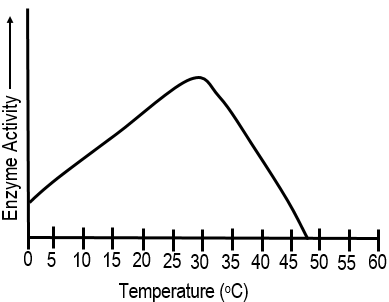
Based on the graph, what is the optimal temperature for this enzyme? 
a)
15oC
b)
40oC
c)
30oC
d)
35oC
55.
At high temperatures enzyme activity declines because of:
a)
Denaturation
b)
Decreased Kinetic Motion
c)
Increased H-Bonding
d)
Dissociation of Ionic Compounds
56.

synthesis

a)

to make

b)

to destroy

c)

to harm

d)

to eat

57.

Hetero-

a)

different

b)

four

c)

same

d)

one

58.

In a biology class, a teacher explained that the root "bio" in the word "biology" means:

a)

life

b)

butterfly

c)

many

d)

study

59.

In the field of academics, what do the suffixes "-ology" and "-ologist" represent?

a)

A field of study

b)

A person who studies a particular field

c)

A field that does not require study

d)

A person who does not study a particular field

60.

The suffixes "-phobia" and "-phobe" mean:

a)

fear

b)

someone who fears

c)

fearless

d)

the study of