
Font size
 Worksheets
Histology Test Review
Total questions: 56
Worksheet time: 46mins
Which of the following is a type of connective tissue in the human body?
nervous
cartilage
epithelial
muscular
During a biology class, Isla observed a slide under the microscope and noticed cells with goblet cells secreting mucus. What type of tissue was she observing?
squamous
cuboidal
columnar
keratinized
Which type of gland releases a portion of its cytoplasm along with its secretions?
merocrine
apocrine
holocrine
endocrine
The presence of ducts in the salivary gland indicates that these glands are
exocrine glands.
stratified squamous epithelium.
endocrine glands.
transitional epithelium.
Which of the following are types of fibers found in connective tissues?
reticular & elastic
muscle & nerve
elastic & collagen
epithelial & connective
During a biology class, Ava learned about different types of cells. Which type of cells are responsible for bone formation?
chondrocytes
erythrocytes
osteoblasts
fibrocytes
While working on a biology project, Charlotte observes cells within lacuna under a microscope. Which type of connective tissue is she examining?
adipose
dense regular
cartilage
dense irregular
During a biology class, Maya is observing a slide under the microscope and notices large droplets of oil filling most of the cell’s space. Which type of connective tissue is she looking at?
adipose
dense regular
cartilage
dense irregular
Which type of connective tissue is found in tendons, giving them rope-like strength in one direction?
adipose
dense regular
cartilage
dense irregular
In connective tissue, the matrix surrounding the cells, which is often fluid or semi-fluid, is referred to as the
reticular fibers
collagen fibers
ground substance
muscle tissue
Match the following structure to the correct description.
Muscle tissue
the type of tissue that causes movement of the body
Elastic cartilage
found in your ear lobe and tip of your nose
Blood
connective tissue that contains macrophages and mast cells
Simple
the category of epithelial tissues with only one layer of cells
Stratified
the category of epithelial tissues with more than one layer of cells
What is the likely meaning of the word 'dermatologist' based on the prefixes and suffixes you’ve learned?
A person who studies skin
A person who studies rocks
A person who studies weather
A person who studies fish
Lily is studying biology and comes across the term 'histocompatibility'. Based on her understanding of prefixes and suffixes, what does this term most likely refer to?
The ability of tissues to be accepted by the body
The study of ancient civilizations
The compatibility between different organisms
The process of tissue healing
What is a key characteristic that distinguishes smooth muscle tissue from skeletal muscle tissue?
Smooth muscle tissue is involuntary, whereas skeletal muscle tissue is voluntary.
Both smooth and skeletal muscle tissues are striated.
Skeletal muscle tissue is found in the walls of internal organs, while smooth muscle tissue is not.
Both smooth and skeletal muscle tissues are voluntary.
Identify two main categories of body membranes.
Epithelial and Connective Tissue Membranes
Muscular and Nervous Membranes
Skeletal and Cardiac Membranes
Endocrine and Exocrine Membranes
Which type of epithelial tissue is composed of multiple layers and has a columnar shape?
Simple cuboidal epithelial tissue
Stratified columnar epithelial tissue
Simple squamous epithelial tissue
Transitional epithelial tissue
What is a common feature of all connective tissues?
They consist solely of cells.
They contain a matrix of fibers and ground substance.
They lack any blood supply.
They are composed entirely of extracellular matrix.
What is the primary difference between exocrine and endocrine glands in terms of their secretion method?
Exocrine glands use ducts to transport their secretions; endocrine glands release hormones directly into the bloodstream.
Exocrine glands release hormones directly into the bloodstream; endocrine glands use ducts for their secretions.
Both exocrine and endocrine glands use ducts for their secretions.
Both exocrine and endocrine glands release hormones directly into the bloodstream.
A single layer of epithelial tissue is classified as
stratified
singular
simple
squamous
What is a tissue?
A group of cells with similar shape and size
A group of tissues with similar structure and function
A group of organs with similar shape and size
A group of cells with similar structure and function

simple columnar
stratified columnar
psedostratified columnar
simple longitudinal

simple columnar
stratified cuboidal
simple squamous
stratified columnar
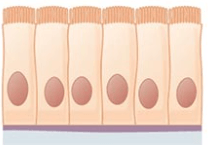
Simple columnar
simple cuboidal
stratified columnar
stratified squamous

simple squamous
simple cuboidal
stratified cuboidal
stratified squamous
Which type of tissue is found in tendons and ligaments?
dense fibrous
areolar
reticular
blood
Which type of cartilage is found in your ear and epiglottis?
elastic cartilage
hyaline cartilage
fibrocartilage
Which type of cartilage is found in your trachea, nose, larynx and cartilage of ribs?
elastic cartilage
hyaline cartilage
fibrocartilage
This type of tissue is located in the brain and spinal column
smooth muscle
skeletal muscle
cardiac muscle
nervous

Identify the tissue shown.
Pseudostratified ciliated columnar
Simple cuboidal
Simple squamous
Stratified columnar

Identify the tissue shown.
Pseudostratified ciliated columnar
Simple columnar
Transitional
Stratified columnar
Which one is a main type of tissue? (Select all that apply)
Connective
Epithelial
Muscular
Nervous
Smooth

How do we classify epithelial tissue?
Shape
Shape and number of layers
Counting the number of individual cells
Squamous
What does pseudostratified mean?
Many layers of cells
Single layer that looks like many layers of cells
Single layer of cells
No layer of cells
What is the function of the nerve cells?
They are responsable of your defense mechanism.
They transmit signals or messages to other neurons, organs or glands.
They transmit substances to your endocrine system to produce hormones.


Areolar
Elastic Glue
Adipose
Fat
Reticular
Mesh Framework
Dense, Regular
Withstand Pulling Force
Dense, Irregular
Impact Resistant

Identify the type of epithelial tissue from the picture above.
Simple squamous
Simple cuboidal
Stratified columnar
Stratified cuboidal

What type of tissue is in this image?
Stratified Columnar epithelium
Simple cuboidal epithelium
Pseudostratified columnar epithelium
Simple columnar epithelium

What type of tissue is in this image?
transitional epithelium
Stratified Cuboidal epithelium
stratified columnar epithelium
Eric Aguirre

What type of tissue is in this image?
Pseudostratified Columnar epithelium
Stratified cuboidal epithelium
Stratified Squamous epithelium
Jr araiza
Match the description to the structure
Single layer of flat cells
Simple squamous
Single layer of tall cells
Simple columnar
Many layers with flat cells on top
Stratified squamous
Many layers of different shaped cells with umbrella cells on top
Transitional
2 or more layers of cube shaped cells
Stratified cuboidal
Match the following description of the structure to the type of tissue
Branching tissue with striations and intercalated discs
Cardiac
No striations and only one nucleus per cell
Smooth
Solid matrix
Bone
Branching structure with a cell body and nucleus
Nerve
Rigid but flexible
Hyaline
What is the function of stratified columnar?
Secretion and absorption
Secretion and absorption in kidney tublules
Absorption and secretion in respiratory passages where cilia are needed
What is the function of transitional tissue?
Secretion and absorption
Secretion and absorption in kidney tubules
Allow organs to stretch and expand
What is the function of pseudostratified tissue?
Secretion and absorption
Secretion and absorption in the kidney tubules
What is the function of simple squamous cells?
The function of simple squamous cells is to protect from abrasion.

